Favorites Friday: Dramatic Musicals

I was thinking about doing a post on favorite musicals, and realized I have too many.  And also that there seems to be two types of musicals.  The division is clear to me but hard to define.  The best I can say is that there are the dramatic ones, and the light-hearted ones.

Or maybe I’d do well here to quote Andrew Lloyd Webber, who I heard say something in an interview (I think talking about Phantom) to the effect that musicals must be about the big emotions, the passions and the desires and the tragedies.  The emotions are so intense that the characters have to sing, because words simply aren’t enough.

That may be the case in Webber’s musicals, but there are others that just don’t seem quite that, well, intense.  So today, I’m talking about the intense ones, the big emotion ones–the dramatic ones, which may nevertheless be very funny at times.  Some other week I’ll talk about the light-hearted ones, which may still touch on deep emotions and have dramatic moments.  It’s a complicated division…  But anyway–on to the musicals.

Phantom of the Opera has to be mentioned first here, which will surprise absolutely no one.  I’ve waxed on here and here, so I won’t do it again today…

Les Miserables is my favorite musical that I’ve never seen; I’ve just listened to the soundtrack.  I love loud emotional songs, and Valjean gets some really good ones.  There’s all the despair and the tragedy and the yearning…and then there’s the revolutionaries and all their songs, and Eponine’s tragic unrequited love, and Gavroche comes in with his funny songs and…big emotions.  Beautiful music.

Sweeney Todd…well, it’s almost strange how much I like this one.  I mean, it’s about a barber who kills people, and his partner who bakes them into pies.  Really not my kind of story.  And yes, I saw the movie to begin with because it was starring Johnny Depp, but I ended up genuinely loving the music…and sort of the story, horrible though parts of it are.  But there’s the tragedy and the romance and the really funny song about cannibalism and lots of loud emotional songs and…it’s a cathartic experience.  Honestly.  It makes me feel the entire range of emotions.

Wicked is giving me the most trouble with my divisions, because in some ways it feels more like a light-hearted one.  Certainly large portions of it are light and funny.  But…I love it mostly for “The Wizard and I” and “Defying Gravity” and the complicated relationship between Elphaba and Glinda, and all of those parts seem like they belong in the dramatic musical list.  I actively dislike the book, but I love the musical.  I love Elphaba’s yearning to prove herself, and Glinda’s somewhat haphazard growth as a person, and I just love that it’s a musical with two strong female characters.  And now I have real trouble listening to “Ding-Dong, the Witch Is Dead” because it seems so heartless.

Jesus Christ Superstar is my go-to musical every Lent.  It’s definitely a big emotion one, and I love the portrayal of the characters.  It’s not always quite Biblical, but you can tell Webber knew what he was doing and that he’d read the Gospels (he practically quotes John in places).  The semi-modern context makes it all so much more accessible, and is a good reminder–these people weren’t ancient figures at the time.  I love how human everyone is.  And the music sticks in my head like you wouldn’t believe.

What are your favorite musicals? 🙂

Favorites Friday: Fantasy Worlds

I recently read Ready Player One by Ernest Cline, about a future where most of humanity spends most of their time in a massive virtual world (stay tuned for a review!)  Made up of thousands of planets and universes, there’s a tantalizing mention that many fictional worlds have been created within the virtual universe.  Which got me thinking about which fictional universes I’d most like to visit…

Star Trek is an obvious first choice.  It’s such an idealized future, both in terms of technology and humanity’s advancement, that it would be an amazing place to live.  I’m not so sure about being a tourist there, because I don’t know precisely what I’d like to see–the universe in general is amazing, but isn’t so much big on the landmarks.  If I was just visiting, I’d be most interested if I could hang out with the known characters (by which I mostly mean Kirk, Spock and McCoy).  It’s a very much character-driven fictional universe for me, and they’re wonderful characters who also live in a really nice universe.  So either meeting them or having a whole life there sounds…well, fascinating!

I find more appealing a vacation on Pern, Anne McCaffrey’s dragon world.  I’d like to come by long enough to fly dragon-back and visit the Harper Hall for a concert.  If I managed to discover that I have musical ability, I could see living at the Harper Hall (the Harpers are, after all, the storytellers), but that’s a big if.  It would be a great place to visit, though, and then come home to my air conditioner and indoor plumbing.

I’d also like to visit Discworld, but only with a friendly native guide.  I love reading about the corrupt city of Ankh-Morpork, but I know I’d get into an enormous amount of trouble if I was actually there.  For one thing, I’m not paid up with the Thieves’ Guild!

I’d like a long trip to Diana Wynne Jones’ Time City, where residents seem to be able to get the best bits of every period of history, from the ancient world on up to 100,000 AD.  I’d just be so fascinated to find out about the whole sweep of history.  I could see myself spending a very long time in the library (or equivalent) and being perfectly happy.

On first thought I have doubts about going to any of Edgar Rice Burroughs’ worlds–I guess the significant one is Barsoom (or Mars).  It is, after all, a rather violent place.  I think I’d only want to live there if I could be a Burroughs heroine, because nothing really bad ever happens to them; and, of course, they all get brave, noble Burroughs heroes!

Much as I love Tamora Pierce’s Tortall books, I don’t think I’d much like to live there.  There’s magic, but it’s magic in a rather gritty, historical-fiction-type world and, well, see air conditioning and indoor plumbing above.  I’d love to visit long enough to meet my favorite characters, but the world itself doesn’t particularly draw me in.

There are lots of other worlds I love reading about, and lots of characters I’d love to meet (which I guess would mean visiting their worlds, but it’s not the world that counts there), but that covers at least some of my top choices for worlds to visit or take up residence in.  I know as soon as I post this I’ll think of somewhere else!

It’s funny how in some books, the setting is just the background, and in others, it’s really an integral part, as interesting as anything else.  The worlds I’m most drawn to, besides being reasonably pleasant places (for contrast, the world of The Hunger Games? Never want to go there), are also immensely detailed and elaborate worlds.  Perhaps I can imagine living there because I can believe in them as places, and because there are plenty of details to be fascinated by.

Your turn!  Where would you go if you could?

Favorites Friday: Discworld Moments

Continuing our Discworld theme this Friday…I originally thought of doing favorite quotes, but as I compiled them I realized there were several that were all about the dialogue or the back-and-forth.  So here are some favorite Discworld moments.

First, a philosophical one, about the power of knowledge:

They thought the Library was a dangerous place because of all the magical books, which was true enough, but what made it really one of the most dangerous places there could ever be was the simple fact that it was a library.

– Guards! Guards!

And another time, Death waxes philosophical.  It should be noted that Death always speaks IN ALL CAPITAL LETTERS:

WHO KNOWS WHAT EVIL LURKS IN THE HEART OF MEN?
The Death of Rats looked up from the feast of potato.
SQUEAK, he said.
Death waved a hand dismissively. WELL, YES, OBVIOUSLY ME, he said. I JUST WONDERED IF THERE WAS ANYONE ELSE.

– The Truth

And because Death is so brilliant, another one, after someone suggested that he should be “more of a people person”:

KNOCK KNOCK.
He looked up.
“Who’s there?”
DEATH.
“Death who?”
There was a chill in the air. Beano waited…
I WONDER… CAN WE START AGAIN? I DON’T SEEM TO HAVE THE HANG OF THIS…

– Men at Arms

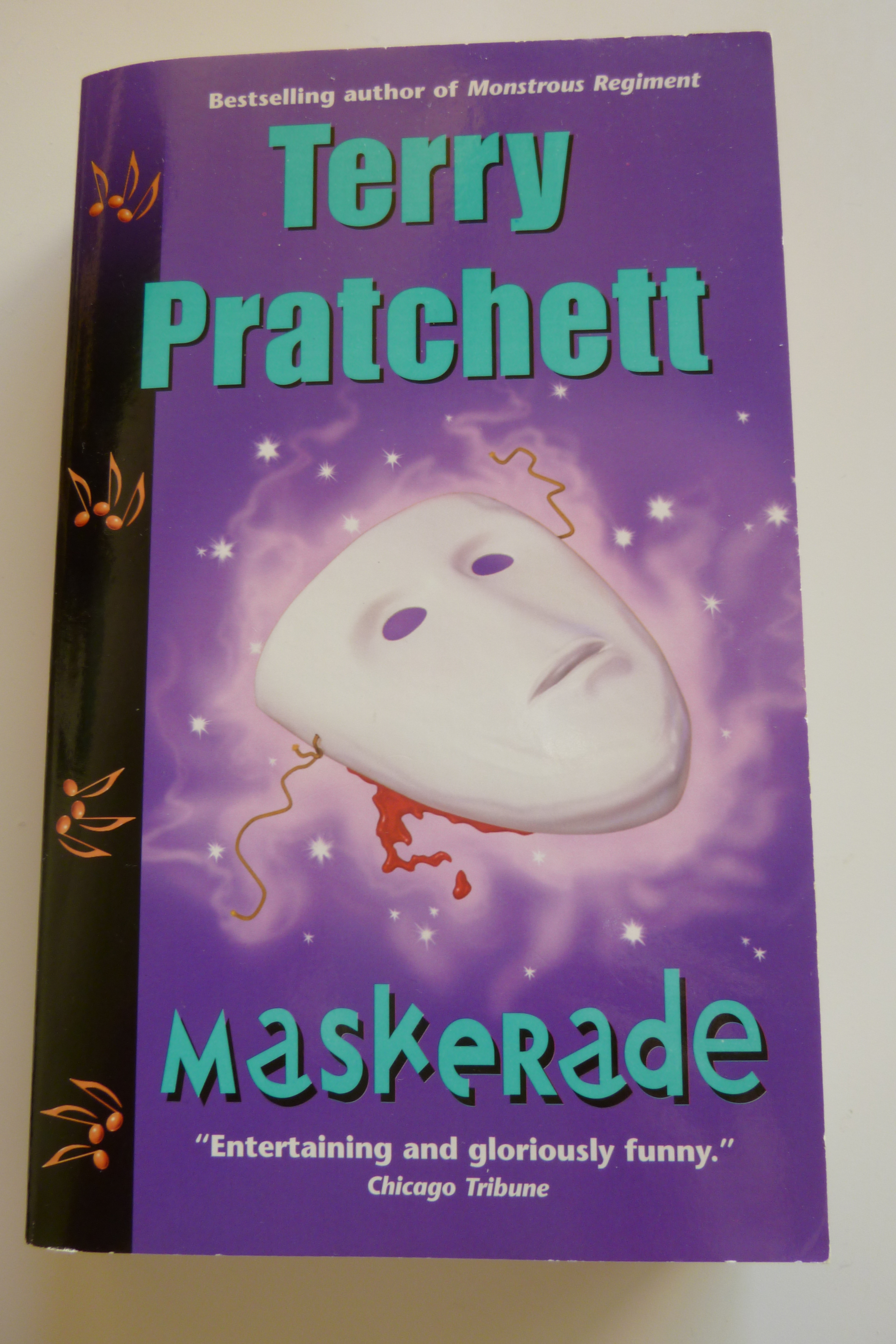
Maskerade is probably a favorite moment in its entirety, and I could quote most of it…but here’s just one moment.  A dead body turns up, along with a note from the Opera Ghost:

Hahahahaha!  Ahahahahaha!
Yrs, The Opera Ghost
P.S. Ahahahahaha!

“I don’t understand!  Is this man mad?”

Salzella put an arm around his shoulders and led him away from the crowd.  “Well, now,” he said as kindly as he could.  “A man who wears evening dress all the time, lurks in the shadows and occasionally kills people.  Then he sends little notes, writing maniacal laughter.  Five exclamation marks again, I notice.  We have to ask ourselves: is this the career of a sane man?”

“But why is he doing it?” Bucket wailed.

“That is only a relevant question if he is sane,” said Salzella calmly.  “He may be doing it because the little yellow pixies tell him to.”

– Maskerade

The image of the Phantom of the Opera, chatting with the little yellow pixies, never fails to crack me up.  It’s the same for this very odd bit below, about a crazed artist:

“He was convinced that if he went to sleep at night, he would turn into a chicken.  He’d leave little notes for himself saying, ‘You are not a chicken,’ although sometimes he thought he was lying…  Scholars have puzzled over the notes ever since, seeking some insight into the poor man’s tortured mind.  They are not in any order, you see.  Some are very…odd.”

“Odder than ‘You are not a chicken’?”

– Thud!

I think I need to re-read all of these books now.  🙂  Other Discworld readers, what are your favorite quotes or moments?

Fairy Tale Round-Up: The Twelve Dancing Princesses

I focus on fairy tale retellings often, and right now it’s the season for them, since I’m participating in the Once Upon a Time challenge.  I thought it would be fun–and maybe useful to someone–to spend a few Fridays gathering together lists of the retellings I’ve read.

I decided to start with a relatively minor fairy tale that has been getting a lot of press lately, “The Twelve Dancing Princesses or The Shoes That Were Danced to Pieces.”  It’s certainly not on a level with Cinderella as a cultural touch-point, but I stumbled on a number of retellings in the past few years, and then when I decided to write my own version, I started seeking them out.  It seems to be a popular story at the moment.

The Brothers Grimm story is “The Shoes That Were Danced to Pieces,” and is about twelve princesses who are wearing out their dancing slippers every night, even though they’re locked in their bedroom.  Their father the king puts out a call for champions, who will each be allowed to spend three nights in the princesses’ chamber.  If they can solve the mystery, they get to marry a princess.  If they fail, they lose their heads.  After a number of champions fail, an old soldier comes to try.  With the help of an invisibility cloak, he’s able to follow the princesses through a magic forest of silver, gold and diamonds, across a lake to a castle where they’re dancing with twelve princes.  By telling the king what’s happening, the soldier breaks the spell and marries the oldest princess.

It’s fascinating to see what is and isn’t in the original story, compared to the retellings.  There are definite trends in how the story has been retold.  The original is entirely the soldier’s point of view, but most of the retellings are from the princesses’ perspective, or from a new, female character who’s seeking to help them.  In the retellings, the king is well-meaning and at worst a bit stern; I’ve yet to read a retelling where heads are actually being chopped off.  The princes in the castle are usually cast as demons or monsters, although I personally don’t think that’s clear in the original.  And almost everyone struggles to develop twelve princesses as characters, which really is a remarkably large number to deal with.

So let’s see what’s been done more specifically…

Wildwood Dancing by Juliet Marillier was one of my first retellings, and a very loose one.  Only five girls, they’re not princesses, and they go dancing at a fairy court that is not as terrible as in most versions.  This story combines with a retelling of The Frog Prince, so that brings in some significant different elements.

Princess of the Midnight Ball by Jessica Day George is a much closer retelling, and one of the few that gives at least part of the story from the soldier’s point of view.  It does better than most at developing the relationship between the soldier and the oldest princess–and I rather love that the hero is brave and strong and also knows how to knit (soldiers have to get socks from somewhere!)  It also has some of the best-depicted princesses.

The Twelve Dancing Princesses by Marianna Meyer and illustrated by Kinuko Craft is a very beautiful picture book.  It doesn’t do anything too exciting with the story (though it is another one from the champion’s point of view) but the illustrations are exquisite.

“The Twelve Dancing Princesses” by Robin McKinley is a longish short story in her book, The Door in the Hedge.  I had such high hopes for this one (I mean, Robin McKinley!) and they were only partially met.  It’s a beautifully-written retelling with vivid imagery and all the details of description and character emotion that the Grimms always leave out.  But…there’s really nothing innovative about it either.  It’s pretty much precisely the original story (minus the head-chopping).

The Thirteenth Princess by Diana Zahler supposes that the princesses have a thirteenth sister, Zita.  Their mother died when she was born and their father banished her to be a servant in his grief.  She evades the spell that captures the rest.  It’s a cute version in some ways, although the twelve princesses are unusually undeveloped as characters.  The focus on Zita’s story means less focus on the twelve princesses’ adventure.

The Phoenix Dance by Dia Calhoun is another one that brings in a new heroine, this time the royal shoemaker’s apprentice.  Her master’s reputation is being ruined by the constantly worn-out dancing slippers–which, by the way, is a fantastic idea!  The original fairy tales never address that kind of detail.  I loved that premise, but then I didn’t love the heroine as well.  This is also a fantasy look at bipolar disease, and while I respect what Calhoun was trying to do, I actually had difficulty getting a sense of the character through the mood swings.

Entwined by Heather Dixon is one of the latest retellings, which made the rounds of all the blogs I follow.  This one more than any other I’ve read emphasized the beauty of the dancing, and played with the princesses’ love of dancing.  There are twelve princesses named in alphabetical order, which was very helpful for keeping track of the relatively bland younger nine.

The Night Dance by Suzanne Weyn meshes the dancing princesses with Arthurian legends. It’s a clever idea, but the book is hampered by some very slight characters.  They served their roles, but I can’t remember a single character’s name anymore.

Troll’s Eye View has “The Shoes that Were Danced to Pieces,” a short story by Ellen Kushner.  Mostly pretty light and silly, this captured better than any other version how annoying it could actually be to have eleven younger sisters.  The princesses are universally devoted to each other in other versions, and it was fun to see an oldest princess who finds her clamoring crowd of sisters overwhelming.

There you have probably more versions than you could ever actually want.  🙂  Recommendations…if you want a close retelling, go for McKinley’s short story.  If you want something close but more elaborated upon, read Princess of the Midnight Ball.  If you want to look at beautiful pictures, definitely get Craft’s picture book.  And if you just want to know which book is overall the best read…it’s only a loose retelling but a wonderful book…Wildwood Dancing.

And if I’ve missed a version–let me know!

Favorites Friday: Discworld

The Discworld series by Terry Pratchett really is a world unto itself.  It’s a sprawling, chaotic hilarious tumult of a series, with forty-odd more and less connected books.  The biggest problem is where to begin, and that did put me off for a while…until a friend finally handed me one and told me to start.  I’ve read 18 since then (I think–I swear I counted my list five times and it kept coming out different, which is actually very appropriate for Discworld).  I found out it doesn’t really matter where you start, so if you enjoy humorous fantasy with a satirical bent, I highly recommend jumping in wherever you like.

But some places are perhaps better to start than others, and some books are more hysterically hilarious than others…so I thought I’d share a few favorites, to give you some ideas.  Don’t start with the first book in the series, The Colour of Magic; it’s fine, but there seems to be universal agreement that it’s not one of the best.

Maskerade is the first Discworld book I ever read, sort of.  I did read it first, but I came at it solely as a Phantom of the Opera retelling, had no context to put it in, and haven’t reread it (or enough of the books about the same characters) since reading others to really get it into my head as part of the larger whole.  But technically it was the first, and still a favorite.  There’s a masked madman who’s terrorizing the Ankh-Morpork Opera House with, among other things, little notes where he writes down maniacal laughter (as in “Ahahahahaha!!!!!  Yrs, The Opera Ghost”).  This book also has one of my all-time favorite lines.  Death, a recurring character, appears to a recently deceased man, and tells him he’s going to be a rat in his next life.  The character says, “But I don’t believe in reincarnation!”  To which Death replies… “But reincarnation believes in you.”  Actually, he says it in all capital letters, because he’s Death.

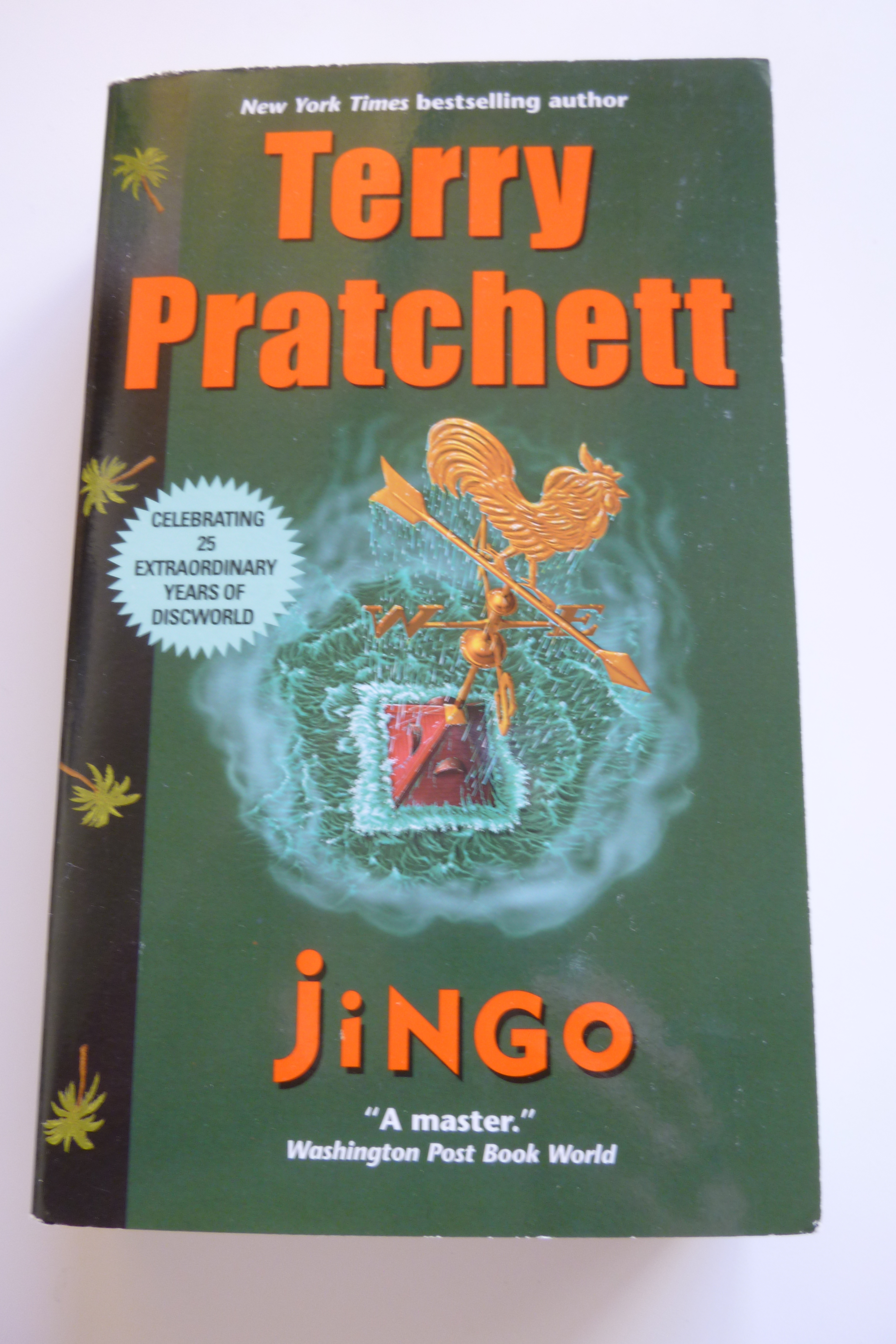
I began my proper reading of Discworld with The City Guard books.  There are eight books focused on Guard Captain Sam Vimes and his crew of more and less competent watchmen.  Guards! Guards! is the first, if you want to start there.  One of my favorites is Jingo, which satirizes the political jockeying around wars.  Vimes eventually prevents war by arresting both opposing armies for disturbing the peace.  Also, Nobby Nobbs gets in touch with his feminine side–which, trust me, says it all if you know the character, and is impossible to explain if you don’t.

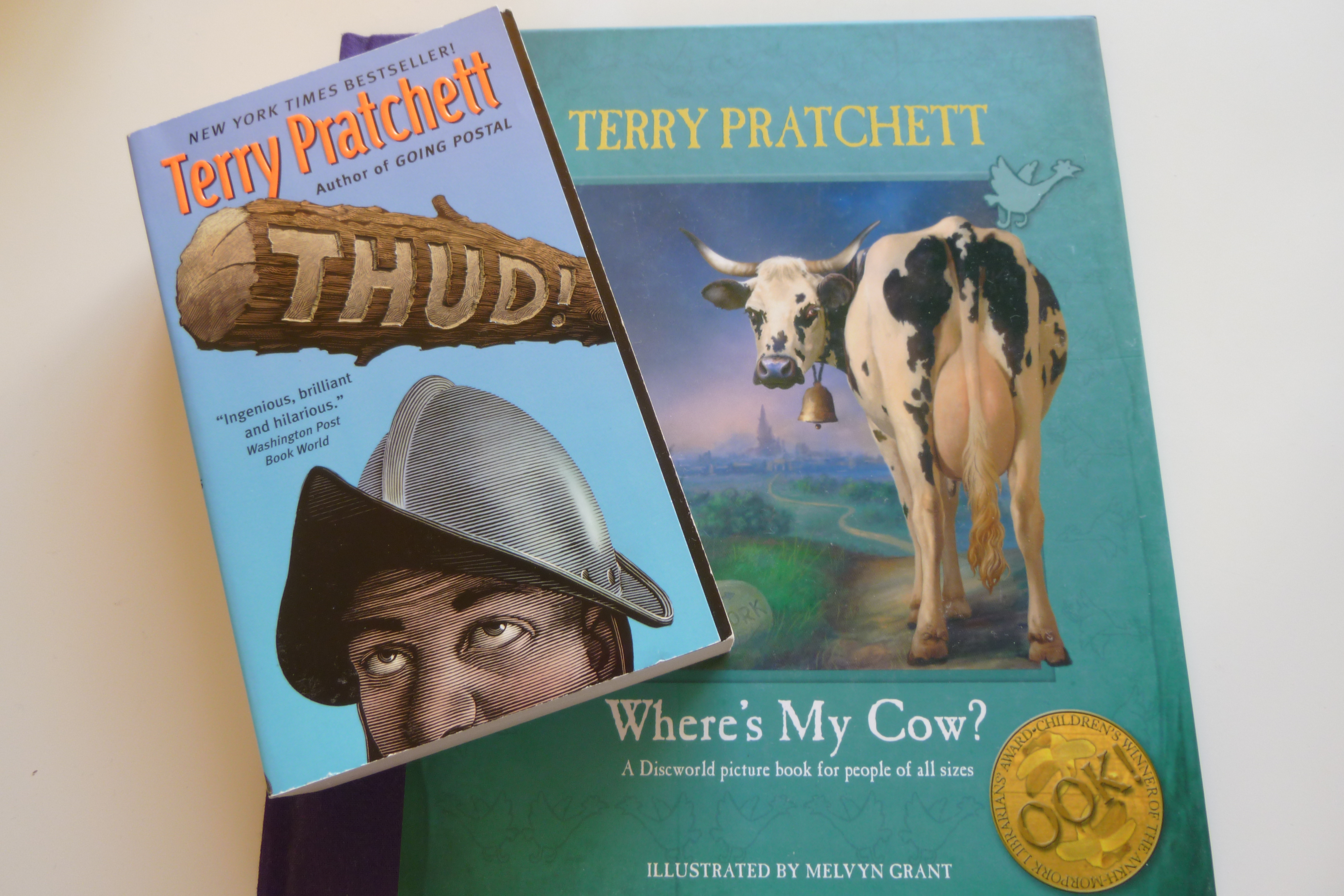
My other favorite City Guard book is Thud!  This one is about racial tension–and it’s hysterically funny.  No, really.  In this case, the two races are trolls and dwarfs, and Vimes has to prevent their ancient feud from exploding all over his city.  My favorite parts, though, are kind of sidenotes.  There’s a famous artist whose papers are almost impossible to decipher, because some of them were quite odd…even odder than “you are not a chicken.”  Also, there’s Vimes’ adorable practice of reading Where’s My Cow? to his son every night promptly at six o’clock, and he never misses.  Even if his men have to declare a state of city-wide emergency to get him home on time.  There’s a companion picture book of Where’s My Cow? which is simply adorably good fun.

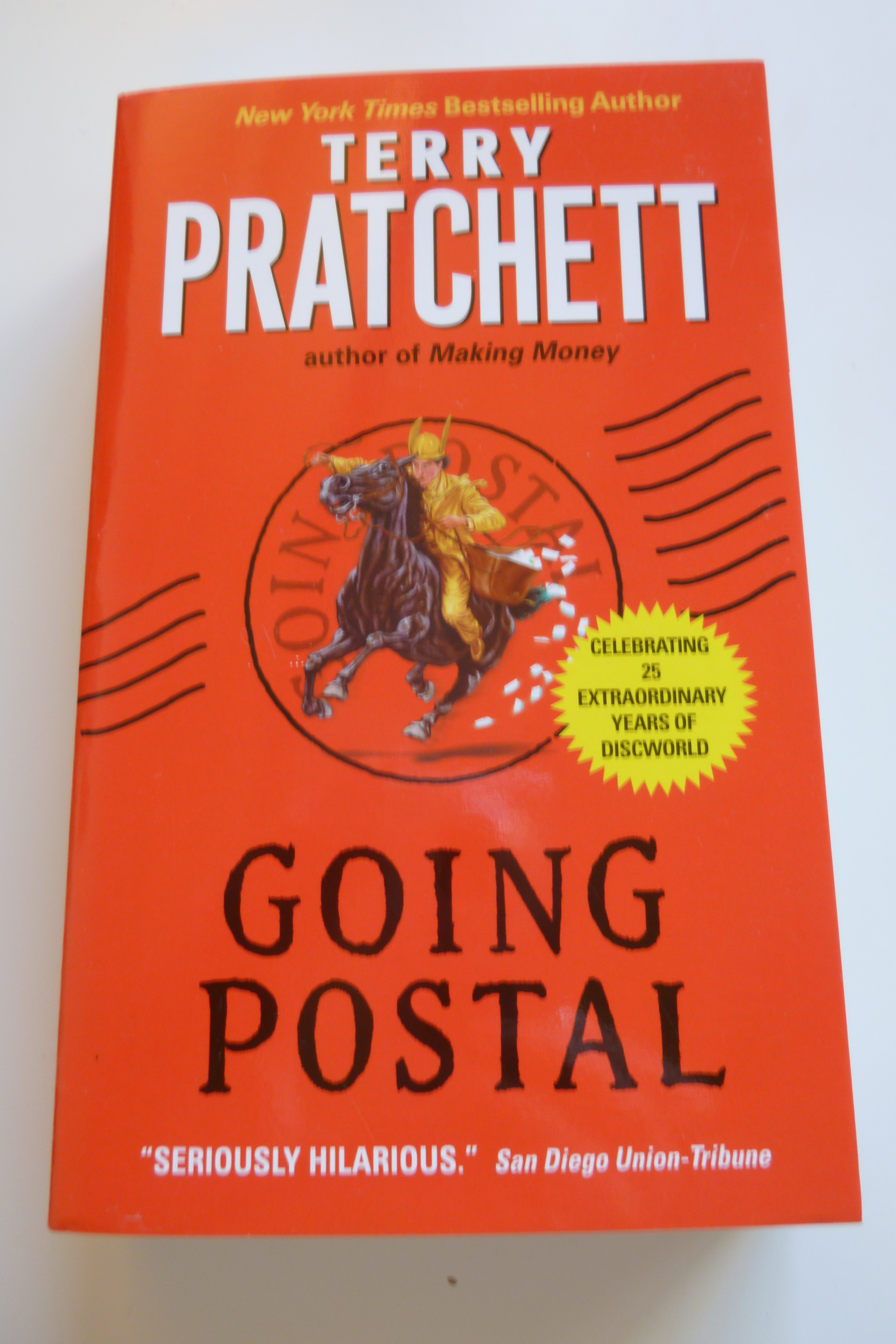
Going Postal is actually my usual recommendation to people of where to start.  I wrote a review earlier, so suffice to say here that it’s about a petty criminal who survives the gallows and is given a chance to become Ankh-Morpork’s new Postmaster.  The Post Office hasn’t functioned in twenty years and is literally filled with undelivered mail.  And I do mean literally.

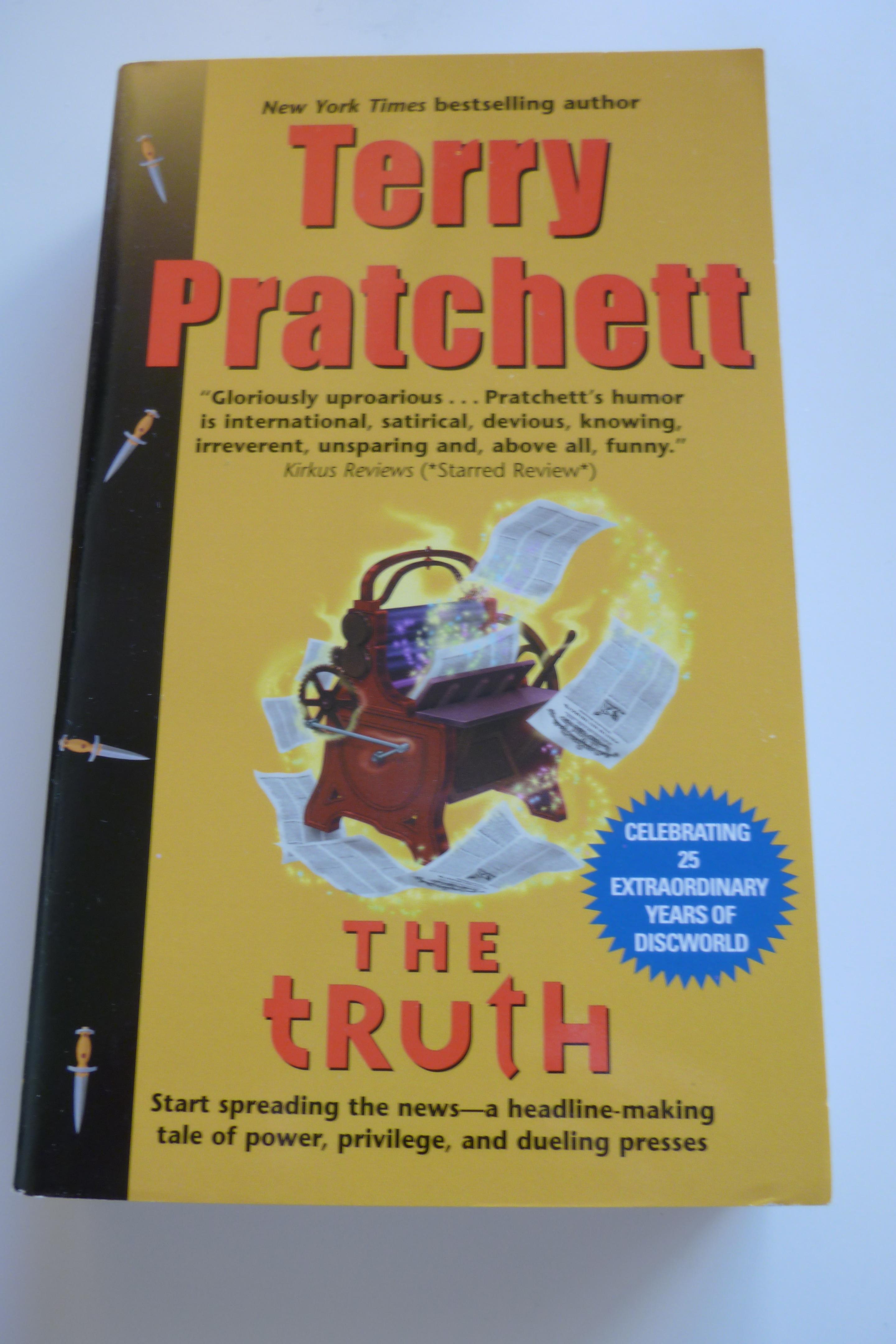
The Truth is another good starting place, another fairly independent one.  This one satirizes journalism, and features a vampire photographer.  The light from the flash turns him into dust every time he takes a picture.  But it’s okay, he has it rigged so he turns back again.

If this post is a little disjointed and incomprehensible, that’s just the nature of the series.  Not really disjointed and incomprehensible, but random and complex and marvelous.  You know you want to understand all my half-comprehensible jokes and carefully veiled references…so you ought to read the series!