Songs About Pursuing Your Dreams

Since the subject of pursuing your dreams came up yesterday, I thought I’d do a follow-up post, about two of my favorite songs.  They haven’t come up before because, well, they’re not books!  But since they’re both about dreams, they’re appropriate to the theme.  They could even be a response to one of the questions essay writers answered for Living the Life of My Dreams.

What is your favorite audio material, and what do you enjoy most about it?

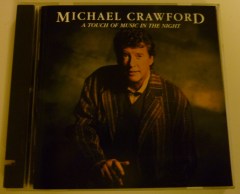
Michael Crawford is my favorite singer; he’s best known as the original Phantom of the Opera, but I have his other CDs as well and they’re amazing.  He’s a wonderfully talented singer who puts so much emotion into songs, and can hold notes for ridiculous lengths of time.  My favorite song is “A Piece of Sky,” which is all about following your dreams.  In essence, it’s about realizing that from your window you can only see a piece of sky, stepping outside and seeing that the world is so much bigger:

What’s wrong with wanting more?
If you can fly, then soar.
With all there is, why settle for
Just a piece of sky?

I can’t find a clip online anywhere of Crawford singing this one.  You can listen to Barbra Streisand sing it (although, with all due respect to Streisand, I like Crawford’s version better) or you can find it hiding as the second half of “Papa, Can You Hear Me,” on his concert CD and available on iTunes.  Or you can do what I did, and buy his CD, A Touch of Music in the Night, which has the best version.  Just for a sample, here’s another of Crawford’s songs.  And I swear I’m not being compensated for recommending his music! 🙂

My other favorite song about following dreams may be from an odd source…Newsies is a live-action Disney movie about a newsboy strike.  There’s one song, “Santa Fe,” that’s sung by the lead character (a very young Christian Bale!) and is all about his dream to go to Santa Fe.  Santa Fe becomes symbolic about pursuing a new life:

When I dream, on my own, I’m alone but I ain’t lonely,
For a dream o’ nights the only time of day,
When the city’s finally sleeping, and my thoughts begin to stray,
And I’m on the train that’s bound for Santa Fe.

And I’m free, like the wind, like I’m gonna live forever.
It’s a feeling time can never take away.
All I need’s a few more dollars, and I’m out of here to stay.
Dreams come true–yes they do–in Santa Fe.

I hope you all get the chance to see how big the sky is–and to find your Santa Fe.

The Things Characters Tell You

I’ve noticed recently that I’m a fairly trusting reader.  By that, I mean that if a character (especially a narrator) tells me something, I believe them.  I’m good at catching twists in a plot, so in a way I can spot when things aren’t what they seem.  But if one character, for example, describes another character to me, I’ll accept that–and sometimes I think it causes problems.

I’ve just been reading a book with two first-person narrators, going back and forth.  At first, they don’t like each other when they meet.  I noticed that when one narrator described the other one as annoying and stuffy, I started seeing him that way–even though I’d liked him perfectly well (and hadn’t had that impression) before she described him.  The trouble arises because, as I read on, I do think, intellectually, that she was wrong, and she even changes her opinion–but I’ve incorporated her initial impression into my impression of the character, and I have trouble getting rid of it.

Another, perhaps more illuminating example, from a different book: a ten-year-old girl, narrating, meets an adult man and describes him as old.  Years pass, they’re friends, she realizes as she gets older that he was probably only twenty or so when she met him.  But I’ve been picturing him as old, and I have a terrible time trying to get rid of that impression now that I’m learning new information.  Which made the whole thing fall a little flat when they eventually got together romantically–the age difference is big enough, and I’m saddled with an impression that it’s much larger.

I heard in a writing class once that having one character say something about another is one of the best ways to reveal things about that second character (and the one doing the describing, for that matter).  But it gets more complicated with a character who’s mistaken, or even lying.  How does a writer, or a reader, handle that?

It makes me think, as a writer, that if you want to pull a twist on your reader, it’s better to do it by leaving out information than by telling the wrong information.   I read another book recently where a supporting character named Jamie seems to be male–then turns out to be female.  I don’t mean she was in disguise.  All the characters who knew her knew perfectly well she was a girl, but the author kept the reader from realizing it through very clever writing–and careful avoidance of personal pronouns.  And that worked.  Even though I was imagining Jamie as male, when she turned out to be a girl no one had actually told me otherwise, and I could appreciate the twist.  If another character had told me something about Jamie that needed to be re-thought, I think it would have been harder.

Anyone else want to weigh in?  Do you believe what characters tell you?  And can you change your impressions when they tell you something new?

Tribute to That Man in the Red Shirt

Today I decided to write a bit about one of my favorites of the characters I’ve created.  In some ways, he’s the least important–but only because he’s written to be that way.

Richard Samuel Jones is one of my earliest, longest enduring and certainly most suffering characters.

It began when I wrote Star Trek fanfiction.  For those not familiar with Star Trek, there’s a concept among Trek fans of a redshirt.  You see, the redshirts are the men who beam down to the planet with Captain Kirk and don’t come back.  It’s very typical on the original series for Kirk, several regular characters, and one or two crewmembers no one has seen before to beam into a dangerous situation.  Three guesses which one is going to get killed.  Both according to legend and according to statistics, the man who gets killed will most often be wearing red.  (This actually makes sense–security guards aboard the Enterprise wear red uniforms, and it’s logical to bring them into dangerous situations.)

In my Star Trek stories, Jones was my redshirt.  I never killed him off (because that would end the story) but whenever I needed something dreadful to happen, it would happen to Jones.  That sounds awful, but it might help to note that I don’t write bloody stories.  So usually Jones would end up attacked by carnivorous plants, or swept away in a flood of orange juice when the food replicators malfunctioned, or turned invisible when chemical beakers fell on him.

Jones is the quintessential redshirt.  He’s nondescript in every physical appearance.  He’s clumsy, hapless, and prone to accidents, of course, as well as nervous and beset by large numbers of phobias.  He is eternally well-meaning, and, though pessimistic in the moment, generally optimistic in his larger world-view.

His full name is Richard Samuel Jones.  Jones because it’s the nondescript, common sort of name you’d expect a redshirt to have.  Richard Samuel because R. S. can also abbreviate to Red Shirt, and because Sam Jones (which he goes by) is another very nondescript and common name.  Obviously I over-thought this!

I put a lot of Star Trek stories up on Fanfiction.net, and Jones actually became quite popular with my readers.  I think the haplessness was endearing.  I got attached to him too.  So when I went on to write non-Trek stories, I decided to take Jones with me–he is, after all, an original character.  He stopped being a security guard aboard the Enterprise, and simply became a nondescript, hapless, well-meaning man, usually in a red shirt, who turns up with at least a cameo in all of my major writing projects.

So far, Jones has been chased by a swarm of angry rabbits near Port Royal, Jamaica for my Pirates of the Caribbean novel (it was an odd story).  He has also been a scene changer at the Paris Opera; he went with a mob below the Opera and fell into the Phantom’s torture chamber, but was pulled out unharmed.  He’s also been a pirate during the Golden Age of Piracy, sailing with Captain Red Ballantyne aboard the Ocean Rose for my original pirate novel.  Most recently, Jones has been working at the Nightingale, an inn in the magical country of Perrelda.

Sometimes when I look at my stories, I feel like they’re all really the same story, in that they all have the same themes, whether I intended it or not.  Freedom comes up a lot.  So does chasing dreams.  The People the Fairies Forget is largely about realizing that everyone, even those people in the corners of the story who are rarely paid attention to, has a story to tell too.  But I think that’s been Jones’ message all along.

So this post is for Richard Samuel Jones.  And for all those men who beamed down with Captain Kirk, and had the misfortune to not be wearing blue.

Books As Objects

I’ve lost track of how many conversations I’ve had over the subject of e-books.  Wonderful new revolution in books?  Horrible travesty attacking the very nature of reading?  Well, I’m not sure I’d come down quite at either of those extremes.  But it has made me think about books as books.  Not as keepers of stories, though they’re that of course, but books as objects.

Books, by their very nature of being books and not e-books, function in a completely different way.  And I don’t mean function in the sense that you turn pages.  I mean their physical shape, what they look like, the space they take up, the markings they hold, and all that means.

Looking over my bookshelves, some are very marked-up.  Not marked by me–I rarely write or highlight in books–or even marked by anyone else trying to note favorite passages.  But I love buying used books and I’m a frequenter of my library’s sale section, so I have quite a few books that look as though I ought to be paying late fees on them.

This isn’t true of every book I’ve bought from the library, but a number have been sold with all their library stickers and designations still intact.  So I can look along the shelves and tell you that this book used to belong to the Rancho Library, and that one came from McKinley.

I enjoy that, maybe because 95% of the books I read come out of a library.  With the volume of books I read, I would be very poor if it weren’t for the institution of libraries.  Since most of the books I’m holding from day to day have stickers on their spines and stamps on their tops, somehow I feel fond of the ones I own that look that way too–even though I’m sure it would lower their resale price.

This also says something about books as remembering objects.  Somewhere I read a quote–and I can’t remember where–about objects having value for their ability to connect us to the past, and to the future.  Books are the main objects I own that give me that feeling.  I like being able to hold a book and know that it has existed through past years.  Most of my books were bought used, so they’ve been read by other readers before me.

Those library stickers give the books history.  Rancho was my library growing up.  McKinley is my library now.  I don’t have any books with stickers from the libraries I went to in college, but I wish I did.

I love books with history, either mine or their own.  Whenever I’m buying an old book, I try to find the oldest edition I can (provided the prices are reasonable!)  I always hope to find a used book with an interesting inscription written on the flyleaf, especially something with a very old date.  I have two that are particularly good.

I have a copy of Poems by Robert Browning.  It was my grandma’s, and from the inscription I know one of her best friends gave it to her on her 18th birthday.

I also have A Window in Thrums by J. M. Barrie, published in 1897.  The inscription reads, “For Grandma from Mary Eunice, December 25th, 1898.”  I’d so love to know who Mary Eunice was, and who else owned the book in the last century.

Those are my most extreme “books as pieces of history.”  Most of my books don’t have such a colorful past.  But most have some story behind them, if only “I bought this/received this as a gift/somehow acquired it at this time for this reason and I wanted it because…”  And I like it enough to carry it around with me ever since, and here’s the history of my life during the time I’ve had it.

I gave thought to the physical appearance of a lot of my books before I bought them.  Do I like the cover, or does the main character not match my image of her?  I just passed up a very cheap copy of a book at a library sale because it was the movie cover edition, rather than the original cover (and it’s not a very good movie).  I’ve bought new copies of some books because all my other books in that series are new, and bought used copies of other books because all my books in that series are used.  I once gave away a new copy of a Burroughs book and bought a used edition because the new copy was disrupting my set of battered 1960s paperbacks.  I’ve created my own covers for paperbacks that have cover images I don’t like, and discarded the dustjackets of hardbacks that look better without them.

I went searching for a beautiful copy of Peter Pan when I already owned a battered paperback, and bought the edition with illustrations by Scott Gustafson.  When I bought copies of Alice in Wonderland and The Wind in the Willows, they had to meet the same criteria of beauty.

I’m not against e-books to a 100% extent.  I think they’re a nice idea for text books, for travel, and for anyone who doesn’t feel any of the things that I’ve written about today.  And not everyone does.  If you hold on to your history another way, then perhaps you don’t need physical books.

But I, and I think a lot of readers, do need physical books.  Because I can’t imagine any way that e-readers will ever duplicate what I’ve been writing about.  It’s hard to imagine scrolling through an e-book collection on a Kindle or a Nook or an iPad and thinking, oh, I remember I bought this back when…and I’ve transferred it from device to device…  Maybe.

But I’m never going to look at inscriptions in e-books and wonder what little girl gave it to her grandmother more than a century ago.  I doubt my granddaughter will be keeping an e-book that belonged to me as an heirloom.  An e-book will never connect me to the past or to the future.  I’ll never line e-books up on a shelf and feel satisfied with how nice they look.  Can I choose an e-book based on its illustrations?  Maybe, but not for the weight of its paper, the shininess of its pages, or the size of it.  I can’t buy an e-book that was published in 1902, or a 1914 copy of Anne of Green Gables (same cover as the first edition).  You can’t ask an author to sign an e-book.

It’s true an e-book will give you the story.  But a book will give you so much more.
Bloggiesta Update

Finishing out the weekend, here’s my update on  how I did with my blogging goals:

Clear through my half-written draft posts.  Either finish them so they’re ready to go, or decide they just weren’t meant to be and get rid of them.  Went through my drafts, dropped some and finished others.  Ruminations and Quotables are the ones who tend to get stranded in Draftland, so expect more of those in the next few weeks!

Find more cool bloggers to follow in my reader (not exactly an improvement to MY blog…but related)  I found two new blogs to add…scrolled through several others, but not much was grabbing me.  I would have liked to add more, but that’ll do–this was my low-priority goal anyway.  I’ll probably try to pick up a few more over the next few weeks.  Any recommendations are welcome!

Go through past posts to check formatting is all in order.  As a relatively new blog, I haven’t had much time for things to fall into disarray and disrepair, but it’s still worth checking to make sure that I didn’t miss any strangely arranged posts, forget to add a page break to a long Fiction Friday, or have WordPress pull a fast one on my spacing (I swear I’ve seen a neatly spaced blog post suddenly go haywire for no apparent reason).  Went through everything, glad to see nothing had gone too crazy while I wasn’t looking.  🙂

Find new Reading Challenges to join for 2011, and update my one existing one.  I had lots of fun with this one.  I really enjoyed looking at the challenges other people were doing, even if they weren’t ones I’d try myself.  I ended up adding three new challenges, and got the whole thing better organized.

Explore new places where I can add links to my blog, like directories.  I found four directories to submit to, and also found out that a lot expect you to pay.  How irritating.

Try any of the mini-challenges that look fun/useful/interesting!  I wandered through a lot of the mini-challenges.  The one I spent the most time on was a past year’s challenge about adding your link to directories.  See above!

Bonus–I updated my calendar for tracking planned posts, so I feel extra-organized and on top of things now.

This has been a fun blogging-intensive weekend!  I made some good updates, although most of what I was doing was more turned outwards, looking at other people’s blogs, rather than working on my own.  I liked that, though, since it’s made me feel more aware of, and a little more connected to, the larger blogging community–which is probably the point of these blogging events.  🙂