Writing Wednesday: Characters Galore

I’m on a break from my ongoing work on my ongoing Phantom trilogy, and have turned back to the Beauty and the Beast novella I co-wrote with several writer friends.  It happened that I wrote my two (early in the book) chapters before the rest wrote theirs.  Which was fine for all plot purposes, because we had a good outline, but it means none of their characters had been created yet.  (It probably also gave an opportunity for prominence to Archambault, my footman-turned-coat rack who’s running around the castle with a feathered hat and a pink fur coat, but that’s a different point entirely…)

Now that I’m revising and we’re working on tying our respective chapters more closely together, I’m trying to get more characters into these early chapters.  Mostly just a glimpse, partially because my chapter one POV character really doesn’t care about any of them (she’s like that)–but it’s been fun working in those glimpses.

Here’s an excerpt, including no less than seven characters (plus music being played by three others), who will all have their moments of importance as the story goes on.

*****

“Now then,” I said once I was inside.  I shook snow off my cloak and looked over the two footmen standing in the hallway—both quite common fellows, one with long stringy hair and the other young, with freckles and very big eyes.  I do like how impressed common folk get.  As they should.  I pointed a long bony finger at the impressed footman.  “Where can I find your prince?”

He stammered for a moment, then blurted, “…in the ballroom?”
Continue reading “Writing Wednesday: Characters Galore”

Writing Wednesday: Research in Novels

In doing research for my Phantom trilogy, I’ve gone down some interesting trails trying to get information on a specific detail, like whether a Paris police officer would have a six-shot gun (yes), whether the catacombs are actually under the Opera Garnier (no, but I’m putting them there anyway) and where Meg’s home village ought to be (near Toulouse).  Bigger topics require more intensive research though, and I’ve read entire books on classical music, on 19th-century Parisians’ attitudes towards darkness and towards eccentricity, and on ballet.

The single most helpful book, however, has actually been a novel.   It’s been remarkably difficult to find substantive information about the ballet program at the Opera Garnier in the 1880s.  A lot of my information about the Opera Garnier itself has come from forwards in different copies of the Phantom of the Opera!

But I did have one wonderful find with regard to what life might actually have been like for Meg: Marie, Dancing by Carolyn Meyer, about the model for Degas’ famous statue, “Little Dancer Aged Fourteen.”  Marie was a dancer at the Opera Garnier at exactly the same time as Meg, and the novel paints a more vivid and more substantive picture than any book or essay I’ve managed to find.  I read it some six years ago, then read it again just in the last year, and it was incredibly helpful.  Along with a general picture, she has details like how much money the dancers earned, which nights performances were held on, and the schedule for practice and rehearsals.  Also, it’s just a good book!

Continue reading “Writing Wednesday: Research in Novels”

Writing Wednesday: The Phantom and Madame Giry

Madame Giry is one character who had a big influence on my Phantom retelling.  In most versions, including mine, she knows a little more than most about the Phantom, and may have some level of sympathy for him.  That was part of what led me to wonder about the story told from the point of view of her daughter Meg.

After that initial spark, though, Madame Giry became a supporting character in my actual story–although I think a powerful presence.  What I don’t actually have much of is Madame Giry and the Phantom together.  If I ever write a fourth book, one reason will be because I’m curious to explore the two of them.

But they do have a scene together near the beginning of Book Two that is one of my favorites.  The Phantom has taken a first tentative step towards a friendship with Meg, and Madame Giry comes into Box Five to make sure he fully understands that he’d better not step out of line.  Here’s just a bit of it. Continue reading “Writing Wednesday: The Phantom and Madame Giry”

Writing Wednesday: In the Beast’s Library

I wrote a few months ago about a writing retreat I attended, and the joint novella I worked on with a few other authors, retelling Beauty and the Beast.  Well, I recently finished the latest draft of Book Two of my Phantom trilogy, which calls for some form of celebration, I expect.  🙂  I sent it off to beta-readers for feedback, and turned back to novella revisions.

I wrote three chapters for the story, two from the point of view of a certain Good Fairy, and one from the point of the view of the Beast’s librarian.  The last excerpt I shared was from the fairy’s perspective, so today I’m sharing one from the librarian, Hugo Livre.  We set the tale in France (as traditional Beauty and the Beast tales are) so I named my librarian after Victor Hugo.  The other French writer I might have chosen to reference just wouldn’t have worked…because you can’t put a character named Gaston (Leroux) into a Beauty and the Beast story! Continue reading “Writing Wednesday: In the Beast’s Library”

Writing Wednesday: Charles Garnier at the Opera

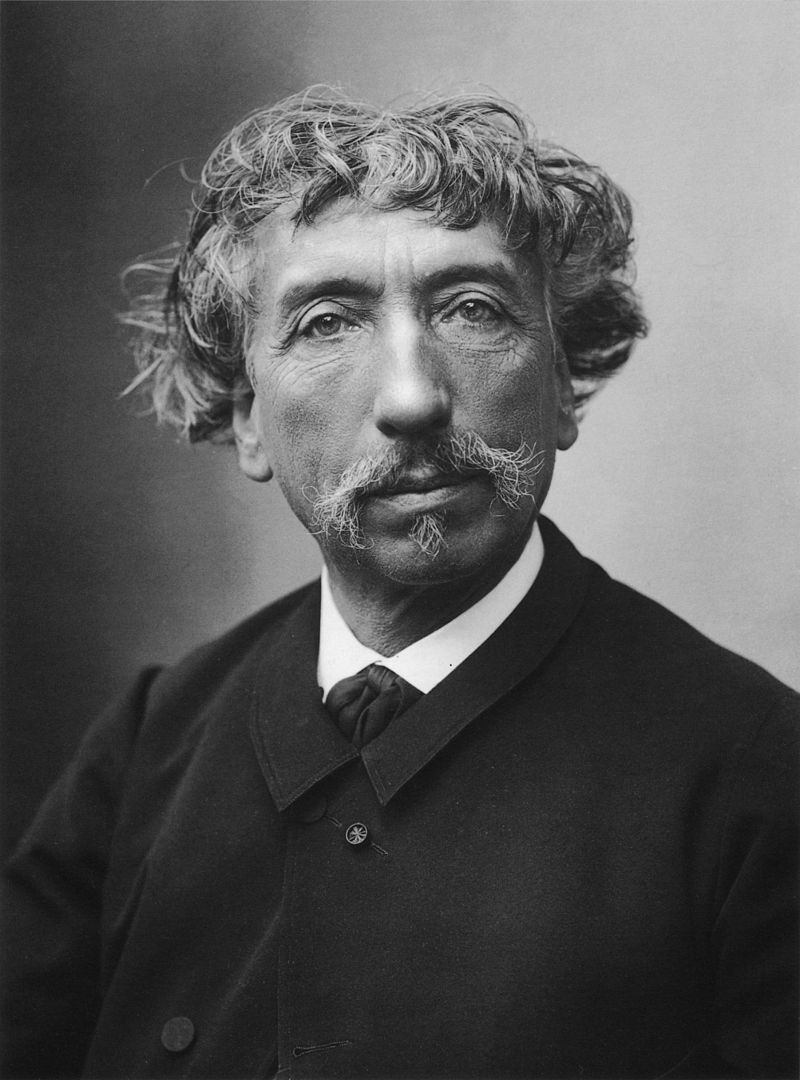
Charles Garnier by Nadar - Leniaud 2003 p142.jpgCharles Garnier plays a funny role in my Phantom novel–a character who is and isn’t there.  I wanted him in it as a kind of shadow, a part of the Opera he built, almost literally.  Erik reads his book on the construction of the Opera–Meg sees his portrait in two places in the Opera–Erik references him with respect–and of course, the building is called the Opera Garnier throughout my trilogy, an actual choice since it could have been the Opera de Paris (or the Palais Garnier, or the Salle des Capucines) and still been correct usage.  But I wanted that Garnier acknowledgment.

Garnier is nearly the only historical figure in my novel.  The only other one is Degas, and he’s only referenced very slightly by comparison (although the Phantom does have one of his paintings on his wall!)

Somewhere I picked up a kind of fondness for Garnier, maybe from Susan Kay’s novel where he’s a more prominent character, or from visiting the Opera Garnier itself.  Or maybe because of one story I heard about Garnier that I just love.  While the Opera was under construction, Empress Eugenie, the wife of Napoleon III, was not wild about Garnier’s design.  She asked him what style the architecture was and, being a clever man, Garnier responded, “The Napoleon III style, of course!”

So he’s in here, a little, for those reasons–but also for what I can say about the Phantom through him.  And that mostly comes out in one very brief flashback.  Garnier may be in the rest of the trilogy just for the sake of this moment, because I love the image of Charles Garnier and the Phantom of the Opera sitting on the edge of the stage the night before the Opera opens, drinking champagne to their masterpiece.  And I will trust that the ghost of Garnier won’t mind me giving a little credit to the fictional Phantom!

Here’s my favorite bit of the flashback, as the Phantom reflects on their relationship and his role.

****************

Finally, looking at the champagne bubbles and not at Garnier’s shadowed face, he had said, “Please don’t tell them about me.”

“Of course not.”

That was all.  No more than that.  It was enough, because unspoken between the words and filling the empty auditorium was the tacit understanding that had always existed between them.  There had never been anyone else who understood their mutual obsession for this building, no one else who loved it as they did.  He had liked to think of it as similar to two men in love with the same woman, each uniquely able to understand the feelings of the other.

Of course, when that situation actually came about, it had been utterly different.  So much for metaphor.

Garnier had a career, a family, a public face, and had gone on to design other buildings, explore other landscapes.  Erik was the shadow he left behind to watch over his masterpiece.