Writing Wednesday: Pre-Edited

Occasionally while working on revisions, I find myself thinking I need to add something and then, happily, find that I already have.  I’ve been over and over this story so many times now, it’s hard to remember at times what’s been written and what’s only been thought!  This happened to me recently, as a beta-reader recommended that I add in a Joan of Arc reference in the scene when Christine tells Meg that an Angel of Music has been speaking to her.  I couldn’t quite find a spot in the conversation–and then as I read on, found that I’d already done it at the end of the scene!

Here’s a glimpse at Meg’s reaction to the news, including that Joan of Arc reference.

****

I was a good Catholic girl and I believed in angels in the abstract—but to believe that an angel was speaking audibly to Christine in her dressing room, and giving her advice about how to improve her singing?  I was more likely to believe that the Ghost was really a ghost, and I didn’t even believe that.

Besides, when there’s a man lurking around an opera house, possessing an amazing voice, an ability to walk through walls and strong opinions about music, you don’t have to look far to find an explanation for an angelic visitation involving singing lessons.

It was that likely conclusion that was keeping me awake more than the uncertainty.  Should I suggest the idea to Christine?  But the thought of telling her made my stomach hurt.  And besides, I was only guessing that the Angel was the Phantom.  Perhaps I shouldn’t upset Christine if I wasn’t sure.  Even at the time I knew I was trying to convince myself of a way to avoid an uncomfortable conversation, but the half-decision still let me fall asleep.

We didn’t speak of the Angel the next morning, parting on the most cheerful of terms, and the whole idea seemed no more plausible while I was sitting in Sunday morning mass.  Angelic visitations had precedent, true, but angels had had more important things to say to Joan of Arc than recommendations on singing techniques.

Writing Wednesday: Retreating

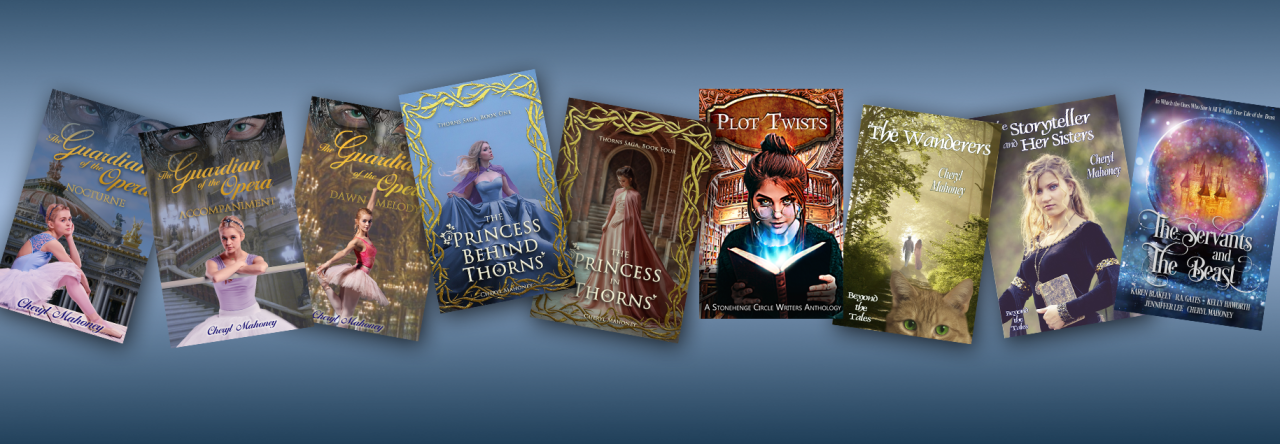
I have exciting writing activity coming up, as I’m going on my annual Stonehenge Circle Press writing retreat this weekend.  Organized by one of my writer friends, a small group of us are getting together for a long weekend to do some workshops and spend some concentrated writing time.

As part of the retreat, we’re also collaborating to write a Beauty and the Beast novella (with some twists!)  We each took on a chapter or two, mostly from the point of view of different servants.  We’ll discuss at the retreat and smooth out fitting our different parts together.

I wrote one chapter from the librarian’s point of view which I may share later…but today I thought I’d share the beginning of Chapter Two, when the prince becomes cursed.  A familiar if unnamed character is to blame for it all…

******

He really should not have been rude. Kind-hearted as I am, dedicated to the highest principles of Goodness and Niceness, I normally try to rise above that sort of thing. But some rudeness simply cannot be borne. For the good of the rude person, naturally. And I always act for the good of others. I’m sure he’ll thank me someday.

The whole little affair began for me on a snowy, blowy night. Just the sort of night for cozying up to a nice cup of tea, for petting an adorable pink kitten, or for wandering about in the snow disguised as an old crone, testing souls.

I pulled my carefully tattered cloak around me (so much goes into tattering a cloak just so, for that truly decrepit look—it’s an art form) and shuffled up the long walk towards the main doors of the castle. I pride myself on my cronish shuffle. And I never go to a castle’s backdoor. You don’t meet any princes that way, and I obviously have not time to waste on the souls of the common folk. They just don’t have that royal touch, you know.

Writing Wednesday: Charting Revisions

For something a little different this week, I thought I’d give a peek at a tool I used in my revisions of my Phantom novel–which turned out to be a trilogy.  Essentially, I went through every scene, and created an Excel chart tracking scenes, their purpose, and the appearance of certain characters who I was concerned were inconsistently present.  The result?

You can see from the red cells that Christine does not arrive on the scene immediately, which was as I planned.  But I also swiftly realized that there were long gaps where characters like the Persian (brown) and Jammes (green) went missing, something I worked on correcting in revisions.  I also realized that some scenes repeated the same theme or emotional arc too closely, or that others were unnecessary in the plot, their minor purpose easily folded into another scene.

By the time I got to the end, I’d charted 250 scenes, and realized from the way the colors clustered that I had a trilogy.  There was a clear progression with a different villain dominating in each third.  Which I might never have realized if I hadn’t laid things out this way!

It’s not a tool for every revision problem…but I did find it useful for several of mine. 🙂

Writing Wednesday: Class Divides in 1880s France

Earlier this week I did some editing on a scene in my Phantom retelling that gets at a thematic point (and plot obstacle) that I think has been largely ignored in other versions of the Phantom’s story: namely, the class divide between Raoul, Vicomte de Chagny, and Christine Daae, opera singer.

Mainly, Raoul could never marry Christine, and everyone involved would know that.  She could be his mistress, sure, but it would be a scandal to marry her.  In the original novel, Raoul is sad at one point early on because he knows he can’t marry her–and that obstacle is never referenced again.  (Spoiler: they get married eventually.)  Webber ignores the issue entirely.

In my ongoing effort to distinguish my retelling, and to provide a (reasonably) historically accurate version, I wanted to take that issue on directly.  The excerpt below comes just after Meg asks Raoul what his feelings are about marrying Christine.  It’s not the only place the class issue comes up (it becomes a major part of Meg’s plot in the third book too), but I like how this bit captures it.

*******

Raoul looked at the ceiling, the programs, the far end of the corridor.  “You must understand—my options are very limited—it’s all nonsense about the aristocracy having more freedom, we’re really very constrained in many ways—”

“I understand perfectly, Monsieur,” I said in my politest tones, because why waste any more time on this nonsense?

“Oh good,” he said, shoulders visibly relaxing, which just went to show that he had no idea what I meant.

I understood that he genuinely cared about Christine, that he thought well of her and, maybe, wanted to do the right thing by her.  I also understood that none of that weighed as heavily as the pressure of Philippe, or of societal opinion.  Nothing was surprising in that.  Everyone knew that men like Raoul didn’t marry girls like Christine.  Or like me.  Though with a sudden, uncomfortable feeling, I realized I wasn’t sure that Christine knew it.  But did I dare try to point it out to her?

I felt a surprising pang of disappointment too.  I didn’t even like Raoul, it wasn’t exactly that.  But it didn’t seem fair, that even Christine, beautiful, talented, magnetic Christine, wasn’t good enough for a silly vicomte.

Writing Wednesday: A Dragon Poem

I recently took a break from my revisions to play with a sudden idea for something very different.  I was having conversation with a writing friend about her new kitten, named Dragon, and his dragonish qualities, like his dragon heart.  I asked if he had a dragon’s voice though, and it turns out he’s quite squeaky!  With leaps and bounds, this led us both into separate ideas for a children’s story about a dragon seeking his roar.

Because it all looked rather Dr. Seuss-ish in my head, I ended up spending a week writing a rhyming tale of baby dragon Squeak and his search, in all the wrong places, for his very own roar.  I’ll offer the initial qualifier that I am not a poet, and offer a few verses just for fun.

And so the days passed, and the baby dragons grew,
Named for the sounds of their first cry and hue,
Gree and Fwoof and their fine brother Squeak,
Who hated his name, sounding so soft and so meek.

He was a brave dragon, he knew this was true,
He knew that his roar should be brave and strong too.
He tried and he tried, and then he tried even more,
Opened his mouth and produced a shocking squeak.

“Don’t worry, my child,” his kind mother soothed,
A serene dragon she was, not easily moved.
“You’ll find your own roar, just like all your kin.
Just remember your roar must come from within.”