A Few Birthday Acknowledgments

This isn’t a full book review–just a happy birthday wish to two of my favorite authors, L. M. Montgomery and Mark Twain.

I think I own everything currently available by L. M. Montgomery in prose, including novels, short stories, letters and about 2,000 pages of her personal journals.  I’m sort of a big fan, but she was an amazing writer.  For recommendations, you can’t go wrong with Anne of Green Gables, of course, although my personal favorite among her novels is The Blue Castle.  It’s a beautiful story about a woman who stops being afraid of the people around her and goes out to seize the life she wants.

Everyone knows Mark Twain, right?  Tom Sawyer and steamboats and the Mississippi.  I love that he’s one of those authors who can tell a good story that also has a message
(even though he denies it) and neither the story or the message gets in the other one’s way.  Huckleberry Finn is my favorite of his books, and every time I see it in a bookstore I feel an impulse to buy it.  So far I’ve been resisting and only have one copy, but someday (probably when my disposable income goes up!) I may start capitulating, and will devote an entire bookshelf just to Huckleberry Finn.

As a side note, it’s also the birthday of William Bouguereau (a great pre-Impressionist French painter I’ve recently become obsessed with) and Winston Churchill (born the same year as L. M. Montgomery, he was a writer, painter, famous wit, and, oh yeah, Prime Minister of England during World War II).  Who knew November 30th was so significant?

A Trip to Burroughs’ Jungle

I had a running joke with one of my English professors at USF; he could never fathom my attachment to Edgar Rice Burroughs.   And I was never willing to relinquish said-attachment.  It’s not that I don’t think my professor had some valid points; Burroughs’ books are not without flaws.  But nevertheless, if you’re looking for beautiful prose and a ripping good yarn (that’s really the only way to put it), Burroughs is the best.
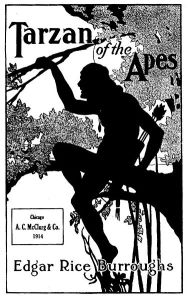
In discussing Burroughs, I feel like I have to start with Tarzan of the Apes.  He has others I like better, but that’s certainly his best known–and one of his best.

I think everyone has an idea of the basic plot of Tarzan–a child is raised by apes, becomes Lord of the Jungle, and romances Jane.  So far, true.  Before going further though, two Tarzan concepts to clear up.

He never says “Me Tarzan, you Jane.”  Before he ever meets Jane, he has taught himself how to read English, but can’t speak any.  They’re separated for a while, and by the time they meet again, he’s completely fluent in both English and French.  (That’s a usual Burroughs Implausability–he likes to throw people from totally different cultures together, but he needs them to talk to each other, so in Burroughs’ world it takes about two weeks to learn a foreign language fluently.  You just have to go with it.)

Second, Tarzan doesn’t shriek while swinging on vines.  He does swing on vines.  And he does shriek–but that’s the cry of the Great Bull Ape after a kill.  He doesn’t do both at the same time.

Now that we cleared that up…Tarzan of the Apes follows Tarzan from birth, to his adoption by the Great Ape Kala, how he grows up among the apes, becomes Lord of the Jungle, and, eventually, how he romances Jane.  Along the way, I lose track of how many lions and gorillas and other apes he fights.  Burroughs’ books are nothing if not exciting–there will be blood.  But it’s not graphic.  There will be heart-pounding action, obstacles to surmount, and lots of hand-to-hand combat.  And, of course, some romance.

All of it is against the backdrop of Burroughs’ African jungle.  Along with his prose, one of his great strengths is in creating bizarre and fascinating landscapes–the surface of Mars, the interior of the moon, the interior of the Earth.  And I include the jungle as one of his landscapes, because it’s not accurate to Africa.  But I think it’s the way everyone who doesn’t know the jungle (me included) imagines it, with great vaulting canopies of trees, dangerous beasts lurking behind every bush, and adventure always at hand.

So the great virtues of Tarzan, and most Burroughs books, are the prose, the action, and the landscape.  I should probably warn you of the most prevalent flaws as well, at least as relevant to Tarzan.  If you want a strong heroine, you’ve got the wrong writer.  Jane spends a lot of time being carried off by people–literally.  There are also some racist parts about the African natives.  Without condoning that, I think we also have to accept that Burroughs was a product of his time.  We can’t expect 2010 enlightenment in a novel written in 1912.  I’ve never found it severe enough to interfere with my enjoyment of the story.

That’s all, really.  And trust me, the positives of the story make it worth it.  Two more practical things to note, before you pick up Tarzan.  I have a used copy of the book–I can’t remember where I got it anymore, but it’s missing the first 12 pages.  This doesn’t bother me, because, despite being completely action-packed later on, Tarzan starts slow.  My advice is, if you feel like it’s dragging, just skip to the last page of chapter 3.  In the first three chapters, John Clayton (also known as Lord Greystoke) and his wife are on a ship; there’s a mutiny; they end up set ashore in Africa; he builds a cabin and she has a baby; she dies of an unspecified illness when the baby is a year old.  That’s all you need to know.

And if you get to the end, and think–wait, that can’t be the end!–you’re right.  They ought to just publish The Return of Tarzan in the same volume, because the story continues.

Author’s site: http://www.tarzan.com/
Meditations on Stones

This is a little more reflection than narrative…and I suppose the “I” in this case really is me (which it usually isn’t, in my writing).  But this has more of a story quality than an essay quality, so I’m going to put it in for Fiction Friday anyway.

On some level, this may be one of the most valuable things I’ve written.  I submitted it as my writing sample when I applied for an internship at UniversalGiving, where I’m now working…and while I couldn’t say how big a factor it played, one never knows…

*******************************

I swear Stonehenge was laughing at us.

            Not literally, of course, I don’t mean it like that.  But in a metaphorical, immense, stony kind of way, Stonehenge was definitely laughing.

            I think Stonehenge is maybe about an hour or two bus ride outside of London.  I say “bus ride” because I think tour buses are all that go there; tour buses and druids, maybe.  I was on a tour bus when I went there.  Tour buses usually make me sleepy, which is why I’m not so sure about the time length to get there.  I woke up quick when we got there though.  Stonehenge is not something to be slept through.

Continue reading “Meditations on Stones”

The Twisting World of Wizardry

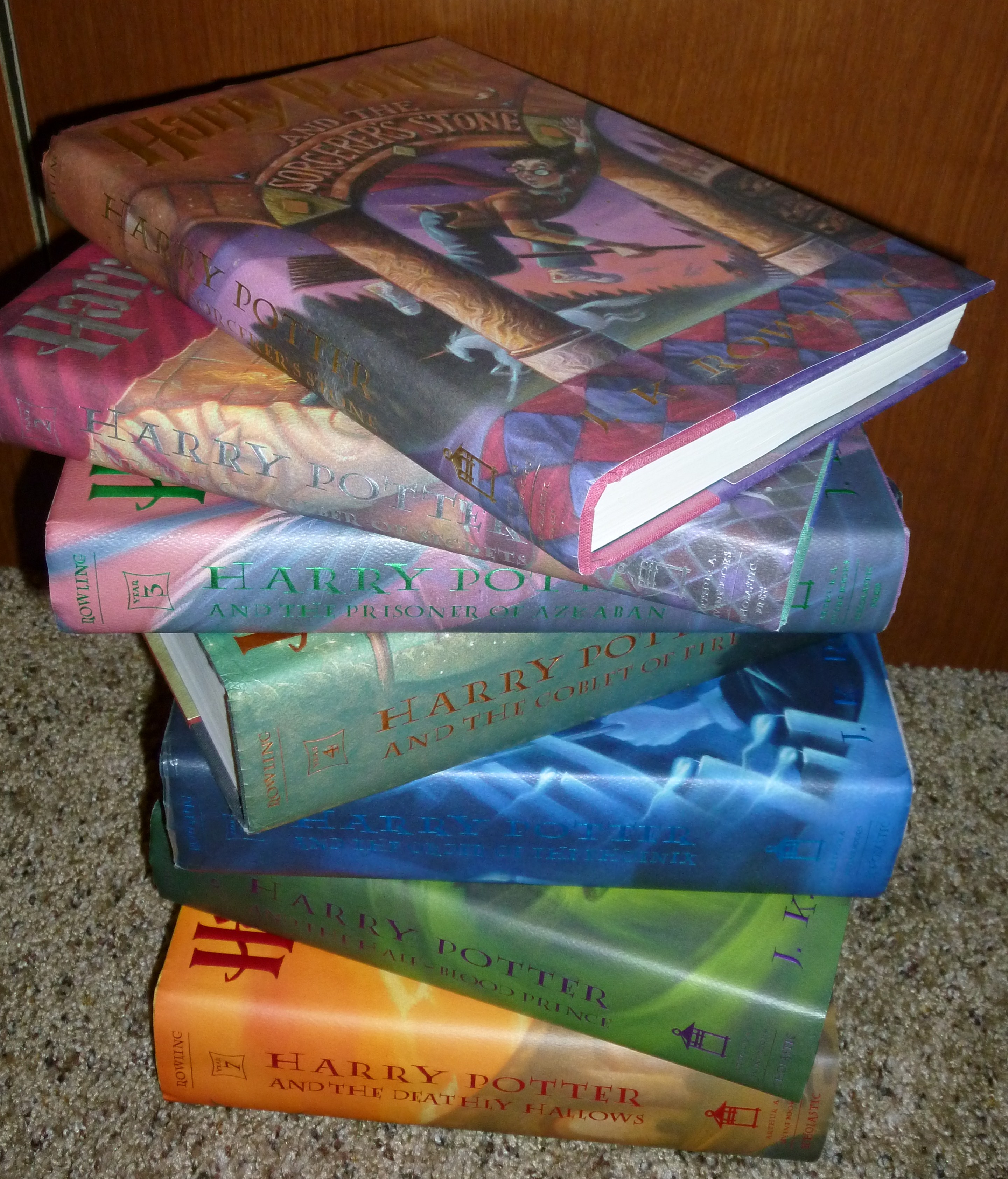
Having covered Twilight, that leaves one more young adult fantasy novel I know I have to cover–Harry Potter, by J.K. Rowling.  Unlike Twilight, I can pretty unreservedly recommend the Harry Potter series.  Oh, I wouldn’t swear that they’re excellent writing, and the first few hundred pages of Book 5 does drag a bit.  But on the whole, Rowling has created a wonderful world and very enjoyable books.

If you are somehow not familiar with the premise of Harry Potter, they’re about a boy–Harry–who finds out on his eleventh birthday that he is actually a wizard.  He goes off to Hogwarts where he learns magic with his close friends Ron and Hermione, and does battle with the evil wizard Voldemort.  Voldemort killed Harry’s parents and, though defeated in the past, is always threatening to rise again.

There are several points that I find to be the great strengths of the series.  One is the complex world Rowling creates.  It’s detailed and plainly well-thought out.  The wizarding world has their own food, their own sports, a complex history, extensive legends…and without ever coming across like a bad historical fiction novel that’s trying to drum history lessons into you.  People (and by people I suppose I mean me) love the power of a book to take you to another world, and Rowling’s world is one that is easy to enter into, because it is rich and complete.

Second are Rowling’s plot twists.  I’ve noted elsewhere that I often can see twists coming, but I rarely predicted the twists in this series.  She is particularly good at disguising who the villain of the book is.  Voldemort is supported by numerous henchmen…but some are not nearly as obvious as others.  Despite unexpected turns, these are books that usually leave me saying “Oh, NOW I see what it all meant…” rather than feeling like I was tricked or misled.

I also love the way Rowling drops a side comment in book one that becomes pivotal in book three, or introduces a character in book two who becomes important in book six…she ties things together so well, and I enjoy spotting something important on a re-read that I didn’t even notice to begin with.

A few reservations on the series…I was never that happy with the romances that turn up.  There are solid friendships here, but the romance, though present in the later books, never felt all that satisfying.  And it’s not that I want characters to end up with different people than they eventually paired off with…but we didn’t get much in the way of romantic scenes for anyone.

I also was never able to feel much for the death scenes.  I know Rowling has said she’s cried while writing them, I know other readers have been deeply moved, and I respect that…but for me personally, I don’t feel a lot of pathos.  (There is one exception to that, and to avoid giving a spoiler, I’ll just say it was the one who died with “the ghost of his last laugh still etched upon his face.”)

Still, Harry Potter‘s strengths certainly outweigh what weaknesses there are.  And one thing the books do have in common with Twilight–I tended to read them for the first time in a few days.  And usually I’d read the last part of the book straight through in a couple of hours, because another strength of the books is extremely engaging climaxes.

Author’s site: http://www.jkrowling.com/

Of Sparkly Vampires

I NEVER sparkle. But I am double-jointed.

When I first started thinking about this blog, I knew that if I was going to write about young adult fantasy, there was one book I couldn’t ignore for very long.  So while I didn’t want to start with Twilight by Stephenie Meyer, I think the day has come to look at it.

If you’ve never heard of Twilight, I’m going to have to respectfully ask what planet you’ve been on recently.  Twilight is the love story of Bella, clutzy book lover, and Edward, ravishingly handsome vampire.  They’ve taken the teenage world by storm and spawned any number of vampire story knock-offs.  Some of which surely make Bela Lugosi, above, turn over in his, er, coffin.

I’ve read all four books in the Twilight series.  And there are few books that leave me so confused about how I feel about them.

You see, here’s the problem–I can tell you all about why they are deeply flawed books.  And yet I read each one in two or three days, and found it very difficult to put them down.  So let’s take both sides of it.

The flaws.  Well, chief in there are the characters.  I can’t tell you much of anything about Bella or Edward as people.  I described Bella as a klutzy book lover, and that is ALL I can tell you about her.  Oh, and she’s in love with Edward.  Madly, obsessively, all-consumingly in love with Edward.  Which kind of works out, because he’s madly, obsessively, all-consumingly in love with her.  And that’s pretty much all I can tell you about him.  Oh…wait…he plays music.  Which we mostly hear about because he wrote Bella a song.

The two leads are one-dimensional characters.  And, in the first book at least, none of the other characters are developed either.  That gets better later in the series…the rest of the vampire clan get their moments to talk about their histories and we find out more about who they each are.  I particularly like Carlisle and Alice.  Jacob has his moments.  Edward and Bella…stay pretty flat.

The all-consuming, to the exclusion of all other interests, romance is…well, it is kind of fun, but it’s also disturbing when you step back long enough to really look at that.  I watched the movie version of The Great Gatsby not that long ago, and there’s a scene where Gatsby stands outside Daisy’s house all night “in case she needs me.”  And I thought–that’s such an Edward thing to do!  Except that it’s clear Gatsby is unhealthily obsessed, and Edward is supposed to be a model for romance.

So there’s some massive problems.  And I know that the writing is really not that great, and even the plots are, well, not usually much more complex than “evil vampires are coming to get us!!!!”

And yet…I found the books so addictive.  Why????  I don’t really know.  The main thing I’ve been able to figure out for myself is that Edward and Bella are really cute when they’re romantic.  Yes, they’re obsessive…but there are a lot of cute, sweet scenes.  And one thing sort of on that note that I do have to give Stephenie Meyer huge points for (minor spoiler here)–way to go on not having them sleep together before they’re married.  Especially when Bella’s only seventeen.  That is so sadly rare in modern stories (books, movies and television) and it’s nice to see that.  And also–concrete proof that it’s possible to write extremely romantic stories without having the characters jump into bed (okay, well, literally they do–but you know what I mean).

Now that I’ve rambled a little about my Twilight conflict, I’m going to give up on inventing my own explanations and just point you to someone who’s already got it all worked out–Cleolinda Jones (maybe you’ve heard of her Movies in Fifteen Minutes parodies?) wrote an absolutely brilliant analysis on TwilightHere it is.  I think she’s nailed it on all counts.  And also, she pretty much sums up all of Twilight in this one line: “Omg I love him I love him I love him I love him I love him I love him he loves me!! And he sparkles!”

Yeah.  That’s Twilight.  And the literary analyst in me can’t stand the thing, but my inner teenage girl loves it.  So I’m conflicted.  And, please, by all means–tell me your thoughts about the sparkly vampire.

Author’s Site: http://www.stepheniemeyer.com/