This is the second installment of a story I wrote for my senior thesis at the University of San Francisco. Set in the strange world of a women’s clothing store, the story follows Carin on a trying shift. Part Two picks up just after an awkward interaction with a difficult customer. Carin has tried and failed to graciously explain why the Sale signs say “Up to 70% off” and why the items may in fact be only 30% off. Carin has finally told the customer that it’s just the evils of capitalism, and escaped by taking the woman’s clothes to the fitting room.
You can catch up with Part One here, and continue the story below.
**********************************
Back in the fitting room area, Joanne looked up from folding clothes when I came in. She was stationed back here this shift and I envied her. I usually enjoyed the fitting room more than other positions. I liked it when it was busy. Not insanely busy, but right on the edge. I liked having six things to do and to bounce and whirl and twirl between all of them, not overwhelmed but dancing right on the edge of it. I’d gone off the edge sometimes and that was no good, but I loved it when I could skirt the cliff, moving fast and getting everything done. Those were the best days. They went by much faster too. I’ve had eight-hour shifts in the fitting room that were shorter than five-hour shifts spent sizing clothes.
I’m going to assume that most people are familiar with the premise of Peter Pan by J. M. Barrie. In brief: Peter Pan flies with Wendy and her brothers to Neverland, where he lives with the Lost Boys and Tinkerbell the fairy, and has adventures fighting pirates and Indians. And, of course, he never grows older.
Peter Pan (originally titled Peter and Wendy) is the ultimate celebration of childhood. Neverland is the best parts of childhood, and the best parts of a child’s imagination, all rolled in together with none of the bad parts. Even the bad things–say, villainous pirates–are only exciting adventures.
The peculiar thing about Peter Pan is that I don’t actually think much of the main characters. Tink is a nasty brat, Peter is horribly arrogant (though oddly appealing in that, I must admit), John and Michael are fairly non-entities, and as for Wendy…well, I have no use at all for a girl who goes to Neverland and spends all her time cooking and cleaning and darning socks. Hook, actually, is a more interesting character–dastardly but elegant, and rather melancholy (not sad–melancholy). But it’s actually all right that the characters leave something to be desired as people, because the concept is so fantastic and the book is so charming.
More on the concept in a minute, but first on the charm. That actually brings me to my favorite character: Mr. Barrie. He doesn’t overtly appear in Peter Pan, not even in an fictionalized role like the kindly old gentleman in The Little White Bird, and yet he is very present as the narrator. Every so often throughout the book “I” and “you” come into the narration–“I” who’s telling the story, and “you” the reader. There’s a clear feeling that “I” is Mr. Barrie, and that you is you personally, you reading.
(On a side note, I always felt a bit smug in some of my writing classes in college, when the discussion turned to how wonderful experimental writing is, such as addressing the reader directly–experimental, maybe, but Mr. Barrie was doing it a century ago!)
My favorite part of the book is near the end of chapter seven–everyone is on the island by now, and Mr. Barrie is debating which of their many adventures to tell (because there isn’t possibly time for all of them). Perhaps this battle with the Indians, or perhaps that prank of Tink’s…
Which of these adventures shall we choose? The best way will be to toss for it.
I have tossed, and the lagoon has won. This almost makes one wish that the gulch or the cake or Tink’s leaf had won. Of course I could do it again, and make it best out of three; however, perhaps fairest is to stick to the lagoon.
I love it. I know he’s not sitting in a study tossing a coin. And yet, Mr. Barrie telling you the story is almost another level of the story.
Then of course the story of Peter Pan is exciting, dramatic and endlessly appealing…because who hasn’t occasionally wished they could escape to Neverland? Even if most of us, most of the time, are reasonably happy about being grown-ups, Neverland is a place of youth and joy and innocence, free from cares or worries. Sometimes a little fairy dust and a trip past a star looks very good.
Besides recommending the book itself, I also have to recommend a particular edition of Peter Pan. I decided some while ago that I wanted to buy a really beautiful copy. After looking at different versions in different bookstores, I fell completely in love with Scott Gustafson’s illustrations. Every picture is an incredible work of art. Lovely.
There are some parts of An Unexpected Apprentice by Jodi Lynn Nye which may sound a little familiar. A magical world with a number of magical races. One of them is a race of kind people smaller than humans. One of the characters is a wise old wizard. There’s a quest, involving a group made up of several races. There’s an object of immense power on the loose, which could destroy the world. Said-object tempts its bearer to use its power for his or her own gain.
Some of it, I suppose, is archetypal. Some of it is Lord of the Rings. I could forgive An Unexpected Apprentice for resembling Lord of the Rings, but it’s harder to forgive it for being, well, kind of bland. I’m not sure why I was left with that feeling of blandness. There are dangers, and the world is reasonably well-developed. But maybe the world lacks enough details, and maybe I didn’t care enough about any (except one) of the characters to feel much concern about the dangers.
One good point: I do like that object of immense power. Rather than a ring, it’s a book. The Great Book that holds everything’s true sign, from individuals to entire countries. Change the sign, and you change the thing. Destroy the sign in the book, you destroy whatever it represents. There’s something fascinating about that.
The essential plot of An Unexpected Apprentice is that someone has stolen the Great Book, and Tildi (a Halfling, one of those small people mentioned above) and her friends go on a quest to get it back and restore it to a place of safety. Tildi and all the rest are nice enough, but no one on the quest made much of an impression on me. I wanted to like Tildi, if only because I have a soft spot for girls who disguise themselves as boys to go pursue their dreams (ever since reading The Song of the Lioness Quartet by Tamora Pierce). Tildi does that at the beginning, although she’s unmasked as soon as she takes up her apprenticeship with the wizard. But despite that, I never developed much attachment to her.
No one in the book experienced that problem. That is actually at the root of one of the book’s biggest problems, and certainly one of the most easily defined. The other characters like Tildi too much. That sounds odd, but what I mean by it is that they have all only recently met her, yet they worry about her, care about her, appreciate her–when I don’t feel Nye has built relationships that would justify it. It almost feels as though the other characters know that she’s the main character.
There is one great and glorious exception to this band of so-so characters, and that is Magpie. He’s a prince who travels around in an alternate guise as a minstrel. During a recent war, he became a close friend of the enemy king by becoming the minstrel at his court. He’s engaged to a princess, has a volatile relationship with his family, and is charming and witty and a bit roguish. All around, he’s the kind of character I could love. Unfortunately, he’s only here in a supporting role, and we find out most of the above as backstory.
If I find out that Nye has written a book just about Magpie, I’d pick it up. But so far, despite doing some searching, I haven’t found anything. There is a sequel about Tildi. But so far I haven’t picked that one up. I said this blog would be about sharing favorites and warning you off of some not so good books…and this post is much more of a warning.
This is a story I wrote for my Senior Thesis at the University of San Francisco. I don’t think I was ever so profoundly glad that I had chosen to be a Writing Emphasis major as when they told us we could write fiction for our final project. The Literature Emphasis English majors had to write analytical papers.
For my last semester, one of my classes was a Senior Writing Seminar, where we only met a few times but were supposed to be “living and breathing” our writing project the rest of our time. Don’t tell my writing professor, but that semester, in between writing this 20-page final project for him, I also wrote the 250-page first draft of my novel.
I was already pretty sure that a story about fairies and dragons and glass slippers was not quite what the English department was looking for, so instead I gave them a story set in the sometimes no less bizarre world of retail. This is one of the rare times in my life when I decided to “write what I know,” as I spent several summers working in a very similar store. I do want to say, though, that while the store is modeled on the one I worked on, the characters are fictional, and Carin, my narrator, is not me. We share a love of musicals, but not all of her experiences or personality traits are mine. And the store I worked for (which I will leave nameless…) was actually pretty good to me.
I hope you enjoy Part One, and Part Two will follow next week.
**************************************
Bad things happen when customers aren’t greeted as soon as they enter our store. I was submerged in medium-size jackets and tangled in tags when a new customer strode in the door. All I registered was that she was wearing a sweater with too much embroidery; it looked silly but probably cost a fortune. She went past me, coming through the front entrance at a steady pace and heading directly for the sale section in the back corner. I hurriedly abandoned the clothes rack I was sorting by size and followed her at something between a walk and a trot. You can’t run in a high-end women’s clothing store; sometimes I sorely regretted that. It would make catching customers easier, and that was something management firmly expected me to do.
Once I was within range I fired off my usual greeting. My line for this situation was, “Hello, my name’s Carin. Looking for anything in particular today?”
“Fine, thank you,” she responded and kept walking.
I watched her continue her straight line to the back corner.
As I’ve said elsewhere, J. M. Barrie (best known for Peter Pan) is one of my favorite authors. Peter Pan is not a series, but I have been able to track down several related books, by Mr. Barrie and others–prequels and sequels and so on. So that I don’t overwhelm anyone with a steady stream of Peter, I’m going to spread some related posts out over the next several weeks, to explore the good, the great, and the simply dreadful.
To begin at the beginning–that’s actually not Peter Pan. It all began in the The Little White Bird. It’s very possibly my favorite J. M. Barrie book, even over and above Peter Pan.
The Little White Bird; or Adventures in Kensington Gardens is a tale about a man who befriends a little boy, and has adventures with him in London and Kensington Gardens. If you’re not already suspecting the autobiographical nature of this novel, the little boy’s name is David. Historically, J. M. Barrie befriended the Davies brothers in Kensington Gardens. Not too subtle! He also has a dog named Porthos, as did Mr. Barrie. The man in the story is left unnamed. He’s referred to as Captain W–. I somehow picked up the habit of calling him the kindly old gentleman.
A review in The Times said of the book when it was first published, “The peculiar quality of The Little White Bird…is it’s J.-M.-Barrie-ness…whimsical, sentimental, profound, ridiculous Barrie-ness…Mr. Barrie has given us the best of himself, and we can think of no higher praise.”
I couldn’t put it better. The Barrie-ness is often the best part of Mr. Barrie’s books. The charm, the whimsy, the flights of fancy, the sweet sadness…the book is funny and tragic, absurd and heartbreaking, and sometimes all at the same time. The tragedy, for the kindly old gentleman at least, is that David doesn’t really belong to him, and will one day grow up and leave him.
And there we come to the Peter Pan connection. Besides thematic connections, there are also four chapters in the middle of the book that are about Peter. They’re almost oddly unrelated to the rest, other than by geography, but I think they’re meant to be stories that the kindly old gentleman tells David. In Peter Pan, Peter tells Wendy, “I want always to be a little boy and to have fun. So I ran away to Kensington Gardens and lived a long, long time with the fairies.” And this is that story.
We read about Peter’s running away from home, find out why he doesn’t grow up, see him meet the fairies, and also meet a girl he knew long before there was Wendy. This is before Peter went to Neverland (although an island features) and the Lost Boys and Tinkerbell are yet to come on the scene, but there are other wonderful magical creatures and adventures. The four chapters about Peter, along with one chapter giving a Grand Tour of the gardens, have been excerpted and published as Peter Pan in Kensington Gardens, with lovely illustrations by Arthur Rackham.
The Baby's Walk
The Grand Tour (and map) is especially wonderful, because if you’re ever in London, I highly recommend spending an afternoon in Kensington Gardens with The Little White Bird in one hand. It’s what I did, and I spent a couple of hours going, “Oh, there’s Mabel Gray’s gate! And the Round Pond! And that must be the Baby Walk! And this is probably the weeping beech where Peter sat!” Even a century later, I was able to find almost everything J. M. Barrie described. And it’s a little easier to get to Kensington Gardens than to figure out which star is the second one to the right.
One more note on The Little White Bird–George Davies, who was the chief inspiration for David, took a copy of the book with him to the trenches in World War I. I think that’s one of the saddest and sweetest things I ever heard.
Even in much less dire reading circumstances, it’s a lovely, sweet and enjoyable book–and, of course, a bit magical too.


 One good point: I do like that object of immense power. Rather than a ring, it’s a book. The Great Book that holds everything’s true sign, from individuals to entire countries. Change the sign, and you change the thing. Destroy the sign in the book, you destroy whatever it represents. There’s something fascinating about that.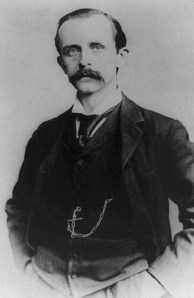

 Tales of the Marvelous