Les Miserables on Tour

Les Mis Musical (2)A few weeks ago, Les Miserables came to town.  I bought my ticket six months ago, because I was definitely not going to risk missing it!  The production was wonderful, and I’ve been meaning ever since to write up some thoughts.  Who knows–it might be coming to your town next!

Come to think of it, maybe this is an appropriate week for this review.  Wrong revolution, but…  🙂

I’ve previously reviewed the book by Victor Hugo (Parts One, Two and Three), the recent movie, and the London stage production.  I’m not actually obsessed with this story, just…fond of it.

In case you don’t know the plot at all, here’s the brief description I wrote for the London review: The plot is complex, but basically we’re following Jean Valjean, a former convict (for stealing a loaf of bread) who broke parole to try to remake his life, but is still being sought by Inspector Javert.  Valjean’s path intersects with Fantine, a woman who’s driven to prostitution in order to provide for her daughter.  Valjean ends up raising Fantine’s daughter, Cosette–whose path in turn intersects with Marius, a student who is in with a group of young revolutionaries, determined to rise up on behalf of the poor and downtrodden of France.

It was fascinating to see the stage production again, after seeing the movie and reading the book.  I felt like I was much more informed about some of the choices that were being made, or the extensive backstory addressed in just a few lines in the play.  It was also funny how vividly the London production came back to me while I was watching.  I was much farther back from the stage this time, so I found my mental pictures filling in the actors’ faces from London.

I was impressed by the staging and the set design, which in some ways felt like the biggest differences from London.  In London, it was largely minimalist and sometimes (as in the beginning with the convicts) settings were suggested more by pantomime than anything else.  It’s the exact opposite of what I’d expect–you’d think a play that’s permanently in one theater could have far more elaborate sets than a touring company!  Instead, this production had more present scenery, including buildings and backdrops and a dramatic landscape for the convicts to be working in.  There was just one staging decision I did not agree with at all…but I’ll get to that later on in the story.

Peter Lockyer as Valjean was…fine.  Which makes me feel like I’m damning with faint praise, but really he was…perfectly good in the role, he just oddly didn’t resonate with me.  He was quite good in “Who Am I?” which is one of my favorites, and otherwise, I find myself without any comments.

Andrew Varela as Javert, on the other hand, was excellent.  I especially loved “Stars.”  They staged it on the bridge over the Seine (from which he eventually jumps…), so I spent the whole time loving the layers of symbolism.  And he just delivered the emotion of the song so beautifully.

Fantine (Genevieve Leclerc) was absolutely wrenching in a completely different way than Anne Hathaway.  In fact, I noticed she sang “I Dreamed a Dream” very loud and dramatic, which I almost suspect was in deliberate contrast.  Very different–equally effective.  Her descent seemed particularly painful, somehow, maybe because it was so rapid–the space of one song, basically.  Something about having it on stage, no scene cuts, as she keeps stumbling on and off and comes back more disheveled and desperate each time…wow.  Heart-breaking.  And her first “customer” was the factory foreman, which was so subtle and so hideous and SO brilliant (and not done in London–I watched for it).  I feel like Fantine’s journey was possibly the most powerfully presented one, in this production (and I wouldn’t say that’s universally true).

Moving on ahead to second-half characters…Marius (Devin Ilaw) and Cosette (Julie Benko) got an interesting portrayal, as I felt like they were played to some extent for comedy.  Cosette had a kind of puppy-like eagerness in spots, and when Marius sang “I’m doing everything all wrong”–he meant it.  Since the Marius/Cosette romance is usually kind of a non-thing for me (in the play; the book is better), I’m all for getting some comedy in with them.

Eponine (Briana Carlson-Goodman) was another who just didn’t resonate.  No idea why–she’s one of my favorite characters, absolutely loved her in London and the movie, but have no real comments this time around.

Les Mis Musical (1)On the plus side, little Gavroche (Gaten Matarazzo) was absolutely splendid.  Cheeky, adorable, and present so often…it really conveyed the idea that he has his eyes on everything that’s going on, and he’s the one who really knows what’s what.  Enjolras (Jason Forbach) was excellent leading the revolutionaries.  Dramatic, impassioned, always ready with the fist-pump or raised rifle when the song needs that final dramatic push.  And I swear, I predicted the actor when I was looking at the program.  I was 0n the page with all the actors’ pictures (see photo) but no roles identified, and Forbach just looked like Enjolras to me.  I think it was the sweep of curly hair.  He’s in the middle, third row down.

I was also hugely impressed by Grantaire (Joseph Spieldenner).  He was only called by name once, so I had to look up character descriptions to make sure I had the right revolutionary!  He’s the cynical one, often drunk, ragging on Marius for his puppy-love and pointing out that they’re probably all going to die.  In a way he’s the sour note in the revolutionary fervor, but I find I have to love him for it.  He’s the voice of practicality–and he still stands with them when it counts.  And, he’s the one who’s close with Gavroche, and there was some really nice pairing of the two of them during crowd scenes.

This, I find, brings me to my one objection to the staging.  The barricade didn’t turn.  Those unfamiliar with the play will have no idea why this is important; those familiar with it, I hope you understand the problem!  (Spoilers here on…)  Incredibly important things happen on both sides of the barricade.  We have to see the revolutionaries behind it (which we did).  But in London, we also got to see Gavroche clamber over it, stealing ammunition from fallen soldiers–and falling himself.  Hearing it is just not the same.

The one redeeming aspect of the non-turning barricade was that, while we’re hearing Gavroche on his mission, we see Grantaire.  His reaction, falling to his knees as Gavroche’s song goes silent, almost sold me on the staging.  So, huge appreciation for Grantaire at that moment.  …but I still think it would have been better to turn the barricade.

No turning means we also lost Enjolras falling across the barricade with his flag.  Enjolras draped over the barricade, Gavroche lying below–that moment in London is so vivid in my mind.  They tried to compensate a bit here by having a moment of Javert looking at Enjolras and Gavroche as a cart carried their bodies away.  It was a moving moment–but just not the same.

All right, so much for that.  After the barricade, heading on towards the end, there was beautiful staging for “Empty Chairs and Empty Tables.”  All the revolutionaries came back to stand around Marius, each one holding a candle, and I can’t tell you how much I love it that Grantaire and Gavroche were walking together.  Love.  That.

And I love that theater is never the same twice.  This was my second experience with the live musical, and it really was different this time around.  Some parts were better in London, other parts I absolutely loved what they did here.  But for all the pros and the cons, if Les Mis comes to your town…go see it!

The Last Unicorn Read-along, Week Two

Last UnicornWe’re back for the second half of The Last Unicorn!  You can read my post about the first half, and check out host Lynn’s thoughts for the second half of the book.

Let’s jump straight in, shall we?

Chapter 8 is a pivotal chapter. Not only does the story bound forward, but we learn more of Schmendrick’s origins. How does this knowledge affect your view of the character? What are your thoughts on the means he uses to save the unicorn from the Red Bull?

I waxed on about this a bit responding on Lynn’s blog, so let me just pick up those thoughts…  I really liked finding out more about Schmendrick’s past.  I think that was when I began to connect to him on a deeper level, where I hadn’t been connecting on the surface. The copy I read describes him on the backflap as a “bumbling magician,” and I have to laugh, because I feel like that doesn’t capture it AT ALL. I think on the surface, I was looking for a comical, bumbling magician, and he’s not that. It was when we got into the depths, when it became clear why he isn’t comedic (mostly), and why the “bumbling” is so much more complex…then I was more able to relate to the character.

Lynn also made some very interesting points about Schmendrick’s use of deception, and how he is willing to present a false personality but not a false identity.  It made me think about the idea of a “false personality.”  Is it a kind of lying or illusion to pretend to, for example, mirth when you’re sad, or confidence when you’re scared?  Or to pretend to be an entirely different kind of person than who you feel you really are?  I feel like there’s a point where the answer is yes, but also a long stretch of gray where the answer is…not exactly.  Ish.  Comparatively, lying about a name, a specific identity, is incredibly straight-forward!

And then of course, the question of identity and illusion comes up again in the unicorn’s transformation…but let me get to that point more later on.

Beagle has chosen to tell the story of how Lír became a hero as a dialogue between Lír and Molly. This isn’t the first time in the book that Beagle has drawn our attention to the way stories interact with one another. What do you think of this choice? How does treating Lír’s growth as a story-within-a-story affect your perception of the tale as a whole?

Making this dialogue, instead of present action, gave a huge amount of distance to that part of the story.  In some ways it minimized it.  Maybe that was to keep the focus on the unicorn.  Maybe it was to keep the fairy tale feel, where great deeds are commonplace and vague.  I think this book would feel completely different if there was a stronger focus on Lir’s adventures–and that last word may be the key.  The book would become an adventure story, instead of the layered fable it is.  Maybe.  Or maybe Beagle would have found some way to tell layered, fable-like adventures!

This method of distancing us from Lir’s heroics also gives us a different perspective on his change.  His transformation is hugely dramatic, yet unlike other characters (Amalthea, really), it seems to be presented not as a loss of identity, but as growth.  I have to wonder, though.  He decides to become a hero, a poet, and/or a secret admirer, and it seems to have less to do with who he is, and more to do with what he thinks will impress Amalthea.  Is it genuine growth, then, or is he also experiencing a loss of identity as he tries to mold himself into what he thinks she wants?  And does it make any difference if he becomes someone (arguably) better in the process?

I don’t have an answer to those questions…

In chapter 11, we see Lír giving up his courtship of the lady Amalthea to become a secret admirer. He’s mulling over what name to use when he runs into Amalthea again. She’s suffering from nightmares about her past and, once more, Beagle highlights the theme of story versus reality and the theme of identity. How do you think he’s shown these themes in the latter half of the book?

Oh…I just talked about that, didn’t I?  Well, taking the angle from Amalthea/the unicorn’s point of view again, I was thinking about this part last week relative to Schmendrick’s comment that the unicorn is the only one who’s real.  That’s a curious statement, considering it’s placed just as she was about to undergo a transformation that caused her to nearly lose her identity.  Maybe.  Back on the subject of reality and illusion, was Amalthea an illusion?  Or was she another truth of the unicorn’s identity?  Different, but also real.

I feel like the answer to that one is that Amalthea was truth, because her existence altered the unicorn’s identity, once she was returned to her original shape.  What she felt for Lir didn’t simply disappear, suggesting it too was real.  And look, that brings us to the next question…

What did you make of the ending? Was it everything you wished it would be? (Will you be back for Two Hearts?) How do you feel about Schmendrick’s ending? Did you think the ending was long enough?

There’s a definite bittersweetness to the ending for the unicorn and for Lir, but while I normally like a happy ending, I don’t see how this one could have been satisfying a different way.  And I liked the ending for Schmendrick and Molly, so I got a happier piece there!  I find it so intriguing that the unicorn started out the most certain of her identity, but then ended up more conflicted.  Schmendrick and Molly seem to be much more comfortable and confident in who they are by the end, and I love that they had that journey.  And I never object when two people get to have a happy ending together. 🙂

And… of course, what did you think of the book as a whole? Did you enjoy it?

I did enjoy the book, but I can honestly say that I enjoyed the discussion even more!  The book was interesting, but it was sitting down and thinking through all these different elements of it that I really enjoyed, and that has made me appreciate the book much more deeply.  So, Lynn, thank you for hosting!

And now that I got my book-thoughts written out, I’m ready to go on to the movie…

What Are You Reading?

itsmondayIt’s been a couple of weeks since my last What Are You Reading post, so it looks like time to check in again…

My last post mentioned the pile of series -books I was planning to read, and which I am happy to say I finished up this week.  Children of the Mind by Orson Scott Card means finishing the Ender Quartet, The Garden Intrigue by Lauren Willig got me up to date on the Pink Carnation series, and after finishing Seer of Sevenwaters by Juliet Marillier, I just have one book left in the Sevenwaters series too.  Progress!

Coming up next, I decided to read a couple of very light books, after all the denser ones I’ve been reading lately (meaning: Tolkien).  I decided to do a reread of a fun time travel book, The Secret of the Ruby Ring by Yvonne MacGrory, and The Ogre Downstairs by Diana Wynne Jones is one I’ve somehow never got around to (despite loving her books!)

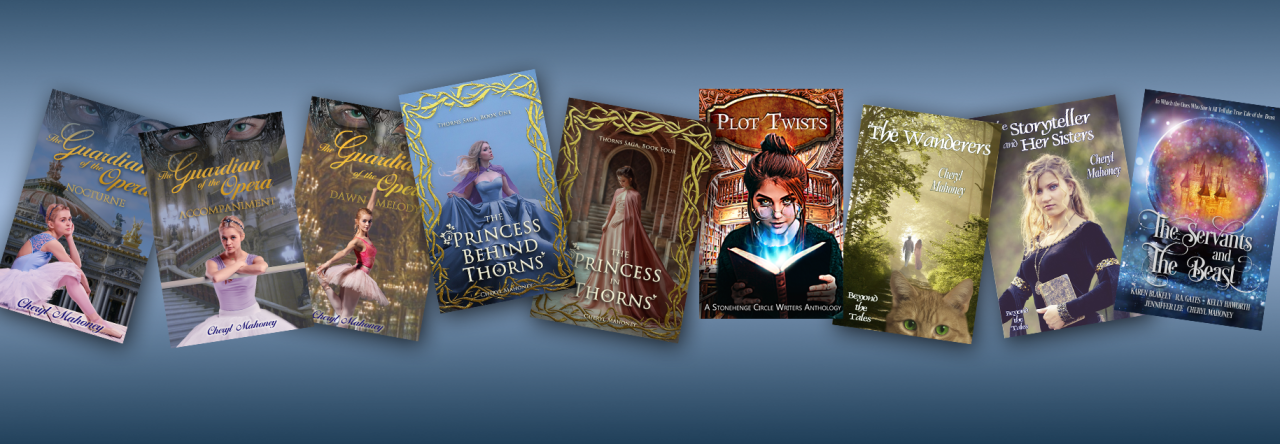
What Are You ReadingNot at all on the lighter side, I also have Eccentricity and the Cultural Imagination in 19th Century Paris by Miranda Gill, and Nights in the Big City: Paris, London, Berlin, 1840-1930 by Joachim Schlor.  Both are research for my next novel, a retelling of The Phantom of the Opera.  Seeing as I’m writing about a masked man who lives under an Opera House in 1880s Paris, it is a source of wonder to me that there’s actually a book about the cultural attitude towards eccentricity, in that city, at that time.  I have no idea yet if it will actually have anything useful, but I’m fascinated by the prospect!

And the last big thick book, somehow strangely on the lighter side, is a book of letters between Winston Churchill and his wife, Clementine.  I started reading it a few years ago and absolutely loved it (who knew Winston Churchill could be cute and romantic and adorable?) but somehow got sidetracked and never finished.  So I’m resolved to pick that up again too.

So much for my plans!  What are you reading this week?

2013 Reading Challenges – Halfway Mark

The end of June marks the midpoint of the year, which of course means it’s time for an update on reading challenges…

All links go to reviews, and if you’re curious about any unreviewed books, just ask!

The Chunkster Challenge

In my efforts to overcome my fear of long books, I’m trying to read some of the intimidating ones I’ve been putting off…

1) Walden by Henry David Thoreau (audio)

2) Les Miserables by Victor Hugo (reviews Part 1, Part 2, and Part 3)

3) The House on Durrow Street by Galen Beckett

4) The Fellowship of the Ring by J. R. R. Tolkien

5) The Master of Heathcrest Hall by Galen Beckett

My goal was one chunkster a month, which went slightly awry when it turned out that The Two Towers and Return of the King are not as long as I always thought!  But since the real goal was to finally read intimidating books, I’m calling that good anyway…

FTSRC

Finishing the Series

I’ve been trying since last year to finish the many series I was midway through, and I’m making some good progress…

1) The Pink Carnation series by Lauren Willig
Total books: 9 (to date)
When I began the series: February, 2011
Read prior to 2013: 7
Read in 2013: The Orchid Affair, The Garden Intrigue
Status: Up to date, until the next one comes out in August

2) Ender’s Game series by Orson Scott Card
Total books: 4
When I began the series: February, 2012
Read prior to 2013: 1
Read in 2013: Speaker for the Dead, Xenocide, Children of the Mind
Status: Complete–kind of!
So this is funny–it’s complicated counting how many books are in the Ender series, because there’s a second, connected series, and a few scattered items that fit in as well.  I’ve decided to reduce my focus (for now at least) to just the original Ender quartet.  I may eventually come back and read the other six or eight related books…

3) The Lunar Chronicles by Marissa Meyer
Total books: 2 (to date)
When I began the series: June, 2012
Read prior to 2013: 1
Read in 2013: Scarlet
Status: Up to date!

4) Sevenwaters by Juliet Marillier
Total books: 6
When I began the series: June, 2010
Read prior to 2013: 3
Read in 2013: Heir to Sevenwaters, Seer of Sevenwaters
Still to read: 1

5) The Mrs. Quent Trilogy by Galen Beckett
Total books: 3
When I began the series: September, 2012
Read prior to 2013: 1
Read in 2013: The House on Durrow Street, The Master of Heathcrest Hall
Status: Complete!

Books to Reread

Revisiting Old Friends

I’ve also been resolving to reread some beloved books, and since many of them are fantasy, I made good progress during Once Upon a Time.  Revisited favorites include:

1) Pat of Silver Bush and Mistress Pat by L. M. Montgomery

2) A Voice from the Border by Pamela Smith Hill

3) Dragonflight by Anne McCaffrey

4) Star Trek: Federation by Judith and Garfield Reeves-Stevens

5) Catherine, Called Birdy by Karen Cushman

6) Princess of the Midnight Ball by Jessica Day George

7) Chalice by Robin McKinley

8) The Two Princesses of Bamarre by Gail Carson Levine

9) The Blue Sword by Robin McKinley

10) The Hero and the Crown by Robin McKinley

11) Heart’s Blood by Juliet Marillier

12) The Princess Bride by William Goldman

13) The Crystal Gryphon by Andre Norton

14) Gryphon in Glory by Andre Norton

The plan this year was to be relatively low-key with the challenges, mostly to open up some space for all those big thick intimidating books.  Which has worked, since, after all, I read Lord of the Rings!  But long books have rather thoroughly occupied my reading focus recently, so I’m planning on an increasingly low-key summer to do a little more random reading…at least in theory.  I’ll have another update at the end of September!

Journeys Through Oz

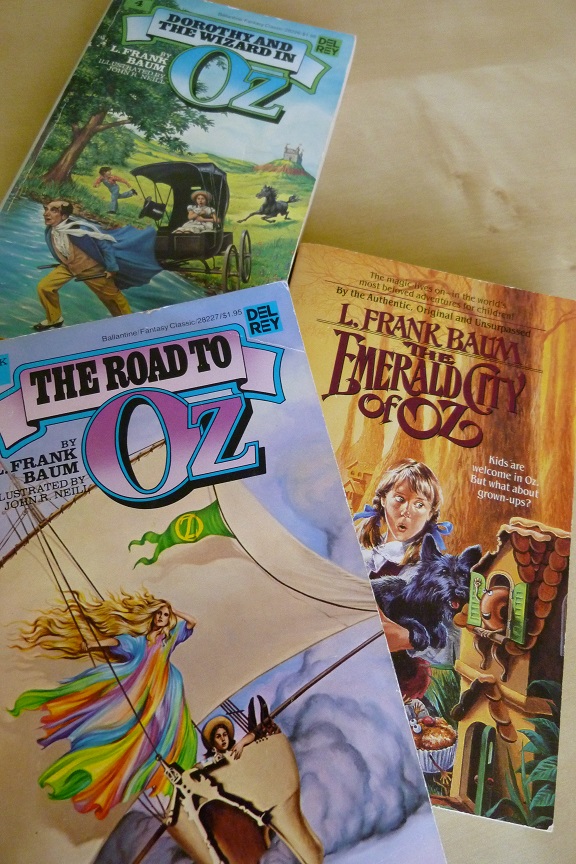
Oz Books 4-6I’ve been pursuing a slow reread of L. Frank Baum’s Oz series, and have found that they can be nicely divided into groups.  Earlier, I reviewed the first three books in the series, or as I like to call them, the Welcome to Oz Trilogy.  Today I’m looking at the next three, what I call the Aimless Journeys Trilogy.

*********

Dorothy and the Wizard in Oz is Book Four.  This one marks the return of the Wizard, who had been absent since he flew away in a balloon in Book One.  The story opens with an earthquake in California, which sends Dorothy plummeting down through a crack in the earth.  She arrives in an underground country, and is soon joined by the Wizard, who came falling down by the same method.  Dorothy, the Wizard and a few friends join together to travel through different countries underground, meeting strange and usually threatening people along the way, hoping to get back to the surface.  Spoiler: They eventually do, by a severe act of deus ex machina.

You probably already see why I’ve titled this trilogy as I have.  While there is loosely a quest to get back to the surface, the characters are basically wandering through magical countries with no particular purpose.  The things they encounter are charming and interesting, and I do love how absolutely anything can be possible, but the book overall suffers from a lack of plot to drive the events forward.

*********

Book Five is The Road to Oz, in which Dorothy and the Shaggy Man set out on a path in Kansas, and find themselves inexplicably on a road through a magical country instead.  Along the way they meet Polychrome, the daughter of the rainbow, and Button Bright, a little boy perpetually getting lost.  As you probably can guess, the rest of the book is devoted to traveling through interesting locales and meeting strange people.  The goal here is even less compelling than in the previous one–they’re hoping to get to Oz for Princess Ozma’s birthday party.

I don’t remember having any trouble with the idea as a kid, but as an adult, it’s hard not to feel that this is THE most meaningless of quests.

The positive side to this book is the characters, as both the Shaggy Man and Polychrome go on to be regulars, and Polychrome in particular is a delight.

*********

The Emerald City of Oz comes next, and is slightly more complicated.  It opens with a beautiful touch of realism and genuine threat.  Aunt Em and Uncle Henry are going to lose their Kansas farm; it was so expensive rebuilding after Dorothy’s tornado carried away the house that they had to get a mortgage and now can’t pay off the debts.  This problem is, of course, swiftly solved by the entire family decamping to Oz.  I do love that in the books, unlike the movie, not only was Oz NOT a dream, eventually Aunt Em and Uncle Henry move there to stay too.

After the family comes to the Emerald City, Ozma decides to send them off on a trip to explore some little-visited parts of Oz, bringing us back to the format of an aimless journey.  Meanwhile, in another narrative strand, the wicked Nome King is plotting to conquer Oz.  Unfortunately, this turns into a series of expeditions to recruit different fierce creatures to join his army.

Like the previous two books, the journey features lots of interesting sights and people (my favorite is a town inhabited by people made of puzzle pieces) but it also loses drive.

This is also not a good book for Ozma.  Again, I never noticed this as a kid–but as an adult, Ozma is troubling.  She has a tendency to direct everyone else’s lives for them (because she always knows best…) and she is good and pure and sweet to the point of insanity.  An army is marching on Oz intending to destroy everything and enslave everyone, and Ozma’s plan is, I quote “I will speak to them pleasantly, and perhaps they won’t be so very bad after all.”  Ahem.

The innocence of Oz is a good bit of its charm, but now and then Baum goes a little too far…

*********

These books have interesting characters and magic, but with the absence of a real plot or any notable character growth, these are not some of the stronger offerings in the series.  I think Baum was genuinely struggling at this point; he didn’t want to keep writing Oz (and he tries to do away with it forever at the end of Book Six) but the public demanded it.

Baum must have made some kind of peace with the situation, because he gets his stride back in the later Oz books.  Journeying through strange locales stays a common feature, but he manages to put it into better plotlines, and comes up with some particular vivid pieces of magic.  I’m still working my way through the series, but I remember some favorites in the later volumes!

I would recommend these three, with reservations.  A young reader might be less bothered by the lack of plot (and engaged by the magic).  More discerning readers (of any age) would probably enjoy any one of these…but I don’t recommend all three in a row!

Other reviews:
Bookmarked Pages (Book 4 and Book 5)
Story Carnivores (Book 4, Book 5 and Book 6)
The Fandom Post (Book 6)
Anyone else?

Buy them here: Dorothy and the Wizard in Oz, The Road to Oz, The Emerald City of Oz