NaNoWriMo Day 19

Tired tonight…

Yesterday was a good day.  We explored the locked room, got into all sorts of character development, and wound up with almost two thousand words written.

Today has involved lots of running about, and for a while there I thought I was only going to get a few hundred words down.  But, I managed some more time and dragged my characters through a couple more scenes (including one scene which probably deserves better and may get it in a revision), to wind up only 96 words behind.  Today, I’m calling that a victory.  Especially because I ended with Lyra starting another story (kind of–I’ve been having her tell backstory like it’s a separate story), and her stories are always good for my word count.  So I’m hopeful for tomorrow.

That’s all I’ve got tonight.  Have a paragraph.

It takes a very special sort of mind to be interested in whether one’s ability to light a candle magically is affected by the waning and waxing of the moon.  Maybe if the candle exploded during the full moon, that would be interesting, but Eleanora never observed any effects so dramatic.

NaNoWriMo Day 17, and a Reconciliation with Thursdays

So I guess I got the hang of Thursday after all.  My expected distraction today didn’t develop, and I got a nice 1,733 words written.  Which would be excellent–but it turned out that it was yesterday I couldn’t get anything done!  Fortunately, I had that big cushion built up, so I finish out today 174 words behind the goal.  That’s a paragraph or two; I can deal with that.

It’s a funny thing about those word-count cushions.  You build what seems like a nice big one, a thousand words or so ahead of the game and the chart looks so pretty with the “written” line up above the “target” line…and then one slow day knocks it all out.  I was out most of yesterday evening, and I swear I was going to be good and write when I got home…but then I had a package.  And I’m compulsive about packages, they have to be opened, and if it’s something fun…well, it was a new picture, so it had to go on the wall, and by that point I figured Lyra and Dastan could wait until today.

Which they very nicely did, and still showed up to get work done tonight.  And anyway–if I ever got too far ahead, I suspect I’d lose all my motivation.  There wouldn’t be any challenge then!

Tonight’s excerpt:

There are many locked doors in our castle.  We’ve slept behind a locked door every night, for as long as I can remember.  Any doors leading outside are locked.  There are all sorts of spare rooms that are kept under a key.

But the most incontrovertibly locked room, the room that was kept the most inviolate, the most untouched and unvisited, was our mother’s.  It had been locked the day she died and, as far as we knew, it had never been opened.

Mother and Father had always had separate bedrooms; it’s common enough among royalty, although I suppose they must have, you know, visited.  There are twelve of us, after all.  But anyway, Mother had a room that was just hers.  Vira remembers it.  I don’t.

I think we get to visit the locked room tomorrow.  I’m looking forward to it.  🙂

Sympathy for the Devil

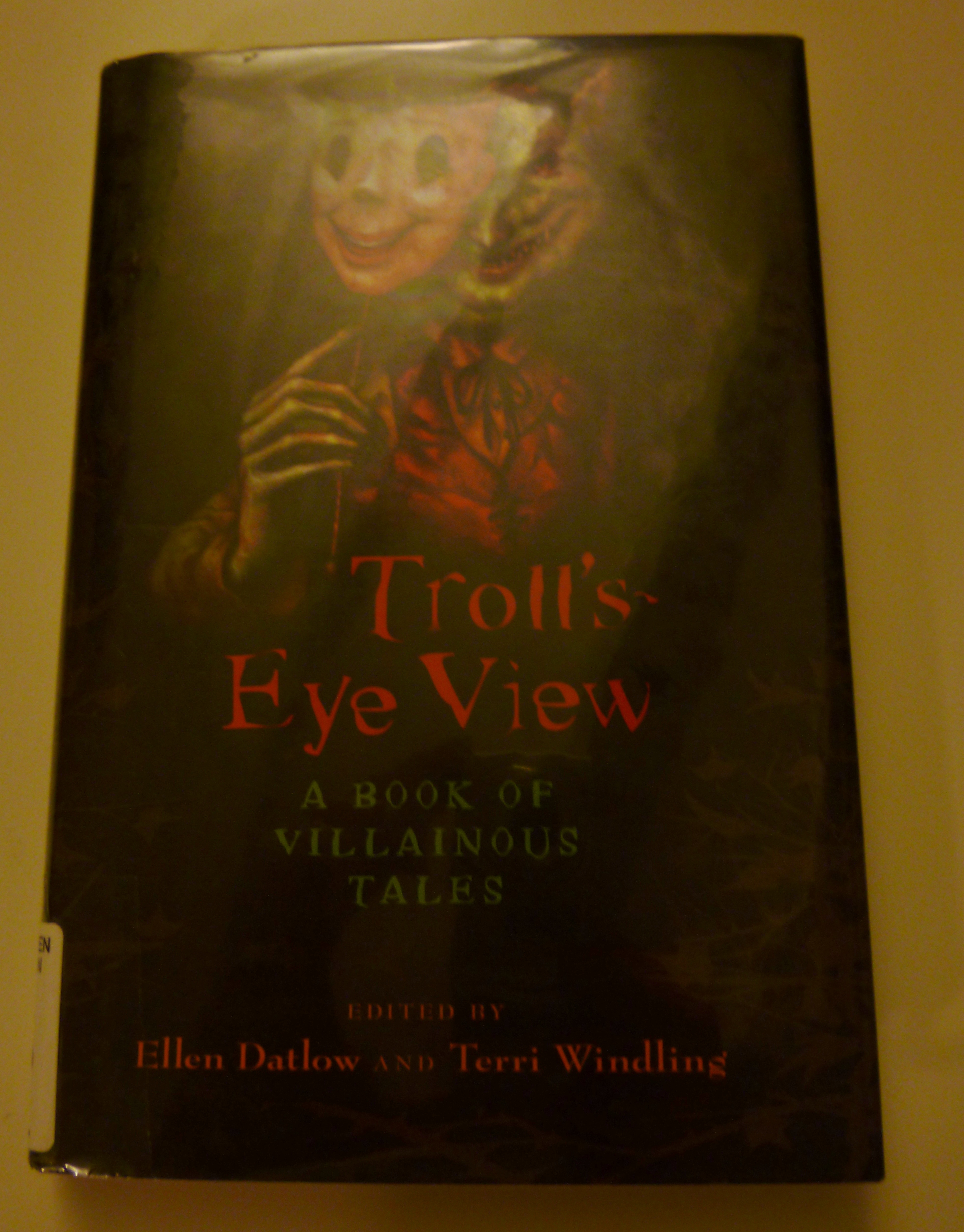
I found Troll’s Eye View in a very writerly fashion–I was doing research to see if anyone had come up with the same angle as I have for retelling “The Twelve Dancing Princesses.”  Subtitled “A Book of Villainous Tales,” it’s a collection of short stories, retelling fairy tales from the villain’s point of view.  That includes “The Twelve Dancing Princesses,” although calling the oldest princess the villain seems like a stretch (granted, she didn’t mind people being beheaded, in the original version).

The book is edited by Ellen Datlow and Terri Windling, and has some impressive writers included, like Garth Nix, Jane Yolen and Neil Gaiman.

There were some excellent stories in here, although I was dissatisfied with a number of them too.  I don’t know if you can tell from the picture, but it’s a slim book, and they fit fifteen stories into it.  I ended up feeling that several were nice ideas that didn’t get much development.  I think I’m the wrong age for those too.  I love children’s books, and very often find ones that are completely enjoyable to me as an adult.  Many of these stories, I think, really are better for just kids, who wouldn’t mind a simpler narrative.

And there were the excellent ones.  “Castle Othello” by Nancy Farmer is really clever meld of Bluebeard and Shakespeare, with a good twist to the ending.  Neil Gaiman contributed a dark poem based on “Sleeping Beauty.”  Nix and Yolen both had some good humor, although I think the shortness of the stories limited their scope.  Ellen Kushner’s “Twelve Dancing Princesses” retelling (actually, “The Shoes that Were Danced to Pieces” was how she titled it) was a clever idea, although another one with limited development–and not the same as my idea, fortunately.

My favorite, by far and away, was “A Delicate Architecture” by Catherynne M. Valente.  This would not have been the case when I was a kid, and in fact I think it probably would have given me nightmares!  But as an adult I can appreciate the creepiness of some of the images, and the beauty of the writing.  It starts out almost as a more poetic Charlie and the Chocolate Factory, with a little girl describing the wonderful creations of her father the candy-maker.  There’s beautiful, vivid imagery…until the story takes a darker turn, and then the images are just as vivid, but turn into nightmares.  (Spoiler warning, because I can’t resist telling you about it!)  The little girl becomes a young woman, until finally she learns that her father’s fanciful tale of creating her from sugar is all too true.  After that she’s treated not as a person, but as a cooking implement, and hung up on the wall of the kitchen at the royal palace, to be used for the desserts…and that’s the image that would have given me nightmares as a child!  Finally she becomes a gnarled old woman, who escapes into the woods to build a house out of candy…  It’s an excellent story, and makes me want to read more by Valente!

The book on the whole was more mixed.  But it was also a quick read, and worth it for the good ones!

NaNoWriMo Day 15–Huzzah for the Midway Point!

It’s mid-month–I can’t tell at all if I’m mid-novel–but I am mid-wordcount!  In fact, I passed 25,000 pretty early this evening, and am now almost 1,500 words ahead on the word goal.  I had a very strong Friday and Saturday, and have managed a bit extra the last two days too.

All of which adds up to a very good thing, because I may be having another “can’t write anything” Thursday.  I haven’t had a good writing Thursday yet this month, and I’m not hopeful for next week either (being Thanksgiving, you know).  It’s just something about the day.

Now I have to quote Douglas Adams: “It must be Thursday.  I could never get the hang of Thursdays.”

So I’m happy about my word count for now.  Although it made me even happier yesterday when I hit on a relationship quirk for my characters.  There must be an official name for the concept…but it’s some back and forth that two characters keep doing throughout the book, and that probably will be used to reveal their connection.  In Red’s Girl, Red always denies needing help whenever Tam helps him, but then thanks her; by the end, she says “you’re welcome” before he gets to the thank you part.  In The People the Fairies Forget, Anthony is forever shortening Catherine’s name to Cat over her objections, until finally an emotionally pivotal moment causes her to admit she likes it–which he always knew.  Relationship quirks.

And then yesterday Dastan suggested that he and Lyra do a daily trade of ways they’re different from their multitudes of siblings.  Not sure of every way I’m going to use this, but I think it’s going to help.

I did have a nice writing point here…oh yes, that the word count is good but having a sudden character or plot breakthrough is actually more satisfying than sheer number of words.  Which is intriguing though not really surprising.

I also think I’m slightly more incoherent tonight than usual.  Lyra wanted to tell a story, so I did a lot of flowery, Brothers Grimm-style writing, and I think now I’m having a reaction, manifesting itself as random chatter.

Don’t mind me.  Too much typing.  Let me find you an excerpt and then I’m off for the night…

I know, you can have the beginning of Lyra’s story, which will probably make it on here in its entirety for some Fiction Friday.  For now, an excerpt:

Once upon a time, there was a shopkeeper’s daughter who was very beautiful.  It was a sad fact that because she was beautiful, people’s automatic inclination was to do things for her.  That might not have been so bad in itself, but she had realized this tendency early on and loved to take advantage of it.

When her mother asked her to clean the house or to help with the laundry, she’d make endless excuses to get out of it, preferring to spend the time combing her hair or trying on different dresses.  When her mother did insist on her working, she was so slow about it that the good woman would eventually give up in exasperation and do the job herself.

When her father asked her to mind the shop, she would avoid helping customers if at all possible, and when she couldn’t avoid it she was as slow as you could imagine.  She asked the customers to pack up their own purchases and couldn’t be bothered even to do the counting to hand out change.  You may expect that service was slow and the customers ended up waiting around, whenever she was minding the shop.  The men, however, so enjoyed looking at her that they didn’t often complain.  Still, her father knew that he was losing business because not everyone was willing to wait—and he wasn’t winning customers to his shop from the women in town.

One day the prince of that country passed through the town and his party stopped at the shop to buy fresh supplies for their journey.  It happened to be a day when the girl was (in theory) helping in the shop.  The prince saw her, and was sure that he had never seen anyone so beautiful, which may have been true.  He had been reading too many stories, and become convinced that such a beautiful face could only indicate a kind nature, a worthy spirit, and a personality that would match his own—in other words, that her beauty proved she was his soul mate, which it didn’t at all.
How Do You Feel?

In  one of my literature classes in high school, we read a narrative about the Great Plague of London.  I’ve completely forgotten what the book or story was.  But I remember there was a scene where the narrator decided he wanted to go see the mass graves of the plague victims, and he was determined to see them at the time when the workers were actually throwing the bodies in (gruesome, I know).  I vividly remember the class discussion, when the teacher asked why the character felt the need to visit the graves at that most horrible time.

I must have had my writer’s brain on, because it seemed abundantly obvious to me that the character wanted to go at that time because it let the writer describe a more compelling scene.

That may only be one jump back from the teacher’s question, which I think is, why is it compelling in its horribleness?  But I think there really is something else at work here.  For me, the interesting question is not why someone would go look at bodies being tossed into a grave (because frankly, I find it unlikely many people would).  The question is, why did the writer want to write about that?

It prompts emotions.  Sometimes I think that is the core of what we are doing when we seek out stories (novels, movies, any kind of story).  We want to feel something.  And it’s easiest to make someone feel something horrible.  Fear and horror are relatively easy emotions to invoke.  I think that’s why we see so much sensationalism on the news–the news companies have realized that it’s easier to create deeper emotions by talking about kidnappings and murders than by covering positive news.

I often think about this in my own writing.  Some of my most helpful responses from people have been about what they feel when they read a story I wrote–are they worried about a character?  Are they angry with the villain?  Does a scene make them laugh or make them sad?  In a way, “it’s good” or “it’s bad” is so subjective.  But if someone says, “I was so angry with that character, how could he do that?” and that’s what I was aiming for–then I feel more sure that I’m conveying what I wanted to convey.

We don’t normally seek tragedies in real life.  Real life has enough feelings, and most people don’t need to go watch bodies be tossed into a pit in our effort to feel something.  But in fiction, we get to harmlessly try on other emotions and other experiences–and then we do seek out the tragedies, the dramatic love affairs, the hilarious comedies, because they all make us feel.  They help us engage with the story–they draw us into the other life we’re reading about.