Dark and Grim, Indeed

Tale Dark and GrimmI think my reasons for reading A Tale Dark and Grimm by Adam Gidwitz should be fairly self-evident in the title…Brothers Grimm-inspired, and dark and spooky for Readers Imbibing Peril!

The premise is very clever, promising to tell the true story of Hansel and Gretel, and then setting off through several Grimm fairy tales.  When Hansel and Gretel’s father learns that his faithful servant, previously turned to stone in his service, can be restored if he chops his children’s heads off…he goes ahead and does it.  Hansel and Gretel are restored to life, but (quite understandably) decide it’s time to run away from home.  They encounter the wicked witch with her candy house, but also go on adventures through other fairy tales, struggling against dangerous magic and frightening or fantastically irresponsible adults.

With the exception of the original Hansel and Gretel story, these are not the best-known Grimm fairy tales, like Sleeping Beauty or Cinderella.  I recognized most of the stories, but I’ve read a good bit of the original Grimms…and considering my audience here, you might recognize them too!

There’s definitely constant excitement in this novel, with a new twist and villain at every turn.  It actually didn’t feel as episodic as you might expect, though.  With the constant thread of Hansel and Gretel as the main characters, the different tales wove together surprisingly well.  There’s also an amusing narrator who occasionally stops the action to make remarks to the reader about the story.  I might have liked a little more subtlety in weaving the narrator into the story…but that’s a choice, and once I got used to the narrator, the device worked well.

For all that’s good here, I do have one BIG reservation–I really don’t know who the target audience is meant to be.  The style of the writing is clearly juvenile.  There’s a simplicity to the language, Hansel and Gretel seem to be about 10 or 12, and there’s just a very strong juvenile feel to the book.  However–there is a LOT of blood.

I feel a little strange pointing that out, because the narrator points it out too, in a very sarcastic, tongue in cheek kind of way.  Early on, he keeps advising that little kids should be kept out of the room because they’ll be disturbed by upcoming sections.  Those remarks read like jokes…but they’re true!  The blood and the violence are told in the matter-of-fact style of the original Brothers Grimm, and there’s probably nothing here that wasn’t there…which still leaves you with blood, beheadings, dismemberment, two (unrelated) severed fingers, and all in all quite a bit of nastiness.

As far as I can tell from Gidwitz’s website, the blood is supposed to be a large part of the appeal.  All the same, I haven’t the slightest doubt that if I had read this when I was actually the target age suggested by the writing style, I would have been thoroughly disturbed.  There’s a bit in here about skinning a monster that I find slightly disturbing now.  Conclusion: although I liked aspects of this, apparently I’m not the target reader.

So…I guess the natural reader is either a kid who doesn’t mind gore (and I’m sure there are ones less squeamish than I was), or an adult who doesn’t mind a simplistic writing style.  If you pick it up, there’s plenty that’s well-done, but be warned that this really is inspired by the Brothers Grimm, not Walt Disney!

Author’s Site: http://www.adamgidwitz.com/

Other reviews:
Here There Be Books
Rex Robot Reviews
The Mountains of Instead
Anyone else?

Buy it here: A Tale Dark and Grimm

Revisiting Fairyland with September

So…we all know that I madly, madly love Catherynne Valente’s Fairyland series, right?  I mean, there was quite a bit of conversation on that subject in the comments section of my RIP launch post.  As per plan, I reread Fairyland 1 and Fairyland 2, for Readers Imbibing Peril and as preparation for the soon-to-be-released Fairyland 3…and it won’t surprise you at all that I madly, madly loved them!!

Girl Who Circumnavigated FairylandBook One, The Girl Who Circumnavigated Fairyland in a Ship of Her Own Making, was my favorite book last year–and I read 182 books in 2012. The only serious competition was from Book Two, The Girl Who Fell Beneath Fairyland and Led the Revels There.  Both books follow the adventures of September, an ordinary girl from Omaha who is swept away to Fairyland.  She encounters wonderful and whimsical magic and makes dear friends–but this is not Baum’s terror-and-tension-free Land of Oz, and September needs courage and heart to survive very real dangers, and solve very real problems.

I already reviewed both books (here and here) the last time I read them, so I’ll try not to repeat myself too much…and I’ll try not to just gush all over the place!

It’s very possible I loved these books more the second time through–which is really pretty amazing, considering.  But I feel like I know the characters even better now, picked up on some little nuances that probably went past me before, and loved the seeds planted in Fairyland 1 to suggest Fairyland 2 and (I think!) the ones in both books suggesting Fairyland 3.

Normally I refer to a book as a “fast read” as a good thing, and a slow book as a negative…but these were slow books in a GOOD way.  Especially in the first one, I found myself stopping practically every page to think “oh, that’s a clever line,” or “what an interesting insight,” or “that’s so TRUE.”  And there are few things I love more than seeing a book express something that I KNOW and FEEL but have never seen explained in quite that way before.

I just opened Fairyland 1 at random (to pages 114 and 115, if you’re curious) and found six different bits I love.  Really.  Lines that are clever or whimsical or touching or insightful or particularly well-phrased.

Fairyland 1 is particularly full of splendid little nuggets of thought or phrase, but Fairyland 2 brings a little more maturity, a little more wisdom.  Nothing too mature, of course!  But September begins to grow up, just a little, and the book reflects that.  It’s a beautifully drawn portrait of a girl beginning to grow towards adulthood–this is not Neverland, where no one ever ages, and even a girl fighting monsters in Fairyland can be prey to the same worries of growing up of everyone else.  She has fears about friends changing and feels often like the only person who doesn’t know her proper path.

Girl Who FellMaybe I love September because she seems to act the way people really would if they were whisked away to Fairyland.  Much as I love the classics, I want to shake Wendy for spending her time in Neverland darning socks, and I just don’t know what to do with Dorothy who wants only to go back to gray Kansas–or the Dorothy of later books who is never the least bit worried or concerned by anything.  September thinks about home, just enough, but she wants to revel in the magic of Fairyland–and when it goes bad, when there are challenges to be faced, she does it with a real understanding of the hazards and the fierce determination necessary to go forward anyway.

The book is very self-aware of its source material in a delightful way.  Little bits of classic novels are given nods here and there, in September’s magic shoes or her visit to a rather mad tea house.  And then there’s a piece where September visits a Questing Physickist, who begins discussing Object Quests, the Laws of Heroics, the Conservation of Princesses Law and E. K. T. (Everyone Knows That) Fields.  It’s brilliant.

Another aspect of the book that I love is the way everyone and everything is a meaningful character–I say “everything” because it applies even to September’s clothing!  Everyone has complexity and history, and seems to be carrying out their own lives that September just happens to be passing through.  I love that depth of characters and of the world.  And even the villains have their secret tragedies, and believe on some level that they are, in fact, the heroes.

I could gush and ramble on some more, about how much I love September’s fierceness and Saturday’s shyness and A-Through-L…well, his whole concept is brilliant, and about the wonderfulness of getting the shadows of characters in the second book to bring a whole different layer to them, or how creepy the Autumn Lands are and how heartbreakingly sad I find Mallow’s story, and how intrigued I am by little hints here and there that I hope will be explored in later books…but perhaps this review is long enough? 🙂

Suffice to say…I love this series.  I really, really, REALLY love this series.  I have the publishing date (October 1) for Fairyland 3 in my calendar, and I cannot WAIT to read The Girl Who Soared Over Fairyland and Cut the Moon in Two.

Author’s Site: http://www.catherynnemvalente.com/

Buy them here:
The Girl Who Circumnavigated Fairyland in a Ship of Her Own Making
The Girl Who Fell Beneath Fairyland and Led the Revels There
The Girl Who Soared Over Fairyland and Cut the Moon in Two

Thieving Through a Mythical Landscape

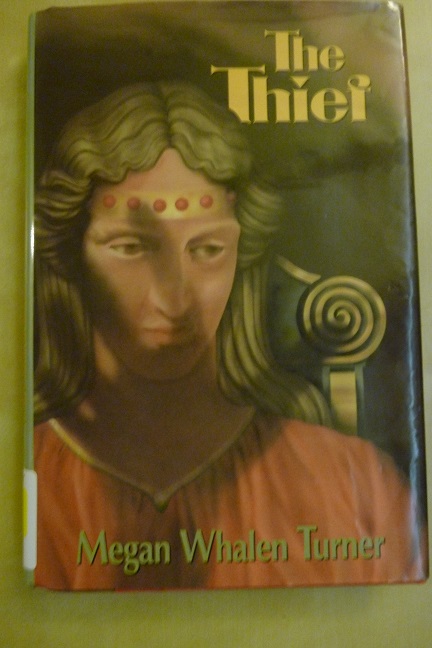
ThiefI’ve read The Thief by Megan Whalen Turner at least four or five times–and I feel like I see something new every time.

The story is about Eugenides (Gen for short), who claims to be the greatest thief in the world.  It appears there is only one thing he can’t steal–himself, out of the king’s prison.  He finds his opportunity, though, when the king’s advisor, the Magus, selects Gen for a mysterious quest, with something to steal at the end.  Joined by the Magus’ two apprentices and a body guard, the party travels through three countries and a landscape rich in mythology.

Gen is a splendid protagonist, apparently a crude thief but with undertones of thoughtfulness and depth.  He also has considerable pride in his art and a healthy belief in himself.  He’s in some ways an unlikely hero–small, apt to laze and complain, and with few indications of the nobility and honor you might expect from a fantasy hero.  But as I said…there’s depth!

I don’t want to give too much away here–but Gen is also an absolutely brilliant unreliable narrator.  He doesn’t lie so much as he omits…and sometimes he tells very revealing truths, but in such a way that the reader will most likely misread them and not learn anything after all.  It’s so well-done that I’m not too worried about spoiling it, because I doubt even someone watching for it will be able to spot what’s really being said!

The Magus also develops increased depth as a character, as he and Gen come to a wary–but by no means certain–respect for one another.  I have less to say about the rest of the traveling party, but suffice to say we get them to know them all as well, and there’s generally unexpected depth going on all around…

Apart from Gen and the secret twists of the book, the best aspect is the setting–something I rarely say about a novel!  The three countries of Sounis, Eddis and Attolia are clear and distinct.  The book manages to paint the economic and trade situation for the three countries, and situate it in the picture of the larger world…none of which are things I would expect to find interesting, yet here are plot-important and easy to understand.

There’s also the mythological landscape, which adds an extra layer.  Gen and the Magis tell a few mythological stories along the journey–and eventually the gods come to have a very active role in the current story as well.  The mythology is loosely based on Greek, but not in a one-to-one kind of way.  For one thing, the head of the pantheon of gods is female!  Despite the all-male traveling party we’re with most of the book, there are some strong women in here too, goddesses and humans.

The Thief is actually the first book in a larger series…which is something I try to forget.  I know there are people who love the rest of the series just as fiercely, but I simply don’t.  I really, really tried–I read the second book TWICE.  Unfortunately, I just can’t wrap my head around some of what happens to the characters later on–and especially some choices Gen makes.  So far, I haven’t been able to bring myself to read the following books.

However–I love the first book.  Read it.  Then go get some other opinions and decide whether to read the rest.

Author’s Site: http://meganwhalenturner.org/

Other reviews:
The Flyleaf Review
Christina Reads YA
Caught Between the Pages
Anyone else?

Buy it here: The Thief

Magic in the Tanglewood Forest

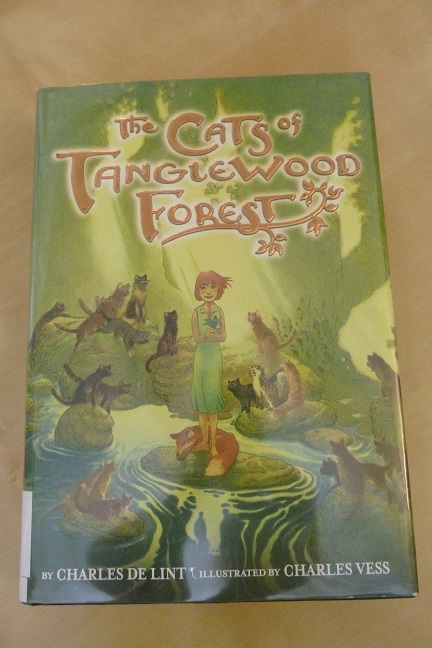
Cats of Tanglewood ForestTalking cats and Charles de Lint–now how could I resist The Cats of Tanglewood Forest?  This made the rounds of the blogs I follow when it first came out, and I’ve finally jumped in to read it too.

De Lint gives us a folk lore-like story about Lillian, a girl who loves all the creatures in Tanglewood Forest–the real ones, and the ones who may be only stories.  When Lillian is bit by a deadly snake, the cats of the forest turn her into a kitten to save her life.  Lillian is offered what seems to be an easy and complete solution to her problem…but as Rumpelstiltskin would have warned her, magic always has a price, dearie.  When that price turns out to be higher than she ever imagined, Lillian must find a way to change things–even if it means she’ll go back to being a cat.

I finished this book several days ago…and I’m still not entirely sure how I feel about it.  On the one hand, I was a little disappointed to not see de Lint’s usual edge.  It was a different style than I expect from him–but it is a book for a younger audience, and the folk lore style that is here is very well done.  So that’s not really a complaint, though perhaps a warning for de Lint fans who may also have different expectations.

The plot is a little more of a problem.  Everything progresses in a reasonable fashion, but once I got to the end, I felt like the entire midsection–the bulk of the book–was really just a divergence.  That’s especially a shame because that section ends with Lillian deciding to make (what seems to me) a significant sacrifice for a loved one–and I don’t feel like de Lint gave that the emotional power it should have had.  If the midsection had been about Lillian’s growth to be able to make this huge sacrifice, great!  But it didn’t quite read that way for me.

All right, so much for cons.  On the pro side, the book moves along in a quick, easy read (so even a divergence doesn’t take long) that stays engaging.  There are a number of intriguing, folk lore characters that are fascinating to read about, from the comical Fox to the horrid Bear People to the mysterious Apple Tree Man and even more mysterious Father of Cats.  And all cats are pretty mysterious, of course!

Lillian is a likable heroine and I love her love of nature.  She’d fit in beautifully with L. M. Montgomery’s heroines, who love their wild surroundings and leave out milk for cats or for fairies.  Lillian is a little rougher around the edges, a little more hands-on than Montgomery’s heroines, but that probably improves her for a modern reader (with all due respect to Anne, Emily and the rest).

The best part of the book, though?  It’s illustrated, with gorgeous illustrations by Charles Vess.  Every chapter opens with an animal twined around the first letter, and every few pages there’s a full or half-page illustration breaking up the text.  The pictures are lovely soft water colors that give so much warmth and heart to the story.

So consider yourself warned that this is folklore, not urban fantasy, and the plot makes some strange choices…but it’s a good read anyway, and a visually beautiful book.

Other reviews:
A Reader of Fictions
Fantasy Literature
A Book Obsession
Sturdy for Common Things
The Green Man Reviews
Anyone else?

Buy it here: The Cats of Tanglewood Forest

A Trilogy of Non-Oz Oz Books

I’ve been doing a slow reread of the Oz series by L. Frank Baum, and blogging on subsets of books as I go.  If you missed them, you can read my reviews of Books 1-3 (The Welcome to Oz Trilogy) and Books 4-6 (The Aimless Journeys Trilogy).  Today, I’m skipping past Book 7 until a later grouping, and looking at Books 8-10–as I like to call them, The Non-Oz Oz Trilogy.

It’s known history that Baum didn’t really want to keep writing Oz books.  He wanted to write other magical adventures, but the public (and I assume his publisher) kept insisting they wanted Oz.  I blame this lack of interest on Baum’s part for the so-so quality of The Aimless Journeys Trilogy.  Fortunately (in my opinion) he found a different solution later in the series, by writing Oz books…that aren’t really Oz books.

**************

Oz 8Book 8, Tik-Tok of Oz, begins in a backwater corner of Oz with Queen Anne of Oogaboo, who decides to gather all the men in her kingdom (eighteen) and go conquer the world.  Meanwhile, Betsy Bobbin and Hank the mule are victims of a shipwreck, which lands them in the magical Rose Kingdom.  Betsy eventually meets the Shaggy Man, who is on a quest to find his lost brother.  They’re joined by Tik-Tok and Polychrome, and eventually the group meets up with Queen Anne and her party, and the whole lot of them go to confront the wicked Nome King, who is holding Shaggy’s brother captive.

The plot is made to sound more complicated than it is by the wide ensemble of characters, but apart from the difficulties of getting everyone together, it’s basically a quest story that quickly becomes an extended confrontation with the Nome King–and features a side-journey through the center of the Earth to a land of Fairies.  Random though it may be at times, I love that there is a goal, and a valid one.  Rescuing a long-lost brother is a much better focus than journeying to Ozma’s birthday party (Book 5).  The confrontation with the Nome King also presents a real villain, and one who interacts with the characters throughout the book instead of merely appearing at the end, as happens in other volumes.

I quite enjoy this installment–there are some lovely images and magic, especially in the Land of Fairies, and the Nome King is an effective villain (more so here than at other times).  Betsy is a perfectly acceptable “sweet girl heroine” (a character-type Baum used often) and I always enjoy Polychrome.

But is this an Oz book?  Well…after the first chapter, we don’t get back to Oz until the last two chapters.  Tik-Tok and the Shaggy Man are the only familiar characters who are from Oz (Polychrome isn’t).  Really it’s more of a Nome King story…with some Oz accents.

**************

Oz 9Book 9, The Scarecrow of Oz, is really a Trot-and-Cap’n-Bill story.  Baum wrote two previous books about little girl Trot and her sailor friend Cap’n Bill, and then decided to send them to Oz.  The two are sucked down into a whirlpool while out sailing, and find themselves trapped in a cavern.  A series of adventures gets them out of the cavern and leads them to join up with the flying Ork (one of Baum’s stranger creatures) and old friend Button Bright.

They eventually reach Oz–but land in Jinxland, which is cut off by mountains from the rest of Oz.  There they get involved with local politics, fighting King Krewl and an evil witch who stole the throne from…well, either Princess Gloria or gardener Pon, depending how you look at it.  Ozma sends the Scarecrow along to help, and to lend his name to the title.

This is one of my favorite books in the series.  I like Trot and Cap’n Bill quite a bit.  Their friendship is sweet and Cap’n Bill, with his wooden leg and past sailing life, has a little more depth than you see in most Baum characters.  They also tend to have adventures that feel genuinely hazardous.  Not too hazardous–Baum is always light and whimsical–but when they’re trapped in the cavern and low on fresh water, it feels like real danger, unlike when Dorothy fell through the earth in an earthquake (Book 4).

This book also has the benefit of one of the very few romances in Oz, between Pon and Gloria.  It’s not one of the great romances of literature…but hey, it’s there!

But like Tik-Tok of Oz, this isn’t really an Oz book.  Technically Jinxland is in Oz, but for all intents and purposes it might as well not be, meaning we don’t properly get to Oz until the last few chapters.  Really it’s a Trot-and-Cap’n-Bill book, with the Scarecrow in a guest appearance.

**************

Oz 10Of all the non-Oz Oz books, Rinkitink in Oz is the most strikingly non-Oz.  The story is about Prince Inga, whose tiny island country was conquered and his parents and people taken away to be slaves.  Fortunately, Inga possesses three magic pearls–one that gives great strength, another that grants invulnerability, and a third that speaks wisdom.  With his friend King Rinkitink, Inga sets off to rescue his people, running into a series of dangers along the way, and is eventually forced to confront the Nome King to rescue his parents.

Where, you ask, does Oz come into this?  Well, Baum originally wrote this as a non-Oz book, with no connection at all.  Then he changed it–and this is the one time I think the public’s preference for Oz harmed one of the books.  At the very end of the story, Dorothy shows up in a complete deus ex machina to scold the Nome King and solve all the problems.

I wish I knew what the original ending was, because the existing one is disappointing.  Inga was an effective and likable hero throughout the book, who deserved a heroic end to his story.  Instead Dorothy arrives…and all the tension leaves.  She’s blissfully confident she can handle the Nome King, she brings the Wizard along as back-up, and Ozma is keeping an eye out just in case.  This may point to one problem Baum was having writing Oz stories–he had made his characters too powerful to sustain plots.

Ending aside, Rinkitink is actually one of my favorite “Oz” books.  Prince Inga, his island kingdom, and his magic pearls are as delightful as anything going on in Oz–and like Tik-Tok, the book is driven by a real goal, Inga’s desire to rescue his family.

**************

Personally, I don’t mind at all if Baum wanted to give us non-Oz stories and stick Oz in the title.  I know some readers object that these books aren’t really about Oz characters (mostly) but I find the characters who are here to be just as engaging–and I can’t say I strongly miss the ones who aren’t present.

I’ve read Baum’s books that really aren’t part of the Oz series, and they tend to be very much the same–whimsical fantasies with strange creatures and kingdoms, and sweet boys or girls making their way through them.  That’s the case for the truly Oz books, and for these three too.  If you’re open to new landscapes and new characters, I find these three to be strong contributors to the series.

Other reviews:

Story Carnivores (Tik-Tok and Scarecrow)

Cavalcade of Awesome (Tik-Tok, Scarecrow and Rinkitink

Tor.com (Tik-Tok, Scarecrow and Rinkitink)

Anyone else?

Buy them here: Tik-Tok of Oz, The Scarecrow of Oz, Rinkitink in Oz