The Last Unicorn Read-Along, Movie Edition

Rounding out The Last Unicorn discussion, today I’m looking at the movie version.  Barring the possibility that I saw it as a kid and remember nothing (unlikely) this was my first experience with the movie, and either way, it was all new!  It was interesting to watch so soon after reading the book, and I really enjoyed the movie overall.  It was fun to compare, and it’s a good movie in its own right…though rather like the book, it’s much more deep and complex than I might have expected (if I hadn’t read the book, that is).

I’m not going to use all of Lynn’s questions this time, because she gets into some details I must admit I didn’t notice.  There are some stories I can discuss that kind of minute detail about (try me on the choreography in Webber’s Phantom) but I don’t know this one well enough!  Here goes some thoughts, though…

The movie is very faithful to the book in a lot of ways, but one of the most noticeable changes to me has always been that it moves the unicorn’s encounter with the butterfly forward. What do you think this does for the narrative? Does it work better or worse for you?

Mixed thoughts here.  I do like that the butterfly gives the unicorn added impetus to leave her forest, and that certainly focuses the plot more by bringing the Red Bull in as an element earlier on.  On the other hand, somehow I like it in the book that she meets the butterfly already out in the world.  Since he’s representative of outside knowledge, I’m not sure I like it that he turns up in the unicorn’s forest in the movie.

On another point, I can’t decide if I like the butterfly’s changing hats.  It’s clever, and it’s a visual for his frantically spinning dialogue, but it also has a kind of Genie-from-Aladdin feel, and seems almost a little too silly for this movie, especially early on when the tone was still being set.

One of the biggest differences between the novel and the movie is that the movie cuts out the storyline of Hagsgate almost entirely. What do you think it does for the plot? Do you think it’s something that the adaptation should have kept or does it work without Hagsgate’s tale?

I quite missed Hagsgate, actually.  That was easily the biggest thing that felt missing to me.  I think the prophecy, especially around Lir, added a really big additional layer of legend, and tied this so much more into traditional tales.  I feel like losing the prophecy means losing two or three layers of meaning!  Additionally, Haggard’s throw-away movie line about picking up Lir as an orphan feels like a total “say what now?” thing with no further context, while the context of the book means it’s just one part of something hugely layered and important.

I also like Hagsgate just to know that there are people in this country.  Of course there are the outlaws and the traveling circus, but those are wanderers on the fringes of society.  Hagsgate (however twisted it may be) is the only actual representative of society, which the others are on the fringes of.  I get stuck on this in Lord of the Rings and Neil Gaiman’s Neverwhere too, trying to figure out where normal people in the magical world live their normal lives…because not everyone can be engaged on magical quests.

The movie has a tendency to condense the passing of time into a song sequence. Do you feel that the songs enhance the storyline or that they don’t fit the narrative?

I didn’t notice the time-condensing aspect of the songs all that much (maybe because songs for travel periods feels normal in movies) but I did really like the songs.  In a way they’re a good example of what makes this story different than might be expected.  I feel like if someone told me there was a movie about a unicorn, with songs, I would have a very clear picture of what those songs would be like–but rather like Schmendrick the “bumbling magician,” the songs aren’t at all what I would have been imagining.  They’re much more reflective, and really fit the style of the story.

The opening song especially was so beautiful, and so effective at showing the unicorn’s earlier life–and it was familiar.  I’m reasonably sure I never saw this movie before (see first paragraph) but I knew the song and I have no idea why or where I might have heard it.  Memory is funny, isn’t it?

What were your favourite moments of the movie? Did the movie leave out any of your favourite bits of the story?

Strangely enough, I most liked and least liked the visual of the movie.  Let me try to unpack that…  The book is in many ways very cerebral.  There’s so much going on and much of it is on (here’s that word again) layers that are below the surface of what we’re actually seeing.  Some things can be conveyed through the visual of the movie, or through character dialogue, but some subtleties and nuances have to be in thoughts, or even in the style of the writing–there’s no way to completely carry that over.  However, at the same time, all those layers in the book sometimes makes it hard to actually see the visual level, because the description (while beautiful) is also hard to pick apart from the abstract.

So I really liked some of the visual of the movie–the best was the image of the unicorns among the waves, because I could never quite see that in the book.  I also liked the movie’s twist of showing things differently to demonstrate what different people were seeing.  Most of the uses of that trick in the carnival were really effective–except for the unicorn’s double horn, which just bothered me somehow.  But I liked the depiction of the Red Bull, and Haggard’s castle.

On the other hand, visually seeing the unicorn, a goofy-looking magician and a handsome prince made that surface-level story feel stronger in the movie.  Which is good and bad, because I had trouble relating to the surface-story in the book, but on the other hand, relating to it in the movie may be at the expense of deeper layers.

So…yes.  The visuals were my favorite part, and least favorite part.  And I feel like that’s an appropriate comment to make about a story that discusses truths, contradictions and, of course, many different layers…

The Last Unicorn Read-along, Week Two

Last UnicornWe’re back for the second half of The Last Unicorn!  You can read my post about the first half, and check out host Lynn’s thoughts for the second half of the book.

Let’s jump straight in, shall we?

Chapter 8 is a pivotal chapter. Not only does the story bound forward, but we learn more of Schmendrick’s origins. How does this knowledge affect your view of the character? What are your thoughts on the means he uses to save the unicorn from the Red Bull?

I waxed on about this a bit responding on Lynn’s blog, so let me just pick up those thoughts…  I really liked finding out more about Schmendrick’s past.  I think that was when I began to connect to him on a deeper level, where I hadn’t been connecting on the surface. The copy I read describes him on the backflap as a “bumbling magician,” and I have to laugh, because I feel like that doesn’t capture it AT ALL. I think on the surface, I was looking for a comical, bumbling magician, and he’s not that. It was when we got into the depths, when it became clear why he isn’t comedic (mostly), and why the “bumbling” is so much more complex…then I was more able to relate to the character.

Lynn also made some very interesting points about Schmendrick’s use of deception, and how he is willing to present a false personality but not a false identity.  It made me think about the idea of a “false personality.”  Is it a kind of lying or illusion to pretend to, for example, mirth when you’re sad, or confidence when you’re scared?  Or to pretend to be an entirely different kind of person than who you feel you really are?  I feel like there’s a point where the answer is yes, but also a long stretch of gray where the answer is…not exactly.  Ish.  Comparatively, lying about a name, a specific identity, is incredibly straight-forward!

And then of course, the question of identity and illusion comes up again in the unicorn’s transformation…but let me get to that point more later on.

Beagle has chosen to tell the story of how Lír became a hero as a dialogue between Lír and Molly. This isn’t the first time in the book that Beagle has drawn our attention to the way stories interact with one another. What do you think of this choice? How does treating Lír’s growth as a story-within-a-story affect your perception of the tale as a whole?

Making this dialogue, instead of present action, gave a huge amount of distance to that part of the story.  In some ways it minimized it.  Maybe that was to keep the focus on the unicorn.  Maybe it was to keep the fairy tale feel, where great deeds are commonplace and vague.  I think this book would feel completely different if there was a stronger focus on Lir’s adventures–and that last word may be the key.  The book would become an adventure story, instead of the layered fable it is.  Maybe.  Or maybe Beagle would have found some way to tell layered, fable-like adventures!

This method of distancing us from Lir’s heroics also gives us a different perspective on his change.  His transformation is hugely dramatic, yet unlike other characters (Amalthea, really), it seems to be presented not as a loss of identity, but as growth.  I have to wonder, though.  He decides to become a hero, a poet, and/or a secret admirer, and it seems to have less to do with who he is, and more to do with what he thinks will impress Amalthea.  Is it genuine growth, then, or is he also experiencing a loss of identity as he tries to mold himself into what he thinks she wants?  And does it make any difference if he becomes someone (arguably) better in the process?

I don’t have an answer to those questions…

In chapter 11, we see Lír giving up his courtship of the lady Amalthea to become a secret admirer. He’s mulling over what name to use when he runs into Amalthea again. She’s suffering from nightmares about her past and, once more, Beagle highlights the theme of story versus reality and the theme of identity. How do you think he’s shown these themes in the latter half of the book?

Oh…I just talked about that, didn’t I?  Well, taking the angle from Amalthea/the unicorn’s point of view again, I was thinking about this part last week relative to Schmendrick’s comment that the unicorn is the only one who’s real.  That’s a curious statement, considering it’s placed just as she was about to undergo a transformation that caused her to nearly lose her identity.  Maybe.  Back on the subject of reality and illusion, was Amalthea an illusion?  Or was she another truth of the unicorn’s identity?  Different, but also real.

I feel like the answer to that one is that Amalthea was truth, because her existence altered the unicorn’s identity, once she was returned to her original shape.  What she felt for Lir didn’t simply disappear, suggesting it too was real.  And look, that brings us to the next question…

What did you make of the ending? Was it everything you wished it would be? (Will you be back for Two Hearts?) How do you feel about Schmendrick’s ending? Did you think the ending was long enough?

There’s a definite bittersweetness to the ending for the unicorn and for Lir, but while I normally like a happy ending, I don’t see how this one could have been satisfying a different way.  And I liked the ending for Schmendrick and Molly, so I got a happier piece there!  I find it so intriguing that the unicorn started out the most certain of her identity, but then ended up more conflicted.  Schmendrick and Molly seem to be much more comfortable and confident in who they are by the end, and I love that they had that journey.  And I never object when two people get to have a happy ending together. 🙂

And… of course, what did you think of the book as a whole? Did you enjoy it?

I did enjoy the book, but I can honestly say that I enjoyed the discussion even more!  The book was interesting, but it was sitting down and thinking through all these different elements of it that I really enjoyed, and that has made me appreciate the book much more deeply.  So, Lynn, thank you for hosting!

And now that I got my book-thoughts written out, I’m ready to go on to the movie…

Journeys Through Oz

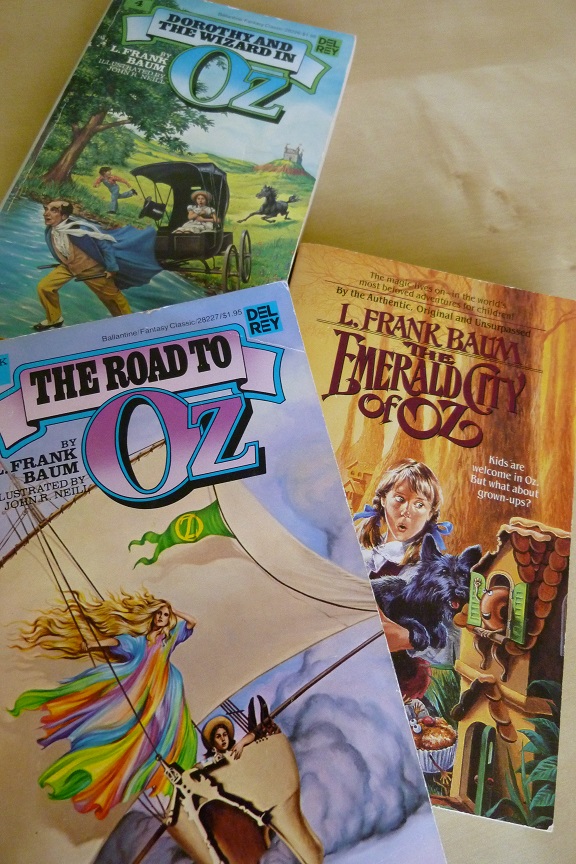
Oz Books 4-6I’ve been pursuing a slow reread of L. Frank Baum’s Oz series, and have found that they can be nicely divided into groups.  Earlier, I reviewed the first three books in the series, or as I like to call them, the Welcome to Oz Trilogy.  Today I’m looking at the next three, what I call the Aimless Journeys Trilogy.

*********

Dorothy and the Wizard in Oz is Book Four.  This one marks the return of the Wizard, who had been absent since he flew away in a balloon in Book One.  The story opens with an earthquake in California, which sends Dorothy plummeting down through a crack in the earth.  She arrives in an underground country, and is soon joined by the Wizard, who came falling down by the same method.  Dorothy, the Wizard and a few friends join together to travel through different countries underground, meeting strange and usually threatening people along the way, hoping to get back to the surface.  Spoiler: They eventually do, by a severe act of deus ex machina.

You probably already see why I’ve titled this trilogy as I have.  While there is loosely a quest to get back to the surface, the characters are basically wandering through magical countries with no particular purpose.  The things they encounter are charming and interesting, and I do love how absolutely anything can be possible, but the book overall suffers from a lack of plot to drive the events forward.

*********

Book Five is The Road to Oz, in which Dorothy and the Shaggy Man set out on a path in Kansas, and find themselves inexplicably on a road through a magical country instead.  Along the way they meet Polychrome, the daughter of the rainbow, and Button Bright, a little boy perpetually getting lost.  As you probably can guess, the rest of the book is devoted to traveling through interesting locales and meeting strange people.  The goal here is even less compelling than in the previous one–they’re hoping to get to Oz for Princess Ozma’s birthday party.

I don’t remember having any trouble with the idea as a kid, but as an adult, it’s hard not to feel that this is THE most meaningless of quests.

The positive side to this book is the characters, as both the Shaggy Man and Polychrome go on to be regulars, and Polychrome in particular is a delight.

*********

The Emerald City of Oz comes next, and is slightly more complicated.  It opens with a beautiful touch of realism and genuine threat.  Aunt Em and Uncle Henry are going to lose their Kansas farm; it was so expensive rebuilding after Dorothy’s tornado carried away the house that they had to get a mortgage and now can’t pay off the debts.  This problem is, of course, swiftly solved by the entire family decamping to Oz.  I do love that in the books, unlike the movie, not only was Oz NOT a dream, eventually Aunt Em and Uncle Henry move there to stay too.

After the family comes to the Emerald City, Ozma decides to send them off on a trip to explore some little-visited parts of Oz, bringing us back to the format of an aimless journey.  Meanwhile, in another narrative strand, the wicked Nome King is plotting to conquer Oz.  Unfortunately, this turns into a series of expeditions to recruit different fierce creatures to join his army.

Like the previous two books, the journey features lots of interesting sights and people (my favorite is a town inhabited by people made of puzzle pieces) but it also loses drive.

This is also not a good book for Ozma.  Again, I never noticed this as a kid–but as an adult, Ozma is troubling.  She has a tendency to direct everyone else’s lives for them (because she always knows best…) and she is good and pure and sweet to the point of insanity.  An army is marching on Oz intending to destroy everything and enslave everyone, and Ozma’s plan is, I quote “I will speak to them pleasantly, and perhaps they won’t be so very bad after all.”  Ahem.

The innocence of Oz is a good bit of its charm, but now and then Baum goes a little too far…

*********

These books have interesting characters and magic, but with the absence of a real plot or any notable character growth, these are not some of the stronger offerings in the series.  I think Baum was genuinely struggling at this point; he didn’t want to keep writing Oz (and he tries to do away with it forever at the end of Book Six) but the public demanded it.

Baum must have made some kind of peace with the situation, because he gets his stride back in the later Oz books.  Journeying through strange locales stays a common feature, but he manages to put it into better plotlines, and comes up with some particular vivid pieces of magic.  I’m still working my way through the series, but I remember some favorites in the later volumes!

I would recommend these three, with reservations.  A young reader might be less bothered by the lack of plot (and engaged by the magic).  More discerning readers (of any age) would probably enjoy any one of these…but I don’t recommend all three in a row!

Other reviews:
Bookmarked Pages (Book 4 and Book 5)
Story Carnivores (Book 4, Book 5 and Book 6)
The Fandom Post (Book 6)
Anyone else?

Buy them here: Dorothy and the Wizard in Oz, The Road to Oz, The Emerald City of Oz

The Last Unicorn Read-Along, Week One

Last UnicornLover of fantasy books though I am, I somehow never read The Last Unicorn by Peter S. Beagle.  It’s been on the To Be Read list for a while, so I was happy to see Lynn’s Read-Along, to give me a push to actually get it off the list!

This week is for the first half of the book.  I’ll give it some general thoughts, and then go on to Lynn’s questions.

I’m not sure I’ve ever read a book that was so obviously layered.  Many books work on multiple levels, but this one constantly felt as though there was so much MORE going on than the surface story suggested.  And you didn’t have to dig deep to realize the layers are there; it’s apparent right from the surface, in everything about the writing.

The plot doesn’t even begin to describe anything more than the topmost layer.  The last unicorn goes searching for the rest of her kind, in the company of an inept magician and a fierce woman.  That’s true–but I feel like it implies a completely different book, one that’s funny and full of magic and the unicorn is probably pretty and sparkly.  And the really strange thing is, that’s true too–it is funny in spots, and there is magic, and the unicorn is beautiful.  But that’s not really what it’s about either, because it’s so much more complex, and the unicorn probably isn’t really a unicorn but some kind of symbol though I’m not certain of what (innocence?  wonder?  childhood?) and the magician’s ineptness and the woman’s fierceness are deep-rooted, complicated and even tragic.

So I think what I’m really saying here is…I didn’t fully understand the book.  But that’s okay.  And while normally the sense that there’s deliberately much going on irritates me, in this case, it actually seemed to work.

Let’s see what our questions are…

Mommy Fortuna’s Midnight Carnival is built upon illusion. Think of Schmendrick’s words in chapter 3 “The enchantment on you is only magic and will vanish as soon as you are free, but the enchantment of error that you put on me I must wear forever in your eyes”. How do you think we’ll revisit this theme in the rest of the book? How do you feel it relates to life in general?

The subject of illusion is so intriguing, and I feel like it’s closely tied in to perception.  We all perceive each other in different ways–is it truth or illusion?  Maybe even more compelling, how do we perceive ourselves?  I think that’s the “enchantment” that’s hardest to change, and I don’t think our self-perception is necessarily more true than the truths (and illusions) other people see about us.

Or, to quote Pontius Pilate by way of Andrew Lloyd Webber, “You speak of truth–is truth a changing law?  We both have truths.  Are mine the same as yours?”

To circle back to what I said above, I don’t think the unicorn is really a unicorn, or maybe it’s better to say she’s not only a unicorn.  Her identity as a unicorn is in some ways more solid than anyone else’s identity in the book, and yet at the same time, very few characters can see her as a unicorn.  And on a deeper, symbolic level, I think she’s something else entirely (I’m leaning towards the spirit of wonder).

Throughout the book, we find several fairly anachronistic moments, some more visible than others. One example is Captain Cully talking about the Child collection in chapter 5. What do you think these moments add to the book?

There’s something so other-worldly and mystical about the entire book that I never gave much thought to when it’s meant to be.  If I had to place it, it seems more or less to be in the same medieval-ish time of all (most) fairy tales.  However, there are anachronistic moments that throw that off.  I noticed anachronisms more in the phrasing than in the particular references.  Most of the book is very poetic, very cerebral even, and then suddenly something will be modern slang.

I actually liked the jarring effect of those modern moments.  They kept me from getting too swept along by the flowing language.  It’s easy to get too caught on the level of “beautiful fairy tale,” and those anachronisms were a jolting reminder of additional layers.

And they were used to comedic effect at times too…

Cully’s chapters are also very concerned with the question of reality versus mythology, with Molly claiming that they are the legend and Robin Hood is real and Cully claiming that they are real and not Robin Hood. How do you feel about the book drawing attention to its artificial nature this way? (It’s not anything new. Tristram Shandy did it even more noticeably several centuries earlier and many other books have since.)

I think we’re back on the subject of truth and illusion, although maybe it’s a nuance to say instead that it’s the subject of truth and story.  Stories are often not true in a factual sense, but that doesn’t mean they can’t represent a deeper truth.

Cully is particularly layered on the subject of truth and reality.  He’s a fictional character who makes up false ballads about himself, while being extremely conscious of the Robin Hood legend that he is modeling himself after.  It’s a fiction, inventing fictions, modeled on  what might be fiction, and all self-aware at the same time.  Whew!  And maybe all of that is really pointing to a truth, not about robbing from the rich, but about the stories we tell ourselves.  Above, I talked about our self-perception being false, and I really meant the ways it can be unconsciously false.  Cully seems to represent the ways we knowingly tell false stories.  Not necessarily lies, but perhaps trying to appear confident when we’re nervous, or claiming we have everything under control when we know we don’t!  Although again I have to wonder, are the stories we knowingly tell really as false as we think?

This part of the read-along ends on a bit of a cliff-hanger. While they’re walking out of Hagsgate, Molly asks Schmendrick what the unicorn’s role in the story is. Schmendrick replies by saying that, unlike them, she’s real. What do you think that means? What do you think will happen next?

Erm, I’m not any good at stopping books halfway through, so I already finished!  And I feel like I want to come back to this question while we’re discussing the second half…

What are your impressions of the characters so far? Do you like them? What are your expectations of Haggard and Lír?

Well, like I said, I did finish the book already…  I had some trouble connecting to the characters initially, and I think that’s because there’s a surface level where they feel somewhat removed.  Maybe it’s because so much of the book is (wait for it!) layered!  I think to a certain extent I had to read farther into the book, or maybe even get to the end and then look back at it, before I could see some of those deeper layers where the characters are actually stronger.  That may not make a bit of sense…

I think I’ve exhausted my philosophical thoughts for the moment–now I want to hear what you think!  And do go read Lynn’s answers to the questions, for excellent analysis and exploration of some very deep layers in the story.

Have you read The Last Unicorn?  It’s not too late to jump into the Read-Along if you haven’t!  And even if you haven’t, any thoughts on truth, illusion, and the stories we tell ourselves?

The Crystal Gryphon by Andre Norton

Crystal GryphonThe Crystal Gryphon is the reason I keep meaning to read more Andre Norton.  Another reread for Once Upon a Time, it’s a beautifully written book with a vivid world and excellent characters.

The narration alternates between our two leads, Kerovan and Joisan.  Kerovan was born of humans but with his taint of Old Blood showing in his amber eyes and hoofs.  He is shunned by his mother and grows up apart, despite being the son of a lord.  Wishing to affirm Kerovan as his heir, his father makes a political betrothal for him to Joisan.  She’s strong-minded and independent, but fiercely conscious of honor, duty and loyalty.  Officially married as children but never meeting, Kerovan and Joisan follow separate paths, until all plans change with the coming of invaders from across the sea.

I love Kerovan and Joisan, and the growth they each experience.  Kerovan in some ways comes to terms with his past and his differences–and in other ways does not, which is okay because there are two more books after this.  Joisan is always intelligent and strong, and in time of crisis she emerges as a leader for her people.

Without giving much away, Kerovan and Joisan do eventually meet.  I liked all of the book, but it felt most compelling when the characters came together–and in my memory, it stood out as a much larger section than it really is!  The development of the romance is brief, but felt satisfying too.

The culture and the world is immensely rich and complex, with several societies jostling together.  Kerovan and Joisan’s people have a feudal structure and loosely Medieval technology.  The invaders come with modern weaponry.  And all throughout the land, there are traces of the Old Ones, who possessed mysterious powers.  The book has some sense of a larger context, and apparently its part of Norton’s larger Witchworld series.  I don’t know much of the larger context, but I don’t feel like that was ever a barrier to reading.

I have a few criticisms…Norton relies a bit on characters experiencing compulsions, to make them do things that don’t entirely make sense but move the story forward.  Considering powerful magic and larger forces are woven throughout, though, I’ll mostly give that a pass.  The alternating POV is brilliant for getting into both characters, but can make the chronology confusing in places, when we jump backwards in the timeline with a POV shift.

But those are relatively minor issues, more than made up for by Norton’s beautiful writing style and wonderful characters.  Highly recommended–and I already got hold of the sequel.

Author’s Site: http://www.andre-norton.org/

Other reviews:
Rachel Manija
Angieville
Okay, more people should read this…hardly any reviews out there!

Buy it here: The Crystal Gryphon