The Princess Bride by William Goldman

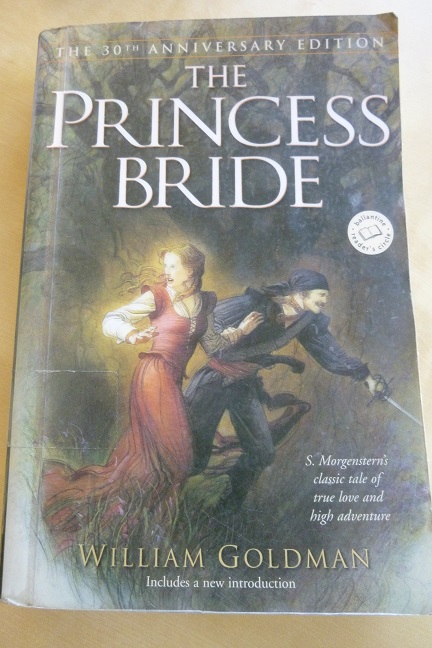
Princess Bride (2)We’re getting down to the end of Once Upon a Time, but I fit in another reread of an old favorite: The Princess Bride, S. Morganstern’s Classic Tale by William Goldman.  The first time I read this was in college, and it only took me a day.  I didn’t have quite so much reading time this go-around–so it took two and a half days.  It has a decent number of pages, but it’s a fast-paced, very quick, very delightful adventure story.

Plotwise, the story centers around Buttercup, the most beautiful woman in the world, who is engaged to Prince Humperdinck but in love with Westley.  But it’s not really about the plot, which is largely just a farcical blend of kidnapping, conspiracy theories, and excuses for swordfights.  It’s really about the other characters, the derring-do and the witty repartee, and the dangerous and sometimes absurd circumstances.

If you’ve seen the movie (my review here), then you’ll have a very good idea what to expect in the book.  I’ve rarely seen a movie that was so true to the book, and I’m sure that has everything to do with the fact that Goldman also wrote the screenplay.  They’re basically the same thing–the book is just a bit more.  More history of the characters, more descriptions, more witty asides.  But it’s the same in the essentials, and there were plenty of lines of dialogue I read in my head the way the actors said them.

The spoofing quality of the story may be one way the book is more.  The movie is obviously playing on adventure story tropes, but it’s even clearer in the book how much it’s deliberately poking fun at the standards.  You can see it in the main characters: the beautiful but dumb Buttercup, the impossibly heroic Westley, and the ruthless Humperdinck are all caricatures, but they’re knowingly caricatures, and they’re such entertaining ones besides.  This entire book feels like one big, sly wink.

For me, I think it’s much more about the supporting cast.  There’s Fezzik the giant who has the world’s strongest arms and biggest heart, who’s not very smart but loves rhymes, and is afraid of nothing so much as loneliness.  And there’s Inigo, a Wizard with a sword who is driven only by his desire to seek revenge on his beloved father’s murderer.  There’s also Vizzini, the brilliant and crafty Sicilian–but mostly it’s about Inigo and Fezzik.

We get more of Fezzik and Inigo and their friendship in the book.  One of my favorite sections is when the two of them enter the Zoo of Death, looking for Westley.  They both have to face fears and it’s clear that neither could make it through without the other one–and even though they squabble along the way, they seem to figure that out too.

The book has more or less the same frame story as the movie as well, though in the book it’s Goldman’s father reading him the book.  Frame story spoiler in white text, highlight if you want to read it…  The story goes that Goldman’s father read him only the good parts of the book, and now he’s abridging S. Morganstern’s classic tale…which just isn’t true.  It’s a lovely idea, but if you actually read the book, it becomes pretty clear that it’s not true (and a quick search online will confirm it), just from the style of the book itself, the things that Goldman claims to have cut, and especially the things Goldman writes about his own life.  I love the concept, though, and I love that the idea is floating out there and believed.   I think that’s why I had to do this part in white text–I wanted to comment on the whole thing, but I hate to give it away for anyone! Like I said, the book really is one huge, sly wink.

All in all, The Princess Bride is not a deep story or a profound one, but it’s just so much fun.  Watch the movie or read the book, both are light and delightful.

Other reviews:
Fresh-scraped Vellum
Shut Up! I’m Reading
Elle Literate
Hot Diggity Daffodil
Anyone else?

Buy it here: The Princess Bride

The Return of the King by J. R. R. Tolkien

Return of the KingI am very happy to report that I have finished reading the Lord of the Rings.  The Return of the King turned out to be much shorter than I always thought–only 340 pages (plus Appendices, which I skimmed…)  I might have read these books years ago if I’d had a clearer picture of their length!  But I’m happy I finally read them–and in time for Once Upon a Time.

The Return of the King finishes out the trilogy.  (Read my reviews of Fellowship and Two Towers, if you like.)  Like Towers, the book is really in two separate sections.  The first half deals with Sauron’s forces attacking Minas Tirith, capital city of Gondor, and the various forces rallying to fight him.  The second half brings us back to Frodo and Sam, and the final stretch of their quest–followed by a hundred pages of the aftermath.

Overall I enjoyed the book quite a lot, although parts of the first half dragged for me.  I enjoyed the setting, and there were wonderful moments in there, especially ones centering on Merry or Pippin.  I loved anything with Faramir or Eowyn (more on them in a bit), and Gimli had some nice moments too.

As I write this, it’s becoming even clearer to me why I liked some parts better than others.  It comes down to characters.  When the focus narrows down and is just on what one individual is doing, feeling, thinking, I was engaged.  When we pull out and it becomes the epic sweeping clash of armies, then it lost me.  I thought this part went on a bit too long in the movie too (until the Riders of Rohan showed up, because they always make battles awesome).

I was happy when we (finally) got back to Frodo and Sam.  I love their sections, because it’s exactly what I wanted in the previous section–we zero in close on Sam, and we get nearly all of the quest from his point of view.  It’s immediate, it’s personal, it pulls me into the story because I’m not watching an army, I’m pushing through Mordor with Sam.  It’s funny, I think of Tolkien as being a very dry, detached writer, but he really was capable of writing beautiful, deep character stories (just not often enough…)

There are two other parts I wanted to look at, and they’re very late in the book, so spoilers ahoy!

I was thrilled to pieces by the Faramir/Eowyn romance.  I knew it existed (and the extended cut of the movie did lovely things with it, even though it only got about a minute and a half of screentime) but I wasn’t expecting much.  By this point, if a woman was identified by name I felt like we were ahead.  So when there were actual conversations, and entire scenes, and really sweet, cute lines back and forth, and an exploration of Eowyn’s feelings…it was still probably only ten pages but it was beautiful.

I was expecting something much more like what the Aragorn/Arwen romance turned out to be–she shows up just in time to look pretty and marry him!  Otherwise, not really in the story.  (The Appendix fleshes it out a bit, but not much.)  So I was so happy to get something actually romantic for Faramir and Eowyn, and I just love the two of them as characters besides.  They’re two of the most relatable characters, because they struggle more than most.  Faramir’s father never thought he was as good as his brother; Eowyn chafes against society’s role for her.  Most of the characters here are great fun to read about, but too perfect in some ways.  I love that Faramir and Eowyn are awesome, but still human.  (I think it relates to a lot of the reasons of why I love Sam too…)

The other part I wanted to talk about–the Scouring of the Shire.  This section (and its exclusion from the movie) seems to be highly controversial among the faithful.  I have to say I didn’t mind the long wrap-up, and I didn’t mind the concept of trouble coming to the idyllic Shire.  It did bother me what the specific trouble was, though.  The whole trilogy exists in this very high fantasy, very Medieval realm.  Then we return to the Shire to find a metaphor (surely not an allegory…) about the Industrial Revolution and Communism.  Or so it felt, anyway.  And that jarred for me.  I’m also not quite sure when Merry and Pippin became generals…they were soldiers, yes, but when did they learn how to organize battle plans and command an army of Hobbits?

On the other hand, while the nature of the trouble felt strange, I actually quite liked it that there was work to do when they returned to the Shire.  The end of the movie feels very empty to me.  The whole time the Hobbits dreamed about returning to the Shire, but when they actually come back from their grand adventures and find nothing at home has changed…I don’t know, I always like to believe people can go home again, but it just seemed to me that they would all find their daily lives so meaningless and dull, after the incredible events that they’d been involved in.

I really liked that in the book, after saving the world, they had to save the Shire too.  The scale is smaller, but the work is just as important, and you could see how everything they had done then enabled them to become leaders in their own community and to set about making things better there too.

I feel like I should have some succint, summing up words here.  I’m happy that I finally filled in this gap in my fantasy knowledge by reading Lord of the Rings, and of course it wasn’t nearly as intimidating as I always thought.  The Two Towers is my favorite, book and movie, although there are wonderful moments in all three.

I don’t have plans to read The Silmarillion…but I am very much looking forward to the next movie installment of The Hobbit!

Author’s Site: http://www.tolkiensociety.org/

Other reviews:
Rawr Reader
Suzie Hunt
Carol Rae’s Random Ramblings
Arrow Through the Sun
Anyone else?

Buy it here: The Return of the King

The Hero and the Crown by Robin McKinley

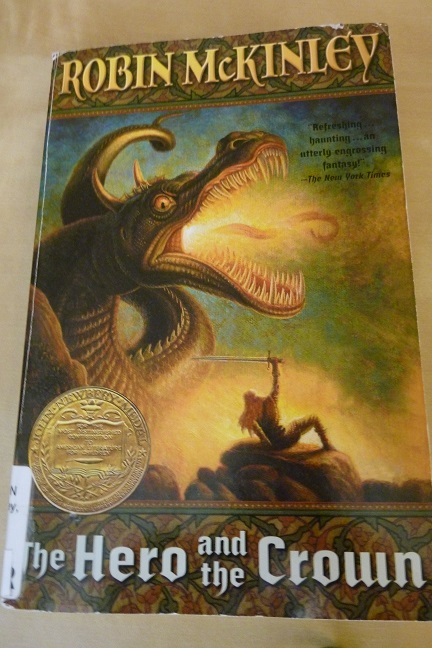
Hero and the CrownI recently followed up my reading of The Blue Sword with its prequel/companion, The Hero and the Crown by Robin McKinley, another book for Once Upon a Time.  The books are separated by a few centuries and feature (nearly) all different characters, so either could be read independently.  I read them in publishing order, but I almost wish I had read them chronologically, as I think The Hero and the Crown provides more depth to The Blue Sword, more so than happens the other way around.

I enjoyed the book in a lot of ways, and I feel like I could see McKinley’s development as a writer even between these two books.  There are strong characters, awesome magic, and really interesting dragons.  And…there are problems.  But I’ll get to that in a bit.

The Hero and the Crown focuses on characters who featured as legends in The Blue Sword, particularly Aerin.  The daughter of the King of Damar and his foreign wife, Aerin is viewed with mistrust and disdain by her father’s court.  She’s hot-tempered and impetuous, and strives to prove her worth by killing dragons–who in this world, are a kind of pest, like wild dogs or wolves.  Bigger events surface when a Great Dragon comes out of the hills, and when war threatens with the demonic forces of the North.

I loved Aerin.  She’s likable even when she charges into foolish actions, and I find myself so wanting her to come into her own.  I love that even when she begins killing dragons (which seems like a traditional route to being a hero) she still has to struggle.  I love how she gradually grows throughout the first half of the book, growing in her relationships with others and in her acceptance of herself.  The one reason I’m glad I read The Blue Sword first is that I love having met her as a mythical figure, and now meeting her as a very real girl–it’s never as neat and simple as the myths.

Aerin is surrounded by solid characters as well, from her father who means well but doesn’t know what to do with his daughter; Tor, her dearest and sometimes only friend; Teka, her somewhat fussy nursemaid and surrogate mother; Galanna and Perlith, representatives of the hostile court.

The best character, though, is Talat, Aerin’s horse.  Once the king’s warhorse, Talat was lamed in battle and put out to pasture.  Aerin and Talat lean on each other to find their path, and form a beautiful bond.  A-girl-and-her-horse is an oft-told tale, but this one is really lovely.

I touched on the dragons a bit already, and I just have to say that I love it that they’re not the big bad fearsome and impressive dragons of most stories.  They’re about the size of dogs and treated like any other dangerous wild animal–but not as anything more impressive than that.  In fact, in this country, there’s very little honor in killing dragons.  The Great Dragons are more traditional, but most people consider them only myths…until one arrives, at least.

I don’t want to get into the second half of the book too much, to avoid spoilers, but I have to talk about it to discuss my chief problems with the book.  There’s a clear shift about midway through, as Aerin begins to deal with forces on a larger stage.  The plot shifts, and that’s fine–but I feel like the character shifts too, and that’s not.

It’s hard to pinpoint the exact problem or exactly what was missing, but it feels like Aerin stops making decisions for herself.  While she decided to fight dragons or to befriend Talat, later in the book it feels like she’s being moved around by circumstances.  She goes to fight a magician because of a prophecy; she goes through a battle using a sword that seems to move on its own; she climbs endless, endless, endless stairs and never once thinks about turning around.

I wouldn’t say that Aerin behaves out of character in the later parts of the book–but I don’t get a sense of her anymore being an active force in her own path (which, in its own way, is out of character…)  The actions she takes do make sense for her, but there’s a piece missing in the motivations behind the actions.  And that, I find frustrating.

The second half also introduces a new romantic interest, which turned out to be the worst of both worlds.  I didn’t hate that romance, but it never resonated with me either–and yet it was able to disrupt the development of the earlier romance which I had been enjoying.

I didn’t hate the entire second half of the book, by any means.  It was actually still a pretty good story–but it was just a bit off too, and it didn’t live up to the brilliant first half.

I read a review by Memory on Stella Matutina that describes all of this very well and raises some excellent points, if you want to explore the subject further.

I have to wonder if McKinley herself may have realized the issue here.  I’m reminded very much of Rose Daughter, one of her later books.  The heroine is also being pushed around by prophecies and expectations and even the usual format of “Beauty and the Beast”–but she ultimately makes decisions that turn everything on its head.  Choice is very heavily emphasized…so perhaps McKinley knows what happened in The Hero and the Crown.

There’s about half of a really amazing book here–and then a pretty good second half.  So in the end I do recommend it, but I wish I could recommend it more whole-heartedly!

Author’s Site: http://www.robinmckinley.com/

Other reviews:
Beyond Books
The Sleepless Reader
The Book Stop
Dab of Darkness
Anyone else?

Buy it here: The Hero and the Crown

The Master of Heathcrest Hall by Galen Beckett

Master of Heathcrest HallI had insomnia one night last week, and the one silver lining was that I got to finish The Master of Heathcrest Hall at four that morning.  I’ve been working on this trilogy for both Once Upon a Time and my Finish-the-Series goal, and I’m so very glad I did–because I loved it.

If you like, you can jump back and read my reviews of the first two books, The Magicians and Mrs. Quent and The House on Durrow Street.  To give very quick context: the trilogy is set in an alternate England (Altania), where some men are magicians, others can craft illusions, and certain women can speak to the Wyrdwood–Old Trees that are self-aware and capable of movement.  Oh, and the day and the night are of uneven lengths, which fascinates me, and the whole writing style and society has a strong Austen feel.

The third installment brings us back to our three major characters.  Ivy is living on Durrow Street with her two sisters and her beloved husband, Mr. Quent, and still trying to puzzle out messages left her by her father.  Rafferdy has become fully involved in the Assembly, as well as a clandestine group of magicians, working to protect the Wyrdwood.  Eldyn is performing as an illusionist, and learning how to make impressions (a kind of magical photo).  All their lives are going along pretty well…but there are political rumblings, a revolutionary army on the march, and a red planet coming ever closer and bringing with it the Ashen, terrifying enemies set to destroy all life in their path.

All these bigger issues were largely in the background in the second book, which worked surprisingly well.  I was hoping they would become more central in the third book and (eventually) they did.  Beckett does very nicely gradually building up to the larger crises, while somehow never losing the feel of ordinary people who (mostly) are trying to go about ordinary lives.

I also hoped for more of Mr. Quent (he is, after all, the title character) but only partially got that.  There was a bit of a facepalm moment when, at the very beginning of the book, we find out Mr. Quent is out of town.  Again.  As usual.  He was perpetually out of town or working late in the second book.  He actually does end up being in this one a bit more, and I just love it whenever he and Ivy are together.  There’s such a Bronte feel to the two of them.  Bronte actually gives us those sweet conversations Austen likes to skim past.

Mr. Quent also gave me the most heart-wrenching moment of the book…which I can’t explain without spoilers, though those who’ve read it probably know.  It wasn’t actually when horrible things happened–it was when I realized horrible thing were going to happen, and how, and why.  Sigh.

These books are all around 700 pages each, so by the end of the third, I had spent a lot of time with our three main characters.  I loved how they grew and developed.  Ivy was always wonderful, but she found new strengths and confidence over the course of the trilogy.  There were a few moments in this book, however, when I felt like she did some really stupid things, which felt like they only happened to keep the plot moving.  I tried not to get too irked, and the book and Ivy both did get back on track…

Eldyn had some interesting growth, as he always wanted to do great things but had to learn his own right path.  Rafferdy grew the most, from a dandy with interest in nothing, to an honorable, caring man willing to sacrifice for a greater cause.

There’s a love triangle in here that I really liked, because it felt like a genuine conflict (though I guessed how it would ultimately resolve) while at the same time all three were so honorable, and respectful of everyone else involved.  It struck me as such a contradiction to the (false) idea that you can’t write a book about genuinely good people.

As noted, this is a long book and, considering it’s written in an Austenish style, it’s not usually in much of a hurry.  It works though–don’t expect fast paced action (except now and then) but there is a very satisfying slow unrolling of events and revealing of mysteries.  Without getting into spoiler specifics, I’ll also mention that, in the end, everything ties up happily, in a way that’s almost too convenient.   I know that bugs some people, so be aware…although personally, I like neatly happy endings.

I’ve been recommending this one to all of my friends who like Austen and fantasy.  I think you really do have to like both, but if you do, this trilogy is one not to be missed!

Author’s Site: http://wyrdwood.net/

Other reviews:
Stella Matutina
Fyrefly’s Book Blog
Just Book Reading
Anyone else?

Buy it here: The Master of Heathcrest Hall

Heart’s Blood by Juliet Marillier

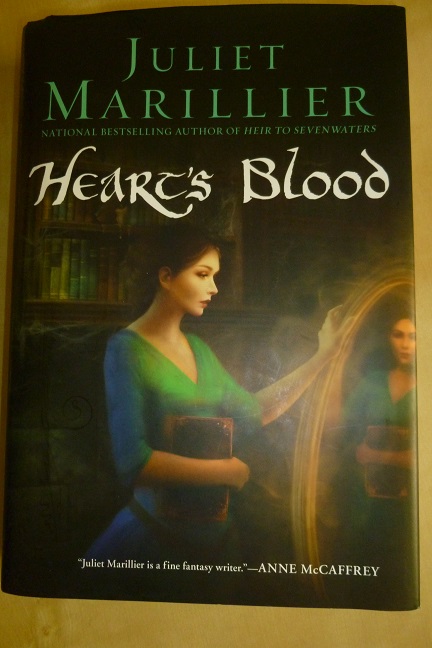
Heart's BloodI’d just like to say, when Juliet Marillier is good, she’s really good, and I’ve been having a nice run with her books lately.  After recently reading Heir to Sevenwaters, I jumped into a reread of Heart‘s Blood, in part so that I could try to actually notice sooner this time that it’s a “Beauty and the Beast” retelling…  It took me far too long to figure that out on the first go-around.

The heroine of the story is Caitrin, who flees an abusive situation and, in desperation, seeks refuge and work as a scribe at Whistling Tor.  There are strange rumors about monstrous spectres in the woods around the Tor, and about Anluan, the chieftain.  Anluan proves to be bad-tempered and unfriendly; he was stricken by illness as a child and it left him semi-paralyzed on his right side.  He nearly runs Caitrin off at once, but instead she stays, becoming part of his very unusual household and delving into the myserious curse afflicting the Tor.

You probably already see some “Beauty and the Beast” parallels, and there are also enchanted mirrors scattered throughout.  It’s really only “Beauty and the Beast” in the broad strokes, though, and most of the story focuses on deducing the origin of the curse, as well as on an outside threat from foreign invasion.

I was also struck by Jane Eyre parallels, particularly in the second half of the book, so I don’t want to get into details too much.  Even at the beginning, though: a talented young woman sets off from a difficult situation, and finds work with a gruff employer at a big house on a misty moor (or Tor…)  He’s unfriendly but secretly attracted to her, while she comes to see the value behind his unattractive exterior.  (Although no, there’s no first wife locked in a tower.)

This was an interesting one to read right after Heir to Sevenwaters, because it was once again two of my favorite archetype characters: a heroine who has to find her own strength and worth, and a dark hero with a heart of gold.  That’s not to say, however, that Caitrin and Anluan are the same characters as Clodagh and Cathal.  They have their own unique characteristics and paths to walk.

Caitrin has a particularly difficult journey, overcoming abuse in her past.  Marillier focuses less on the bruises and more on the psychological damage, which is deeper and far more complex.  I ultimately found Caitrin’s path to be immensely satisfying.  Anluan has different internal demons to overcome, and though we get less of his internal thoughts (Caitrin narrates, but we do get into Anluan’s journal) his development is intriguing too.

The magic is spooky at times, creepy at others, and delves into questions of good and evil and the hazard of judging too quickly whether someone is one or the other.  There’s a nice balance of character growth with unraveling mysteries and, as is usual for Marillier, the last hundred pages are breathless and hard to put down.

Highly recommended. 🙂

Author’s Site: http://www.julietmarillier.com/

Other reviews:
Ivy Book Bindings
Academics Go Clunk
The Book Rat
Anyone else?

Buy it here: Heart’s Blood