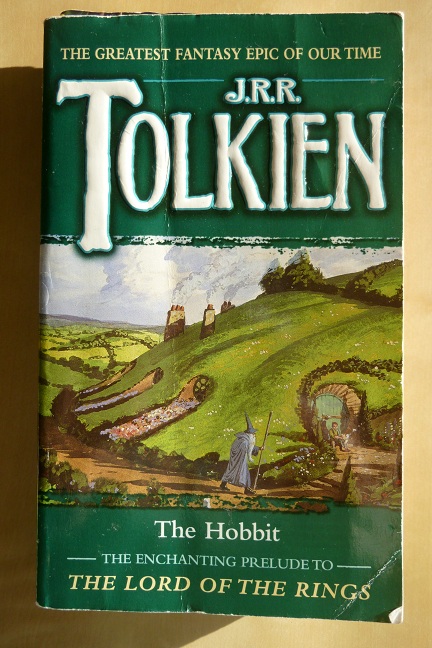
The Hobbit by J.R.R. Tolkien

HobbitIn another read for the Once Upon a Time Challenge, I reread The Hobbit by J. R. R. Tolkien.  This is one I read so long ago (twelve years?  Fifteen?) that it mostly felt like a new read by now.  I kept meaning to read it before the movie (review here)…and then wanted to read it after…and mostly read it now because I plan to read the Lord of the Rings trilogy this spring, and it seemed like a good place to start!

The story, as most of you probably know, follows Bilbo Baggins, a Hobbit who only wants a tidy life and regular meals.  He is enticed into an adventure by Gandalf the Grey Wizard, who recruits him to join thirteen dwarves on their quest to reclaim their lost home and treasure from Smaug the dragon.  Adventures along the way involve elves, trolls, goblins, a truly creepy forest and, now and then, even a few humans.

I love Bilbo’s growth as a character throughout the book.  He begins by feeling that adventures are unpleasant things which make one late for dinner (one of my favorite lines!), and comes to find his own strength and ability–and a taste for adventure.  He learns how to use a sword, devise a daring plan, and make a hard decision about loyalties and sacrifice.  There’s a thread that runs through the novel about the state of Bilbo’s pocket handkerchiefs, and it’s just a delightful illustration of how he progresses.

I also love (spoiler?) that Bilbo ultimately does return home.  So often stories like this end up with the character in a new place, or deciding that they don’t really want to go home after all, or realizing that “you can never go home again” as the cliche goes.  (Or there’s Dorothy, who does go home, apparently only learning that home is really wonderful.)  The Hobbit takes a different and more complex path by sending Bilbo back home in the end, meaning that the real exploration is not ultimately how Bilbo’s life changes, but how he himself changes.

The world of Middle Earth is also great fun to explore–and I suspect that was a major part of Tolkien’s inspiration to write the story at all!  It’s a story about a character, but it’s just as much about the wild places he’s wandering through, with so many interesting creatures along the way.  Humans come across as a small minority, present in a few communities but no more dominant than any other species (at least in this installment).

My two favorite scenes are the very funny opening sequence of the dwarves descending unexpectedly on Bilbo, and the quite creepy Riddle contest with Gollum.  I very much look forward to more Gollum in the trilogy to come.

There are aspects to the book that didn’t work as well for me–and at times it’s abundantly obvious this was written in a different time, because a modern writer would make a different choice (or editors would insist on it).  The most obvious, perhaps, is when a character we’ve never seen before ends up killing Smaug.  It’s a rather disappointing way to finish off the dragon…though at least it leads into further excitement.  I’m very curious to see how Peter Jackson, as a modern filmmaker, is going to handle that part.

I also wish the dwarves had been better developed.  Rather like the discussion we’ve been having around the Twelve Dancing Princesses, it’s tough going when you have so many characters to juggle.  There were thirteen dwarves and most were completely undeveloped.  Even the five or so that had some personality were pretty slight.

Last critique–I don’t think there was a single female character with a name or a line of dialogue in the entire book.  For all I know, hobbits, goblins and elves are only men!  The dwarves reference a female relative or two in explaining family connections between men (Fili and Kili are the sons of Thorin’s sister, for instance), and some human women get into boats when Smaug attacks the town…but otherwise, Middle Earth seems to be entirely male.  Frustrating…though, if I can go by the movies, there are at least a few actual female characters in the LOTR trilogy!

Whatever its flaws, this is a still a very fun, very interesting adventure.  And, as I hoped, it’s great gateway-Tolkien, because it has me looking forward to exploring the world more and delving into new characters for the LOTR trilogy.  I’ll let you know how that goes. 😉

Other reviews:
Books Please
The Bookworm Chronicles
Pocketful of Books
There must be many, but I was struggling to find other good reviews…tell me about yours!

Buy it here: The Hobbit

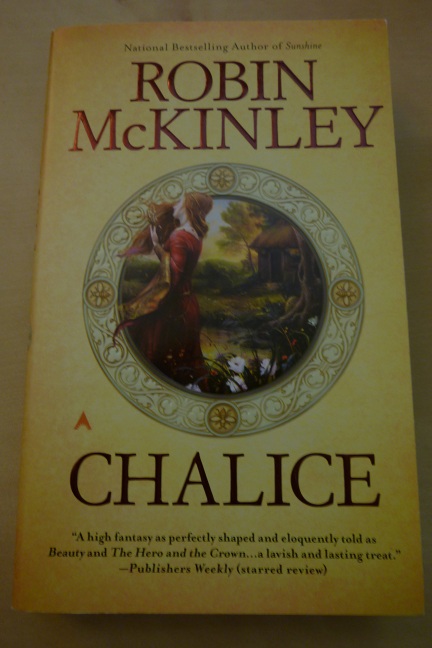
Chalice by Robin McKinley

ChaliceFor the second year in a row, I began the Once Upon a Time Challenge with a Robin McKinley re-read.  Last year it was Rose Daughter, a surreal “Beauty and the Beast” retelling.  This year it was Chalice, about a beekeeper trying to take on a very difficult magical role.

Chalice is set in a fascinating magical realm that I so wish we could spend more time in.  The land is divided into demesnes (rather like Fiefdoms) each of them ruled over by a Circle, twelve individuals with specific roles, bonded together by magic.  The first member of the Circle is the Master, the hereditary Lord of the demesne.  The second member is the Chalice, who binds the demesne together, tending to everything from magically encouraging fellowship among the Circle to quieting restless earthlines.

In Mirasol’s demesne, an unstable Master and his Chalice died suddenly together, sending the land into disarray.  In desperation, the Circle summons the Master’s brother, now a Fire Priest, the last blood heir who can assume the duties of Master.  Meanwhile, Mirasol finds the powers of a Chalice suddenly erupting within her, and she must find a way to learn and manage her new role.

This is a fairly slim book, but hard to summarize, because the world and the magic system is so integral and so complex–and not quickly explained in the book!  McKinley has a tendency to throw the reader into a novel without a lot of explanation, and then drop dribs and drabs of information as we go.  I often find that frustrating in books, but McKinley is generally quite good at making it work.  All the same, I think I did enjoy this book more on a reread because I had a clearer context at the beginning.

It’s a truly fascinating world and magic system, and it all ties together into the larger conflict.  The demesne is threatened both from within and without, from political manuevering and from the land literally fighting the instability brought on by human actions.  Mirasol and the new Master have to work together to hold the demesne together, while dealing with their personal internal struggles, and with conflict among the people around them, who have serious reservations about a Fire Priest Master.

Mirasol is an excellent heroine, one who is clearly strong, intelligent and good-hearted, but doesn’t entirely believe she has any of those qualities.  She’s a beekeeper who is suddenly dealing in things so much bigger than her former realm, and she’s struggling to learn the role and duties of Chalice.  Even more, her struggle is how to stay Mirasol within the Chalice, and carve her own unique path.

I pretty much can’t avoid liking the Master as a hero.  He’s dark and terrifying and mysterious (it’s that Fire Priest thing), while kind and caring underneath the intimidating exterior.  I love dark, brooding heroes with hearts of gold, and this is one of the most clearly good heroes of that type.  His magic is also just so intriguing.  As a Fire Priest, he’s been physically transformed so that he’s not quite human anymore, and he’s struggling to adapt to this return home.

Arguably, this is McKinley’s third “Beauty and the Beast” retelling, though unlike the first two, which lift direct elements from the fairy tale, this is only the tale in its themes.  It is a story about a girl who finds herself, while helping a man who lost his humanity learn to be human again…but all the surrounding details are different.  Still, I’m sure the themes are deliberately there.  Somewhere I heard McKinley say that “Beauty and the Beast” is THE story for her, the one she’s really telling, to a greater or lesser extent, in all of her novels.  That is certainly abundantly clear here.

If there’s a flaw in the book, it’s that the ending is too fast.  It’s completely right.  I love the way things work out, all the earlier hints and clues are there to set up the conclusion, and the details are all immensely satisfying.  But it happens so quickly!  The first time I read Chalice, I read the ending twice, because I just couldn’t get the emotional resolution so fast.  This time, I found myself rereading individual paragraphs, trying to linger on key moments.  The point here is that I love the whole thing…I just wish there was more of it.

This is among my favorite McKinley books, and I highly recommend it.  I also recommend having honey on hand while you read…remember, Mirasol is a beekeeper, and honey figures prominently!

Author’s Site: http://www.robinmckinley.com/

Other reviews:
Starlight Book Reviews
Bookshelves of Doom
Beauty Is a Sleeping Cat
Anyone else?

Buy it here: Chalice

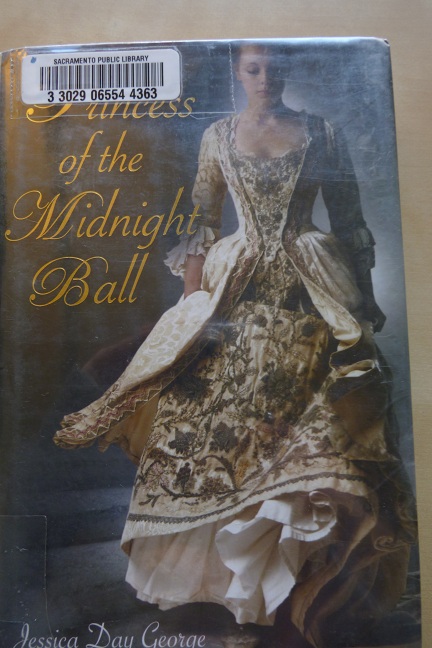
Princess of the Midnight Ball

Princess of the Midnight BallSomewhere in the last couple of years, “The Twelve Dancing Princesses” (or, “The Shoes That Were Danced to Pieces”) became one of my favorite fairy tales.  I’ve read many retellings, and even wrote one for NaNoWriMo 2011.  For the Once Upon a Time reading experience this year, I decided to go back and re-read one of the first retellings I encountered, Princess of the Midnight Ball by Jessica Day George.

This is a lovely, magical retelling that evades the typical pitfalls of the story, while shining mostly for its two lead characters.  The point of view is split between Galen, a young soldier just returning from a long war and taking up a job as under-gardener at the palace; and Rose, the oldest princess, trying to hold her sisters together as they suffer through a curse, evading questions about their mysteriously worn-out slippers.

Rose and Galen both have a way of looking harmless, with unexpected depth and strength beneath.  Rose is a pale, beautiful princess–but that doesn’t mean she doesn’t have intelligence and strength of will.  Galen is a gardener who spends his spare time knitting–which proves to be a surprisingly valuable skill.  When I think about it, the two of them don’t spend much time together.  But I don’t really think about it when I’m reading the book, and this is a rare occasion when I find myself completely buying into a very cute romance, even when the characters don’t really have much opportunity to get to know each other.

The other eleven princesses largely run together, which tends to happen quite a bit in these retellings.  It actually worked rather well in this one, though, I think because George hit a very nice balance of giving me just enough information, while not making me feel like I should be knowing/remembering more.  I’m not sure that makes sense…but for example, on the princesses’ ages: Rose and Lily are the two oldest, at eighteen and seventeen.  Petunia and Pansy are the youngest, seven and six.  The other eight exist in some vague space in between, and while I don’t know precisely how old they are, I also never felt like I needed to know.

Similarly, I had a slight sense of the personalities of roughly half the princesses, and that seemed to be enough.  George has a nice way of never asking the reader to remember the princesses’ personalities, because it’s self-evident whenever that particular princess is referenced.  Poppy is the boisterous one, and it was no effort to remember that because she’s always being boisterous whenever we see her.

For the most part this is a very light retelling, though there are a few moments of genuine creepiness.  It follows pretty close to the original fairy tale, and comes up with some very nice explanations and backstories, filling in the empty spaces in the Brothers Grimm’s much shorter tale.  Some retellings move farther away from the original and it works…but others have completely floundered in the process.  This one didn’t try to go too far, and succeeded very well within its own scope.

I remembered this as one of the best of the retellings I’ve read, though it was hard to judge since I read it before most of the others.  Happily, I was right!

Author’s Site: http://jessicadaygeorge.com/

Other reviews:
Lili’s Reflections
The Dead Authors’ Club and More
Bird on a Pencil
Anyone else?

Buy it here: Princess of the Midnight Ball

Welcome to the Land of Oz

Welcome to OzI’ve lately been slowly rereading the Oz series by L. Frank Baum.  This is at least my third or fourth time through, over the span of…maybe 18 years.  Everyone knows the first one: The Wonderful Wizard of Oz.  It’s less well-known that there are another thirteen books in the series–and even more if you count the non-Baum ones, which I don’t.

Fourteen would be a bit many to tackle in one review 🙂 but I’ve been discovering that it’s surprisingly easy to divide the series into sections, mostly trilogies.  So today let’s look at the first three–I’d like to call them the “Welcome to Oz” Trilogy.  Though new characters are introduced throughout, these first few introduce the principle players, not to mention the setting, which is frequently a character in itself.

***********

The Wonderful Wizard of Oz bears some resemblance to the movie…and some differences.  Kansas farmgirl Dorothy is picked up by a tornado and carried away to the magical land of Oz with her little dog Toto.  There, her house lands on a wicked witch, she acquires a pair of magic slippers (silver, not ruby), and sets off through Oz with a Scarecrow, a Tin Woodman, and a Cowardly Lion.  Eventually she meets the Wonderful Wizard, kills the Wicked Witch of the West, and goes home by slipper power.

That all sounds like the same plot as the movie…but the difference is focus.  While the movie ties neatly together with both Glinda and the Wicked Witch appearing early on, and the Witch providing an ongoing threat, they come in later on in the book.  Dorothy spends more time simply wandering about on adventures, without the drive and the urgency of the movie.  Growing up, I actually never liked this book–and I think the problem was that I was comparing it to the movie.  This most recent read-through, I was finally able to look at it more separately, and it is a rather charming (if unfocused) fairy story.

We’re introduced to a lot that’s fun here, and the characters are delightful.  At the same time, there were some things that Baum hadn’t quite figured out yet.  For instance, he all but directly says that the emeralds in the Emerald City are illusion, and that the Wizard didn’t really give Dorothy’s companions their various rewards, but just humbugged it.  This takes a turn in later books–in the later volumes, the Emerald City really is covered by gem stones, and the brain, heart and courage bestowed by the Wizard really are magical.  While I like the message that Dorothy’s friends had all they needed all along…I do also like the more magical version of events.  Though at least Baum maintained the magic in this book to the extent that the story didn’t all become a dream sequence at the end!

The ramblingness of the book is the most serious problem, and while this is good, I don’t actually think it’s one of the strongest volumes–strangely, when it’s the best-known!

***********

In the second book, The Marvelous Land of Oz introduces new characters.  Dorothy isn’t in the story at all, and the hero instead is Tip, a boy being raised by Mombi, an evil witch.  Tip runs away with Jack Pumpkinhead, a stick-man with a Jack O’Lantern head, which Tip made and Mombi brought to life.  Their adventures eventually lead them to an alliance with the Scarecrow and the Tin Woodman against an army of girls who have conquered the Emerald City.

Between the threat of Mombi and the possibility of war, this is one of the more exciting installments.  The characters are also particularly entertaining, the ones mentioned above as well as a giant, highly-educationed Woggle-Bug, a strange flying contraption called the Gump, and a return appearance by Glinda the Good Witch.  The army of beautiful girls armed with knitting needles (really) sets off my feminist instincts a bit, but they’re counterbalanced by Glinda’s far more capable female army.  The ending of the book is bizarre to say the least–I won’t give it away, but I’ll say that sometimes you have to just go along with Baum and not ask too many questions…

***********

Ozma of Oz is Book Three, and one of my favorites of the series.  Despite the title, which refers to the new Queen of Oz, this is largely a Dorothy book.  She gets lost at sea and washes ashore in a magical country near Oz, swiftly reuniting with old Oz friends who are on a journey to the Nome King to rescue the Royal Family of Ev.

This one is full of images and moments that have stuck with me all out of proportion to their importance–though maybe I should just say it has memorable moments.  There’s a wonderful bit early on when Dorothy finds trees laden with lunch boxes and dinner pails.  She picks ripe ones, opens them up and finds entire meals growing inside.  It’s not an important scene, and yet it’s so delightful and whimsical.  It encapsulates the magical things that can happen in Baum’s world.

Later on, Dorothy encounters Princess Langwidere, who has a collection of different heads and interchanges them at whim, the way people normally change hats or jewelry.  It’s weird and wonderful and just a bit creepy!

When the party from Oz reaches the Nome King’s cavern, he explains that he’s turned the Royal Family of Ev into knick-knacks, and invites each rescuer to search among his collection and try to choose the correct ones–at the peril of being turned into knick-knacks themselves.  That story element of having to choose the right enchanted object from a collection has definitely threaded itself into my mind, and is directly responsible for a chapter in my novel–though my heroine had to select the right enchanted fish.

***********

Baum’s books are whimsical and magical and full of funny, fascinating characters.  There are very few rules and anything is possible.  The first one has some flaws, but on the whole these first three in the series are excellent.  They’re rarely highly dramatic or very deep, but they’re entertaining and bright.  These are wonderful pieces of classic fantasy I highly recommend.

Other reviews:
Story Carnivores
Sarah Reads Too Much
Booksessed
Dark Chest of Wonders
Anyone else?

Buy it here:
The Wonderful Wizard of Oz
The Marvelous Land of Oz
Ozma Of Oz

…or the movie version 🙂

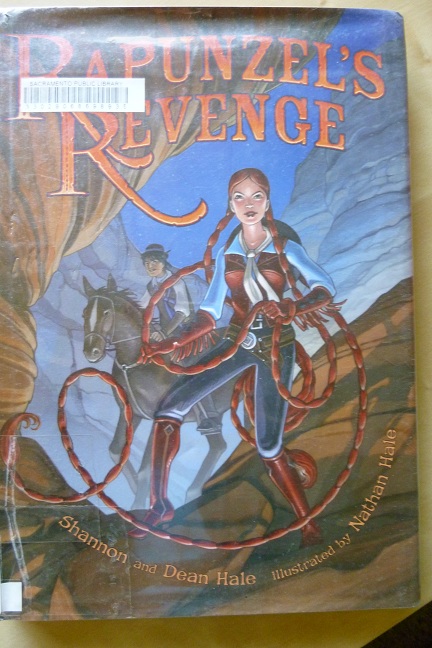
Rapunzel’s Revenge

Rapunzel's RevengeIn between sections of Les Mis last week, I picked up the far lighter Rapunzel’s Revenge by Shannon and Dean Hale.  I’ve loved Shannon Hale’s novels, and naturally I was intrigued by a graphic novel retelling of “Rapunzel”–and apparently one with a very awesome heroine.

Happily, I was not disappointed.  This takes “Rapunzel” as its jumping-off point, but mostly tells an original story.  Mother Gothel did steal Rapunzel as a small child, but in this version she’s using her magic to rule over the surrounding country, and keeping Rapunzel’s real mother as a slave in her mines.  When Rapunzel discovers the truth and reacts defiantly, Mother Gothel locks her up in a tower…where an effect of Mother Gothel’s growth magic causes Rapunzel’s hair to get longer and longer.  This Rapunzel rescues herself, and sets off to fight Mother Gothel and free her mother, joining forces with a good-hearted if slightly inept young man named Jack for a series of adventures.

There’s a bit of an Old West flair to this magical world, not the least in Rapunzel’s outfit.  She puts her hair into two braids and uses them as ropes or as whips, as the situation calls for it.  The idea of Rapunzel using her hair as a weapon is pretty awesome.  It’s a little similar to Tangled, but this Rapunzel has a lot more control of her hair than Disney’s Rapunzel.

I rather enjoy the gender role reversal too.  Jack has his talents, but he’s not as good a fighter as Rapunzel–and seems to be remarkably well-adjusted about that fact.  They’re clearly partners and mutually respect each other…and it’s fun to see the girl be the more aggressive half of the partnership.

This is an excellent, light retelling of a fairy tale–with an awesome, braid-toting heroine!  I’ve already got the sequel on request from the library.

Author’s Site: www.shannonhale.com

Other Reviews:
Fyrefly’s Book Blog
EA Younker
Tales Old as Time
Anyone else?

Buy it here: Rapunzel’s Revenge