The Girl with the Geese

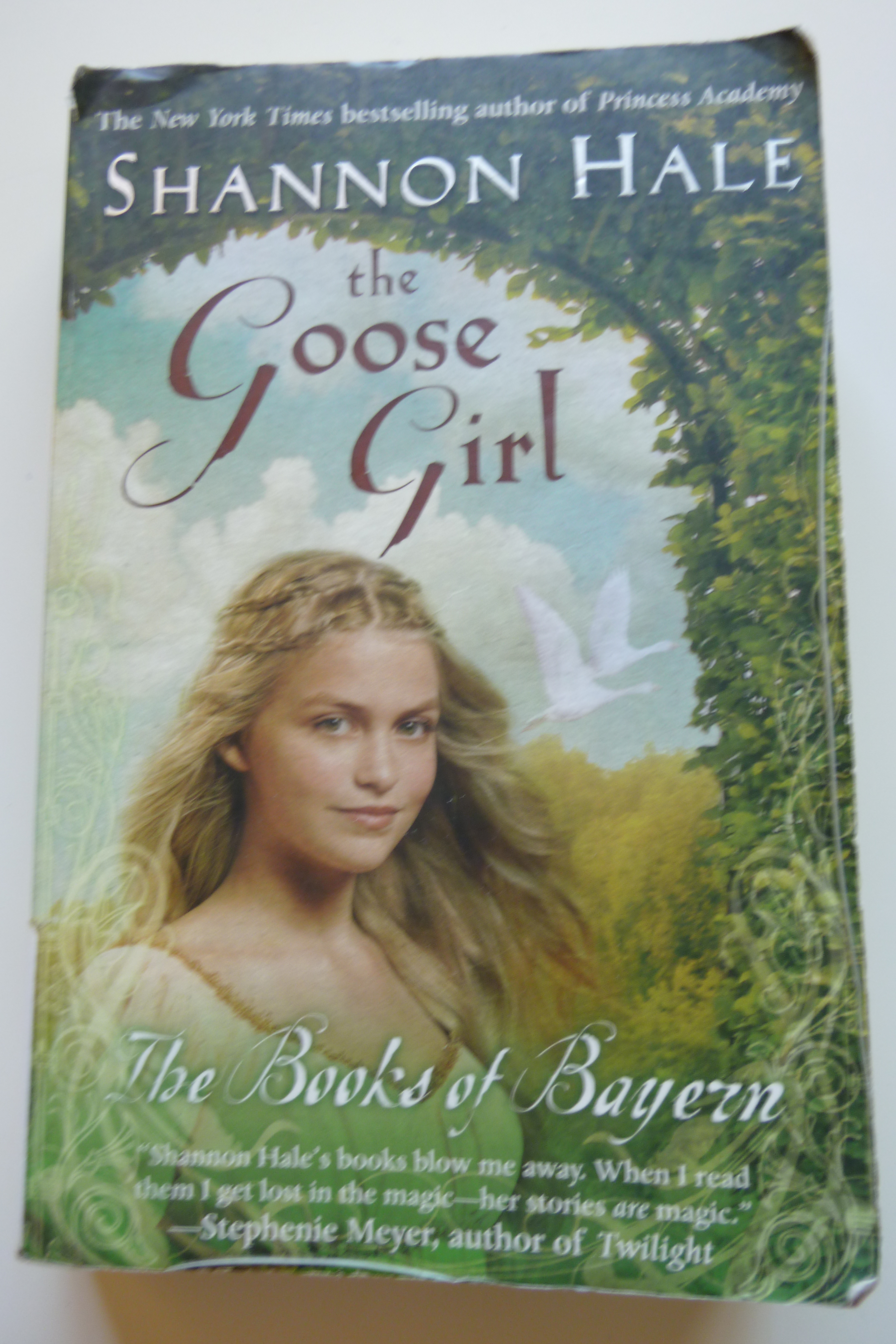
It made me a bit sad that my library’s copy of The Goose Girl by Shannon Hale was blurbed by Stephenie Meyer.  It’s a much better book than Twilight.

As you might guess from the title, this is another retold fairy tale, suitable for the Once Upon a Time challenge.  The Goose Girl is about Ani, a princess who’s never been very good at the job.  Her mother sends her to a neighboring kingdom to be married, but along the way her lady-in-waiting, Selia, stages a mutiny and usurps her place.  Ani makes her way to the capital, but has to hide from her enemies in the role of Goose Girl, tending to the royal flock.  And that’s where she begins to find friends–and her own strengths.

This book reminds me of a lot of other books, while being very uniquely itself.  It’s a story about a none-too-successful princess who has to find a way to save the kingdom.  There are plenty of books like that, but Ani and her particular path feel very different than most of them.  Most ordinary princesses are freckled tomboys.  Ani is a beautiful blonde who desperately wants to be a proper princess, but has lived all her life in the shadow of her strong-willed and charismatic mother.  Even though Ani tries very hard, she just doesn’t have her mother’s charm and poise, or talent for handling people.

Ani isn’t a plucky heroine who immediately sets about to save the day when the situation goes bad.  She spends much of the book hiding, with her primary goal being to save herself.  Somehow I liked that about her–she feels very real, and her challenges (and ultimate solutions) feel believable.  She’s a likable heroine with depth, and strength that emerges over the course of the book.  There’s some magic in the story (Ani can understand birds, and talk to her beloved horse), but it feels largely secondary to Ani’s personal growth, as she realizes her own abilities and begins to look beyond herself as well.

Hale’s writing is beautiful, with a nice fairy tale flavor while having much more detail and plausibility than the Brothers Grimm usually go in for.  She created a vivid world, with two countries that have clear cultures and customs.  And there’s some humor and romance in here too.

I thought the last hundred pages or so were somewhat dragged out, though the ultimate climax is exciting.  It’s a little hard to explain without spoilers; there was a plot twist that seemed unnecessary to me, and just pulled the story out longer before we got to the final confrontations.  The romance turns out rather convenient–but it IS a fairy tale retelling, so it’s just about what I would expect!  And it’s a sweet romance for all that.

If you like retold fairy tales, I’d recommend adding this one to your list.  The original “Goose Girl” has never been a particular favorite of mine, and I still thoroughly enjoyed this book.  Hale has made a wonderful story out of it–something she does consistently in other books too.  When people ask me about excellent fantasy authors, I’ve really got to start adding Shannon Hale to my litany (which goes something like, Tamora Pierce, Robin McKinley, Gale Carson Levine, Patricia C. Wrede and Diana Wynne Jones, if you were wondering!)

Author’s Site: http://www.squeetus.com/stage/main.html

Other reviews:
Reading for Sanity
This Blonde Reads
Liberating Libris
Anyone else?

Tim Burton and Johnny Depp’s Dark and Shadowy Movie

The movie world seemed to be all abuzz recently over The Avengers.  I was more interested in another release—Dark Shadows, directed by Tim Burton and starring Johnny Depp.  This is their eighth collaboration, and if you’re looking for something new, well…better find another movie.  But if you want another ridiculous, campy, shadowy Tim Burton/Johnny Depp movie, you’re in luck.

The story is about Barnabas Collins, and the Hell-fury of a woman scorned.  Barnabas makes the mistake of scorning a witch, who kills his parents, kills his true love, turns Barnabas into a vampire, has him buried alive, and spends the next two hundred years trying to destroy the Collins family fishing business.  When Barnabas is finally dug up in 1972, he finds that the family has dwindled to just a few destitute members, though they have hung on to Collinswood, the enormous manor house.  Uncle Barnabas resolves to restore the family fortune, while casting an interested eye on the new governess and sparring with the evil witch.

There is blood.  There is ridiculous make-up.   There’s Helena Bonham Carter, as usual upstaged by her hair (bright orange this time), and Christopher Lee in a small role.  There are bizarre plot turns, a shadowy gothic atmosphere, and a lot of laughs.  In other words, it’s the usual fare for Johnny Depp and Tim Burton.

I have no familiarity with the original Dark Shadows, so I really can’t comment at all on how this compares.  I could feel the soap opera origins at times.  I can easily imagine how certain plot twists and character revelations, which happen in five minutes here, would have furnished three weeks of plotline, soap opera style.  The movie doesn’t feel rushed, though—just wild and unpredictable.

The best part of the movie for me was watching Barnabas try to adjust to the world of 1972.  He’s blown away by a lava lamp, doesn’t know what to make of a paved road, and attacks a television trying to figure out how the tiny songstress is inside.  In one of my favorite moments, he mistakes the arches of a McDonalds for the sign of Mephistopheles over the gates of Hell (kind of apt, actually).  He has a wonderful conversation with a group of hippies about wooing women (the hippies impart great wisdom, such as that modern girls don’t care about sheep).  Johnny delivers endless completely absurd lines, and manages a straight face through the whole movie.  I really hope this DVD has a blooper reel!

This is not a deep movie.  If there’s a moral, I don’t know what it is (other than, possibly, don’t make a witch angry).  If it’s about any important issues, I don’t know which ones.  But it is full of dark, shadowy, slightly creepy fun.

You know, just like Johnny Depp and Tim Burton’s other seven films.

La Belle et la Bête

In my ongoing quest for more fairy tales, I recently watched the French film, La Belle et la Bête.  This is another one for Once Upon a Time‘s Quest on Screen.  The movie was…odd.  I’ve heard this one touted so much as a landmark film in the realm of fairy tale retellings, but sadly, I just wasn’t impressed.  I’d actually seen it years ago, in a mythology class in high school.  I was hoping that I was wrong back then–because I disliked it the first time through.  I liked it better this time, but I’m still not really a fan.

The movie is based on the story by Jean-Marie Leprince de Beaumont, as all Beauty and the Beast retellings seem to be.  Beauty’s father is a wealthy merchant who loses all of his money, forcing his family to live in poverty in the country.  This particular version involved poverty that still featured footmen and a big house, but they were supposedly fallen from greater means.  Beauty has two sisters who are greedy and horrible, while Beauty is kind and sweet and devoted to her father.  This movie does get points from me for including Beauty’s brother (the original had three brothers), the only version I’ve seen do that–and the brother was my favorite character.  Beauty’s father gets lost in the woods one dark night, and is sheltered at a magical castle.  When he makes the fatal error in the morning of picking a rose from the garden, a terrible Beast appears, and demands that the merchant send one of his daughters to live with the Beast.  Beauty, of course, volunteers, to save her father’s life.  And so it goes from there…

The movie was made in 1946, but felt more like it was from the era of The Thief of Bagdad than Casablanca.  I had trouble with the acting, especially Beauty.  She had the big limpid eyes of the silent film stars (which was fine) and she did a lot of strange head tilts and hands waving about (which was not).  There are a few scenes of her walking around the Beast’s castle, and nobody actually walks like that.  On the plus side, like the silent films, I was impressed by…I don’t know whether to call them sets or special effects.  Everything in the Beast’s castle is alive–the statues, the arms holding candelabras, and so on.  Those were well-done, and often achieved a very good, slightly creepy effect.  I also very much liked the music, which I think did a lot to set the tone.

The Beast I found hard to take seriously when he first steps out in the garden.  He’s, well, furry.  He’s just really obviously a man in a Beast-suit.  Which he would have to be, it’s live-action, but…he’s not that ominous when he’s just standing there.  However, he actually was creepy at later moments.  The camera pans in and he kind of looms and it’s much more effective.  He also seems to lose control at times; from a plot standpoint this wasn’t very good because I’m still not clear exactly what happened, but a couple times he wanders around the corridors looking lost and dishevelled with magical smoke coming off of him and blood on his clothes.  In a strange way, he’s much scarier when he seems scared and confused.

I never got very attached to the characters, though.  I don’t think the problem was that it was in French, with subtitles.  There are long stretches without dialogue at all, so I don’t think the language mattered that much.  It was more the style of acting and storytelling that got me.  I mentioned Beauty seemed to be coming from the silent film school of acting, and the Beast and her father also seemed somehow distant.  All three of them felt like fairy tale characters–more archetypes than people.  That’s why I liked her brother best–Ludovic is the only one who seemed liked a real person.  He’s something of a scoundrel but I think good at heart, and the only one with any sign of a sense of humor.

There’s a subplot here involving Ludovic’s friend Avenant, who is also a suitor for Beauty.  When the Beast turns into a Prince (sorry if that was a spoiler…) he turns out to be the same actor as Avenant.  I’m sure this was intended to say something symbolic, but it still felt disconcerting, especially because Beauty noticed it.  She comments that he looks like her brother’s friend, and I feel like that fractures some version of the fourth wall, or something.  A more serious issue (and more of a spoiler so I’m trying to dance around it)…let’s just say something is happening to Avenant at the same moment the Beast is turning into a man, and while they’re related events, I feel like it distracts from what should be the pivotal moment of the story.

So all in all, I’m glad I saw La Belle et la Bête, but it’s never going to be a favorite, and I don’t quite understand the excitement over it.  After we watched it in my class, I went home and watched Disney’s Beauty and the Beast.  The French film may be a landmark in cinematography and certainly is much closer to the original…but I enjoy Disney more, especially the characters.

I did very much like the opening of La Belle et la Bête, a written message from the director.  Translated, it reads in part: “Children believe what we tell them. They have complete faith in us…They believe in a thousand simple things. I ask of you a little of this childlike simplicity, and to bring us luck let me speak four truly magic words, childhood’s Open Sesame: Once upon a time…”

Fascinating Political Intrigue, Just Outside Tortall

Regular readers know that I’ve been re-reading my way through Tamora Pierce’s Tortall series for the last several months.  I’m finally down to the last two–the Tricksters series, a set of two books about political intrigue, revolution and of course some romance.

These books focus on Aly, the sixteen-year-old daughter of Alanna, heroine of Song of the Lioness.  Aly takes after her father more, George Cooper, former King of Thieves and current Assistant Spymaster to Tortall’s king.  Aly knows all about picking locks and picking apart codes, about hiding her thoughts and manipulating a situation.  She needs those skills when she’s captured by pirates and sold into slavery in a neighboring kingdom.  The stakes get higher when Kyprioth, the Trickster god, arrives to offer her a wager.

This series, unlike any of the others, is set almost entirely outside of Tortall, in the neighboring Copper Isles.  The isles’ natives, the raka, were conquered some three hundred years earlier, and have been living as slaves and second-class citizens ever since.  But there’s a prophecy that their royal line will one day be restored, and Aly finds herself in the midst of a brewing revolution.

This is maybe the most fascinating Tortall sub-series.  The intrigue and the plot twists and the thousand and one pieces Aly has to keep track of, especially in the second book, are all, well, fascinating.  It’s probably the most plot-driven series, and in some ways the most focused.

All that fascinating intrigue, however, also comes with some costs.  With a few exceptions, the characters aren’t as good.  The members of the Balitang family, which Aly is striving to protect, are all good, especially Dove, who’s wonderful.  And there’s Nawat, my favorite favorite favorite part of the book.  He’s a crow who turns into a man, and is just adorable and delightful and my favorite Pierce love interest (except George, because I also love George).  But there are also a lot of secondary characters who feel under-developed.  They’re fine for what they are, but when I compare them to secondary characters in other Pierce series, I feel like they could have been better.

As to Aly, similar to Keladry, I like her but don’t love her.  I also find her a bit less believable than the other heroines.  That’s two issues, so let me start with the first one.  Not loving her–I think she gets a poor introduction, and that first impression may be the biggest issue.  When the book opens she’s sixteen and frivolous and doesn’t get along with her mother.  That ought to be fine; plenty of sixteen-year-olds don’t get on with their mothers.  But her mother is Alanna the Lioness who I love and admire and spent years of my childhood wanting to be.  I admit, Alanna may be a very difficult mother, but if it comes to taking sides, I’m still never going to be on Aly’s side.  She is a really good, strong character and I enjoyed reading about her…but I don’t love her nearly as much as her mother.

As to believability, we meet Aly older than most of Pierce’s other heroines, and more established in her skills than any of them.  Usually, heroines go through a book or two (or three) of learning their abilities, of direct or indirect training, and only really come into their power by the end of the series.  Aly already knew everything she was going to know about spying and intrigue when we met her–and there we have a believability problem.  First, she is incredibly skillful for someone who has no actual experience.  It might be easier to believe if we had watched her learn all the theory, but we didn’t.  Second, George doesn’t want her to be in the field, and Alanna doesn’t want her to be a spy at all.  And yet…apparently George and Numair and Myles and all sorts of other intelligent characters we know from other books have been teaching her how to be a spy her whole life.  Some of it I’ll believe was meant to be games or more general skills…but George taught her how to overcome fear spells and Numair taught her how to create elaborate lies that no one could see through.  They taught her that level of skill, and didn’t expect her to use those skills?  Not quite consistent, that.

Still, despite a few issues, it’s a fascinating, intriguing, exciting, suspenseful book.  There are some wonderful twists, occasional humor, and a handful of excellent characters.  And there’s Nawat.  It’s all worth it just for Nawat, and fortunately he’s not the only bright spot of the book anyway!  I’ve also been re-reading Tortall and Other Lands, Pierce’s collection of short stories, reading the stories relevant to each series as I come to it.  One of the best is a story from Nawat’s point of view, about a year after the Tricksters series closes.  Definitely worth reading as well!

And that brings me to the end of my Pierce reading–it was a wonderful adventure, and I have corrected a great wrong in my world, that it had been ten years since I read some of these much beloved books.  If you’d like to read my other reviews, here are the links:

Song of the Lioness
The Immortals
Protector of the Small
Beka Cooper: Terrier, Bloodhound, Mastiff
Tortall and Other Lands

Author’s Site: http://tamorapierce.com/

Other reviews:
Reviews from the Hammock: Trickster’s Choice and Trickster’s Queen
Ems Reviews
Emma Michaels
Yours?

Twelve Princesses, Plus One

What if the twelve dancing princesses had another sister?  That’s the premise of The Thirteenth Princess by Diane Zahler, retelling the fairy tale of the twelve dancing princesses from the point of view of their youngest sister, Zita.

This story starts out by tackling the question of why the king and queen opted to have quite so many children.  The king desperately wanted a son (as kings usually do, in medieval-type kingdoms), but instead, daughter after daughter was born.  Finally, the queen died giving birth to the thirteenth princess, Zita.  The king blames her for the death of his wife, and the end of his hopes to have a son, and banishes her to live in the kitchens as a servant.  As she gets older, she finds ways to secretly spend time with her sisters, and when they became mysteriously ill (and their dancing slippers keep mysteriously wearing out), Zita and her friends have to investigate to save the princesses.

I have mixed feelings about this one.  It’s a cute story about a spunky girl, and it is nice to see a girl with close ties to the princesses rescue them, instead of a strange man coming in to save the day, as happens in the original. There’s some good description, especially about the damp, moldy castle–because when you think about it, a castle built over a lake probably would be moldy!

Somehow this just didn’t quite grab me, though.  I don’t think it’s only that I’ve read so many versions of the fairy tale.  There really are some issues here.  For one, while the essential concept of the youngest, semi-banished princess is interesting, it also felt contrived.  It’s hard to imagine a king actually doing this, or having his court go along without batting an eye.  The king has twelve daughters who live like, well, princesses, and one who’s banished to the kitchen.  It almost feels like a story about child neglect, with a parent who targets just one child, while a lot of good people watch this happening and don’t do anything–everyone in the castle knows what’s going on, and no one does anything.  I don’t think Zahler was trying to write social commentary, but the situation creates a strange undertone to the story.  Zita isn’t being abused, but she’s still in a dramatically different situation than her sisters, while right alongside them.  It is, at the very least, incredibly socially awkward, to an extent that I don’t feel like Zahler really dealt with.

Zita’s separation from her sisters and status as a servant are essential to the plot, but I wish Zahler had found a different way to set that up.  Create a question about her parentage (though that could be dicey in a Juvenile book), or say that her identity had to be hidden, or something…

The focus on Zita’s story also means that we spend less time on the twelve older princesses.  I’ve already seen authors with longer, more-focused books stumble over dealing with a cast of twelve princesses.  They’re often under-developed as characters, but this book is one of the worst for that.  Arguably, they were never meant to be developed, since the book is about Zita, but it’s about Zita’s relationship with her sisters, and the major conflict of the plot is how to save them…so for the book to work, we have to care about them.  Other than in a vague, general way, I don’t.  They’re perfectly nice girls, but I don’t care about them as individuals.

Zahler doesn’t help matters by giving all the princesses A names–Aurelia and Alanna and…I can’t remember any of the others.  I’m on shaky ground criticizing that decision, since when I wrote a retelling, I gave my princesses A names too (but mine all have nicknames and are rarely called by their identical-sounding A names).  The only princess who’s developed at all is Aurelia, the oldest.  The others occasionally get a comment in the narration to say that one likes to read or another is the prettiest or whatever, but none of that really goes anywhere.  I only remember there was one named Alanna because of Tamora Pierce, and I don’t remember anything about that particular princess anyway.

On the other hand, Zita is a pretty good character, marked by strong loyalty to her sisters, and she’s in an interesting place trying to figure out her role and her relationship to her family.  I don’t feel like that was explored quite as much as I’d like, but there was at least some good character development there.  Her friends are Breckin the stable boy and Babette, a witch they meet out in the woods.  They’re both reasonably good characters, if somewhat straight-forward in their friendship for Zita and their desire to help the princesses.

I think that might be the key to my reservations about this book.  There are themes and characters that could have been more complex, and weren’t.  What IS there is good, fun, interesting…but the book feels like it could have been more.  I’m sure there are those who would tell me that this is a kids’ book, so how complex does it need to be…but I’ve ranted before about how deep kids’ books can be.  This book is set up to be about parental neglect, sibling rivalry, discrimination (against magic-doers), thwarted love, and class divisions…but most of that isn’t really dealt with.

It’s a fun little story, and if you want a light, quick read, it’s a good one.  But don’t expect it to be more, and if you only have time for one novel about the Twelve Dancing Princesses, there are others I’d recommend instead.

Author’s Site: http://www.dianezahler.com/

Other reviews:
The Bookwyrm’s Hoard
Debz Bookshelf
Eva’s Book Addiction
Anyone else?