After Waking the Princess

What happens after the hero kisses the sleeping princess?  It’s far more complicated than “they lived happily ever after,” especially when the hero is from the modern world and knows nothing at all about swinging swords or fighting evil witches!

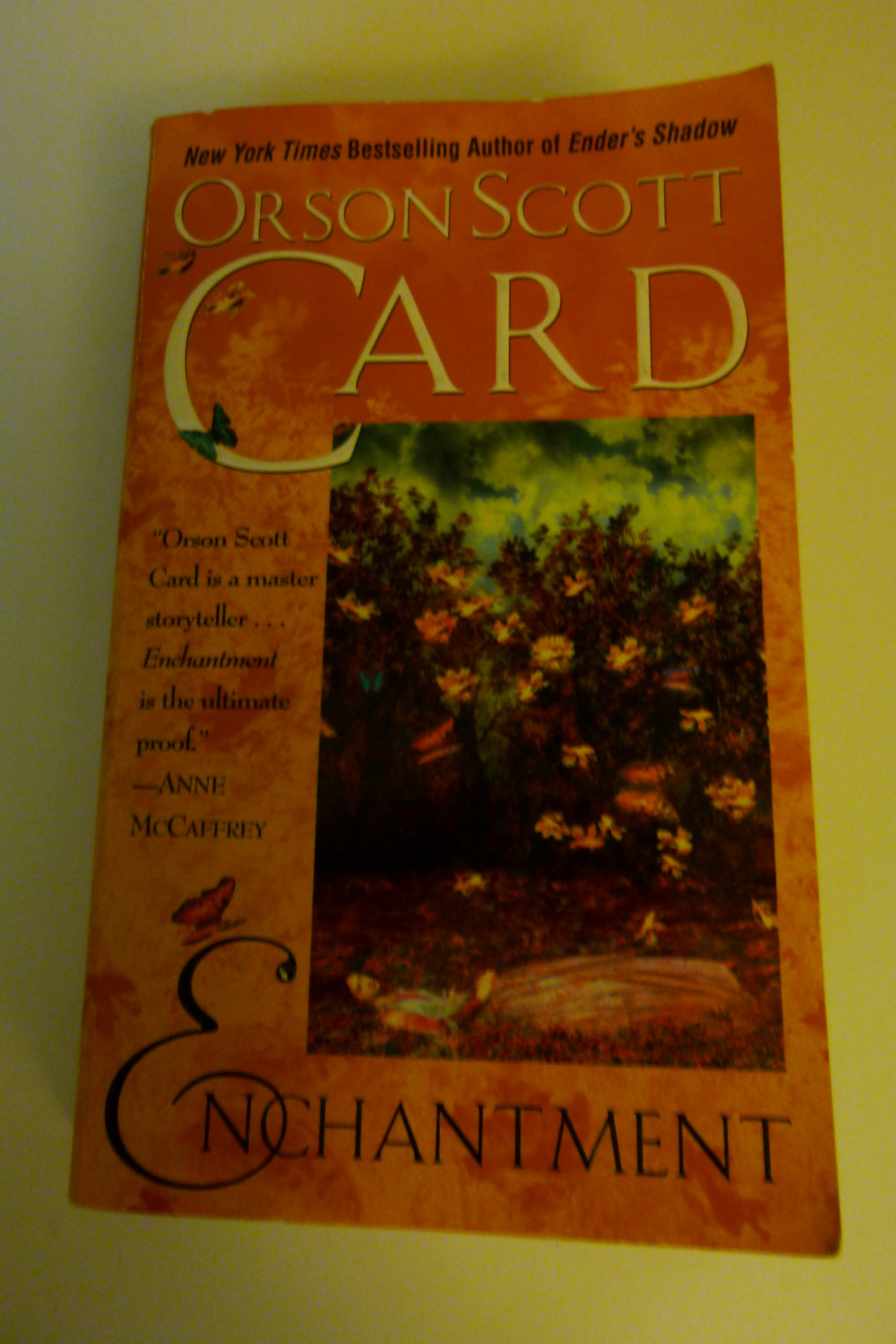
Enchantment by Orson Scott Card was my second book for the Once Upon a Time Challenge, and it also goes towards my Dusty Bookshelf challenge.  Abridged background: I picked it up at a book swap my book club did, I think roughly last summer.  I picked it up because, well–Orson Scott Card!  At the time I actually hadn’t read anything by him, but I had been hearing about Ender’s Game forever (which I did finally read).  I was also intrigued by the plot summary: as a child, Ivan sees a sleeping princess in the forest one day, and runs away.  But then years later, he comes back…

That was all that was in the summary, and it turns out to be only the very beginning.  It also wasn’t clear until I turned to Page One that Ivan lives in the modern world.  He’s from Eastern Europe, though his family emigrates to America when he’s a child.  He returns to Ukraine to work on his dissertation on fairy tales, and ends up drawn to a clearing in the woods, where he finds the sleeping princess he had convinced himself he imagined.  He fights the bear guarding her and wakes up Katerina, a princess from the 9th century.  He ends up back in her time, where the imminent threat of Baba Yaga is just part of his troubles.

I love the concept of this one.  It gets at some great questions about the original fairy tales, and points up a fundamental problem usually ignored–the man waking the sleeping princess is not necessarily at all suitable to be king, or to marry the princess!  Ivan goes through a lot of trials trying to deal with the society of the time, from his lack of prowess with a sword to disconcertingly different views on nudity.  I especially liked it that Ivan goes into this with a scholar’s knowledge–his focus is old fairy tales, so he knows how the stories work, a fair bit about the history, and also what Disney says about it.  One of my favorite moments is when he arrives in Katerina’s village and is trying to reconcile what he’s seeing with his historical knowledge, and with Disney’s Sleeping Beauty.

I did have some trouble getting into this book.  The beginning is spent on Ivan and his life in the modern world; it’s necessary, but it also dragged a little.  It picked up when he woke up Katerina.  I liked the part in the past (although I think I liked the IDEA a little more than the actual handling of it).  The book really got good for me when Ivan and Katerina come back into the modern world (slight spoiler, but it’s only halfway through).  Besides how interesting it is to watch Katerina deal with the modern world, there are some fascinating revelations about Ivan’s family and, perhaps most important, the story gets much more focused on the fight with Baba Yaga.

The characters didn’t make a huge impression on me, good or bad.  Katerina and Ivan’s relationship was ultimately satisfying, although at times I thought Card was a little heavy-handed about it.  They spent much of the book misunderstanding each other, and there was a little too much of “Oh, I thought he meant THIS but what if he meant THAT and in that case maybe I’ll feel THIS way instead of THAT way…”  Less explanation and analysis probably would have been preferable.

Despite being a fairy tale, this is definitely an adult book.  It’s adult-level writing, and also Baba Yaga has a thing for torture.  There isn’t huge detail, but there’s enough.

On the whole, a good book.  I liked it.  I didn’t love it.  I don’t plan to keep it because I don’t see myself as likely to revisit it–but it was good to read once.

Author’s Site: http://hatrack.com

Other reviews:
Breathing Fiction
Wynter Adelle
Semicolon
Anyone else?
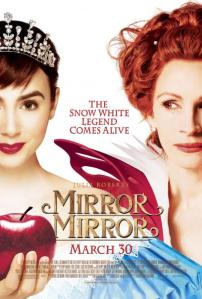
…On the Wall

I told you how excited I was for Mirror, Mirror, didn’t I?  I had another excellent time at the movies this weekend!  Whatever’s going on in Hollywood lately, they have put out excellent movies this past month.

Mirror, Mirror is a very funny retelling of Snow White, putting it squarely on the track for the Once Upon a Time Challenge‘s Quest on Screen.  As the original story has it, Snow White has grown up under the control of her wicked stepmother, who is desperately jealous of Snow White’s beauty.  The Queen is inspired to take more drastic steps when a handsome prince arrives and is a little too interested in beautiful Snow White.  The Queen sends Snow off to the woods to be killed–and sets about to marry the prince herself.  Snow meets up with seven dwarfs who turn out to be bandits, reads them a lecture on not robbing poor people, then bands forces with them to fight the Queen instead.

From the beginning, what drew me to this movie the most was Julia Roberts as the wicked queen.  She was delightful–one of those terribly sweet and poisonous villains.  And oh-so-campy!  She looked like she was having enormous fun with the part.  She gets some snarky lines and occasionally brings a note of practicality to the fantasy world.  For instance, when the prince goes on about Snow White’s ivory skin, the Queen points out that Snow is eighteen and has never been outside, so of course she has good skin!  She’s not an epic fantasy villain evil queen, but she’s a very funny one–vain, condescending, self-absorbed, insulting, and utterly unable to concentrate while looking at Prince Charming’s bare chest.

Actually, it was Prince Alcott (which just made me think of Louisa May–anyone else?), played by Armie Hammer.  You might know him as the Winklevoss twins in The Social Network.  Only one of him this time, but still very attractive, and shirtless more than once (he keeps having unfortunate run-ins with those bandits…so it’s all very plot-relevant, really).  As a character, he’s a bit of a boor at times, but seems to have a good heart.

Lily Collins played Snow White (utterly unrecognizable from her role in The Blind Side), and she was a refreshing take on the character.  This was a sweet but also smart and scrappy Snow White.  And the dwarfs, while not as entertaining as their counterparts in Once Upon a Time, were nevertheless quite amusing.

And of course, no proper Wicked Queen would be without a down-trodden flunky, played in this movie by Nathan Lane.  He’s squirmy, devoted and lacking in all self-respect, as a down-trodden flunky should be.

Another fun side to this movie were the visuals.  I loved the set-design–the Wicked Queen has this gorgeous open-air bedroom with breathtaking views that I really want (aside from the practicalities of it).  The dwarfs apparently had the same architect as Peter Pan, with an underground home that you can reach through a hollow-tree, which looked both cosy and claustrophobic.

Then there were the costumes.  Oh, the costumes.  So many hoop skirts and massive bows and mounds of fabrics and headpieces that must have required special training in balancing.  Utterly fantastic.  There’s a masquerade at one point, and there are so many wonderful headpieces–and the prince has incredibly amusing bunny ears.

This is not a deep movie or a terribly complex movie and it doesn’t have terribly complex characters, but if you want some light-hearted fun with attractive costumes and an attractive leading man, it’s a good day at the movies!

Movie site: http://mirrormirrorfilm.com/

Beauty and the Roses

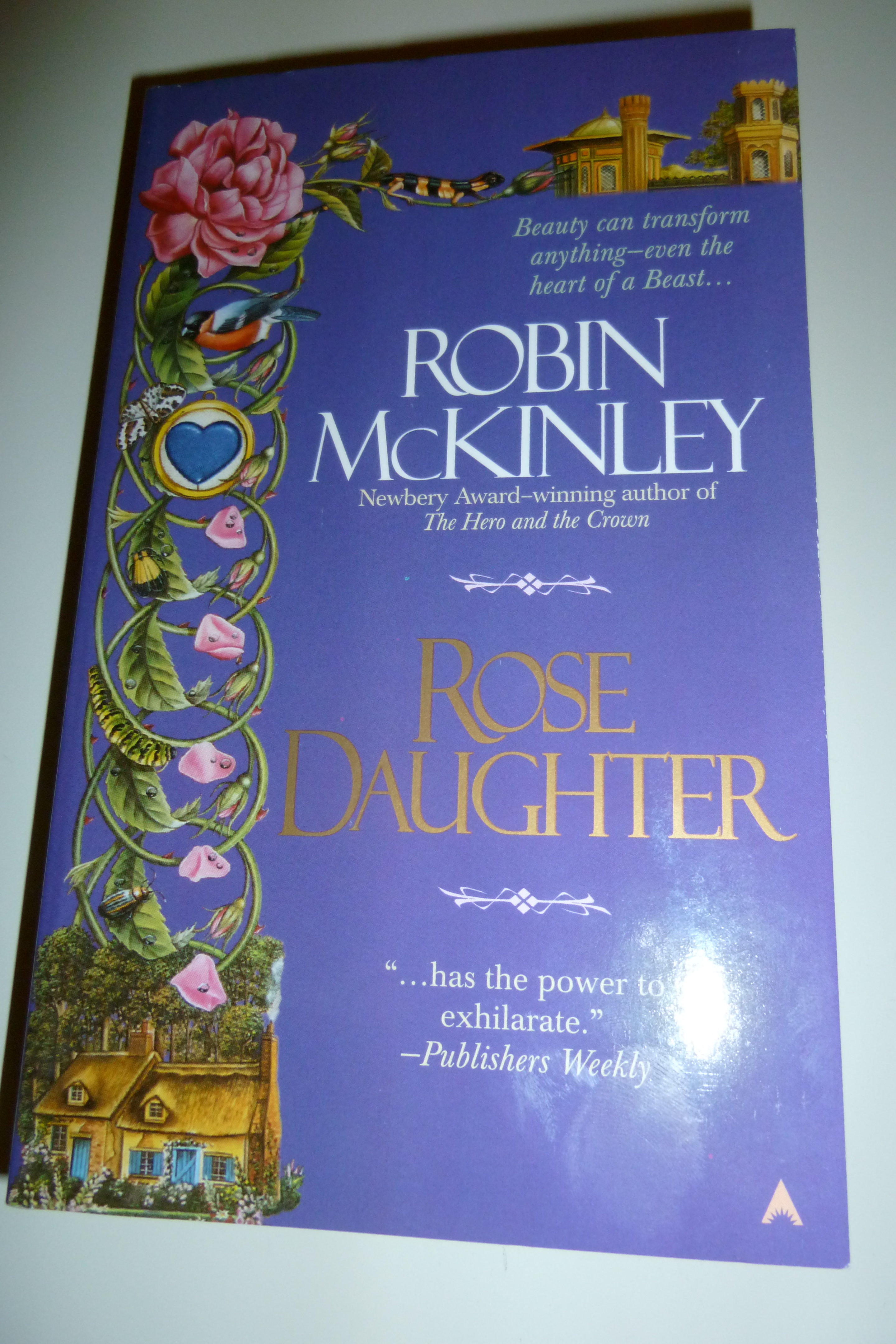
It’s always a joy to come back to a beloved book, and find out you still love it on a reread.  But it’s even better when you find out you love it even more.  That happened to me with Rose Daughter by Robin McKinley.  I’ve read it at least once–maybe twice–and I always liked it.  But this time I really loved it.

Rose Daughter is a retelling of Beauty and the Beast, and my first book for this year’s Once Upon a Time Challenge.  I was excited to jump into the challenge, which is why you’re getting a third book review this week!

I don’t have a lot to say about the plot, because mostly there aren’t surprises here (except when there are, and that’s too far into the book to discuss without ruining it with spoilers!)  There’s a ruined merchant and his three daughters, there’s a mysterious castle with a mysterious Beast, and there are roses.  Lots and lots and LOTS of roses.

You may be thinking–didn’t McKinley write another story with this plot?  A few less roses, but still the same story?  She did–Beauty.  But the amazing thing is how different the books felt to me, even though they are essentially the same plot.

I’ve said before that I am hugely impressed by the different writing style in McKinley’s different books, and that’s very true in these two.  Beauty is practical.  There’s magic, but it’s magic that exists in a very reasonable, understandable world, with real people and commonplace concerns.  Even the magic has a slightly homey feel to it, from winds that scold and candles that whisper “Psst, wake up!” when one of their number forgets to light.

Rose Daughter is surreal.  The Beast lives in a constantly changing castle where laws of time and space simply don’t apply.  The magic is somber and imposing and a deeply serious business, powerful and ominous.  Even the world outside the castle feels more like something wild and strange, a world where everyone’s names reflect who they are (Beauty’s sisters are Jeweltongue and Lionheart), and there are mysteries and magic and curses.

While I always liked Rose Daughter, I also preferred practicality to surrealism.  I’m not sure what happened since my last reading, if it’s just that I got older or if it’s that I read more Brothers Grimm, but I loved the style of Rose Daughter this time.  It really may be that I came to it shortly after writing my own Brothers Grimmesque stories, and this is a Brothers Grimmesque book: the names, and flowery ornateness of the writing, smack of the Brothers Grimm (even though they didn’t write a version of “Beauty and the Beast”).

The writing is just gorgeous.  I love the descriptions, of feelings and flowers and smells.  There are long passages about flowers, but don’t be offput by that.  I’m not even fond of roses, but I never got bored by the book–and it kind of made me want to have a love affair with roses, even though I’ve been in a very happy relationship with daffodils for years.  Based on other reviews, it seems to make many people want to go out and plant rose bushes.

I think, in my heart of hearts, I do still love Beauty better.  I like that Beauty a bit better than this one, and I definitely like her romance better.  Much as I love Rose Daughter, the relationship with the Beast just didn’t appeal to me as much.  But I do love Rose Daughter, and it is a truly, truly beautiful book.

McKinley wrote an Author’s Note about the inspiration that led to Rose Daughter, and mentions that it came twenty years after Beauty–so maybe the story will come back to her in a new form in another twenty years.  That was in 1996, so if that prediction comes true, we only have four years to wait!  If I could, I’d put in my preorder today.

Author’s Site: http://www.robinmckinley.com/

Other reviews:
Angieville
Dodging Commas
Fyrefly’s Book Blog
Others?

Talking to Animals, Fighting Monsters

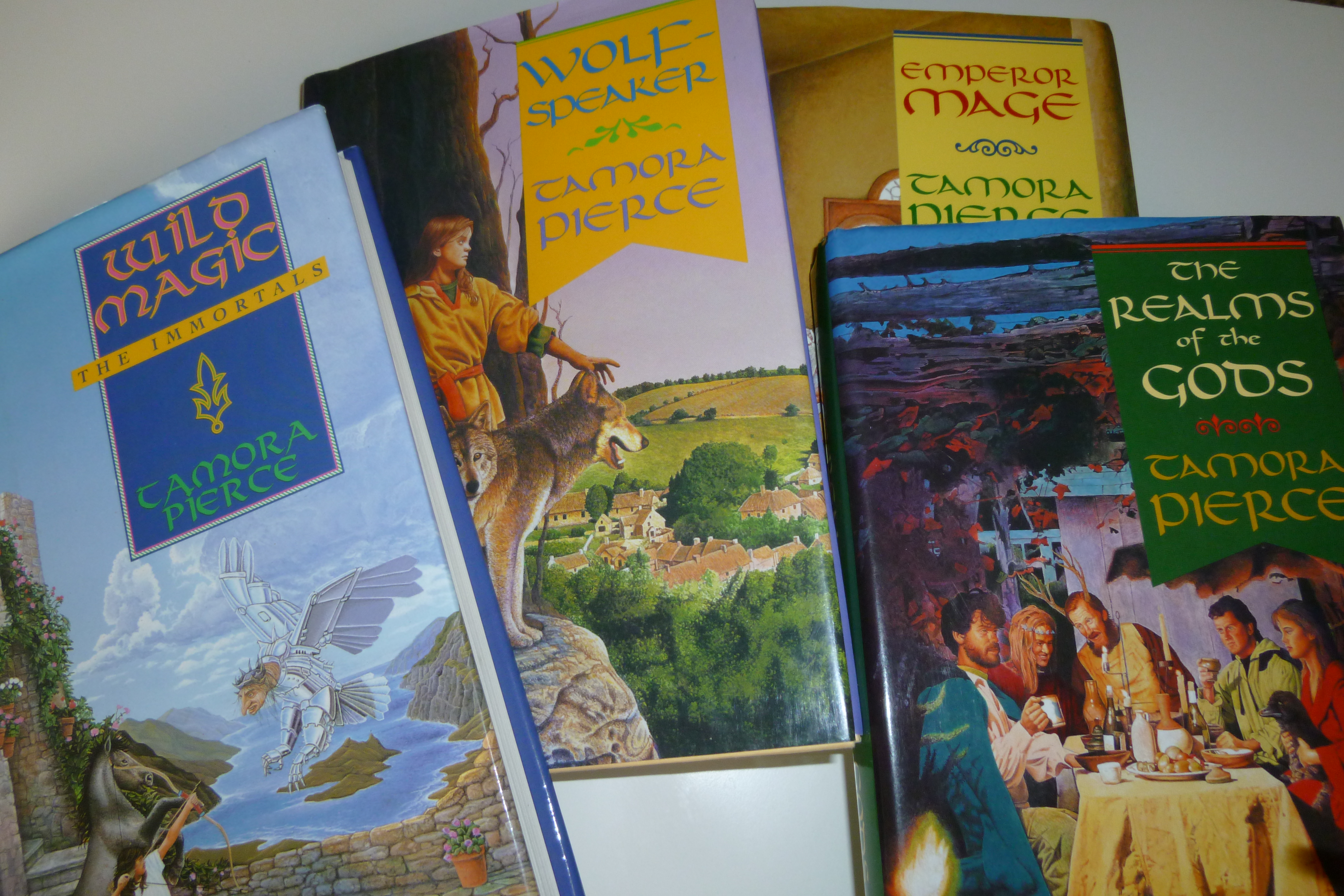
It’s not one of my reading challenges, but I have a personal goal this year to re-read Tamora Pierce’s Tortall books.  I’ve been reading her new books as they come out, but it had been years since I read the older ones.  I re-read the Song of the Lioness quartet in January, and it really is just unutterably wonderful.  In February, I re-read The Immortals quartet–and that’s my subject today.

The Immortals quartet is always referred to in my mind as the Daine books.  The main character is Veralidaine Sarrasri, an orphaned girl who discovers that her “knack with animals” is actually powerful magic.  She comes to Tortall (the setting of Song of the Lioness); she finds a job caring for horses for the Queen’s Riders, and finds a mentor in the magician Numair Salmalin, who helps her learn to use the wild magic that lets her talk to animals.  Meanwhile, the realm is threatened by strange magical creatures, who were locked in the Divine Realm 400 years before and are now escaping.  These are the immortals–they can in fact be killed, but will live forever if they aren’t killed.  Many of the creatures are in league with Emperor Ozorne of Carthak, who seeks war against Tortall.  Daine and her friends, human, animal, and even immortal, have to unite to defend against the threat.

The quartet opens almost ten years after the end of Song of the Lioness.  Many of the major characters from the first quartet come back in supporting roles here, and I LOVE seeing Alanna, George, Jonathan, Thayet and all the rest back again, and finding out what they’ve made of their lives.  The new characters are good too.  Numair is great fun and often quite funny–at one point he’s turned to stone, breaks free of the spell, and asks the spellcaster to do it again so he can try to break out again.

Daine is a lovely heroine as well.  She grows a lot, both as a person and in her magic.  Her magic develops, finding new abilities in every book.  At first she can only talk to animals; then she learns to inhabit their minds, then to change shape herself.  She also starts out very friendless, hesitant to trust anyone, absorbed only in her own life, and grows into relationships and a position of importance in the world.  She also grows in her understanding of the immortals, realizing over time that they’re more than just monsters.  She does find a place among very important people very quickly, which feels a little contrived–but only a little.  It’s mostly justified by circumstance, and also by what I know of the characters.  Queen Thayet’s friendliness to a strange girl from another country has more to do with Thayet than with Daine.

Other than Daine and Numair, the other characters that stand out the most to me are the animals and the immortals.  Daine has at least one animal sidekick in every book.  In the first it’s her horse, Cloud, who feels she has to take care of Daine and keep her from doing anything foolish.  By the second book, Daine has adopted Kitten, a baby dragon.  There’s also a wolf pack in that one, and a squirrel I just love.  In the third book there’s a tiny monkey, and the fourth book introduces the darkings, inkblot-like creatures who are surprisingly adorable.  And there’s Rikash, a Stormwing–half human, half metal bird–who brings Daine to see that even Stormwings, one of the most vile of the immortals, are more than just monsters.

These are in many ways more fantastical books than Song of the Lioness.  There’s certainly magic in the first quartet, but it feels different.  Magic is more like a tool, one Alanna uses or that her enemies use against her, or it comes up as part of rituals.  For Daine, magic is a way of life.  She’s constantly using her magic one way or another, her closest friend is a magician, and she’s always fighting magical creatures.  It creates a different feel; in some ways it may make Daine a little harder to relate to, although it’s certainly a lot of fun to read about.

I love this quartet, although I will acknowledge it’s not quite on a level with Song of the Lioness.  A few times there were point of view switches that bothered me, especially in the beginning of the first book, and sometimes the characterization seemed just a touch off–people weren’t saying things I thought they ought be saying.  Those are relatively minor, though, and I mention them only because I know this was written after Song of the Lioness, and it makes me wonder if that quartet has issues too, only I’m so swept along by the characters and the plot that I don’t notice them!

A bigger issue in The Immortals is the romance.  I don’t like it.  I’m sorry to people who are fans of it, but I just don’t.  I don’t want to give spoilers but…I will say Daine ends up with a character who is in all four books, but their relationship is very different in the first two books.  In the third there are a few hints of something, but everything could very easily and reasonably be interpreted according to the earlier basis of their relationship.  And then in book four there’s suddenly a romance.  And I just don’t like it.  It’s a particular kind of romantic story arc that almost never works for me.

But don’t be put off by that.  Because whatever the minor issues of the books are, they’re still wonderful to read.  I won’t say they changed my life, but they’re certainly another great example of a strong female lead in fantasy, and there’s a good message about everyone having strength and value.

Author’s Site: http://www.tamora-pierce.com/

Other reviews:
My Advice to Avoid Being Laughed Off the Page (includes spoilers)
Kathy Takes on Books
The Sleepless Reader
Tell me about yours!

Wicked, Sans Singing

The library's battered copy

In January, my book club read Wicked by Gregory Maguire.  Funnily enough, this was my second time reading it for a book club.  My high school book club read it too–although I think if the teacher had read it beforehand, we wouldn’t have.  To settle one question right away, this is not a young adult book–don’t let the picture of the witch or the Oz connection fool you.

Wicked tells the backstory of Elphaba, the Wicked Witch of the West.  If you think you know about the book because you’ve seen the musical, trust me, you don’t.  The two are really only similar in very broad strokes.  Elphaba is a girl who was born with green skin, to the consternation of her family.  In college, she finds herself rooming with Glinda, a bubbly society queen.  After initial dislike, the two form an unlikely friendship.  Later on as adults, they both end up using magic in positions of power over sectors of Oz…and one day a girl named Dorothy falls out of the sky to impact both their lives.

The musical tells the story above.  The book does too…but it takes some 500 pages about it, and crams a whole lot more in.  As you may guess already, I had troubles with this book.  I feel a little more on uncertain ground when I criticize a book that is clearly very popular, so let me preface it this way–these were my problems with the book.  If someone else found it brilliant, insightful and life-changing, I accept your opinion.  But this is how it came off to me.

Part of the problem was in the characters, which may come down to point of view.  It’s hundreds of pages before we actually get into Elphaba’s point of view.  Maguire has a disconcerting habit of spending 90 pages from the POV of a particular character, only to then have them completely or nearly disappear from the story as soon as their section is done.  Result: even though this is the backstory of the Wicked Witch, it still felt hard to get any sense of her character, of her motivations, of her hopes, dreams and desires…and so on.  For me, the musical does it all in two songs: “The Wizard and I” and “Defying Gravity.”  The book is 500 pages and doesn’t do it as well.  (And also, I don’t think the book-Elphaba would sing either of those songs.)

Another problem is focus.  Part of our book club discussion (in January, not in high school) was about what Maguire’s purpose was in the book.  It really seems to not be the characters at all.  In many ways he seems far more interested in examining the meaning of good and evil, and the politics of life in Oz–the conflicting religions, the issues of Animal rights (not the same as animal rights), the folklore of history and the questionable rule of the Wizard.  All of these are perfectly good elements…but leave something to be desired as the primary focus of a very long book.  It ended up feeling scattered to me, with too many plot threads and minor characters, interwoven with politics and philosophy.

Maguire was clever in some of the ways he built off of Oz–the green skin, the aversion to water, the talking animals and the tiktok creatures.  Some of it is from the movie, some of it is from the book series, and some of it really is clever.  Some of it is also drawn from the real world and brings the book into a position of satire–which is some of that endless politics and philosophy, but some of it is fine.

And then there were parts that just seemed to be shock value, bringing me to another problem.  This isn’t young adult partially for the philosophy but mostly because Maguire at times seemed to decide to be vulgar just for the sake of being vulgar.  I really think the point was just to say, “this isn’t the Oz you think you know.”  An adult Oz is fine–but gratuitous vulgarity is still gratuitous vulgarity, and there have to be better ways to say that this isn’t the land of sweetness and light that L. Frank Baum wrote about.  Just like kids books can delve into deep issues, you can tell an adult story without making it inappropriate for kids.

The remaining big issue I have with the book vs. the musical is the relationship between Elphaba and Glinda.  In the musical, they clearly are for each other that one best friend who forever changed them, and even if they haven’t seen each other in years they still have a bond.  In the book, they’re both part of the same circle of friends, fond of each other but not in a soul-altering way, and years later they’re just a couple of former friends who had lost touch.

The musical narrows the story’s focus, concentrates on just a few characters and deepens their portrayals and their relationships with each other.  The book is scattered all over the place, and while it has deep examinations of the meaning of evil and of Ozian politics, it doesn’t get very far with any characters.  I still don’t feel like I fully understand the Wicked Witch’s motivations.  At the end, Maguire pulls the “and then she goes crazy” card, and her final confrontation with Dorothy is just a confused semi-farce.

It’s too bad, really, because I LOVE the idea of telling the life story of the Wicked Witch of the West.  I know the book is wildly popular, but I still feel it falls short of what might have been.  I have no idea how anyone ever looked at the novel and thought it could be a musical, but I’m glad they did–because that’s the better place to go if you want the story of what happened before Dorothy got to Oz.

Author’s Site: http://www.gregorymaguire.com/home.html
Musical’s Site: http://www.wickedthemusical.com/page.php

Other reviews:
My Personal Cafe
Ermilia
Nikola’s Book Blog
Zombie Mechanics
Tell me about yours!