The Author Who Brought Together So Many Classic Literature Elements in a Book of Her Own Making

I’ve mentioned, haven’t I (I have), that I love classic children’s fantasy.  So to those familiar with the book, it will be no surprise that I found The Girl Who Circumnavigated Fairyland in a Ship of Her Own Making by Catherynne M. Valente to be absolutely delightful.

The Girl Who Circumnavigated Fairyland follows the time-honored traditional fantasy plot of an ordinary child spirited away from the drab world to strange and magical lands, to meet dear friends and fight evil and have adventures.  This book was a bit The Phantom Tollbooth and a touch Alice in Wonderland, with more than a little L. Frank Baum, a dash of C. S. Lewis at the end, had a narrator who could be sitting in a pleasant study somewhere with J. M. Barrie–and there was some that was just pure Valente.

The story centers on September, who lives in Omaha until one day she’s carried away by the Green Wind to go to Fairyland.  In Fairyland she accepts a quest to help a witch named Good-bye, meets A-through-L, a wyverary (a cross between a wyvern, which is rather like a dragon, and a library), and finds herself pitted against Fairyland’s oppressive ruler, the Marquess.

The characters and the places September visits have all the whimsy of L. Frank Baum.  The capital city of Fairyland is Pandemonium, which good Queen Mallow wove out of thread–so all the cities are cloth.  September catches a ride with a herd of bicycles, and goes to Autumn, where it’s perpetually Fall.  She meets a community of Nasnas, where the people are halves (right down the middle vertically), and are only whole when they join up with their twins.  It’s strange and sometimes funny and very whimsical.

The narrator came from the same school of storytelling as J. M. Barrie.  My favorite character in Peter Pan is the narrator, who really seems to be sitting somewhere telling you the story, complete with occasional moments when I-the-narrator directly addresses you-the-reader.  Valente uses the same trick here, comparing one place to your grandmother’s house, and promising that I-the-narrator hasn’t forgotten about a subplot you may be wondering about.  Like Barrie, it’s charming.

This is the first novel I’ve read by Valente, so I’m not much qualified to comment on her overall writing style–but I did read a short story, in Troll’s-Eye View, which was what led me to The Girl Who Circumnavigated Fairyland.  I had heard about the book, but somehow it didn’t quite grab me.  Then I was so blown away by her short story, I decided I had to try the book.  The short story was beautifully written–magical, dark, creepy and wonderful.  Parts of this book were dark, a bit was creepy, and a lot of it was beautiful and magical and wonderful.

The dark bits brought just a little realism into the fairy story.  I love Baum and Barrie and all the rest, but no one ever bleeds, or gets really, really tired, or really, really hungry, or has to deal with deep-down-scary choices.  September gets into some very hard spots.  It was just enough to make me think, yes, this is what a child questing through Fairyland would really go through, without being too much and losing all the magic and whimsy.  The creepy bit was primarily at one point when September starts to turn into a tree–a crumbling, winter tree, with cracking branches and shedding leaves.  Beautifully written.  So scary.

If you’ve read the classics, read this book.  If you haven’t read the classics, read it anyway, then go read the classics.  And then, hopefully, come back to Valente again–I’ve been searching her website and I can’t find a promise of a sequel there, but the book itself promises one.  I think I’ll end with that quote (no spoilers)–and it’s such a beautiful line, it may do more than anything I can say to convince you of the loveliness of this book:

All stories must end so, with the next tale winking out of the corners of the last pages, promising more, promising moonlight and dancing and revels, if only you will come back when spring comes again.

Author’s Site: http://www.catherynnemvalente.com/

Other reviews:
Things Mean a Lot
The Little Red Reviewer
Tethyan Books
Tell me about yours and I’ll add a link!
Twelve More Dancing Princesses

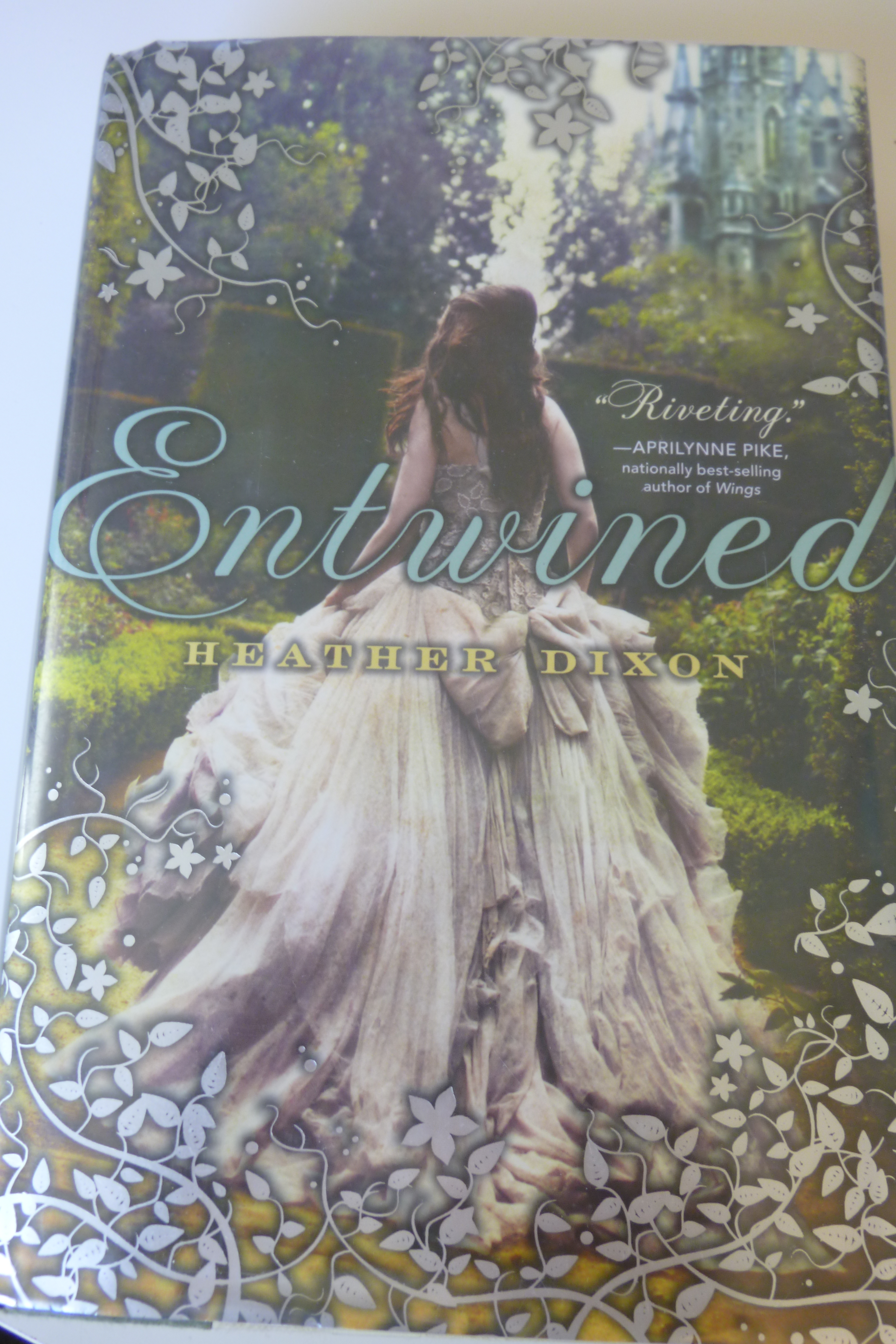
Entwined by Heather Dixon is one of those books I saw make the rounds of several blogs I follow.  And of course I was intrigued–it’s another retelling of “The Twelve Dancing Princesses.”  I reserved this at the library months ago, but the hold list was so long, it finally looked like it was about to come in during November.  Since I was spending November writing my own retelling of the same story, I didn’t want to read this then–I was sure I’d end up subconciously plagiarizing something!  So I put my request on hold, and finally read it in January, after finishing my own novel.

Entwined centers on Azalea and her eleven sisters, all named for flowers or plants and helpfully in alphabetical order: Azalea, Bramble, Clover, Delphinium and so on.  I frequently had to run through the alphabet to figure out the approximate age of, say, Jessamine or Kale.  The princesses’ mother dies early in the book, and the official rules of mourning restrict them from dancing for a year (among other things).  The girls discover a hidden passage leading off their room, relic of a magician-king from two hundred years ago.  They find an enchanted silver forest and a pavilion, whose guardian, the Keeper, tells them they are welcome to come and dance every night.

This book started slow for me.  The first half was only so-so, but it did pick up in the second half.  The turning point for me was when Keeper started threatening the soul of Azalea’s mother, to force Azalea to free him from captivity in the magic pavilion.  It was the first time Azalea seemed to have any significant motivation, and also when she finally figured out how creepy Keeper was–which had been pretty obvious to me from the beginning.  Prior to that, really wanting to dance just didn’t seem like adequate motivation to defy their father and go dancing every night in a pavilion owned by a very sinister stranger.

The romances also pick up in the second half of the book, for Azalea as well as Bramble and Clover.  This actually did a lot for Bramble and Clover as characters.  Prior to that, Clover was very quiet and Bramble was very immature.

That leads me to another point–this book made me think about what is perhaps the first fundamental question of retelling this story.  Namely, which sister to focus on?  The oldest?  The youngest?  Someone in between?  This is a larger question than it might seem, because there seems to be an unwritten rule that the heroine has to be around sixteen or seventeen.  If you give your seventeen-year-old heroine eleven younger sisters, simple math tells you that most have to be children.  Making her one of the younger ones means she can have adult sisters.  In a way, it’s a choice between giving your heroine a circle of peers, or making her a baby-sitter.  The fact that I put it that way probably tells you already that my heroine is at the younger end, #9, with sisters ranging between the ages of 15 and 25 (with a couple sets of twins).

Azalea is the oldest princess, and she spends a lot of time looking after younger siblings.  Most of them completely run together for me.  Even though Bramble should be about 15, she spends the first half of the book seeming very young.  It gets better when she and Clover get a little more screen time, a little more maturity, and can serve more as equals for Azalea.

Another major arc of the book was the relationship between the princesses and their father.  The King starts out as very cold and apparently aloof, but ultimately develops into a caring father (who simply doesn’t always know how to relate to his daughters).  Sometimes that transition is jarring, but it does come together in the end.

There are things I liked about Entwined too.  Some of the description was good, and I liked the treatment of the dancing.  Dixon clearly knows something about dancing, and there’s plenty of discussion about what kind of dance the princesses are dancing, and how they feel.  I do feel convinced about the importance of dancing to Azalea, and there’s good description of what it means to her–for one thing, it’s a connection to her mother, and it also gives her a sense of freedom and of magic.  I believe dancing is important to her–it just doesn’t seem quite important enough for some of the choices she’s making.

This was a good book, with a great climax, and nothing really wrong with it (other than some bland sisters, but with twelve there’s only so much you can do).  It didn’t quite spark for me, though.  Good–but not fantastic, and not particularly distinctive compared to other versions of the story I’ve read.  Aside, that is, from the cover–definitely one of the most beautiful books I’ve read in a while!

Author’s Site: http://www.harperteen.com/authors/37209/Heather_Dixon/index.aspx

Other reviews:
Between the Stacks
Charlotte’s Library
While We’re Paused
Yours?

As You Wish

I love fairy tales, and retold fairy tales, and fairy tale-inspired stories.  I have great success reading books like that, and sometimes I try a movie too.  More often those turn out to be very cheesy…but sometimes it works, as with one of my favorites, The Princess Bride.  It can be cheesy at times too, but in a good way, and all in all it’s a very nearly perfect movie.

There’s a book too, which I have read, and which is also truly excellent.  It’s been a long time since I read it, though, so that review will have to wait until I get a chance to re-read it.  In the meantime, let’s talk about the movie.  It’s at its twenty-fifth anniversary, so I’d like to assume everyone’s seen it…but I’ve learned not to assume that about any movie.  And I do have a friend who just saw it for the first time a month ago.

The Princess Bride starts with an adorable frame-story, about a grandfather reading the book The Princess Bride to his grandson, who had been ill.  The boy pretends indifference, but is drawn into the story.  It’s about the beautiful Buttercup, who is going to marry her beloved farmboy, Westley.  But Westley goes off to seek his fortune, is reportedly killed by the Dread Pirate Roberts, and Buttercup ends up unwillingly engaged to the nasty Prince Humperdinck.  She’s kidnapped shortly before her wedding, carried off by mastermind Vizzini, slow-witted and good-natured giant Fezzik, and brilliant swordsman Inigo Montoya.  They’re pursued by a mysterious man in black (whose identity will probably not turn out to be all that much of a shock).

And it all comes together to be a nearly perfect movie.  There’s romance, swordfights, death, miracles, your choice of heroic figures, a nasty prince, intrigue, treachery, the Pit of Despair, the Cliffs of Insanity and an enormous amount of funny lines.  The effects are not fantastic (as with the Rodents of Unusual Size, or the ROUS) but that’s a minor point.  The more major point that has me putting that “nearly” before “perfect” is Buttercup.  All this movie needs is a really strong female heroine, and Buttercup is not that.  But she serves her purpose, and everyone else is wonderful.

One of my favorite characters is Inigo.  When he was a boy, his father was killed by a six-fingered man.  Inigo has dedicated his life to learning swordplay, so that when he finds the six-fingered man he can defeat him in a fight.  He has it all planned; when he finds the six-fingered man, he will say to him, “Hello, my name is Inigo Montoya.  You killed my father.  Prepare to die.”  Out of context, it’s just a line.  In context, when he does meet the six-fingered man it’s one of the best scenes in the movie.

Not to mention, the movie features such timeless wisdom as “Never go in against a Sicilian when death is on the line,” “There’s not much money in revenge,” and “True love is the greatest thing in the world–except for a nice MLT, mutton, lettuce and tomato sandwich.”  There are endless other iconic quotes, like “Inconceivable” and “As you wish.”  And if none of this paragraph makes sense, all I can say is that it’s a sure sign you should watch the movie!

But if you have any fondness at all for swordplay and fantasy and fairy-tale-type stories, then you should watch The Princess Bride.

Once Upon a Snow White Retelling

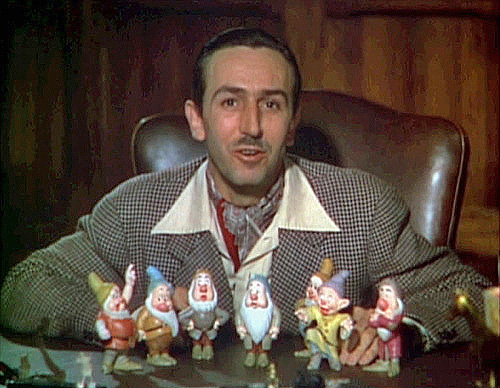
Walt Disney and the Seven Dwarfs

Has anyone else noticed a sudden explosion of interest in Snow White?  It’s always been Cinderella and Sleeping Beauty who get all the press, but the powers that decide these things seem to have finally noticed Snow White too.

Since you know how much I enjoy retold fairy tales, I’m sure it won’t surprise you that I’m watching and enjoying ABC’s show, Once Upon a Time.  It’s a story about fairy tale characters living in the small town of Storybrook, Maine.  They were cursed by the Wicked Queen from “Snow White,” trapping them in our world with no memory of who they really are.  The Queen is running the town as Mayor, and Snow White’s daughter, Emma, who escaped the curse and is now grown up, has to fulfill a prophecy to fight the Queen and bring everyone’s memories back–even though, so far at least, she doesn’t really believe all of this either.

The episodes generally follow a pattern of two related stories, one in our world, one in the past in the storybook world.  And by the way–there are Disney references galore!  They’ve been going through origin stories for the major characters, and they’re doing just what I love most about retold fairy tales–filling in the bits the Brothers Grimm ignored, fleshing out the characters and answering the questions that the original fairy tales will make you ask.

How did Snow White meet the Prince?  How did Jiminy Cricket become a cricket?  Why does Rumpelstiltskin want babies?  Why did the Huntsman agree to kill Snow White to begin with?  Why did the Queen hate Snow White?  All the parts that don’t make sense are where fairy tale retellings can do wonderful things.  Once Upon a Time has answered some questions, and is still teasing about others.

It’s been a great show so far, often exciting and funny, and with some good mystery to it too.  I’m really enjoying the characters.  Snow White is very sweet but also strong.  Her prince gets much more character development than he did in the original Disney movie.  Emma is tough, with a chip on her shoulder and the occasional hint that she’s hiding something softer under her hard exterior.  Rumpelstiltskin is wonderfully smarmy, and the evil Queen is, well, evil.  There’s also a sweet boy named Henry who has complicated connections to everyone, and more understanding of what’s going on than any of the adults.

If you haven’t watched the show, it’s not too late to catch up.  Six episodes are streaming on ABC.com–it’s not all of them, but they seem to have kept the ones you’d need to catch up with the larger storyline.

When I said Snow White is getting a sudden surge of popularity, I didn’t just mean this show, though.  There are also two movies coming out!  There’s Snow White and the Huntsman, with Charlize Theron as the Queen and Kristen Stewart as Snow White.  And there’s Mirror Mirror with Julie Roberts as the Queen and Lily Collins as Snow White.  I’ve seen trailers for both; Snow White and the Huntsman looks like it’s trying to be really, really epic, and just coming out kind of strange.  Mirror Mirror appears to be going for humor, and looks much more like it’s succeeding; that one I’m excited for.

But neither one is out yet.  If/when I see them, I’ll have to let you know how they were.  🙂

In the meantime, watch Once Upon a Time.  That one I can say is excellent.

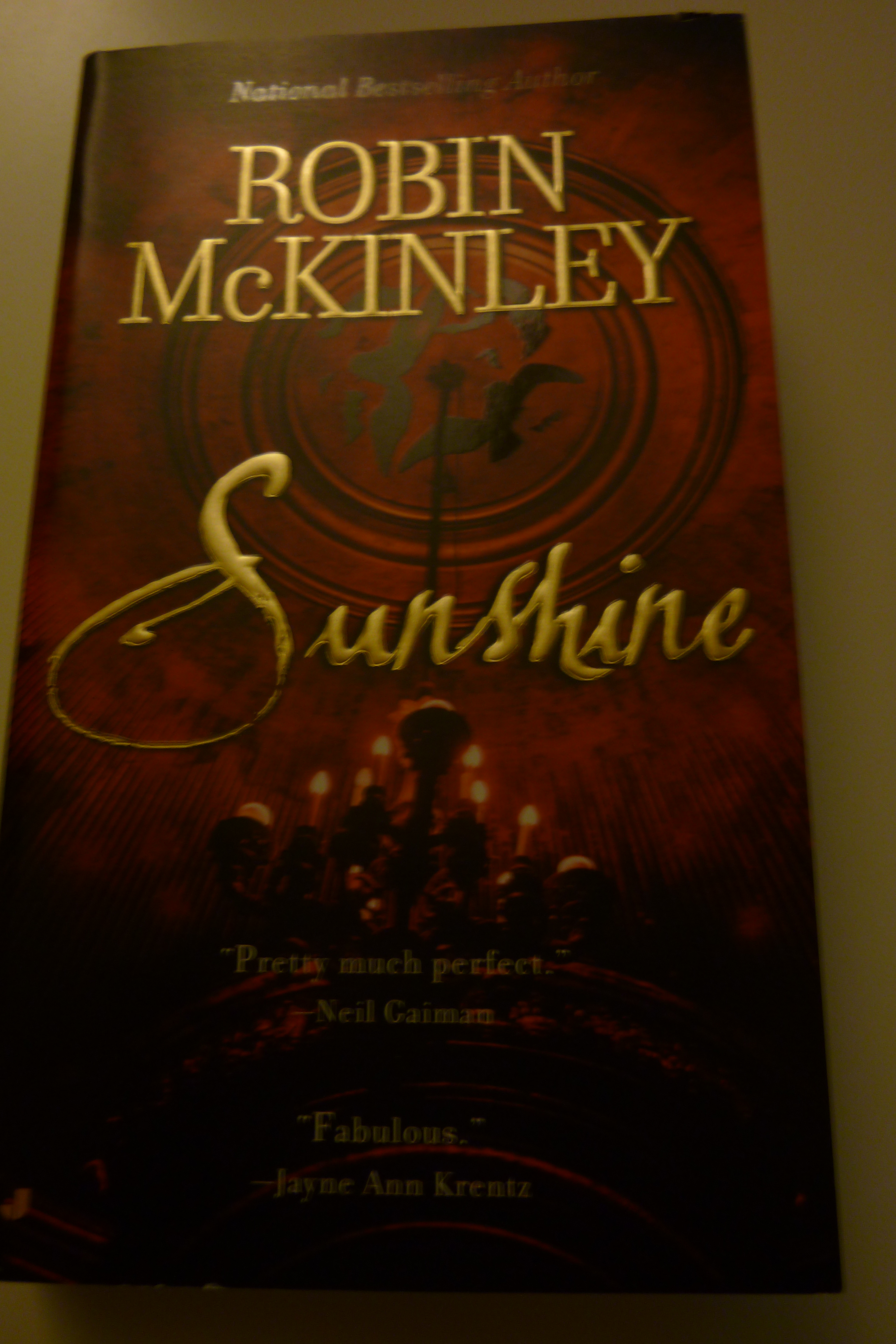
Robin McKinley’s Very Dark “Sunshine”

I think I should begin this post by saying that I love Robin McKinley’s books.  You’ve probably seen her referenced around here as one of my favorite authors.  That said, now I can tell you why I didn’t love Sunshine.

Sunshine was very nearly the last McKinley book I hadn’t read (the only other one is Pegasus, and a friend tells me it has a cliffhanger so I’m waiting for the sequel to come out first).  The funny thing is, I used to know why I hadn’t read Sunshine.  See, it’s her vampire book, and I’ve never been a vampire fan.  It’s also darker, and has a more modern setting.  So I just wasn’t that interested.

But all of my friends had read Sunshine, and they all really loved it (possibly because they are vampire fans), and it was the last one (more or less) that I hadn’t read…so I kind of forgot why I wasn’t reading it.

I finally read Sunshine recently.  It wasn’t a bad book, but I did have problems with it, and it very much was not my kind of book.

Sunshine is set in a world much like ours, but the creatures of gothic novels are real: vampires, werewolves, demons.  Humanity is in an ongoing war, and losing.  The book centers on Rae, nicknamed Sunshine, whose life revolves around her family’s coffee house, where she’s the head baker and cinnamon roll queen.  Life takes an unexpected turn when she drives out to the lake one evening, and ends up captured by vampires.  They chain her up in an abandoned house, an offering for their other prisoner–a vampire named Con.

Con, for reasons more mercenary than merciful, doesn’t drain Sunshine’s blood immediately, and the two of them end up working together to escape.  Sunshine gets back to her normal life, but can’t shake the experience.  She starts discovering that she has strange powers, and that she’s still tied somehow to Con and his enemies.

I liked Sunshine (the character).  The book is in first person and we spend a good chunk of the book reading her thoughts and memories.  She’s pulled in an interesting way between two lives–her ordinary baker life, and this dark world of vampires.  She’s a reluctant hero who just wants to go back to her cinnamon rolls, but finds the other world thrust on her, and with it strange powers and plenty of danger.  She’s a strong character, and I liked following her journey.

I didn’t like Con.  It may not have helped that my friends set me up to expect him to be a great romantic hero, and then…it didn’t come out that way in my reading.  Quite apart from the blood-drinking aspect of things, I didn’t find him likable and I didn’t get any chemistry between Sunshine and him.  She keeps describing him as ugly, for one thing (and yes, sometimes I like the ugly characters because of that–see the Phantom of the Opera–but not in this case).  The larger problem is that he never expresses emotions.  I like Vulcans and I like the occasional mysterious enigma, but I just couldn’t get any sense of Con, or whether he cared at all about Sunshine, because he wouldn’t express anything, ever.

I didn’t much like Mel either.  Notice Mel wasn’t mentioned in that summary up there?  That’s how irrelevant he is, even though he’s Sunshine’s boyfriend and theoretically the other point on the romantic triangle.  Somehow, despite being a tattoed, former biker turned chef, he’s an incredibly bland character.  I think the clincher for me was when Sunshine asked him, sort of rhetorically, who he was, and he answered, “I’m your friend.”  That doesn’t really feel like the right response from a long-time boyfriend and narrative love interest…

I actually liked the more minor characters better.  There’s a whole family of people who work or are regular customers at the coffee house, and some of them are quite interesting and entertaining–like Sunshine’s stepfather Charlie, one of the “big good guys” of her universe, or a customer who turns out to be part demon and can turn himself blue.

My problems with Con and Mel may be me–anecdotally I can tell you that I have three friends who love them, so take from that what you will.  The plot of the story is exciting, and the world is intriguing, although it takes some time to get a proper picture of it.  That’s normal for McKinley, who sometimes makes things mysterious at first, and you gradually start putting pieces together.  This is a dark book, with a lot of blood in it–not too graphic, mostly, but there’s a lot of it.  That’s what makes this not my kind of book, so you’ve been warned…  Also, definitely an adult book, not YA.

It does make me impressed with McKinley in a way, though.  For most of my favorite authors, most of their books are similar (which in a way is nice, because I know what I’m getting).  McKinley has impressive range to write very different books: Dragonhaven, Beauty and Sunshine read like they were written by three different authors.

One more point to address–a sequel.  There isn’t one, but fans have been asking for one for years.  McKinley has said that she’ll write one if she has an idea for one, which says to me that she has, for now at least, no intention of writing one.  (If you ever meet her, don’t ask about a sequel–based on her blog, I guarantee she won’t like it!)

I have to say I agree with McKinley.  I don’t think the book needs a sequel.  I may think that in part because I just don’t care which man Sunshine ends up with…  But the larger point is that I think the book came to an ending.  There’s plenty of plot room for a sequel, and questions left unanswered.  However, I think the book really was about Sunshine’s growth, and her acceptance of herself, both the baker and the monster-fighter.  She comes to a realization at the end, and for me, that is the end.

Final analysis: if you like vampires, read Sunshine.  If you don’t like blood, read Beauty or Spindle’s End instead.

Author’s Site: http://www.robinmckinley.com/

Other reviews (including some who loved the book far more than I did!):
Suite 101
Angieville
Writegray
Bookshelf Bombshells
There are many more–want to tell me about yours, or one you enjoyed?