Fables and Fairy Tales

Quest #2 of the Once Upon a Time Challenge was the trickiest.  This one required reading at least one book in each of the four categories–fantasy, fairy tales, mythology and fables.  The first two more or less fell into my lap, because I read those all the time, Rick Riordan took care of mythology for me, and that just left fables.  Fables was a genuine challenge.

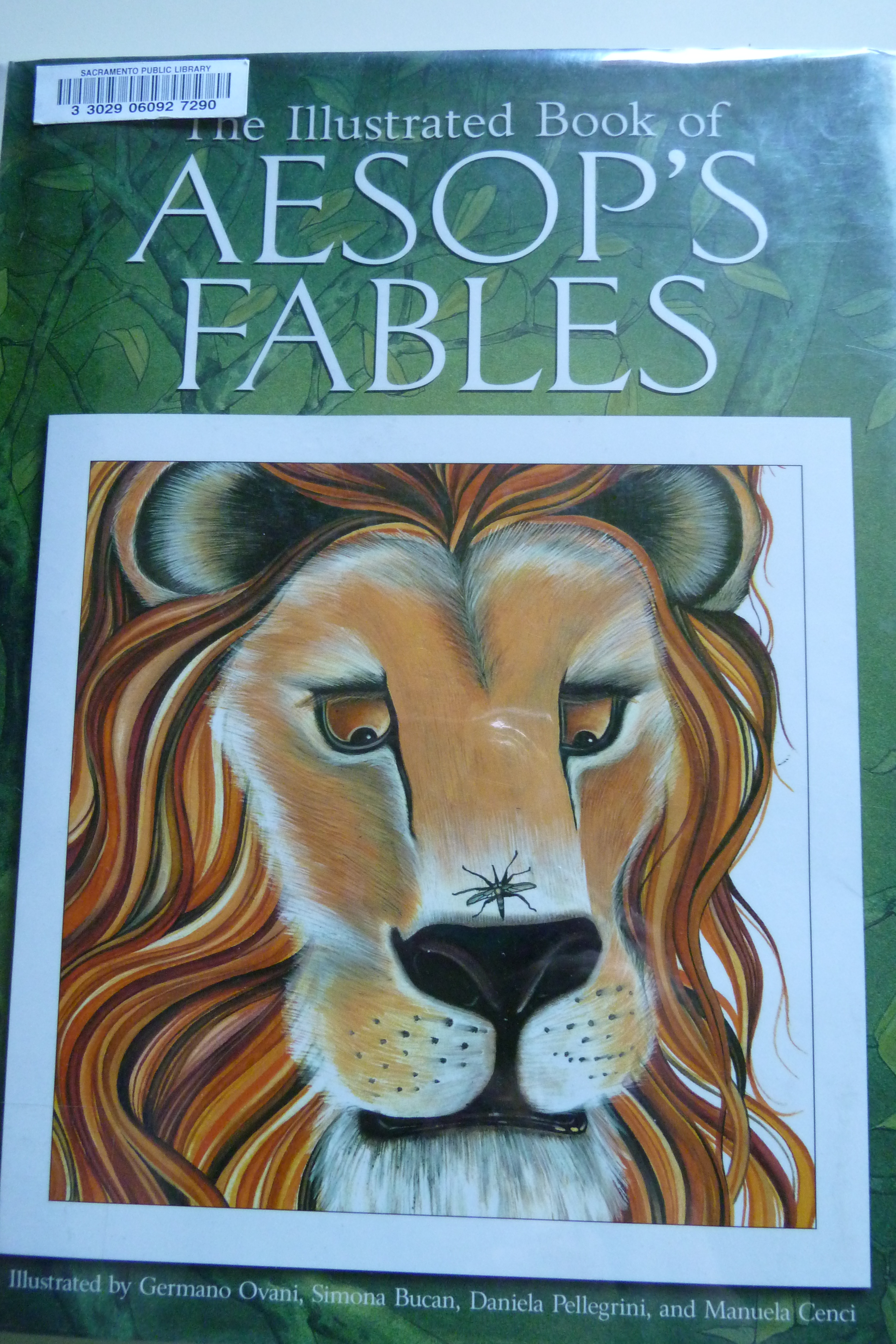
I don’t think I had a firm grasp on what would be defined as a fable, which left me somewhat at sea for finding a retelling or novelized version of one.  So I decided to simplify and pick up a book that had the category right there in the name–and read a collection of Aesop’s Fables.

I’m not nearly as familiar with Aesop as I am with Grimm or Perrault or Anderson.  And I don’t think I liked the stories as well either.  Maybe it was partially the particular collection I read, but Aesop seemed much more about teaching a moral–every story was focused on some lesson about what you should or shouldn’t do.  I like stories to have a moral, but I like it to be woven into an entertaining narrative, rather than becoming the primary focus.

Fairy tales sometimes have lessons too, but they’re usually more subtle, sometimes more complex–and sometimes more questionable too.  But then, I agreed with some of Aesop’s stories, and disagreed with others.

My sense now is that fables are more likely to be about animals or natural forces, focus on ordinary people, and have that aforementioned moral.  Fairy tales, on the other hand, often involve royalty, feature splashier magic like fairies and dragons, and are less obvious about teaching anything.  Which doesn’t explain at all why the graphic novel series Fables is called that, when they’re really more based on fairy tales, but oh well…

I suppose I could actually do some research and look up the difference between the two–but where’s the fun in that?  I’d kind of rather hunt my own conclusions based on what I’ve read.

In this collection, I only recognized one fable: the lion who spared a mouse, which later rescued him in turn.  Maybe there’s a reason that one has filtered into the culture more than others–it was my favorite!

The Once Upon a Time Challenge ends today, so I’ll be posting an update on what I read tomorrow!

Wizards and Luggage, Traversing a Disc

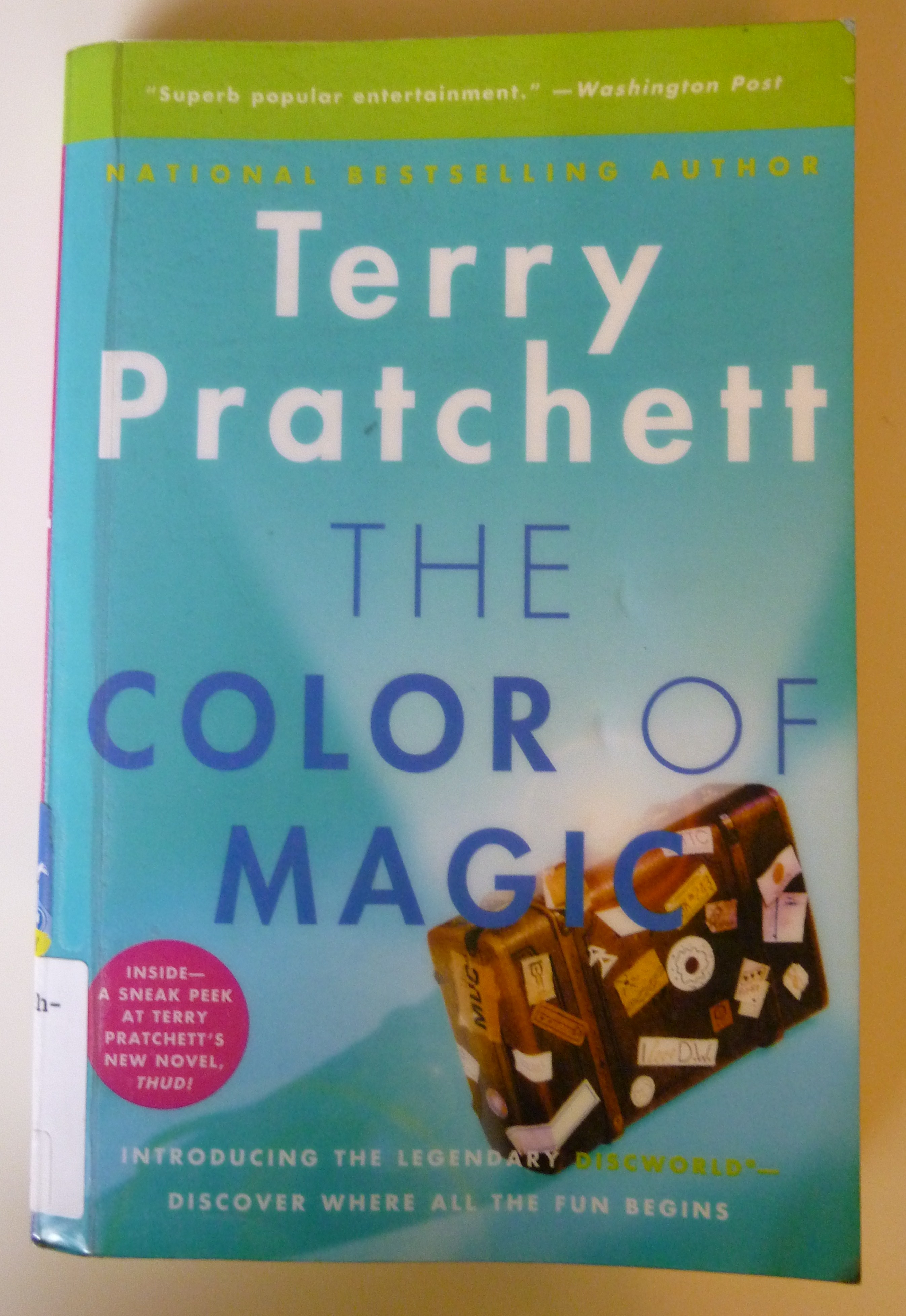
I’ve read upwards of ten books in Terry Pratchett’s Discworld series, but until recently I hadn’t actually read book one, The Colour of Magic.  It’s one of those series where you can really drop in at any point (though some books are better starting places than others).  I think there are over thirty books in the series, so if you, like me, feel a little baffled at where to begin, don’t bother–just grab something and go (though I recommend Guards! Guards! or The Truth as good starting points).  Or, of course, you could start with #1.

The Colour of Magic introduces us to Discworld, an alternate world which exists as a flat disc, riding on the back of four elephants, who are on the back of a giant turtle.  That right there may give you some idea of what we’re dealing with–a truly bizarre and wonderfully hilarious world.

The Colour of Magic begins in the ancient and cheerfully corrupt city of Ankh-Morpork, where Twoflower has come as the Disc’s first tourist, thrilled by the quaint bars and eager to meet heroes and see real Ankh-Morporkian brawls.  Rincewind the not-very-good wizard ends up roped in as his guide, and they embark on a perilous and hysterical adventure around the Disc.

It sounds almost reasonable, until I mention that Twoflower is followed everywhere by an animate trunk with hundreds of legs known as The Luggage, Death shows up every so often and is rather put out that Rincewind keeps stubbornly not dying, and at one point they encounter imaginary dragons who live inside a giant inverted mountain.  And that, of course, is only the half of it.

If you’re having a gloomy, depressing day, read a Discworld novel.  It will brighten everything.  Pratchett’s books are gritty but hilarious, have a grown-up feel but aren’t really inappropriate for young adults either.

There’s a vast cast of characters who wander in and out of the Discworld novels, and there are some subseries within the larger series (although good luck finding a comprehensive, helpful list of which books fall into which subseries), which focus on particular groups of characters.  There are the witches; the City Guard; the magicians; and let’s not forget Death.  I’m especially attached to the City Guard, led by noble but cynical Sam Vimes.

The Colour of Magic doesn’t focus particularly on any group of characters I recognize from later books, but it will definitely give you a solid introduction to the world of the Disc.

And, a random story: years ago I was on a bus, and overheard a couple of people talking about a book.  A wizard wound up in a tree, and was being visited by what seemed to be Death, but turned out to be a non-fatal disease.  The wizard objected that no one died of that disease, and he couldn’t be killed by him.  Sounds fun, right?  Of course I didn’t hear the book title, and I didn’t ask, and despite a little Googling I never could figure out what the reference was.  But now I’m reading along through The Colour of Magic and lo and behold: Rincewind lands himself in a tree, a cloaked figure appears with a scythe–but it’s not Death, it’s Scrofula.  Death was busy.  Rincewind objects, “I can’t die of scrofula!  I’ve got rights.”

Long-time mystery solved.  And almost as randomly as Discworld itself.

Traipsing through Greek Mythology with Hercules

As another foray on the Once Upon a Time Challenge‘s cinema quest, I’m going to review Hercules: The Legendary Journeys.  I recently watched Hercules and the Underworld, which fulfills the goal for the challenge.  It was a pretty good movie, but I think we’ll be better off here if I talk about the series at large.

If you’re not familiar with it, Hercules was a TV show in the nineties following the adventures of the mythological hero, as he journeys through ancient Greece.  There was a six-season TV show, plus five made-for-TV movie prequels, and two spin-offs (I’ll get to them later).

Hercules is basically the greatest guy you could ever want to meet.  He has super-strength from his father, Zeus, the king of the gods, “a strength surpassed only by the power of his heart,” as the opening sequence puts it.  And he’s brave, noble, thoughtful, ethical to a fault…but without ever being annoyingly nice.  Some characters come off as too good, and he’s not that–he’s just a really great guy.

Hercules’ wife and children were killed by his evil stepmother Hera (in a careful revising of the original myth), and now he’s decided to dedicate his life to fighting evil and helping people.  How exactly he makes a living at this I don’t know–but it’s great premise for a TV show.  Generally each episode features a new monster, or a new band of brigands threatening a village, or a new plot by Hera.  Hercules comes in to help, risks his life in feats of daring, and eventually saves the day…to go on to help the next group of people.  And there’s often a lot of humor mixed up in there too–sometimes campy, always fun.  The episodes rarely follow a particular myth, but they frequently weave in elements and ideas from mythology.

Usually Hercules is accompanied on his travels by another character who’ll play the major supporting role for that episode.  Sometimes it’s a character with a one-time appearance.  Most often it’s his best friend, Iolaus, who joins him fighting in battles and defeating monsters.  I was thrilled, reading Greek myths years ago, to discover that the original myth records an Iolaus who helped Hercules fight the Hydra.  I thought he was strictly an invention of the TV show.  Iolaus is a pretty great guy too–a little more flawed, a little more apt to lose his temper or do something foolish, but absolutely someone you’d like to know.

And here’s something I think is important–I think anyone watching the show can pretty clearly see that Iolaus is Hercules’ sidekick.  After all, Hercules is the one with his name in the title, and usually he’s the one who does just a little bit more, and is just a little bit better.  BUT–I don’t think Hercules knows that Iolaus is his sidekick.  I think he would maintain that he and Iolaus are equal partners.  It wouldn’t be false modesty–it would be very sincere.  I think that makes a difference in the character, and in the feel of the show.  Hercules never makes much of his own importance–he just tries to help people.  It adds a lightness to the show.  More on that later.

The other most frequent supporting character is Salmoneus, who is basically an ancient entrepreneur.  He always has a new get-rich-quick scheme, which he always wants to get Hercules involved in.  Hercules always declines (although you’d think that maybe he ought to join forces with Salmoneus some time, since he has no visible means of support himself).  It’s pretty much a guarantee of a comedic episode if Salmoneus turns up.

There’s also Autolycus, the cocky and exceedingly self-confident King of Thieves.  And of course the Greek gods turn up now and then too: particularly Ares, the surly (but very handsome) god of War, and Aphrodite, the beautiful and flirty goddess of Love.

As I said, Hercules has two spin-offs, the possibly more famous Xena: Warrior Princess, and Young Hercules.  I enjoyed Xena, but never as much as Hercules, even though it had a cool warrior girl for a hero.  I think it was that Xena took herself too seriously.  She was just never as much fun as Hercules.  And I think Xena and Gabrielle both knew that Gabrielle was the sidekick in the relationship, and I don’t like that as well as Hercules and Iolaus’ equal friendship.  Don’t get me wrong–it’s a great show too–but if you’re picking one, watch Hercules.  As to Young Hercules, it had a younger target audience so they made it more simplistic, and personally I could never get past the fact that young Hercules did not look like he could ever grow up to be Kevin Sorbo (the actor for the main show).  And I was right–he grew up to be Ryan Gosling, from The Notebook.

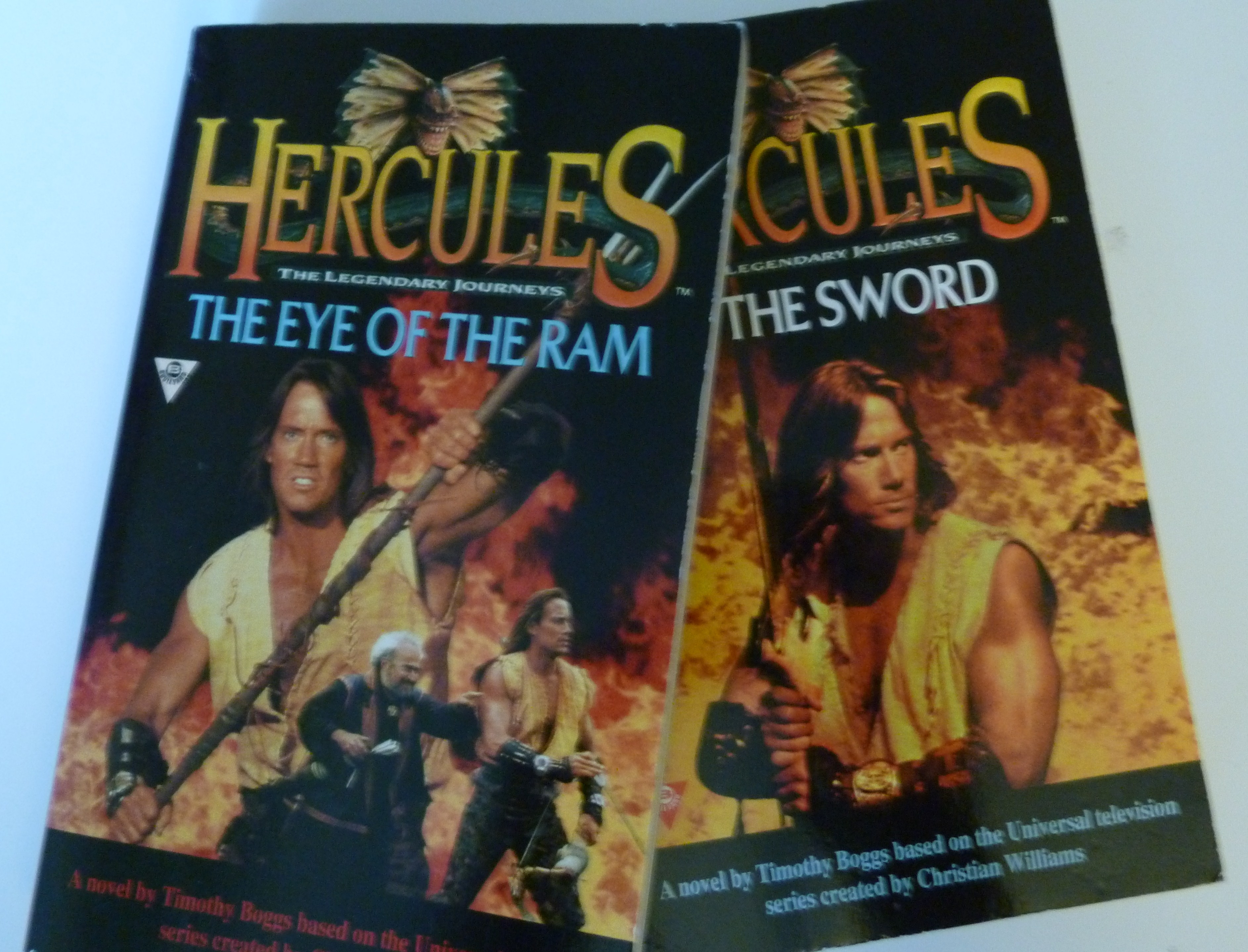
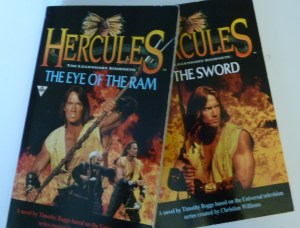
There are four novels as well, a couple of them pictured above, which are also great.  They’re not novelizations of episodes; they’re original stories, and it’s fun to get inside the characters’ heads more than you can in a TV show.

Hercules was my favorite show for a period as a kid.  I’ve been rewatching them recently, after years of not seeing them, and I’m convinced I had good taste.  🙂  They’re all available streaming on Netflix.  If you have any interest in Greek mythology, or funny adventure stories, check them out!
Belle and the Beast

One of the “Once Upon a Time Challenge” Quests involves watching fantasy or fairy tale-based movies.  So today we’re going to take a side-trip into Cinema-land.

I decided to revisit a favorite fairy tale, and watched Disney’s Beauty and the Beast.  I haven’t watched it in a long time–not since I got serious about finding the originals of the fairy tales.  Disney’s Beauty and the Beast is pretty far distant from Jean-Marie LePrince de Beaumont’s version–but I like the way they tell it.  Disney’s was the first version I ever saw/read so I’m sure that slants my view, but I do think they manage some clever revisions of elements of the original.

I like the handling of the rose.  Threatening to kill someone because they picked your flowers is, um, unstable behavior.  But that’s pretty much how it goes in the original.  Having the Beast freak out because it’s a special, magical rose tied into his curse is far more reasonable.  I also like it that the Beast locks up Belle’s father for staring at him, rather than messing with the garden.  Sure, it’s a huge over-reaction either way, but if he has to over-react about something, it makes so much more sense that he’d be overly sensitive about people looking at him funny.

I can’t decide how I feel about Belle finding the castle and volunteering to stay, rather than the Beast demanding that Maurice send a daughter to take his place.  On the one hand, I’m sure the goal was to reduce the Beast’s villainy.  But on the other hand, at least in the original he was taking a proactive step towards breaking the spell.  He needs a girl, so he tries to get a girl.  Not in the best possible way, but at least he was making an effort instead of just moping around.

It’s kind of too bad that Belle lost all her siblings who were in the original, but my guess is that was to make space for other supporting characters, so it was probably worth it.  Lumiere and Cogsworth are really wonderful, and Gaston is a brilliant addition too.

Gaston, besides adding extra comic relief, is a great idea because it gives the story a villain.  In the original, Beauty’s sisters are pretty nasty, and I think a case could be made for the enchantress as the villain, but nothing is clear-cut.

Gaston’s main contribution, I think, is all in the last couple scenes.  First, bringing the mob adds great extra tension, as well as being a fantastic example of mob mentality.  It just needs one charismatic leader and everyone else is swept along (you see the same thing in Disney’s Hunchback, only more so; that crowd makes hairpin turns about three times).  I also love the way the mob demonstrates fear of the Other.  The line “we don’t like what we don’t understand; in fact, it scares us, and this monster is mysterious at least” says it all.

Gaston’s most important purpose, though, is that his presence means there’s someone to kill the Beast.  In the original we have this disturbing bit where the Beast tells Beauty she can leave if she wants to but it’ll kill him, and then when she goes, he tries to starve himself to death.  That’s seriously manipulative and unhealthy.  It’s so much better to have it play out with the Beast sad that she left but not dying–until he’s stabbed by Gaston.

There’s just one thing I don’t understand in this movie.  The spell has to be broken by the Beast’s 21st birthday?  Lumiere tells us, “ten years we’ve been rusting.”  So…this encounter with the enchantress happened when the Beast/Prince was eleven?  Isn’t turning a bratty kid into a monster kind of an over-reaction?  Okay, he was nasty to her, but show a little maturity!  And it doesn’t seem to me that the Beast learned anything much about seeing past appearances.  Belle did that (and as a reward, she gets to marry someone handsome…?) but the Beast went and fell for a beautiful girl, so what’s proved?

But aside from a few of the weirdnesses that often crop up in fairy tales, it’s a wonderful version.  And when I hunted down and read the original, I was so glad to find out that Belle’s love of books goes back to Beaumont.  That’s a favorite part of the movie–and I think everyone I know who loves to read wants the Beast’s library!

Cursed by Christening Gifts

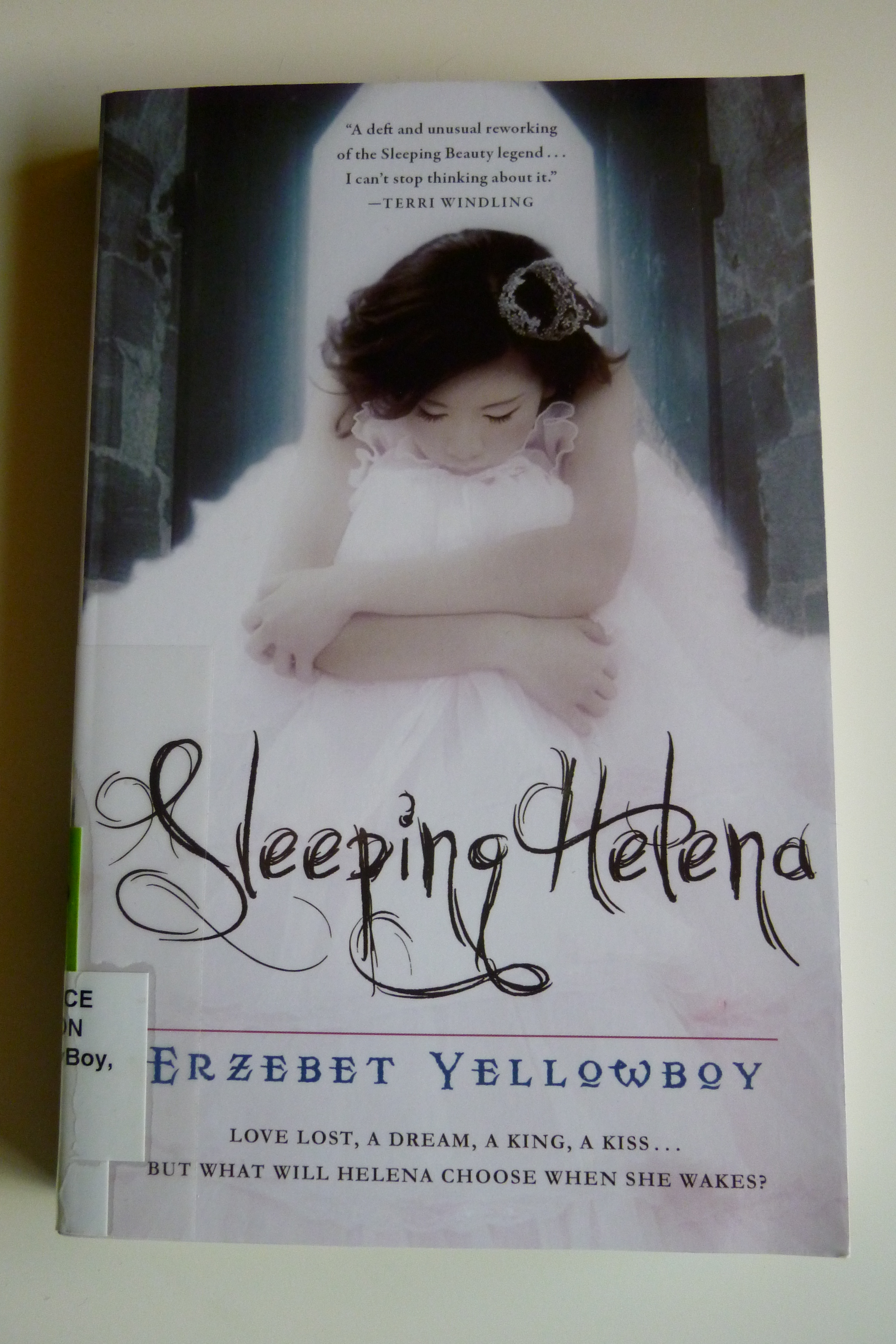
My quest for retold fairy tales most recently brought me to Sleeping Helena by Erzebet Yellowboy. As you can probably guess from the title, it was a retelling of Sleeping Beauty.  And it was…an odd one.

Helena has eight aunts, who all give her special gifts at her christening.  Six offer her well-meaning things like beauty and dancing ability.  One issues a complicated prophecy that seems to predict death.  And the eighth uses her gift to try to undo the curse.  Seven of the aunts raise Helena together, while desperately trying to protect her from the curse.  As the book goes on, we realize that the aunt who issued the curse, Katza, has more complicated motives than it seemed.  It’s all tied into the tragic death of their brother, a century before.

Yes, they have a brother who died a hundred years ago.  Everyone in the family is blessed (or cursed) with extraordinarily long life, which is the first place this starts to get odd.  It’s a little disconcerting when most of the characters are 105 or thereabouts.  Especially when they haven’t been given youth–they really are 105, and apparently feel that way.  I have nothing against elderly characters, but it makes it kind of hard to relate to.

It’s also rather depressing to think about seven sisters living together from childhood into old age, and if any of them ever got married or formed any meaningful attachments outside of their family group, we don’t hear about them.

The purpose of it is so that Helena’s sixteenth birthday can be exactly 100 years after Katza’s sixteenth birthday, which is also when their brother died tragically.  So you get Sleeping Beauty’s hundred years–but going back from the day the curse strikes, instead of forward.

Helena is the most interesting character, although more as a concept than as a person.  I love the way this examines what it would be like to have eight christening gifts.  Helena is so filled with her gifts, there’s no room in her personality for anything else (and they forgot to give her compassion or sympathy or kindness…)  She is utterly absorbed in herself and her gifts, which are constantly clamoring at her to be used–she wants always to dance, to sing, to admire her beauty, and so on.  In some ways, they seem more like curses than the curse.

This does take some interesting turns, and I particularly liked the flashbacks to Katza and her brother, Louis, when they were young.  I ended up disappointed by the ending, though.  I won’t give away the details, but essentially just when it was getting to something really interesting–it ended.

I have to come down somewhere in the middle on this one.  It wasn’t so bad that I’ll talk a friend out of buying it (The Frog Princessactually, she was going to buy one of the sequels and I convinced her it was a terrible idea) or so good that I’ll push it on friends (Robin McKinley–anything by her, really).  It was okay.  So if you have a particular fondness for Sleeping Beauty or some of the elements sound especially interesting, you could give it a try.

Author’s Site: http://www.erzebet.com/