Persephone Today

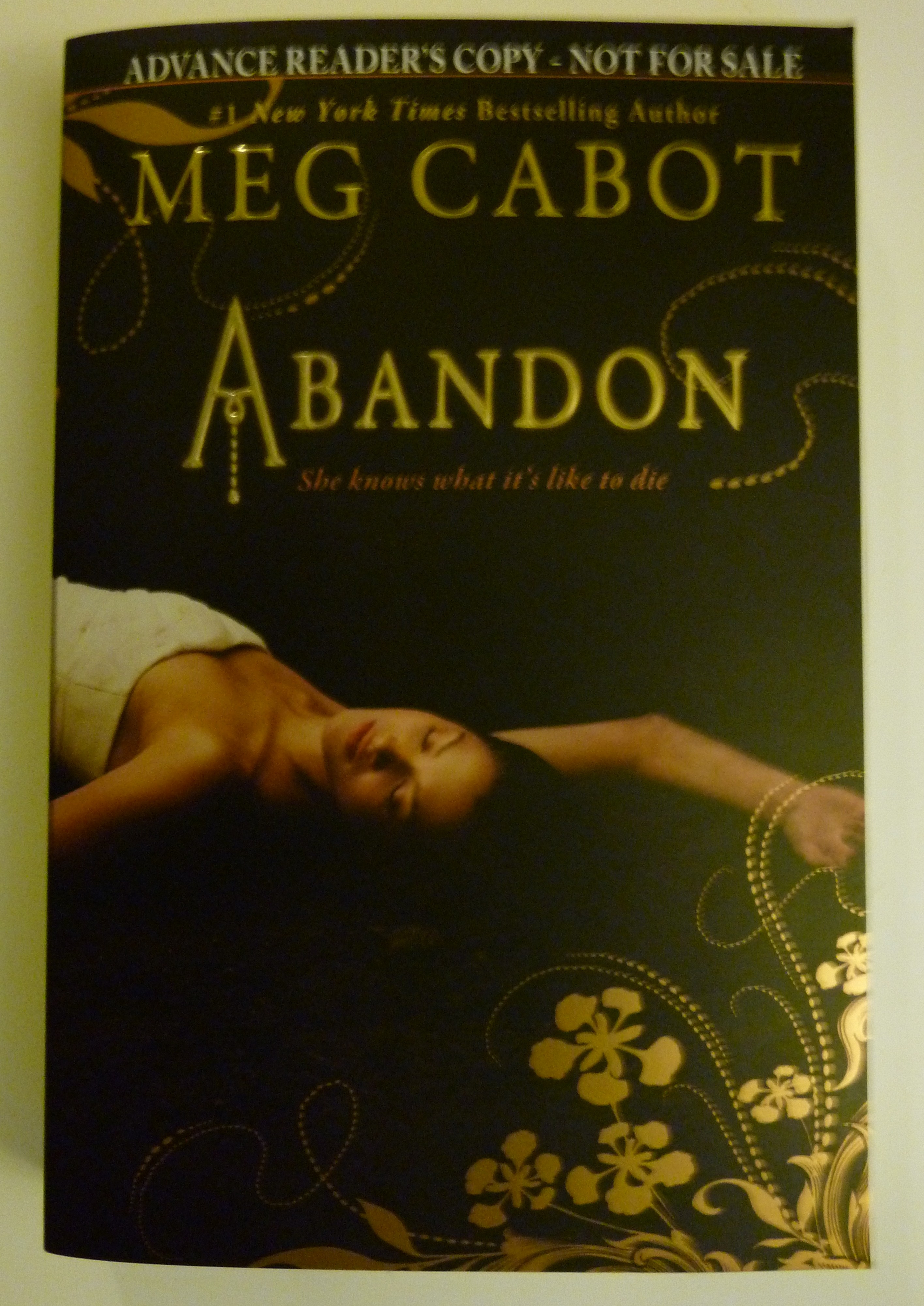
I seem to be on a mythology theme this week.  Heading back towards the Greek isles, in a way, after The Red Pyramid I read Abandon by Meg Cabot.

I’ve read a fair bit of Meg Cabot; she’s a good option when I feel like something light, fluffy and bubbly that I can read in a day or so.  Abandon turned out to be a very different Meg Cabot book.

Abandon is a retelling of the Hades and Persephone myth.  In case you don’t know it, Hades, the god of the dead and Lord of the Underworld, kidnapped Persephone, who if she isn’t the goddess of flowers (I can’t remember for sure) nevertheless gives that distinct impression.  Depending on the version, Persephone and Hades may or may not fall in love.  Ultimately, Persephone ends up dividing her time between the Underworld with Hades and being with her mother, the goddess of harvest, up on Earth.

Abandon retells this, loosely, in the present day.  The lead character, Pierce, is a teenager who had a near-death experience.  While she was dead, she met the Lord of the Underworld (who conveniently looks like an attractive 19-year-old man).  He isn’t Hades, but he has the same job.  He chooses Pierce to be his consort, but Pierce flees, the EMTs bring her back, and she tries to get on with her life.  Except that she’s convinced he is following her, hoping to bring her back to the Underworld.

The funny thing is, I very much enjoyed this while I was reading it.  Then afterwards I started thinking about all the flaws–well, the one big overarching flaw, really.  So I’m not sure where I come down on this one, except that I do feel sufficiently positive that I’ll probably try the sequel when it comes out.

I really like the concept of this, and the plot, though far-fetched in spots, is reasonably good.  It’s the characters that bring me to that big overarching flaw.

One character thing I do love–I love that the dark, brooding, fearsome and mysterious Lord of the Underworld is named John.  Not a dark, mysterious name–just John.  That’s fun.  And John is actually a decent character.  I like dark, brooding heroes with good hearts, so he at least has potential.  Although the more I think about it, the more I think I’m just assuming he has a good heart in there somewhere because it’s the only way this will work at all, not because there’s actually much evidence for it.

But John is all right.  The real problem, the big problem, is Pierce.  She’s one of those bland, underdeveloped heroines.  Other than an understandable obsession with death since her accident, and a concern for animals and other people, Pierce has almost no personality.

I made a possibly unfortunate comparison, and realized there’s a lot of similarity to Twilight–brooding, handsome, not-human hero falls obsessively in love with ordinary, undistinguished girl for no particularly compelling reason.  Edward thought Bella’s blood smelled good.  And John was totally blown away when Pierce asked how he was.

No, really!  She accidentally spooked his horse, he fell off, and she asked if he was all right.  Granted, he’s a death deity, who mostly deals with people who are dealing with the fact of their own recent demise, so he doesn’t get this sort of thing very often–but it doesn’t make her Mother Teresa!  Nor does it seem a reasonable basis for deciding that this is the person you want to–literally–spend eternity with.

Pierce does demonstrate caring for others at other times, but Cabot must have a poor opinion of humanity if she thinks it’s enough to mark Pierce out as an extraordinarily kind and giving person.  The times when Pierce does go over the top trying to help people, it’s either meddling, or totally stupid and ill-advised.

I think one reason this didn’t strike me much as I was reading is that the book went by so fast, I felt like I was still just starting when I was halfway through.  So it didn’t occur to me how undeveloped a character Pierce is until I got to the end–and she was still undeveloped.  It is part of a proposed series, so maybe she’ll get more depth in the next book…but she had an entire book, she could have gotten deeper here.

I do recommend Abandon–I enjoyed reading it–but don’t expect to find a new favorite character in the heroine.  Despite the similarity in how they met their heroes, Pierce is no Jane Eyre.

Author’s Site: http://www.megcabot.com/
Egyptian Mythology in the Present Day

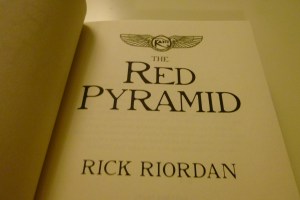
After enjoying the Percy Jackson books, I decided to try another Rick Riordan series, and read The Red Pyramid.  It’s basically the Egyptian Percy Jackson.  Which in a way is a good thing–I mean, I liked the Percy Jackson series.  And Riordan’s given us another book where ancient mythologies turn out to be true, the pantheon of gods is still hanging out in the current day, and ordinary-seeming kids have to discover their hidden powers to fight an ancient evil threatening to destroy the world.

All right, so it’s a formula.  But it’s a fairly unique and specific formula, at least the ancient mythologies part.  And, the most important thing for a formula–it works.

The Red Pyramid is about Carter Kane (who rather resembles Percy) and his sister Sadie (who really resembles hot-tempered and strong-willed Annabelle).  I may be oversimplifying in my character comparisons, and there are distinctions…but not broad sweeping ones.  Things go rather awry for Carter and Sadie when their father blows up the Rosetta Stone using Egyptian magic, and unleashes ancient gods into the world.  Carter and Sadie come to realize that they have magical powers they have to learn how to use, in order to fight the evil god Set, who has captured their father and is also planning to destroy all of North America.  Mostly because he can, I think–it’s all part of an ancient feud among the gods, and an even more ancient conflict between order and chaos.

It’s a good thing, by the way, that all these kids are around to deal with ancient evils, because apparently they’re all in the same fantasy world.  At one point Carter and Sadie are in Brooklyn, and a comment comes up about Manhattan.  The Egyptian magicians don’t get involved there, because Manhattan has other gods to deal with.  Love the reference, as the Percy Jackson books tell us that Mount Olympus is floating above the Empire State Building.

The mythology is the biggest way this differs from the Percy Jackson books, not only the gods themselves but the way the gods relate to the world.  The Greek gods are, to large extent, sort of like very ancient and very powerful humans, who interact with the world more or less like humans do–just in larger than life ways, and in ways that may involve monsters and destruction.

The Egyptian gods seem to lead a more metaphysically-complicated existence.  They mostly exist in a sort of dream world, and primarily access the physical world by possessing humans or objects, but preferably humans with the blood of the pharoahs.  Timelines and chains of events are also a little confused, as the gods apparently act out the same patterns and stories again and again over millenia.

The Egyptian way of engaging the world is certainly more complex, and fascinating in some ways.  But on the other hand–I like that Hermes uses a cell phone, that Poseidon hangs out on the beach, and that Aphrodite and Ares use the Tunnel of Love at the theme park.  The Egyptian gods are, mostly, less relatable, and I can’t decide if I like that or not.  I suppose it’s just different, and both ways have merits.

In the end I think I have to come down saying that I did prefer the Percy Jackson books, but that’s mostly for two reasons that I should elaborate on, because they may not be relevant for other people.

For one thing, I’ve always been a Greek and Roman mythology buff.  Maybe it’s a product of watching Hercules: The Legendary Journeys as a kid (a truly brilliant TV show, by the way).  When I was around twelve, I had run out of new Greek mythology books to read at my library.  The Egyptian gods, on the other hand, I’ve mostly had brief encounters with through friends who love Egypt, or in an occasional historical fiction book.  So when a Greek god shows up, my reaction is usually “oh, them, I know them, they had this story and that story and were the god of this, and it’s so cool how they’ve been portrayed!”  When an Egyptian god shows up, my reaction is more along the lines of “yeah, I guess I recognize your name…”  That skews my impression of the book, I’m sure.

Second thing: my favorite character in the Percy Jackson series is Grover, and there was no Grover equivalent here.  The funny baboon is, well, funny, and Bast as a supporting character is pretty great, especially when she exhibits cat-like tendencies.  But they’re still not as much fun as the ecology-obsessed satyr who loves eating burritos and tin cans.

So if you enjoyed Percy Jackson, and especially if you like Egyptian mythology, give The Red Pyramid a go.  It’s maybe a little darker and a little more complex, but pretty much…it’s an adventure about ordinary (except not) kids on a quest through ancient mythology to save the world.

Revisiting Diana Wynne Jones

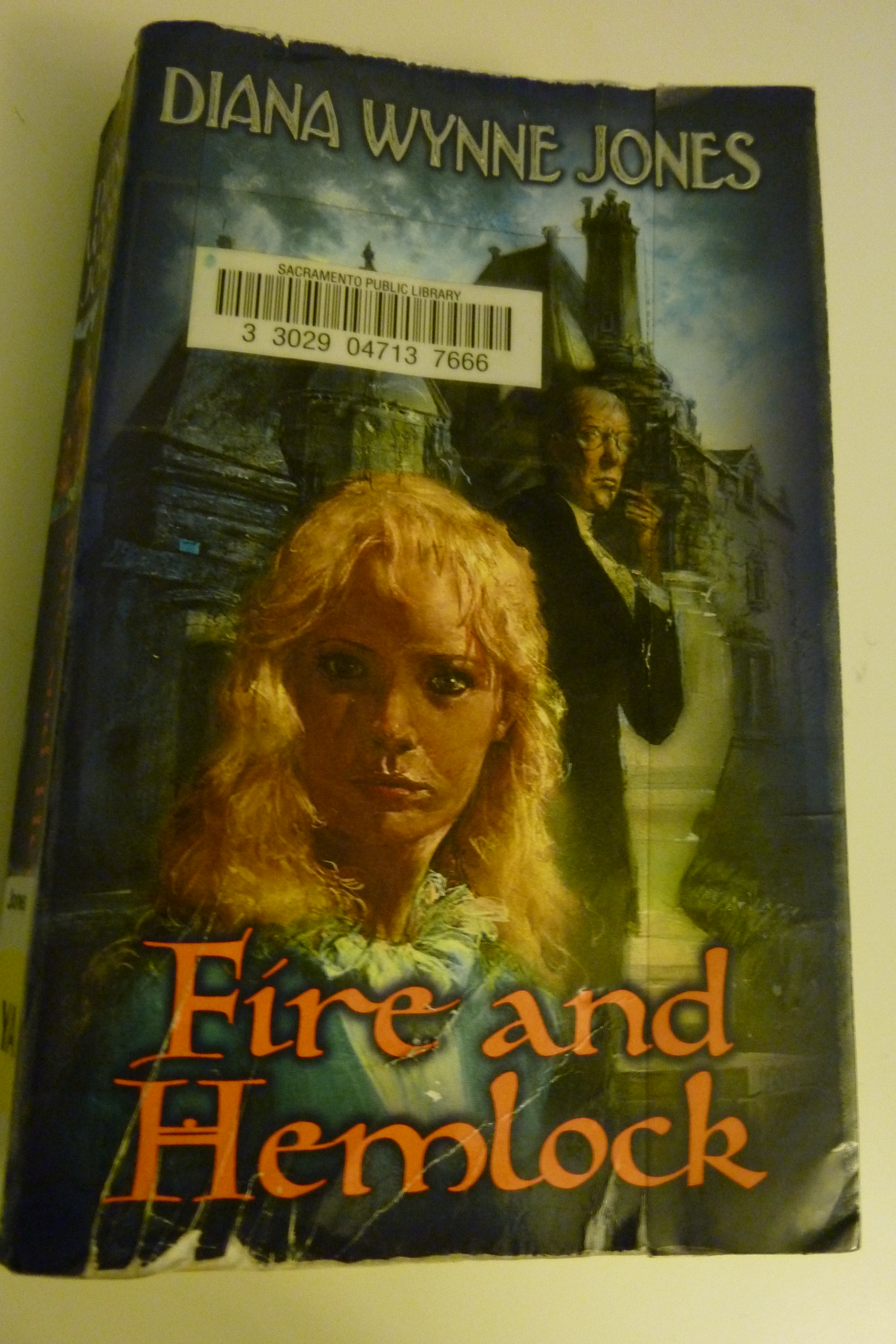
After Diana Wynne Jones’ death a few weeks ago, I–like many people–wanted to go back and read some of her work.  I decided to revisit Fire and Hemlock.  This was a reread, and I selected it in part because I had some trouble with it the first time around–but thought at the time that I might like it better on a second read.

This book is a bit difficult to describe without giving things away.  It begins with Polly, who is 19 and looking at a book of fantasy stories.  One of them, a story about a man with two sets of memories, triggers a series of hidden memories for her.  The book jumps back to when Polly was ten, and moves forward exploring these hidden memories.  They start when Polly gate-crashed a funeral at the mysterious Hunsdon House next door to her grandmother’s, and met Tom Lynn.

At this point I ought to describe Tom; this is also where I had trouble the first read-through.  Ten-year-old Polly views Tom as much, much older than her, and Diana aids and abets this impression for the reader.  I think he’s described as “stooped” at some point, he definitely is described as having an “elderly hairstyle,” and he’s a recently-divorced cello player.  None of this says “young man” to me.  The divorce alone would probably make me assume thirties at least, and everything else had me putting him as minimum mid-forties, and only the relatively young-sounding ex-wife would keep me from assuming he was much older.

I’m about to reveal what was probably supposed to be a twist–so I’m sorry for a spoiler, but it was a twist that thoroughly derailed me, and I would’ve done better had it been spoiled.  Hundreds of pages in, we find out that Polly as a child was a very poor judge of age, and Tom was much younger than she led us to believe.  This becomes important to the ending, which is why I had such trouble the first time.  This time I really tried to implant in my mental image the idea that he was young, to the point that I was mentally chanting “he’s twenty, he’s twenty” on occasion.  Later evidence in the book suggests he was probably early twenties.  So if you read this, keep that in mind–it might help.  And pay no attention to the cover, it has a horrible depiction of Tom.

Back to the plot.  Tom and Polly, despite their not-quite-as-big-as-I-thought age difference, become fast friends, making up stories about their alter ego selves who are heroes in training.  It all becomes more fantastical when the stories they make up begin to come true.  Meanwhile, the Leroys, who own Hunsdon House and include Tom’s ex-wife, have some kind of sinister hold on Tom, and continually warn Polly away.  Nineteen-year-old Polly has to solve the mystery, and determine what happened four years previously that changed, not only her memory, but apparently actual events.

I’m not really sure what kind of review this is.  Because I really enjoyed the book.  There’s so much in here that’s wonderful–characters, mystery, fantastic adventures, humor.  And yet…the end doesn’t quite pull together for me.  The basic mystery is cleared up, there’s essential resolution, but I feel like an extra twenty pages explaining what just happened would be very helpful.  I love Diana Wynne Jones’ books–love, love, love them–but every so often one of them is more convoluted and confusing than the others.

So I guess it’s a mixed review.  I recommend it…but if you try reading it, remember–he’s young!

Author’s Site: http://www.dianawynnejones.com/dwjflash.htm

And official fansite: http://www.leemac.freeserve.co.uk/

Learning to Be a Wizard

Today’s review is a book about a boy who goes away to a school to learn to be a wizard.  At the school, he makes a few close friends, including a freckled, red-headed boy.  The school is run by a kind older wizard.  The conflict of the story arises with an evil wizard who was a co-founder of the school who was cast out for being, well, evil.  The hero turns out to be the fullfilment of a prophecy to fight the evil wizard.

And if at this point you think I’m talking about Harry Potter…I’m not!  I’m actually talking about Wizard’s Hall by Jane Yolen.  I’ve no idea whether J. K. Rowling has ever read it, and would not dream of commenting…except to note that Wizard’s Hall came first.

Wizard’s Hall is about Henry (yeah, the name’s interesting too) who casually mentions to his mother one day that perhaps he’ll be a wizard.  Next thing he knows, his mother has wiped the smudges off his nose, told him that the most important thing is to try, and sent him out the door to walk to Wizard’s Hall.  After that, it’s the story of Henry trying to figure out whether he really belongs at Wizard’s Hall–and, of course, how to fight the evil wizard too.

Henry is pretty swiftly renamed–everyone at Wizard’s Hall has a special name, and they’re all plants, like Hickory and Gorse and Willoweed.  Henry becomes Thornmallow, “prickly on the outside and squishy on the inside.”  I think he’s a bit more squishy than prickly, in an earnest, well-meaning sort of way.  I’ve actually been known to define characters in other books like this–I have a soft spot for tough characters with good hearts, who can sometimes be described as prickly on the outside and squishy on the inside.

Wizard’s Hall is a lot shorter than Harry Potter–133 pages, instead of, I don’t know, 4,000?  It doesn’t have the same elaborate world or the multi-book epicness.  But it is a very good book about a wizarding school, and about trying to find your place.

Author’s Site: http://janeyolen.com/

Sleeping Beauty, Awake and Fighting

What if Sleeping Beauty didn’t turn out the way all those fairies at her christening intended?  That’s one element–and my favorite–of Spindle’s End by Robin McKinley.

There’s a line in The People the Fairies Forget when Tarry wonders what christening-gifted people would be like without the enchantments.  How does it change a person to be enchanted to be compassionate?  In my book, Sleeping Beauty is only a minor character, and is about what you’d expect her to be like if you’ve ever read Charles Perrault.

But Rosie isn’t.  Rosie is Sleeping Beauty in Spindle’s End, and is wonderfully NOT what she’s supposed to be.  She has long eyelashes and fair skin and golden hair, but she keeps the hair cut short so it doesn’t have the chance to fall into ringlets (and ends up a fuzzy, curly mass).  She hates dancing and embroidery, so it doesn’t matter that she’s enchanted to be good at them.  Her laugh may resemble a bell, but it must be a very large and unusual bell.  And most importantly, she is wonderfully, obstinately, stubbornly herself.  She’s not at all sure she even wants to be a princess, and she’s not going to just take a curse lying down.

McKinley does in Spindle’s End some of my favorite things about retold fairy tales.  We all know this story–princess cursed to prick her finger and die, fairies carry her off into the woods to keep her safe, spindles get destroyed, etc.  But she’s retold it with lots of clever, unexpected, practical twists.  What was Sleeping Beauty’s relationship with those fairies, considering they’re the only family she’s ever known?  Does she have her own plans for her life?  What’s it like to get princess-ness dropped into your lap one day?  And how do all those christening gifts turn out?

The gifts are wonderful, Rosie is wonderful, and the fairies–very practical fairies who are human-sized, don’t shed sparkles, don’t have wings, but do some impressive magic–are wonderful too.

I hate to say it, but one reservation here–I’ve never found the romance wonderful.  There is one, but it’s never felt right to me.  I’ve read this at least twice, so the most recent time I knew the romance was coming.  I really, really tried to see it coming, to anticipate it and wrap my head around it, but…while there are one or two cute moments, on the whole it just didn’t feel right.

It may be me.  It’s the kind of romance I often have trouble with.  Sometimes books like to create a friendship between a girl and an older man, which then turns into a romance when the girl grows up.  Once in a while it works for me.  Usually it doesn’t.  (On that subject, as a minor spoiler to the unwritten sequel of Red’s Girl, Red and Tamara are never going to be romantically involved.  Ever.)

But don’t let this turn you off the book.  Because honestly, I think Rosie’s relationships with her “aunts” (the two fairies) and her best friend are the more important ones than the romance, and they’re all very good.

And I love practical fairy tales.  The book opens with some lovely pages about how magic works in this country, and it’s this fantastic combination of total fantasy mixed with practical details about how people go about living their lives with this magic around them.  Magic sort of accumulates around cooking pots, for example, and fairies have to disenchant them every so often, by laying a finger on them.  Absent-minded fairies tend to have burn-scars on their fingers.  And when the evil fairy’s curse goes out, a decree is issued to lop off the tips of the spindles on all the spinning wheels.  How much more reasonable than burning every spinning wheel, and decimating the cloth industry!

My particular fairy tale retold is all about pulling out the most absurd bits of fairy tales and having more practical-minded characters try to work around them.  But I love retold fairy tales that work around those more absurd bits and make them make sense.  And I so enjoy McKinley’s rational, funny, sweet retelling of “Sleeping Beauty” that is the original story…but not quite the way Perrault told it.