Continuing the Climb with Emily of New Moon

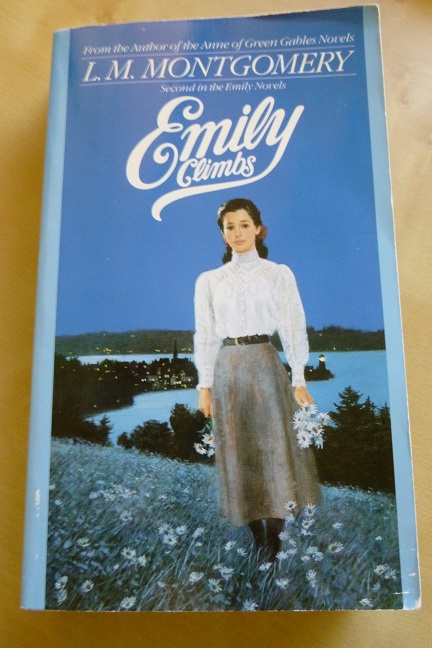
Emily ClimbsFollowing on my review of Emily of New Moon, I’m looking at the next book in the trilogy today, continuing the story of Emily Byrd Starr and her dreams of being an author.

Emily Climbs by L. M. Montgomery gives us Emily’s high school years–even though she begins the book age 13, she felt about 16 to me throughout.  This volume focuses mostly on her writing and her family, as she starts to sell a few stories and poems, and spars with various relatives who cannot understand the things that Emily girl gets up to.  There are also a few ups and downs with best friend Ilse, who continues her wild flouting of propriety.

Male friends Teddy and Perry fade out for large sections of the book, which is a bit of a shame, as their scenes are some of the most compelling.  First, there’s a scene when Emily becomes accidentally locked in the empty church with “Mad Mr. Morrison” and Teddy comes to the rescue.  Later, all four friends take refuge in an abandoned house to escape a snowstorm, where Emily and Teddy share a suddenly soul-revealing glance; under the inspiration of new love, Emily spends the night dreaming out her great novel.  And Perry contributes one of the funniest scenes, narrating a disastrous dinner party he attended.

As you can probably already tell, we’ve left childhood, for the most part, behind by this second book, and ventured with Emily into more adult territory.  The scene with Mad Mr. Morrison is particularly striking for a number of reasons.  As I mentioned in my review of the first book, there’s a darker strain in Emily, and never more so than here.  Morrison is a generally harmless lunatic, endlessly seeking his lost love who died many years before.  He mistakes Emily for his lost bride, and the scene when he searches through the darkened church for her is truly terrifying.  Even though Montgomery mentions that when he finds girls he likes to stroke their hair (in other words–basically harmless), I don’t quite believe that, as the entire tone is that she’s in genuine danger.

Of course he doesn’t catch her, of course she escapes–it’s Montgomery, after all, and if she ever went to the really dark places I wouldn’t enjoy her so much.  But the Emily books go just far enough to make me feel like they’re set in a real world, where there are real problems–and I like that.  There’s also a beautiful conclusion to the scene, telling the reader how Morrison sees himself, the hero seeking his beloved, which brings him away from being a villain and turns him into a truly tragic figure shaped by lost love.

Emily also uses her second sight twice in this book, in more pronounced ways than she did in the first.  I always found these incidents a little baffling because the book is clearly not a fantasy, yet it has these moments…which somehow don’t read as though they’re meant to be fantasy.  Then I read Montgomery’s journal and found out she believed in prophetic dreams and, I would guess, other psychic phenomena (to a point!)

At the end of the book, we see Emily at a crossroads, making a decision about where her life will go next.  I understand her ultimate choice…but in a way I wish she had chosen otherwise, as I would have loved to see where her life would go down that path.  I also wonder if Emily’s decision is, to a certain extent, Montgomery’s efforts to satisfy herself about her path through life, when she never really had the opportunity to go the opposite direction.  I love reading Montgomery’s books from the perspective of knowing the contents of her journals too!

I was originally planning a combined review for both of the remaining books in the trilogy…but then I had more to say than I expected!  So come back next week for a review of Book Three, Emily’s Quest…

Other reviews:
Happy Endings
Becky’s Book Reviews
Lines from the Page
Bookshelves of Doom
Anyone else?

Buy it here: Emily Climbs

Catherine, Called Birdy by Karen Cushman

Catherine Called BirdyIs Catherine, Called Birdy by Karen Cushman a classic, or did I just pick that impression up somewhere?  If it’s not a classic, it should be!

I read this as a kid, probably more than once, and recently revisited it again.  It’s the fictional journal of Catherine, the daughter of a minor lord in Medieval England, who, as she writes, utterly loathes her life.  More specifically, she hates the restrictions society places on her, and most especially hates the idea of being sold in marriage.

Catherine is a delightful, strong-minded character who brings her world vividly to life.  This isn’t pretty, clean historical fiction, more like the modern world in costumes.  Catherine’s world is Medieval, complete with strange food, ghastly hygiene, fleas, a privy and old-style curses (like “God’s thumbs!”)  Catherine visits a monastery, sees a hanging and attends a wedding, giving us a good tour of the time period without feeling like a history lesson.

Catherine is obviously the strongest character, but we meet many others.  There’s Catherine’s barbarian-like father and refined mother.  There’s Perkin, a goatherd who dreams of being a scholar; Aerin, Catherine’s independent-minded friend; and a crowd of successive suitors.  Catherine grows over the course of the book, and much of the growth has to do with realizing that the people around her are far more complex than she had supposed.

The depth of the book and the characters is especially impressive because the novel really is written like a journal.  Most of Catherine’s entries are only a paragraph or two long, and actually sound like something a person could sit down and write about her life.  Many “journals” end up having a level of detail, with extensive description and long exchanges of dialogue, that no one could ever remember and write about her life.  I usually suspend disbelief in that area, but it’s nice to read one that really feels like a journal, and tells a complex, engaging story at the same time.

If you enjoy realistic historical fiction and strong heroines, this book is a great one to explore.  It’s a fun story with a very memorable heroine, and it’s cured me forever of any desire to live in the Middle Ages!

Author’s Site: http://www.karencushman.com/

Other reviews:
Girl with Her Head in a Book
Scattered Pages
A Certain Slant of Light
Anyone else?

Buy it here: Catherine, Called Birdy

The Lone Ranger (and Tonto)

I feel like I’ve been waiting for The Lone Ranger for years.  And considering both the filming and the release date were delayed at least once each, that may not be an unreasonable estimate!  I finally saw the movie on the Fourth of July and happily, it was worth the wait.

The-Lone-Ranger-Movie-Wallpaper1

Johnny Depp as Tonto is the most obvious reason I was excited by this movie, but there’s more to it than that.  I’m a rather passionate fan of Pirates of the Caribbean, and this was made by pretty much all the same people.  It’s a Disney movie produced by Jerry Bruckheimer, directed by Gore Verbinski, written by Ted Elliot and Terry Rossio, with a soundtrack by Hans Zimmer and, of course, Johnny Depp in a wild and weird role.  Plus Lone Ranger has Helena Bonham Carter and the quite attractive Armie Hammer thrown in for good measure.

Lone Ranger is not Pirates of the Caribbean (what is?) but it’s a similarly fun ride, and some of those parallels most definitely show.  They stole some fight choreography out of Pirates, there are similar character arcs, and there are over-the-top, improbable (well, probably impossible) action sequences.

The movie is an origin story for the Lone Ranger, Texas vigilante in the Old West.  John Reed is the sole survivor of a massacre of Rangers.  Rescued by renegade Comanche Tonto, who has his own reasons for hunting the outlaws at fault, the two join forces to seek justice.  There follows a tangle of searches for information, hunts, missteps and near misses, and reveals of backstory and conspiracies.  It’s all really a vehicle for funny moments and insane action sequences (like galloping a horse along the top of a moving train…to the William Tell Overture, of course).

the-lone-ranger-2013-depp-as-tontoTonto seems to have received a lot more attention in the lead-up to the movie than the Lone Ranger–partially because it’s Johnny Depp, and partially because of the controversy around portraying a Native American character.  To me, Tonto felt much less like any attempt to make a racial comment and much more like another in a long line of wacky and weird Depp characters.  Depp’s Tonto is plainly unbalanced.  He’s also the comedic center of the story, and easily the show-stealer of the whole movie.  Trading with dead men, talking to horses or scattering cracked corn everywhere he goes, he’s endlessly entertaining.  The bird on his head is not just a fashion statement but something he frequently interacts with (and it turns out to have a surprisingly dramatic backstory).

Tonto is effectively played for laughs, although in some ways I feel like they never quite nailed down his character.  To paraphrase Captain Jack, it’s funny how often madness and genius coincide.  While Jack usually comes across as genius (if twitchy and eccentric genius), with Tonto it’s more often madness.  It’s much harder to tell which side of the line he falls on, and the movie fell off a few times trying to walk on it.  I was hoping for something to ultimately reveal whether his, um, unusual way of looking at the world really is valid, or really is madness…and it never quite came.

Even though the Lone Ranger was the title character and arguably the impetus to the plot, he fulfilled a Will Turner-type role in the movie, as the handsome friend to the eccentric show-stealer.  He undergoes a similar arc too, from the uptight, straight-laced fish out of water, to finding confidence and competence under the rather shaky mentorship of Depp’s character.  I’m not sure why he’s quite so incapable of coping with the Wild West, considering he’s a native son of the frontier town, but he comes back from years away as the intellectual cityite with no real understanding.  And it is quite hilariously funny when he accuses the Madame of the brothel of breaking numerous health codes, including having a suspicious jar of pickles on the bar…

This was mostly a man’s movie, but Helena Bonham Carter does do a very entertaining turn as said-Madame, typically eccentric as well.  There’s also a love interest, who has her moments although she’s no Elizabeth Swann, and is definitely secondary to the quest for vengeance.

THE LONE RANGERRepresenting the animal contingent, Silver is a truly weird horse.  Tonto takes him to be a spirit animal, and he’s certainly an, erm, independent spirit.  The horse gets a lot of laughs, and it’s fun just to have the faithful steed as an actual character with his own quirks.

I enjoyed this hugely, but my biggest criticism of the movie is the level of violence.  It’s not graphic, but it is obvious and frequently brutal.  One of the opening sequences features a group of outlaws taking a train, and the casual shooting of anyone in their way is shocking in its callousness.  The death of walk-on characters (or redshirts) is a usual convention in this kind of story, but there was something about this that felt a notch higher in violence.  The massacre of the Rangers is also pretty horrific, and while the facts of the scene are plot-necessary, the details could easily have been toned down.  John’s brother doesn’t just die; he dies in a horrible way, and while it’s below the edge of the screen, there’s still no question about what happens.  There are also shots lingering on each of the dead bodies of the Rangers.

The second half of the movie is in some ways better on that front.  The action sequences become less brutal, bigger and more absurd, transcending to the level of cartoon.  Without any element of reality, they become less disturbing–although that’s problematic in its own way, on the level of desensitization.  On a similar note, as is also typical in this type of movie, the Lone Ranger and Tonto both take enough falls and general pummeling to be dead several times over.  I’ll accept the absurd falls, and the crazy stunts–but it does bother me that there are quite a few moments where the violence level felt gratuitous.  This has been marketed as (and for the most part is) a family-friendly, comedy-adventure, and it’s disappointing that they couldn’t rein back the violence to a more appropriate level.

I’ve seen the objection to the violence made elsewhere too, and hopefully Disney will listen (I’m not that hopeful, but it’s possible).  If this movie does well at the Box Office, I’ve no doubt they’ll have the opportunity to try again.  The movie is complete in itself, but it has every marking of the first of a series…and if Johnny Depp signs up again, you can bet I’ll go see it.

Movie site: http://disney.go.com/the-lone-ranger/

The Phantom of the Opera by Gaston Leroux

Leroux PhantomI think we all know I have kind of a thing about the Phantom of the Opera…  I recently did a reread of Gaston Leroux’s original novel–and since I can never keep straight what was in Leroux compared to other versions, even the third time through felt in some ways like a new experience.

The basic story is the same across most versions, and Leroux set the original pattern.  A masked man with a genius for music lives under the Paris Opera House.  In the guise of the Angel of Music, he trains Christine Daae in singing.  When Christine falls for Raoul, the handsome Viscomte de Chagny, the Phantom wreaks havoc in his jealousy.

Leroux was originally in French, so if you’re reading a translation I highly recommend Leonard Wolf’s.  Really, I can’t stress this enough–I’ve read two versions, both “unabridged,” and Wolf’s somehow has significantly more detail and better writing.

It’s always been the characters that really fascinate me in any version of Phantom–and mostly it’s Erik, the Phantom, himself.  Retellings in the last century have been on a nearly-consistent quest to make the Phantom a more sympathetic, romantic figure.  In the original, however, he’s a complete raving madman.  Truly, the man is unhinged.  He has a violent temper and (probably) kills at least three people over the course of the book.  I say “probably” because he denies it himself and we don’t actually see those moments, but I think his denial is a symptom of insanity, not innocence.

There’s nothing romantic about Leroux’s Phantom.  However, he does garner a certain amount of sympathy–or perhaps I should say pity.  I began feeling more sad for him when the Persian (a mysterious figure rarely appearing in films) took over the narration.  That’s not because the Persian portrayed Erik sympathetically, but just the opposite.  He’s the closest thing the Phantom has to a friend, and even the Persian still routinely refers to him as “the monster.”  We also learn from the Perisan that Erik really believed Christine loved him; the Persian himself doesn’t believe it…because Erik is so ugly.  Not because he’s a raving madman with violent tendencies–but because he’s so ugly.  There’s something wrong in that.

The final scene, in which Erik tells the Persian about how he parted from Christine, is absolutely wrenching.  And how can you not feel sad for a man whose mother always refused to kiss him?  Susan Kay does wonderful, devastating things with the idea, but it’s there in Leroux too.

The Phantom as a violent madman casts Christine in a different light too.  I’m not a Christine fan as a rule.  Often she’s an idiot or decidedly callous.  However, it occured to me rereading Leroux that Christine and the Phantom are sympathetic in inverse relation to each other.  The more rational and likable the Phantom is, the more blameworthy Christine seems for any lies and betrayals, and for ultimately choosing Raoul.  The more villainous the Phantom is, the more justifiable Christine’s actions are.  In Leroux, she’s still an idiot at times, but is pretty much justifiable too.

As for Leroux’s Raoul–I have to say I find it downright amusing how frequently he weeps, faints, raves or goes into a sulk.  I understand what Christine doesn’t see in Leroux’s Erik, but I don’t know what she sees in Leroux’s Raoul (his bank account, possibly…)

So much for characters.  The other aspect that struck me most in the novel was the structure.  So much of the story happens “off-screen.”  Many of the most iconic moments, including Christine ripping off the Phantom’s mask and their final parting, are only conveyed in conversations after the fact.  They’re almost detailed enough to be flashbacks–but aren’t really.

We get a lot of Raoul wandering about and wondering what’s going on with Christine.  We get very little of the Phantom actually present in the story.  I think Leroux is one of these classic writers who didn’t really know what he had created–or didn’t know quite what to do with it.  Nearly everyone retelling it has realized that the most interesting one in the story is the Phantom, and has been skewing the story his direction ever since.  Leroux…not so much.

Riding solely on its own merits, I have to say that I don’t think Leroux’s Phantom is all that great of a book.  It pains me to say it.  And I don’t think it’s a terrible book!  But it’s middling at best.  It’s far more interesting from a historical perspective, from the angle of “oh, that’s how Webber changed this” or “I love how Susan Kay took this one line and wrote six chapters from it.”  For me, at the end of the day, I far prefer Webber’s and Susan Kay’s versions.  But it is fascinating to see where they came from.

Other reviews:
ANZ LitLovers LitBlog
The Book Mine Set
In Which I Read Vintage Novels
Anyone else?

Buy it here: The Phantom of the Opera

The Secret Adversary by Agatha Christie

I’ve been meaning to read more Agatha Christie (which may or may not have something to do with her appearance in Doctor Who…) and saw a review on Stella Matutina a few months ago for The Secret Adversary.  I got the audiobook from the library–and absolutely loved it.

The Secret Adversary is a “Tommy and Tuppence” novel, about two friends who, hard-up for employment after World War I, form the Young Adventurers Ltd.  Tuppence’s idea is to be criminals-for-hire, but instead they become enmeshed in an international spy thriller involving the Lusitania, a missing girl, vital documents, and the elusive criminal mastermind, “Mr. Brown.”

This was a delight of a book, which played to all my Anglophile tendencies.  It’s so very, very British–or rather, a certain stereotype of Britishness.  The dialogue is all full of “old thing, old bean, isn’t it all just ripping?”  Much of the book takes place in London, so between ridiculous slang and wanderings through Hyde Park and Trafalgar Square, I was having a wonderful time with that angle.

It’s great fun (or terribly jolly?) from other angles too.  Tommy and Tuppence are splendid characters.  Tuppence (a nickname) is clever, saucy and altogether too sure of herself, and prone to flights of inspiration of varying value.  She’s in many ways the driving force of the book, and I have to love an extravagant yet effective heroine.  Tommy is much steadier and slower to think things out, but more likely to be right once he comes to a conclusion.  Both are very likable, and they provide a nice balance for each other besides.

The mystery becomes somewhat convoluted in spots (not to mention coincidental!), but the essential notion of the mysterious (secret) adversary and international disaster is sound.  I never quite followed all the political ramifications of how it would spell disaster if these vital documents fell into the wrong hands…something about the Labor party and a general strike and I’m not sure what.  But I just accepted that it would mean the fall of the British Empire and went from there without worrying about the details.

There are some nicely tense moments and unexpected twists.  I was sure I saw one twist coming that turned out to be a red herring.  Well-played, Dame Agatha.  Even better, once the final reveal came, it did make sense–it wasn’t one of those annoying bait-and-switch jobs.

The story, of course, revolves around two friends of opposite gender, so at least one aspect of the story isn’t much of a twist…  The romantic moments are brief and mostly backdrop, but still fun and rather sweet.

The CDs I listened to were the “Audio Editions Mystery Masters” series.  The narrator’s British accent contributed a good deal to the fun of the Britishisms, and he did make me jump at least once at a tense moment.  I thought he struggled a bit with some of the other accents though; the American accent especially sounded forced.  Not everyone can be Katherine Kellgren, though, and overall I’d recommend the audio.

There was just one thing I didn’t understand.  On at least two occasions, probably more, a character named Jane Finn is referred to as having a wildly outlandish and unusual name.  Um.  Really?  Jane Finn is outlandish?  As opposed to, say, Tuppence?  Maybe there’s some reference re: “Jane Finn” that made sense in 1922 and doesn’t anymore, because on that one, Christie lost me.

But with everything else, I was right along with her and her delightful characters.  I enjoyed Murder on the Orient Express but didn’t feel obliged to rush out for more Hercule Poirot.  On this one, I’ve already been hunting my library’s catalog for more of Tommy and Tuppence.

Other reviews:
Strange and Random Happenstance
Here There Be Books
Fell From Fiction
The Agatha Christie Project
Anyone else?

Buy it here: The Secret Adversary