Marie, Dancing

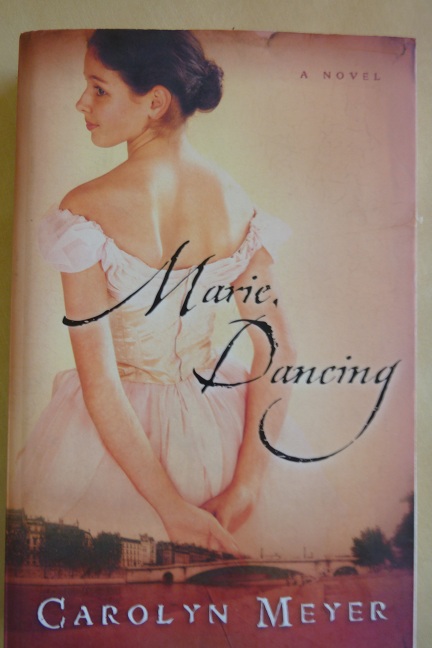
Marie, DancingI think we all know I’m a fan of the Phantom of the Opera…and I’d be lying if I said that wasn’t the primary reason I wanted to read Marie, Dancing by Carolyn Meyer.  It just happens to be set in the Paris Opera House around 1880, the same time as the Phantom.  But besides that, the book also plays to my interest in Impressionist art, and in Paris in general, and in stories about strong young women.  The book only shares a setting with Leroux and there are no Phantom references at all…but there is a good story and a lot of information about the Company of the Paris Opera.

Marie and her two sisters are ballet dancers at the Palais Garnier.  The story opens when the painter, Monsieur Degas, selects Marie to be his model for a sculpture he has in mind–the sculpture that will become The Little Dancer, Aged Fourteen.  Degas and his art are just one part of Marie’s story, as she struggles with her family’s poverty and tries to make choices about her future.

Marie lives in a very, very different world than Christine Daae.  Unlike Leroux’s spooky thriller, this is a gritty, realistic book.  Marie’s problems are real and serious, with never enough food, a mother who drinks too much absinthe to forget her pain, and an older sister who aspires to become a rich man’s mistress and thinks Marie should do the same.  The book is not depressing exactly, but it is a glimpse at the harsh reality behind the elegant forms of the dancers.

Marie does love to dance, and she has dreams of becoming a great dancer.  The book is not really about dancing though–that recedes more and more as it goes on, and becomes more about Marie’s family, her struggles, and a romance–lest you think it’s all grim!

From the point of view of a Phantom fan, this definitely gave me some different angles on things.  It gave me more basic information about life at the Opera House than anything else I’ve read, and was utterly eye-opening on the subject of money.  I never appreciated just how much money 20,000 francs a month (the Phantom’s salary) really is, until Marie sighed with envy over the salary of the higher-level dancers–6,800 francs a year.

The sections with Degas were particularly interesting.  There are occasional references to specific sketches or paintings, and I think I recognized some famous ones!  Mary Cassatt is also present as a supporting character, and I loved the glimpses of the history of Impressionism.

I would have liked more description of the setting–the Opera House is gorgeous, and yet other than a few bits here and there, I didn’t get much sense of it.  But even if appearances were somewhat lacking, Marie’s world came vividly to life.

If you’re interested in dancing, and particularly the Paris Opera, this is a very good slice of historical fiction, unflinching but not unremittingly grim either, and the characters and plot are both engaging.  And you’ll look at Degas’ Little Dancer in a whole new way!

Author’s Site: http://www.readcarolyn.com/

Other reviews:
The Estella Collective
That’s all I found!  Anyone else?

Buy it here: Marie, Dancing

Jesus On Screen

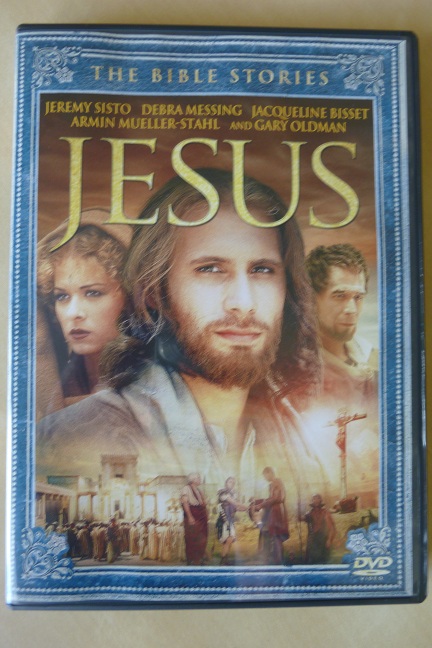
JesusI don’t usually do reviews on Friday, but today is Good Friday, leading up towards Easter Sunday, and I just watched a movie that is immensely appropriate to the day.  It has the very simple title of Jesus and was originally a TV miniseries from 1999, though it plays like a three-hour movie (and there were only a few obvious commercial breaks!)

I watched at least part of this when it first aired, but all I remembered was Jesus having a conversation with the devil, and a vague image of Jesus walking down the road and joking around with his disciples.  Not a lot to go on trying to find the movie again–but obviously it worked out.  And it turned out to be a fantastic movie–I ordered the DVD from Amazon before I even sent back my Netflix disc, and I searched IMDB to see if the director has done any other Biblical movies (he has!)

So what blew me away so much?  Oddly enough, it really may be encapsulated by that moment of Jesus joking around with his disciples.  This is the most joyful Jesus I can remember seeing in…maybe any movie.  The church teaching is that Jesus is fully human and fully divine, but the divinity seems to get more play in movies.  Usually it’s all very serious, every word he says is a solemn and profound pronouncement.  Most often, the humanity gets expressed in suffering.  I’m not saying any of that isn’t important, and this movie gives those moments too–but there are also a lot of moments where you get the feeling that it’s a good time hanging out with Jesus.  Or just that he knows how to live a normal human life, and goes through periods of learning, uncertainty and change.

The movie opens slightly before Jesus (Jeremy Sisto) begins his public ministry.  We don’t often see Jesus with Joseph, and I really liked this movie’s exploration of Jesus’ relationship with his adoptive father.  Mary figures in quite a bit too, and while there isn’t a full scene of the Nativity, Mary and Jesus do have a conversation or two reminiscing over family stories.

Jesus begins his ministry with the baptism by John, and then goes into the desert for a very interesting Temptation sequence.  This was a particularly clever Satan, who is clearly evil but convincingly persuasive.  Although, while the desert sequence was mostly good, I could have lived without the image of Jesus with a severely blistered sunburn…

Jesus then starts collecting disciples, and I love that not only is Jesus very human, real and alive, everyone else is too.  There are about six of the Apostles who get some development, and without spending a lot of time on most of them, I still got a sense of all of them as people, not just distant figures in Bible stories.

As one representative example, I’ll take the calling of Simon Peter.  Peter and his friends have been fishing and caught nothing.  Jesus tells them to take the boat out and he’ll tell them where to drop the nets to catch fish.  Peter scoffs at the whole thing (because what does this guy know about fishing anyway?), but says he’ll do it to prove a point about this supposed Messiah.  When the nets come in miraculously full of fish, Peter is completely flummoxed–and Jesus starts laughing.  There’s nothing remotely mean about it, but it’s so clear that Jesus is having fun teasing Peter.  I love that.

There are lots of moments like that.  The movie walks a nice line, because while it is fun, at the same time, Jesus is also a profound teacher who takes his mission seriously, and has an important message about love and compassion.  It’s not all just larks, there’s a spiritual depth as well.  And there are serious moments–as when Jesus cries over a Roman soldier killed by Zealots (not Biblical, I don’t think, but I like it).

One of the other major characters in the story is Mary Magdalene (Debra Messing).  Overall I thought her portrayal was wonderful, although (rather like the blisters in the desert) I could have lived without two very brief, gratuitous scenes of Mary Magdalene, um, at work.  The movie conveyed everything needed in another scene of her watching Jesus forgive the woman caught in adultery.  We didn’t need the more sensationalist moments.  The tradition of Mary Magdalene as a prostitute isn’t Biblical, but I don’t object to it generally, and the movie used it for the most part in a very profound way to convey a message about forgiveness and releasing judgment.  Another nice touch was the relationship between Mary Magdalene and Mary, Jesus’ mother.  They’re next to each other in paintings of the Crucifixion a lot, but I’m not sure I’ve ever seen it really explored.

On the villain side of the story, Pontius Pilate (Gary Oldman) and King Herod are threaded throughout the movie, rather than only coming in at the very end.  Herod has his own issues, particularly around John the Baptist, and Pilate is working political manuevers to make sure he stays in good with Rome.  By the time we reach the Passion, we know Pilate very well, and I like seeing Pilate as a human too.  Not a very nice one, but human.

The movie successfully makes the bridge from a largely light-hearted ministry to the intense end of Jesus’ life.  The Raising of Lazarus is something of a turn in the tone, I think, as it’s handled in a more solemn way, and that leads into the last week of Jesus’ life.  Satan returns in the Garden of Gethsemane, which I thought was an excellent touch.  The Passion is intense and bloody (as is probably inevitable), but it is mercifully brief.

And after the Crucifixion, there are a couple of lovely scenes with Resurrection appearances.  I don’t know why exactly, but the Passion seems to get far more focus in movies than the Resurrection (more dramatic?), which is too bad because there are wonderful Resurrection stories in the Bible.  Another ten minutes in this part would have been even better, but at least there were some wonderful moments.

I have a tradition of watching Jesus Christ Superstar leading up to Easter, but I may have to expand that tradition a bit.  Jesus is a wonderful movie, and I have to love a Bible-retelling that frequently made me smile.  And not only because it led Netflix to send me an email with the subject line, “Has Jesus arrived yet?”  🙂

Other reviews:
Charles Tatum’s Review Archive
Canadian Christianity
Anyone else?

Buy it here: Jesus

Imagined Lives: Portraits of Unknown People

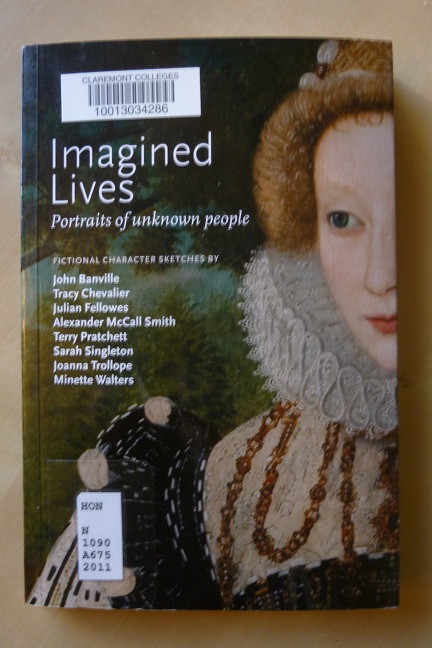
Imagined LivesI’ve been deeply intrigued by the concept of Imagined Lives: Portraits of Unknown People ever since I first heard about it.  Eight authors wrote fictional character sketches, based off portraits whose original identities have been lost.  Many were at some point thought to be someone famous from history, which is how the portraits ended up at the National Portrait Gallery in London.  Later scholarship has overturned their supposed identities, and now the Portrait Gallery (which, by the way, is my favorite museum, ever) has put together a collection of stories around these anonymous portraits.

I almost bought a copy in the gift shop when I was at the museum…but I have trouble buying books I haven’t read, so I resisted.  I hit the library instead, and I think that was the right decision.  I enjoyed the book, but I’m glad I didn’t spend however many pounds they would have charged me.

There are eight authors and fourteen character sketches, and while I liked the book overall, the quality does vary.  The style also varies, which contributes to the changing quality.  I liked best the ones that were more like stories.  There’s a mix of letters, personal reflections, and fictional encyclopedia entries, all of them only two to three pages long.

The encyclopedia entries read like, well, encyclopedia entries.  Some of the more elaborate ones have some intriguing elements to them, but ultimately…well, how fascinating is an encyclopedia entry, really?  Especially a very brief, overview biography of someone.  Some of these would be wonderful as novels, but in such a compressed format, they fall a little flat.  Not all–but some.

For the letters and the reflections, I liked the shortness.  Because of their style, they’re much more intimate, much more detailed, and give us this tiny, very personal glimpse into the individual’s life.  I especially liked it when the glimpse is very closely tied into the portrait–as in a woman writing to her sister about her husband’s rash investment in commissioning a portrait they can’t afford, or a young noblewoman whose painting has been done with the interest of attracting a suitor, and she fears a husband who would choose his wife in such a way.  That was one of my favorites.  We also get the other side of a similar story, a woman writing to her mother about her indecision on whether she should accept a suitor who has sent her his portrait.

My favorite, though, is actually one of the encyclopedia entries, which will make more sense when I tell you that it was written by the delightful Terry Pratchett.  It tells the tale of the very unfortunate Joshua Easement, who dreamed of being a great explorer but whose “navigational method mainly consisted of variations on the theme of bumping into things.”

The portraits all seem to be from loosely around the time of Queen Elizabeth I, and many are tied very closely into history.  As is frequently true with much longer works of historical fiction, some of the fun of the stories is weaving the fictional characters into the lives of real people.

The book concludes with an essay on how scholars identify portraits, and how portraits like the ones in the book can lose their original identities.  It’s a very accessible essay, and an interesting look at the stories behind the portraits in museums.

If you have an interest in portraits or British history, I recommend this intriguing (and very quick) read.  I didn’t enjoy all the character sketches, but in the midst are several gems.

Museum Site: http://www.npg.org.uk/

Other reviews:
Vulpes Libris
Patrick T. Reardon
Anyone else?

Buy it here: Imagined Lives: Portraits of Unknown People

Victor Hugo’s Les Miserables – Parts IV and V

Les Mis (2)We’re coming down to the final stretch in Les Mis.  If you missed them, you can go back and read the first and second reviews.  Today, I’ll be looking at the last two volumes, when the barricade arises.

This section begins with romance and then moves to revolution.  Marius and Cosette’s relationship takes leaps forward compared to the previous section–by which I mean they actually start talking to each other!  After a blissful interlude, however, circumstances separate them, seemingly forever, and Marius decides that he has nothing to live for.  Conveniently for him, a very good opportunity to get himself killed comes swiftly along.

The revolutionaries finally come into their own in this part of the book.  Paris rises in rebellion and the book focuses in on Enjolras and his band, building and holding the barricade at the Rue Saint-Denis.  They rally around to fight the good fight, while Marius turns up mostly by accident and plunges in.  Inspector Javert is in the midst, revealed as a police spy, and before too long Jean Valjean joins in too…for reasons I felt were never adequately explained.

This is certainly the bloodiest part of the book, and probably the most exciting (although it gets stiff competition from an earlier sequence when Javert was stalking Valjean).  Hugo demonstrates his ability to make even inaction interesting, as they wait on the barricade for each next engagement–and the engagements come with all their drama too.

A few spoilers here, although nothing that the musical won’t tell you…  Gavroche’s death is almost identical in the book as in the musical, and is heartrending in both.  Eponine’s death in the book was more of a disappointment to me.  It’s quick, and it’s largely ignored by everyone, including Hugo.  At pretty much every point of Eponine’s arc, I prefer what the musical did.

But the rest of the barricade sequence is excellent, and I didn’t even mind that they retreated eventually into the cafe.  The movie made it look like a pell-mell retreat, but in the book they fight every inch.

After the barricade falls and a few more trials are gone through, there’s a brief interlude where we actually seem to be heading for a happy ending.  But I didn’t trust Hugo to take us there…and he didn’t.  I won’t get into the particulars but the last section is heartbreaking, and I think the blame falls largely on the heads of Valjean and Cosette.

I love Valjean–he’s a wonderful man–at least until the last hundred pages or so, and then I just don’t know whether I want to cry over him or shake him.  He has a very strong streak of self-sacrifice throughout the entire book, and most of the time it’s immensely admirable.  At the end, though, it begins to approach the point of masochism, self-denial for very little purpose.  There’s an argument for what he does, but it’s flimsy.

Valjean clearly grasped two thirds of the “greatest commandments.”  He has “Love thy God” and he constantly demonstrates “love thy neighbor,” but he never got the idea of that last phrase, “love thy neighbor as thyself.”  The concept of self-forgiveness seems to have escaped him.  I still love him–but Hugo maybe takes it all just a little too far by the end.

As for Cosette–I don’t love Cosette.  She’s such a flighty, childish little nothing.  She has nothing to do in the musical, and scarcely anything more to do in the book, long as it is.  She’s sweet and she’s pretty and Hugo (and Marius) keeps referring to her as an angel, but she never does anything demonstrably angelic.  Cosette has all the refinement to present herself well, and appears perfectly demure and modest and all that, but that’s the extent of her talents.  I suppose if the ability to modestly lower one’s eyes makes one an angel, then by all means, call her that.  But by criteria of actively doing good for others…I find Gavroche far more angelic.

Heartbreaking (and somewhat frustrating!) as the end of the book is, this is still a wonderful read.  I spent longer on this book than I’ve spent on any one book in years, but it was absolutely worth it.  The characters and the world they inhabit are vivid and alive and drew me in completely.  Highly recommended–if you have some time! 🙂

Victor Hugo’s Les Miserables – Volume III

Les Mis (2)This week I’m doing a multipart review of the excellent but very long Les Miserables by Victor Hugo.  Read about Volumes I and II here.  Volume III focuses (though not immediately) on Marius, leaving Jean Valjean and Cosette out of the story for quite a while.  This is where I think it helped the most that I knew the musical, or I would have been feeling very adrift!

Marius was raised in wealth, but fell out with his grandfather over his estranged father’s politics.  Turning his back on his grandfather and his money, Marius lives in Paris in relative poverty, scraping along on some minimal scholarly work–but contented with that.  And then one day at the Luxembourg Gardens he sees a beautiful young woman out with her father and is hopelessly smitten.  They carry on a lengthy courtship of glances, until one day she ceases to come and Marius is plunged into the depths of despair.

I’m not entirely sure how I feel about Marius.  He’s such a nice young man.  I can’t dislike him–he’s so nice–but there’s not a whole lot I like about him either.  I both accept and respect his dedication to his principles (a dedication I don’t quite believe in the musical), but at the same time, he follows that dedication with such utter lack of common sense that I shake my head a bit too.  His most praiseworthy attribute in the musical is his revolutionary fervor, which just doesn’t exist in the book.  On the other hand, his most blameworthy attribute, his blindness regarding Eponine, doesn’t really exist in the book either.  But that brings me to two other plot threads…

Marius’ crowd of revolutionary friends do turn up in this book and I enjoyed getting more depth on them.  At the same time, I was surprised by how shallow Marius’ connection to them was.  He knows them, but he’s really not one of them.  It gets more complicated with the barricade, but that’s Part IV.  I was happy to see Enjolras, though, the leader of the group and one of my favorites from the musical.

Marius’ path also intersects with the Thenardiers, who have come to Paris and fallen on even worse times.  Take away the humor from the Thenardiers, and you have instead examples of just how low people can sink, both in poverty and in moral character.

Two members of the Thenardier family particularly fascinate me.  First, Eponine, the older daughter.  I actually found her a more interesting character in the musical.  There’s a spark of something in her, this sense that she could be so much more than her life has so far let her be.  Oddly enough, I get less of that feeling from the book.  I think it’s there, but she’s far more disreputable too.  There also seems to be less of a relationship between her and Marius than the musical suggested, to the point that I can’t blame him for not returning her unrequited crush.  It redeems him a bit, though I felt less for her.

I was just a little disappointed regarding Eponine, but I was thrilled with Gavroche.  I can see why the musical never got into the fact that he’s the Thenardiers’ son–he has only the most tenuous of relationships.  He emerges in the book just as I had hoped, a plucky, cheeky street urchin, keeping his head up and his confidence intact no matter what life hands him.  I love Gavroche’s spirit, and I also love that even in his own poverty, he’s still generous.  He gives to others even if it means he won’t eat that night himself, and he seems to do it instinctively.  Love, love Gavroche!

You may be wondering at this point what ever became of Valjean, and you’d be justified in that wondering!  I don’t think he’s mentioned by name in this entire Volume…although it doesn’t take much insight to match up Valjean and Cosette with another set of characters who do appear here…

I’m definitely not invested in Marius the way I was in Valjean, but that didn’t really interfere with my enjoyment of this section.  The story was engaging even if I had mixed feelings about the main character.

Come back tomorrow for a review of the last section…one day more ’til the barricades arise. 🙂