Victor Hugo’s Les Miserables – Volumes I and II

Compare the thickness here...
Compare the thickness here…

I have a fear of long books, a fear I have been attempting to confront this year by reading some of the big thick books I’ve put off (usually because there are so many other books to read!)  I’m trying to get in one a month, and in February I tackled what’s probably the thickest of them all, Les Miserables by Victor Hugo.  My copy had 920 pages of very small font, and with that much text to get through, it’s a good thing I enjoyed the story so much!

I’ve seen the musical, both as a play and the recent movie, and I think that was beneficial reading the original.  The musical felt (to me) like it was predominantly accurate to the book–not in every particular, but in most ways.  Knowing the soundtrack so well, I frequently had relevant lines running about in my mind as I read the corresponding scene.  That was fun, but more importantly, knowing the musical meant I had a pretty good idea where Hugo was going–which is not always obvious!

Before I go further, I should confess something.  I didn’t actually read all of the book.  I’m guesstimating I read a solid 750 pages.  You see, Hugo has this habit of going off into history or social commentary for twenty pages at a stretch.  And…I started skipping those chapters.  In a way, it’s actually a compliment to the rest of the book–I was far too eager to get back to Jean Valjean and the rest, and couldn’t stomach the amount of reading time it would take to wade through the other bits.  I never found that I was having any trouble following subsequent chapters after skipping sections, so it seemed to work out.

The book is subdivided into five volumes, but I think really reads like three clear sections.  Volume I and II focus on Jean Valjean and, more briefly, Fantine.  Volume III is Marius’ story.  Volume IV and V are about the revolution, in the middle of which all the earlier plot threads intersect.  I could give you a very, very long review…but as you likely surmised from the title, I’m going to break this into three parts instead.  So today, we’ll start with the first two volumes.

Set in France in the early 1800s, Volume I begins the story of Jean Valjean, an ex-convict on parole who finds himself at a crossroads when he meets a particularly sainted bishop (Hugo drives the point home rather).  Valjean struggles with whether or not to steal from the bishop…and I won’t give the details away, but he ends up resolving to shed his former identity and go forward to lead an honest life.

Jump ahead several years and we meet Fantine, a woman left alone with a child born out of wedlock.  She falls on worse and worse times, eventually turning to prostitution to provide for her daughter, Cosette, who has been left in the care of two innkeepers, the Thenardiers.

The first observation I have to make is that Hugo likes backstory.  The first 35 pages are the backstory for the sainted bishop; I was still feeling dedicated at that point and read them.  They’re not bad, but the story picked up a lot for me at the beginning of Book Second, when Valjean arrives in the story.  I loved learning more about Valjean’s backstory, and about Fantine’s as well, when we come to her.  I loved getting the details that the musical only hints at, and I loved the depth of the character exploration.

Valjean is a wonderful character.  It was fascinating to find out his history, and also how he developed (or perhaps I should say, regressed) during his time as a convict.  We then watch his struggle at the turning point to reclaim his humanity and his faith…and then his struggle for the rest of the book to keep them.  More on that later, though.  These first two volumes demonstrate Hugo’s ability to make mental struggle fascinating.  I think I recall that “man vs. himself” is one of the standard conflicts of literature, but I’ve rarely seen it explored to such an extent.

We meet several other principle characters in the first two volumes, particularly the Thenardiers and Inspector Javert.  I was actually a bit disappointed that we didn’t meet Javert sooner.  He turns up fairly far along, and there’s just a few references to establish that Javert knew Valjean while he was a convict.  So many other things are so much more elaborated upon, I hoped for more here.  What was here was good, though, and we delve into Javert’s mind some too.  I know people who just love Javert; I can’t say I’m one of them, but I do find him an intriguing character.

The Thenardiers probably diverged farthest from the musical version of the characters.  In the musical, they are nasty individuals, but they’re played for humor.  In the book, they’re not even remotely funny.  They’re just nasty, horrible, awful people.  Cosette’s situation living with them is incredibly heartrending.  Imagine whatever other “poor orphan waif” story you’ve read, multiply it a few times, and you’ll probably have it.  I think that was one of the most gripping sections of the book.

Volume II ends on what’s essentially a happy note, and we’ll leave it there for today.  Come back tomorrow to meet Monsieur Marius in Volume III!

Other reviews:
Compulsive Overreader
Teacups in the Garden
One More Page
Anyone else…?  I know I have readers who are Les Mis fans–send me links to your reviews and I’ll add them!

Buy it here: Les Miserables

Spend Some Time with Pat of Silver Bush

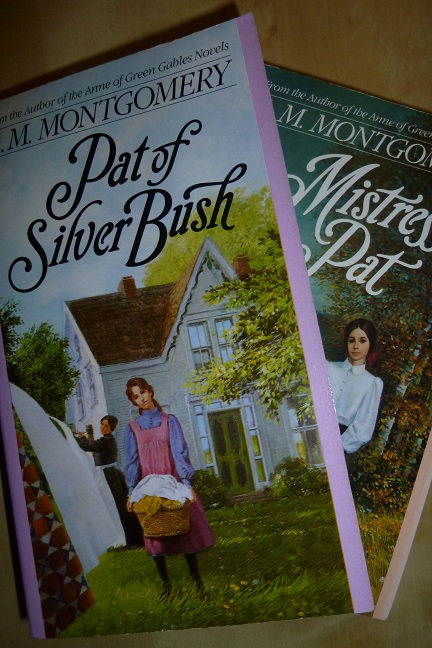
Pat BooksWith the L. M. Montgomery Reading Experience this month, I decided it was the perfect time to revisit the Pat books.  Pat is not as well-known as her literary sisters, Emily and Anne, but she has two charming books, and I was intrigued because Montgomery considered her one of her more autobiographical heroines.

Pat of Silver Bush follows Pat through childhood, from age seven to eighteen, touching on Pat’s small adventures along the way.  I don’t mean “small” as a criticism–part of the charm of Montgomery’s books is that she takes the day-to-day concerns of a girl (and a family) living on a farm on Prince Edward Island, and spins out a beautiful story.

I like Pat, but I think I can see why she hasn’t captured the imagination the way fun-loving Anne or ambitious Emily have.  All Montgomery heroines deeply love nature and a good story, and have at least a glancing appreciation for poetry.  Pat’s interest is more glancing, and though she’s clever, she doesn’t have Emily’s brilliance.  Pat’s chief quality is to love things intensely–often too intensely–and nothing more so than her home of Silver Bush.  Pat worships Silver Bush, and can’t bear the thought of any changes.

It took me a bit to get into the book, and while that may have been a matter of transitioning out of sci fi, I think it also has to do with the particular incidents of Pat’s very early childhood.  Pat can’t bear change–and so she has agonies of emotion over apparently minor things, to the point that it’s hard to sympathize.  This problem is smoothed out as Pat gets older and begins to move in a larger sphere, with larger (and more genuine) concerns.

Pat is one of the few Montgomery heroines to have a large immediate family.  Anne and Emily are both orphans.  Pat has two parents and four siblings.  The funny thing is, I don’t feel properly acquainted with most of Pat’s family.  Her nearest brother, Sid, comes into it a bit, and her younger sister Rae has a significant role in the second book.  The rest, though Pat loves them fiercely, seem to have very little actual presence in the book.

I was particularly struck by the portrayal of Pat’s mother.  She’s lovely and loving and “the heart and soul of Silver Bush”…but she always seems to be off in the other room.  Montgomery’s own mother died when she was a toddler, and she idealized the memory of her mother.  Pat’s mother feels like a living version of this–beautiful, idealized, but not really there.

The one who’s there is Judy, the family cook and house mistress, who understands Pat better than anyone.  Born in Ireland, Judy is an endless source of wonderful, improbable stories, either spooky tales of ghosts and fairies, or funny stories of family history–and of family history for everyone else in town.

The other two characters that shine are Pat’s two best friends: dreamy, ethereal Bets, and practical yet poetic Jingle.  Despite his unfortunate name (and eventually switching to Hilary doesn’t help), Jingle is a delightful childhood sweetheart for Pat–because every Montgomery heroine seems to have one.  Jingle is the mistreated near-orphan of the story, who sees the world clearly and dreams of making a mark in it–but can also join Pat in going in raptures over a bit of woodland.  He has ambitions of becoming an architect, and is forever planning the house he’ll some day build for Pat.

One of my favorite chapters is when Jingle’s long-absent mother comes to visit, and it goes very badly.  It’s a dark crisis for a Montgomery book, not a straight-forward tragedy but a crisis of disillusionment, and very moving.

Mistress Pat follows Pat through eleven years, from twenty to thirty-one, through a series of beaux, new friends and many new changes.  Hired man Tillytuck is a wonderful addition, very colorful and frequently sparring with Judy.  Rae comes into her own as Pat’s dearest friend, and Pat makes new friends out of Suzanne and David Kirk.  They don’t have quite the charm of Bets and Jingle, but they have their moments.

This is a particularly interesting read after reading Montgomery’s journals, because I’m convinced she put so much of her own life into Pat’s.  I’m sure Pat’s brother makes an unwise marriage because Montgomery’s son married a woman she didn’t approve of a year before the book was written.  Pat’s feelings towards David Kirk remind me very much of Montgomery’s feelings towards her husband–though things turn out differently.

I think this is the most heartbreaking Montgomery book (unless you count her journals).  The last third is all but devastating…so at the risk of a slight spoiler, I am glad Montgomery rescued Pat with a happy ending in the last three pages.  I wish there had been a third book–I want to feel Pat’s happy ending, but even though she’s going on to a better life, we don’t get to see it.  Oh well.  It could have been much worse.  It could have ended like Montgomery’s journals!

All in all, Pat doesn’t hold my heart like Anne or Emily, but I still love any Montgomery novel.  Some parts are an absolute delight, especially Judy’s stories, and Montgomery never fails to paint the beauties of Prince Edward Island.  These wouldn’t be the first Montgomery books I’d recommend picking up, but if you’re already acquainted with her other heroines, it’s nice getting to know Pat too.

Other reviews:
This Simple Home
Reading to Know
The Black Sheep
Pages Unbound
And, I am pleased to see, many more–tell me about yours and I’ll link to it!

Buy it here: Pat of Silver Bush and Mistress Pat (It’s weirdly expensive new, but I found some cheap used options!)
Bloody Jack–at School, at Sea, and on the River

Mississippi Jack
Book 5, which has 14 discs in all

I have been continuing through the audio adventures of Jacky Faber by L. A. Meyer, read by Katherine Kellgren, and am now halfway through the series.  They continue enormous fun, and are great to listen to one after another, as they tend to directly follow each other chronologically–though I’ve decided to take a break for a while after the fifth one.

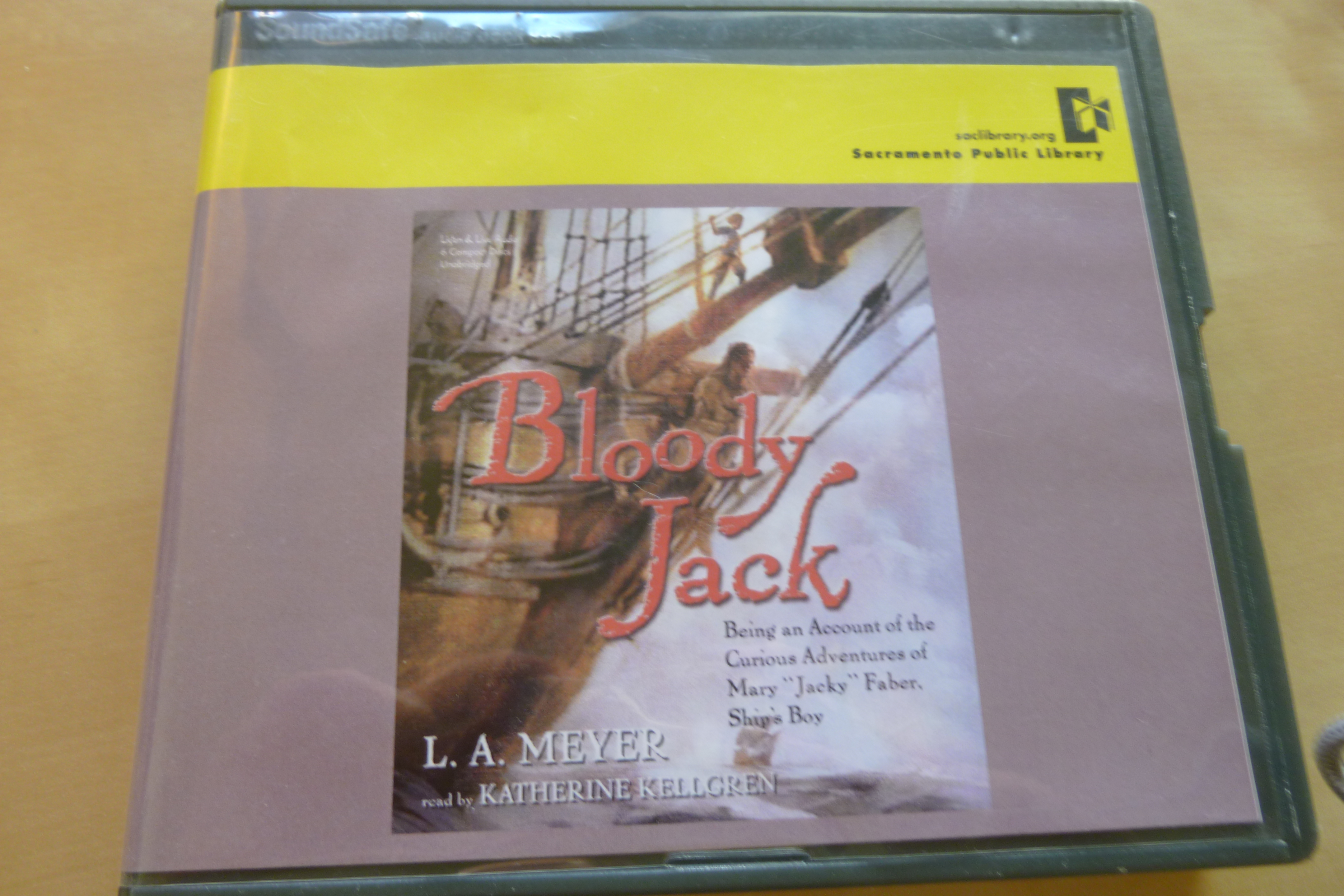
I reviewed the first audiobook here, Bloody Jack, about how a London street urchin disguises herself as a boy to join a Royal Navy ship, hoping to “better her condition.”  Along the way, she meets close comrades and gains the nickname “Bloody Jack”–which, as Jacky likes to say, is not her fault.  Mostly.

I’ll try to refrain from spoilers, but I will tell you that her deception is found out by the end of the book.  Book Two, Curse of the Blue Tattoo, picks up with Jacky being dropped off in Boston at The Lawson Peabody School for Young Girls, where the formidable Mistress Pimm will try–with mixed success–to turn her into a proper lady.  We get to meet two of my favorite characters in this volume.  First, Amy Trevelyne, Jacky’s dearest friend, who comes out of her shell under Jacky’s influence, and who tries–with mixed success!–to rein in Jacky’s wilder impulses.  Second, we meet Jacky’s nemesis, Miss Clarissa Worthington Howe (of the Virginia Howes), who is very much the fine lady–but can hold her in a fight too, with words or claws.  This book also has an element of mystery to it, as Jacky gets involved exploring the death of a serving girl, and the very creepy minister who lives next door.

Book Three, Under the Jolly Roger, sees Jacky at sea again.  Through a series of mishaps, she ends up on the H.M.S. Wolverine, commanded by mad Captain Blodgett.  Jacky’s gender is discovered and her virtue is sorely threatened, but as usual she carries on with aplomb.  This book is really two plots, and Part Two sees Jacky setting up as a privateer–and fighting at the Battle of Trafalgar in the climax.  I remember when I read this one the first time, I had to stop reading it before I went to bed.  Too exciting!

We meet another favorite character here, Higgins, Jacky’s ever faithful man servant.  I can’t tell you how delighted I was listening when Higgins first turned up!  It’s been a long time and I’d forgotten exactly how he got into the story.  Higgins is a prim and proper gentleman’s gentleman, who nevertheless has a taste for adventure.  He faithfully follows Jacky through her madcap adventures, always ready to offer a wise word, a tut of disapproval, a cup of tea or a hot bath.  Just to clarify here, it becomes quickly apparent (though never said in so many words) that Higgins is gay, which makes him one of the few men Jacky doesn’t flirt with.

Book Four, In the Belly of the Bloodhound, sends Jacky back to Boston and school, trying to lay low and avoid the British intelligence officers pursuing her for piracy.  The plan to stay out of trouble goes awry when Jacky and the girls of the school are abducted by slavers, and carried towards South Africa aboard the Bloodhound.  This is my favorite book in the series to date.  Jacky is certainly not going to take slavery lying down, and she martials the girls into a fighting force.  I love the girls of The Lawson Peabody School, and I love watching them grow ever stronger and more confident.  We get a lot of Clarissa, as well as little Rebecca Adams (granddaughter of John Adams) and Dolly Fraser–who later marries Mr. Madison.  Along with getting a wonderful cast of brave girls in this book, Jacky doesn’t meet any pretty boys–meaning for once she has to curtail her sparking.

Jacky lights out West in Book Five, Mississippi Jack, commanding a showboat down the river along with Higgins and a host of familiar and new characters.  Jacky meets Native Americans (including this unnamed Indian woman who went west with that expedition…) and the delightful, hilarious, roaring river man Mike Fink.

As I think about my plot summaries, I realize I’ve left off a major character–Mr. Jaimy Fletcher, who is doomed throughout this series to chase along always a few steps behind Jacky, his fiancee.  Meyer often intersperses Jacky’s adventures with letters (literal or mental) from Jaimy to Jacky, updating what’s occurring with him.  And here I come to my biggest criticism of the series.  On my first read-through, I recall being pretty neutral about Jaimy.  On this second pass, I have to say I think he’s all wrong for her.  They meet as children in the first book and are faithful to each other (mostly) for nine subsequent books…but honestly, I’m not convinced of their relationship’s validity because they’re so rarely actually together.

A bigger problem–Jaimy keeps wanting Jacky to settle down.  And that’s just not who she is.  I don’t have a problem with Higgins or Amy, who clearly value Jacky for her high spirits and just wish she would restrain some of her more dangerous impulses.  Jaimy wants to marry Jacky and install her in a cottage somewhere while he goes to sea and she…I don’t know, raises babies?  I don’t believe Jaimy loves Jacky for who she is; he’s imagined the girl he thinks he wants, and for some inexplicable reason has given her Jacky’s face.  I’d like to believe Meyer will eventually break the two of them up…but I just don’t see it happening.  So I have to hope Jaimy will mature a bit.  As of book ten, he’s still working on it.

As I mentioned, I’ve been listening to the audiobooks on this pass through–the books are great as paper novels, and they’re also wonderful on audio, thanks to the delightful talents of Katherine Kellgren.  She gives us Jacky’s Cockney accent, brings believability to her melodrama, and makes me like Jacky’s singing much more than I ever did on paper.  She also gives us excellent voices for a vast cast of characters, with accents from British to American to deep South to Irish to French, with characters who are male, female, young, old–or even bellowing Mike Fink.  She even makes different characters sound different while singing.  All in all, I’m a big fan.

But I’m a fan of the whole series.  On paper or audio, I highly recommend following the adventures of Bloody Jack!

Author’s Site: http://www.jackyfaber.com

Other reviews:
Gallivanting Girl Books
The Lostent Wife
The Magic of Ink
Anyone else?

The Private–and Public–Life of Elizabeth I

LegacyI think you know that I love Susan Kay’s Phantom.  But I won’t gush on about it (for the third time); I mention it only as context for why I decided to read Susan Kay’s Legacy.  And to acknowledge that I set the bar unattainably high for this book.  I didn’t really expect it to be another Phantom–but can you blame me for hoping?  Well, it wasn’t another Phantom (but nothing is) and while it was good, in the end I feel a bit…mixed.
There are actually some resemblances between the two books.  Just as Phantom explores the life of the Phantom of the Opera, from pre-birth to post-death, Legacy explores the life of Queen Elizabeth I, from Anne Boleyn’s first flirtation with King Henry VIII, all the way up to Elizabeth’s death.  We follow Elizabeth from a precocious child to an adrift young girl, to a clever woman in mortal peril from shifting politics, to a masterful queen, to a legend (or even a goddess) in her own time.  And we see the various men who orbited around the Virgin Queen.

While the focus is on Elizabeth, just as it was always on Erik, Legacy has a wider-angle lens.  Phantom has a scope across decades and continents, but Legacy plays with the intrigues of courts and the ups-and-downs of European history for nearly a century.  Kay spent 15 years writing Legacy and it shows, in good ways and bad.  It’s obviously meticulously researched, and while I appreciate and am impressed by the historical details…it also means that it’s a book about history as much as it is about Elizabeth.  So if you like British history (and I do), this is masterfully presented–but it also removes us from the characters to some extent.

The characters are also difficult.  You may tell me that the Phantom of the Opera should not be relatable–but Kay’s version is.  Legacy is populated by the royal court of England, and almost without exception they are self-serving, conniving, power-driven individuals with very little loyalty and few qualms about selling one another out for political advantage–even if the one they’re sacrificing is a sibling or a wife.  I fully believe this is based in real history so I’m not claiming it’s not plausible–but it doesn’t make for a group of characters that I’m going to get attached to.

The book is interesting all the way through, but it was a good 300 pages (or about halfway) before I much started caring about anyone.  I did eventually care about Elizabeth, and about the two most constant men in her life–childhood friend and quasi-husband Robin Dudley, and chief advisor Lord Burghley.  They’re the two people Elizabeth comes closest to having genuine relationships with, and I think that fact goes a long way towards my caring about all three.  The third man in Elizabeth’s life is the Earl of Essex, but you’ll have to wait quite a while for him to arrive!

Part of the difficulty getting engaged with the characters may have been the point of view.  Phantom alternates first-person narration, so you always know exactly who’s talking to you.  Legacy is omniscient, or a frequently-changing third-person limited (I have trouble telling those two apart) so we’re not as grounded in any one character.  The center is Elizabeth, but we get her story from constantly shifting eyes.

And there’s a lot of narration telling us the history.  The book isn’t dull history, or entirely history–there are romantic moments and moments of high drama and emotional tension.  But there’s also a lot of history.  Often very interesting history…but somewhat heavy history too.

The end of the book is ultimately quite sad, and if you know the course of Elizabeth’s life, that’s inevitable.  Because it’s history, I don’t think it’s giving much away to say she starts to lose her grip by the end.  Kay tells it well and it’s moving–although I realized that the end of Phantom is heart-breaking, tragic and beautiful, while the end of Legacy is just sad.

So the final verdict?  It’s a masterful piece of historical fiction–but be prepared that you have to be just as interested in the historical as in the fiction if you pick up this book.

Other reviews:
QG’s Book Reviews
The Misadventures of Moppet
A Girl Walks into a Bookstore
Rosebush Maze (also offering Phantom comparisons)
Confessions of an Avid Reader (who felt there was not enough history…so opinions may vary!)
Whew, popular book!  Anyone else?

Off to Sea with Bloody Jack

I have finally ventured into the wonderful world of audiobooks, which I entirely blame on all the bloggers who keep raving about them.  I’ve resisted because I work from home–no regular commute to make convenient listening time.  But I’ve increasingly had longish drives for social events, and thought I’d try an audiobook–and now I strongly suspect I’m hooked, for at least nine books.

I’ve started listening to the Jacky Faber books by L. A. Meyer on audio, and now I think I’m in for the series.  I’ve been reading the books for years as they come out–I recently reviewed number ten, Viva Jacquelina.  It’s been a long while since I read the early ones, but I have too many books lined up–where was I going to fit in nine re-reads?  Audiobooks seemed like a natural solution, especially because I was guessing these would be particularly good read aloud–and I was right!

The first book in the series is Bloody Jack, and begins the tumultous adventures of Jacky Faber.  An orphan girl living on the streets of London, Jacky disguises herself as a boy and talks her way onto a Royal Navy ship as a shipboy.  Mostly, she’s hoping for a decent meal–and she longs to see “the Bombay rat and the Cathay cat and the kangaroo.”

Katherine Kellgren does a wonderful job with the reading.  It never sounds like she’s reading–it sounds like Jacky telling you her story, cockney accent and all.  The book is in first person, present tense, making it very immediate.  It’s fast-paced (especially as the series goes on) and the audio swept me right along.  Jacky is very emotive and dramatic, and Kellgren manages to bring believability to Jacky’s most over-the-top exclamations.

Jacky is without question the best part of this very good series.  She’s daring and exhuberant and never, ever manages to stay out of trouble.  She swears she’s really a coward, but that never stops her from diving into scrapes when the situation calls for it.  She’s staunchly loyal, endlessly charming, and one of the most engaging heroines I’ve ever met.

Jacky inevitably gathers friends and enemies around her, and it was fun going back to this first book where we get to start meeting major characters.  Kellgren gives characters different voices in the dialogue, without getting cartoonish about it.  Liam has an Irish accent, the captain sounds stern, and you can just tell immediately that Jaimy is handsome and well-born.

The story is wonderful as a book or on audio.  The adventures are exciting, Jacky is delightful, and, well, it’s just irresistable find out what she’ll do next!

Author’s Site: www.jackyfaber.com

Other reviews:
Good Books and Good Wine
Audiobook Heaven
Finding Wonderland
Anyone else?