
Phantom at Her Majesty’s Theatre

Last week I did a theatre review of Les Miserables in London.  This week, I’m sharing about my trip to see Phantom of the Opera.

Seeing Phantom for me is different than seeing any other play, because I’ve seen it so many times.  I never just watch; I analyze and compare.  I’m convinced that this is really the strength of live theatre, because I swear it’s a different play every time.  I admit this may in part be me reading into things…but since I always look for the same interpretation (because I have my own ideas for the characters), if it was all in my head, it wouldn’t come out different every time!

Counting the filmed 25th anniversary performance, I’ve seen seven performances by six different Phantoms, and I’ve yet to be bored.  I saw the play for the first time on my previous trip to London, and that’s still the best performance I ever saw (though I admit the new-ness may have been a factor).  With that in mind, I was excited to see it in London again.  And it turned out to be one of the more complex and unique performances I’ve seen–which makes this review half an exploration of different interpretations of the play.

I assume everyone roughly knows the plot: the Phantom is a musical genius living below the Paris Opera House, hiding a facial deformity behind a mask.  He falls in love with soprano Christine Daae, and clashes with the management of the Opera and Christine’s childhood sweetheart, Raoul, the Vicomte de Chagny.  The Andrew Lloyd Webber musical is one of the best-known versions of the story–and the musical is wonderful.

I got to the theatre early, as I always do.  My seat wasn’t as good as I had for Les Mis, but it’s another small theatre, so even though I was back pretty far, that was still only the twelfth row.  Although I did spend an inordinate amount of pre-show time wondering if the overhanging balcony would block my view of the Phantom on the rooftop (it didn’t, at least not badly).  This is what comes of seeing a play seven times–you think about these things.

The Phantom was played by Marcus Lovett, and it struck me as a very different performance.  First, his voice didn’t sound like other Phantoms I’ve heard.  I’m not musical enough to know the proper terms to describe it–good singing, certainly, but sort of deeper and broader somehow, with an element of thunder.  It made me wonder in the early scenes how he was going to handle “Music of the Night,” which absolutely must be sung intimately.  For me, Phantom performances live and die by that song.

Lovett ended up carrying the song fine–but it was different.  This was the first time I’ve seen a Webber Phantom who didn’t really seem to be in love with Christine.  The crazy thing is, the interpretation seemed to work (mostly).  I’ve always thought the Phantom was making a mistake falling in love with Christine, but I’ve also always believed that he deeply, passionately loved her.  This one didn’t seem to.  His real interest was the music.  It was the first time I believed a Webber Phantom when he said he had brought Christine below the Opera House to sing.

When you jump from that idea, “Music of the Night” isn’t a seduction at all, it’s a celebration of the music.  It’s all about, come see the night and experience my music.  Of course, some lines like “only then can you belong to me” are pretty unambiguous, but it still felt like that was his secondary, possibly long-range idea.  All he really wanted was for her to be a part of his music, and I don’t think he’d object if it became something else…but that’s not the primary goal.  After all, the last line of the song is not “I love you,” it’s “Help me make the music of the night.”  Which can obviously be metaphorical…but in this performance, it felt literal.

That interpretation kept working for the rest of Act One.  In the morning, after “Music of the Night,” the Phantom’s not mooning over Christine, he’s having a perfectly delightful time writing his music.  After she yanks the mask off, he has a meltdown and then starts singing about his longings–for heaven and for beauty.  It never actually specifies how she fits into that picture.  There is the one line, “fear can turn to love,” but it almost feels like an add-on.  The entire sequence with his disruption of “Il Muto” is all about making the performance of the music better.  On the rooftop, does the Phantom feel betrayed because Christine and Raoul kissed, or because she said nasty things about his face and is planning to run away and not sing anymore?  The ultimate line about the Phantom’s betrayal is not “I gave you my heart,” it’s “I gave you my music.”

So obviously I was having a wonderful time watching all of this–and analyzing.  But then the interpretation falters a bit in Act Two.  I started to lose the thread of the Phantom’s motivations.  The more I think about it, mostly it should work–he’s still focused on Christine’s singing at the Masquerade, and on being the Angel of Music at the graveyard.  It wasn’t coming across as clearly, though, and then I don’t know at all what to do with “Point of No Return,” most especially the Phantom’s “All I Ask of You” reprise, or parts of the finale.  Which are all kind of important.  I still think it’s an interpretation with value, though–because it works for so much of the play.

Christine had similar across-act issues at the performance I saw.  I swear, in Act One she was a schemer.  Disclosure: I want Christine to be a schemer.  She’s that or an idiot, and I like the idea that she’s plotting.  But I don’t think it was all in my head either.  She was a little too gleeful yanking the Phantom’s mask off, and she was definitely playing Raoul on the rooftop.  The lines are there, and the way they were being delivered–I was convinced she was manipulating him.  (I’ve always thought that “order your fine horses” is not an appropriate response to “Christine, I love you” in that scene).

But then we came back from the interval, and Christine spent all of Act Two terrified, and I just didn’t know how reconcile that.  Christine can absolutely be weaving plots in Act Two (a secret engagement?  really?), but this Christine just seemed too frightened.  There was a very strange moment in “Point of No Return” when Christine and the Phantom are struggling, and I honestly couldn’t tell who was trying to get away from whom.  I know that seems like it should be obvious, but with Act One’s portrayal of the characters, it really wasn’t.

So I found the characters brilliantly different in Act One, but then mostly reverted to something more standard in Act Two.  That was a bit disappointing, though it was still very effective portrayals as the play went on.  Just a little inconsistent.

On to other characters…my favorite, after the Phantom, is Meg Giry.  I make a habit of watching her during production numbers.  This was the most social Meg I can remember seeing.  She was talking to people in the background of several scenes, like the opening sequence, or “Masquerade.”  I really wanted to know what she was saying!  Unfortunately, my lip-reading is not that good.  An odd moment in the “Finale”…she did come across as smarter than Raoul, but they dropped the line when she tries to go with them below (and I love that line!  It’s important!)

Raoul made almost no impression on me, I think because I was so distracted by Christine and the Phantom.  There was an unusually angry Raoul in the recent 25th anniversary performance, and I wondered if that was a new standard in London, but it doesn’t seem to be.

The managers had good comedic timing, as did Piangi and Carlotta.  Piangi was obviously wearing padding and Carlotta wasn’t old enough, but their acting was good.  And Piangi struggled mightily to get on his elephant in the opening scene, which is always my favorite moment for him.

The music is always wonderful, the singing and the orchestrations, and the costumes are splendid and elaborate.  Don’t watch the chandelier rise at the beginning because you’ll be blinded–and it always falls with wonderful drama at the end of Act One.  If you’re in London or anywhere else where Phantom is playing, I highly recommend it–as I suspect will come as no surprise to anyone!  I know I had a wonderful time watching Phantom for the seventh time.
A Gothic Parody from Miss Austen

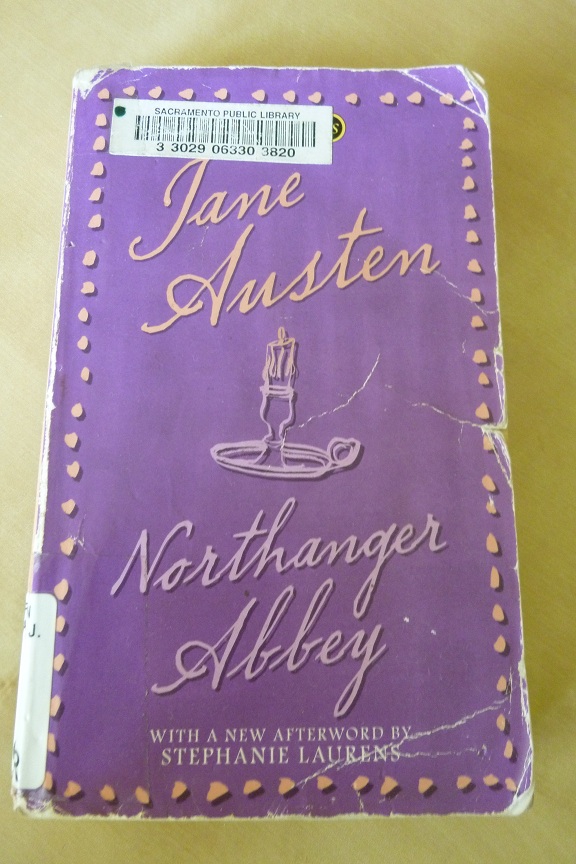
Forgive my battered library copy…I’ll be buying a better one.

I finally got to my last goal-book for R. I. P.Northanger Abbey by Jane Austen.  There’s even a little more of a “finally” to this, considering it was a chosen book for my high school book club and I never got around to it then.  But maybe it’s just as well; I don’t know if I would have found Austen as easy a read then–and I loved the book now.
Northanger Abbey is a spoof on gothic novels.  I haven’t actually read many, but it doesn’t seem to matter.  A lot of the concepts have slipped into the cultural awareness, and it always seemed pretty clear what Jane was poking fun at.

The book is about Catherine Morland who, the narrator tells us, doesn’t seem at all suitable to be a heroine–for instance, her father “is not in the least addicted to locking up his daughters.”  Catherine loves reading about heroines, and simply adores gothic novels.  Her opportunity for adventure comes when she’s invited to accompany some family friends to Bath.  There she makes the acquaintance of the charming Mr. Tilney and his sister, who eventually invite her to their family home of Northanger Abbey.  It’s the perfect setting for a gothic novel and Catherine’s imagination runs wild.

This book has the most delightful feel to it.  It’s the lightest Austen I’ve read, with a wonderful sense of humor throughout.  It’s frequently meta, with a narrator who comments on the ongoing story, noting at times how it does and doesn’t fit a gothic novel, with some lovely tongue-in-cheek observations.  Austen herself feels much more present here than in her other novels that I’ve read.

The characters are vivid, and the cast is a little smaller than usual, so the characters don’t get lost among the crowd.  Catherine is rather silly at times, but she’s also very honorable and good-hearted.  I don’t admire her as much as Elizabeth Bennet, but I like her very much.  She shows good character development as well, maturing through the novel.

And Mr. Tilney–well, with all due respect to Mr. Darcy, it takes Colin Firth five hours to crack a smile in the BBC miniseries.  It’s so nice here to meet an Austen hero with a perpetual smile.  Mr. Tilney makes jokes and is charming and fun.  I was talking about this book with two friends, and the opinion was unanimous in appreciation of Mr. Tilney.  Another note: even though I’m calling him “Mr. Tilney,” the narration actually refers to him as Henry at times, and you can’t imagine how much more human that makes him seem than the perpetual Mr. This and Mr. That we usually see in Austen.

The other major characters are Isabella Thorpe and her brother John who…well, I hate to give things away about them.  But Catherine learns something about real and imagined intrigue, and the difference between books and life.

Which reminds me–there’s a splendid rant from Austen at the end of chapter five, about the poor regard for novels and how wonderful they really are.  Bravi.

I think I’ll be recommending Northanger Abbey next time I’m talking to someone thinking about picking up Austen.  It’s a good gateway book, distinctly Austen but lighter and a less dense read.  And my new favorite!

Other reviews:
The Librarian Next Door
Allegraphy
Lost Generation Reader
All Things Bright and Beautiful
Any other Austen fans?

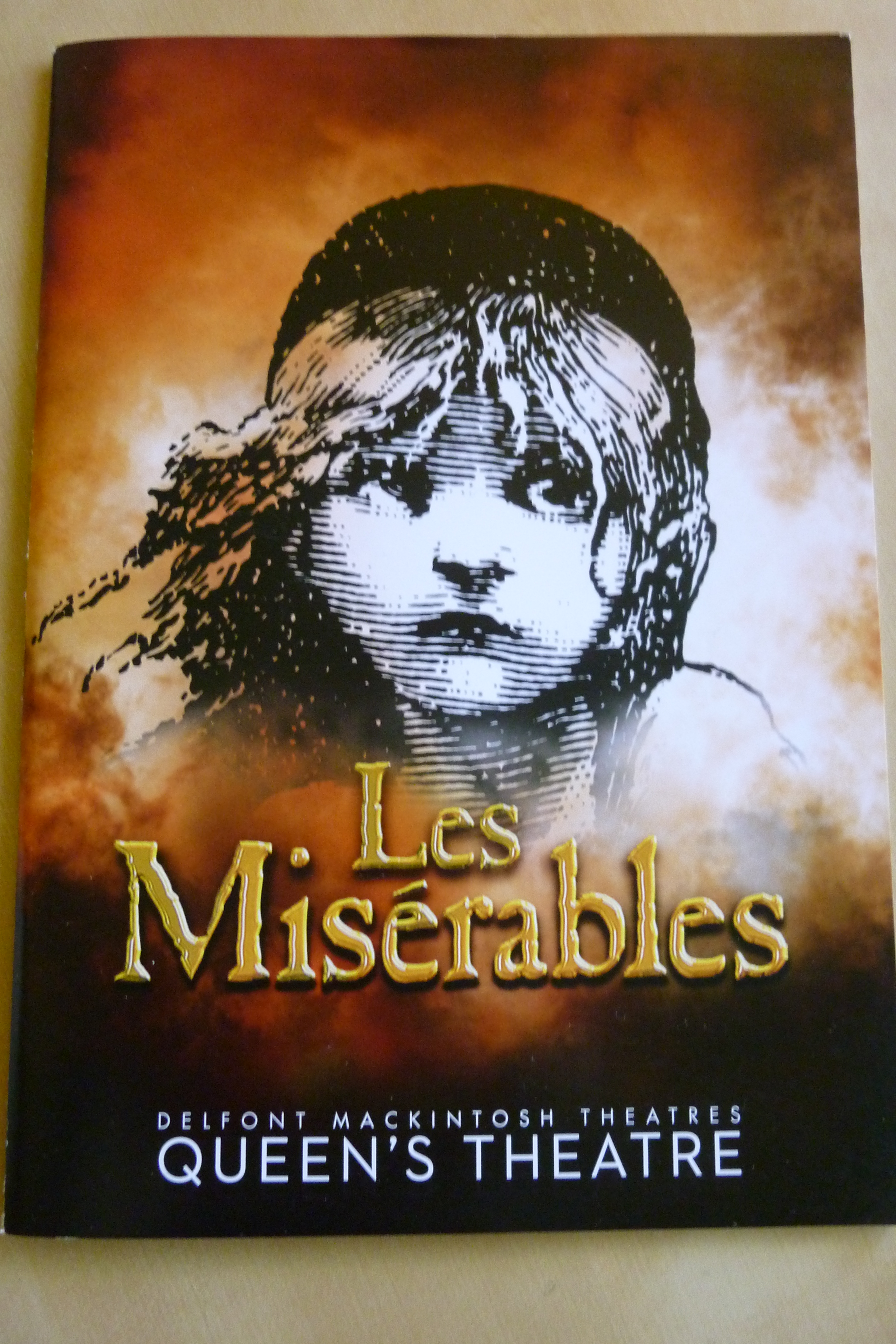
Watching Les Miserables at the Queen’s Theatre

One of the most exciting things I did while I was in London in September was go to the theatre.  I got to see Les Miserables for the first time after listening to the soundtrack many, many times.  I thought I’d do a theatre review and share the experience!  And, because this is me, make some comparisons to Phantom too–another theatre review that’s coming soon!  Spoiler warning for Les Mis (mostly who dies), as it’s hard to discuss without spoilers…but I’m guessing most people have some knowledge anyway.

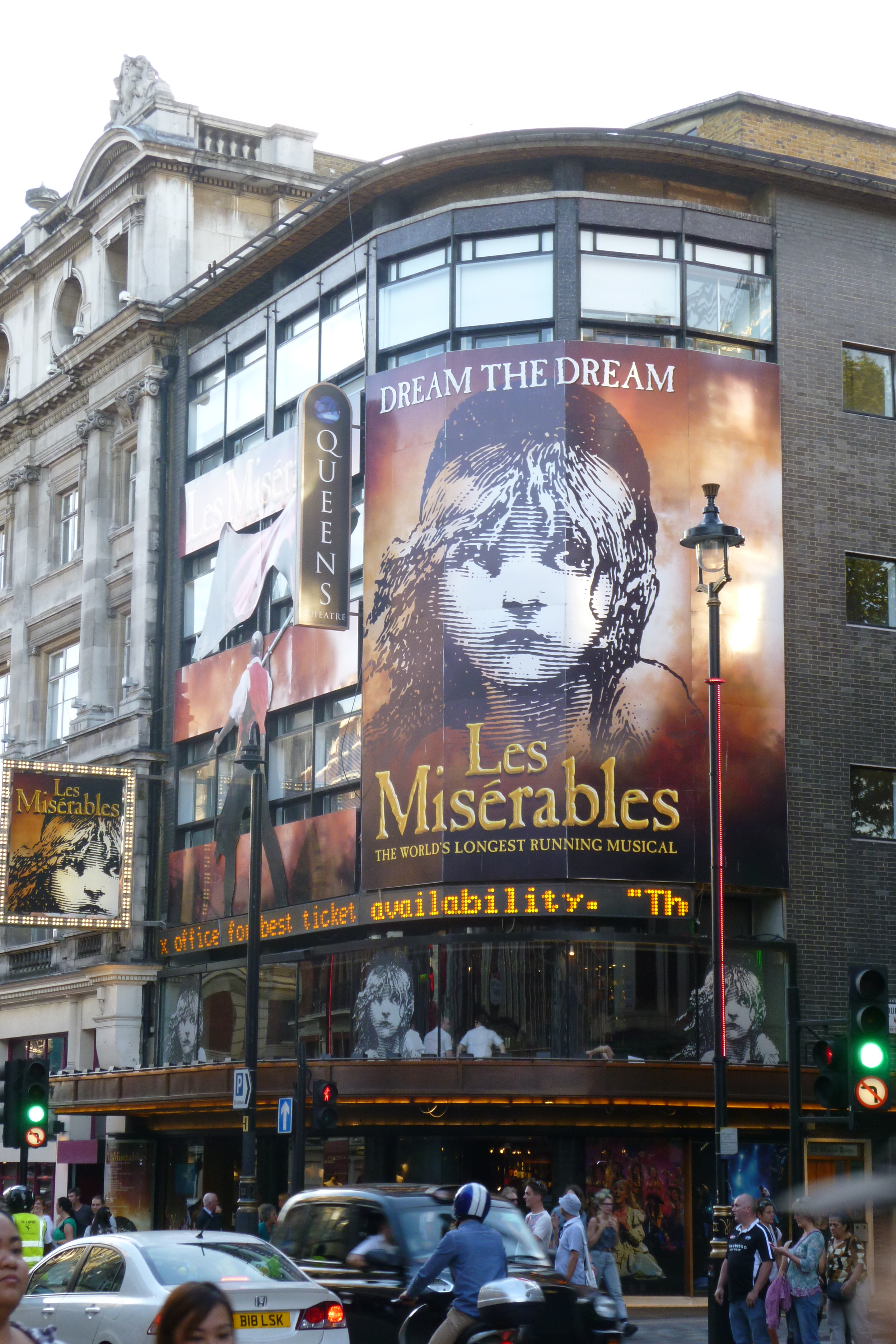
Les Mis in London is playing at the Queen’s Theatre, near Leceister Square.  I set off there in the late afternoon, because I have theatre paranoia.  I always have this dreadful fear that I’m going to be late to a play–fueled, I think, by the fact that some theatres won’t let you in for entire acts if the curtain is already up, and because I’m frequently seeing plays while traveling, and if I don’t see it then…I won’t see it.  So I got there early, and ended up having a quick, order-at-the-counter dinner, at a place directly across the street from the theatre.  And then of course I got there almost an hour early anyway!

I bought my ticket for Les Mis last May, so I was able to get a really good seat–front row and center.  I decided to splurge a little, since I’d never seen the play.  And once you decide you’re buying a ticket, the nice seats are not really that much higher than the so-so seats.  I think almost any seat in the house would be good, though, as the theatre just isn’t that big.

The very short reaction–it was amazing.  There’s so much more than is on the soundtrack.  You can get most of Phantom on the soundtrack, but there are huge pieces of Les Mis that aren’t on the CD.  They put all the dramatic songs on, of course, but there’s so much more dialogue, and scenes that reveal character or explain plot points.  There were some bits that never made sense to me–and they do now!

The plot is complex, but basically we’re following Jean Valjean, a former convict (for stealing a loaf of bread) who broke parole to try to remake his life, but is still being sought by Inspector Javert.  Valjean’s path intersects with Fantine, a woman who’s driven to prostitution in order to provide for her daughter.  Valjean ends up raising Fantine’s daughter, Cosette–whose path in turn intersects with Marius, a student who is in with a group of young revolutionaries, determined to rise up on behalf of the poor and downtrodden of France.  That’s as brief as I can make it, and doesn’t even mention my favorite characters–who I’ll get to in a bit.

Valjean and Javert were both excellent.  They have such powerful songs, and are such complex characters.  As I was leaving the play, I heard someone say, “I really like that even the villain isn’t really a villain.”  It’s possible he meant Thenardier, the comic relief villain, but I think it’s more likely he meant Javert.  And it’s true–Javert wants to hunt down Valjean, who the audience can see is unequivocably a good man, yet Javert is coming from a place where he’s convinced that he’s the one in the right.

There’s a very nice handling of religion in the play, because both men are motivated by a belief that they’re doing what God would want of them.  Perhaps part of Javert’s trouble is that he’s sure he’s right, while Valjean realizes it’s a struggle.  Anyway, they both performed wonderful songs that blew me away.  Geronimo Rauch (Valjean) has also played Jesus in Jesus Christ Superstar, and I could hear it a bit.  I’m guessing he did an amazing “Gethsemane.”  It’s that kind of powerful drama.

The Queen’s Theatre – you can kind of guess what’s playing.

After the major characters, I should talk about my favorite.  I love Eponine.  She’s a girl from the streets who loves Marius, but he just never sees her.  In the production I saw, Eponine was played by Danielle Hope, who’s exciting by association; she played Dorothy to Crawford’s Wizard of Oz.  I thought she was excellent as Eponine–emotional, heartfelt, so powerful in her major song, “On My Own” (which you can find on YouTube, by the way…though of course it was better live).

You don’t get a lot of context on Eponine just listening to the soundtrack, so seeing the play, I realized she is so much braver and more complicated than I knew.  It’s not just that Marius is oblivious, it’s also that he’s a higher social class, making her unrequited love even more poignant.  Especially since he’s so oblivious, he wants Eponine to help him woo Cosette–which she does, at considerable sacrifice.  Loved, loved Eponine.

Fantine was very good too, with this wonderful personal quality to her “I Dreamed a Dream.”  She seemed to be appealing directly to the listener; Eponine had a bit of that too.  I saw Sierra Boggess as Fantine, which was interesting because she’s Christine in the filmed, 25th anniversary production of Phantom.

The Thenardiers are much funnier in the play than on the soundtrack.  They’re also more awful, so that’s a nice mix there.

I was surprisingly impressed by young Cosette.  I’ve never been that fond of her song, “Castle on a Cloud,” but it becomes more remarkable when you can see how small the girl singing it is!  I wasn’t all that impressed by grown-up Cosette.  It wasn’t the actress’ fault.  It’s just that they give Cosette SO little to do.

Which brings me around to Marius.  He’s on stage more than Cosette, and is sort of more involved…but he is such a passive character.  I didn’t think of this until I saw the play, but he reminds me a lot of Raoul from Phantom.  Some of that may have been casting–he looked like Raouls I’ve seen–but I also think they’re the same archetype.  They’re the very innocent, pure, utterly non-threatening romantic lead, uncomplicated and ultimately shallow as characters.  And they can end up coming across as rather dull wimps.

To give fair due, at least Raoul tried to rescue Christine.  He failed, but he tried.  Marius accomplishes nothing, and attempts nothing.  He needs Eponine to find Cosette for him, and to deliver his letters to her.  He fights on the barricade with the revolutionaries, but that feels like he’s just being carried along by his friends–and then he’s literally carried away from the barricade by Valjean.  Marius actually does…well, nothing.

Interestingly, there’s no romantic alternative for Cosette.  Often the innocent romantic lead is paired with a darker, more complex and seductive figure (that would be the Phantom).  Les Mis, on the other hand, gives Marius a romantic alternative in the darker, more complex Eponine.  She’s had a harder life than Cosette (after age five or so), she’s smarter and more capable, and she’s not as innocent.  She’s also the socially-challenging choice.

That in turn makes me question Marius’ revolutionary fervor.  The revolutionaries are all about equality and raising up the lower class, yet when Marius falls in love, it’s with someone from his class (or who at least appears that way).  He barely seems to realize ragged Eponine is a girl, but he falls madly in love with prim and proper Cosette, literally at a glance.  Marius may come across better in the book, but I was not impressed by him in the play.

I did believe in the revolutionary fervor of the others, especially the leader, Enjolras.  He was my favorite of the students.  And I loved Gavroche, the little boy from the streets with an eye on everything.  He’s so sweet and so clever.  After the barricade is taken, there’s this moment where they turn it around and you can see the front.  Gavroche is lying dead among the soldiers, and Enjolras is spread out hanging off the wall with his flag…SO SAD!

I was also (differently) sad that Gavroche didn’t get to sing “Little People.”  He reprised it a couple of times with a verse or two, but he never sang the full song from the soundtrack.  I’m sure that made the reprises less moving.  Anybody know if that’s normal, to leave out that song?

Other thoughts…almost every song was excellent.  I didn’t think they got quite enough power into “Do You Hear the People Sing?” but on the other hand, “One More Day” was breath-taking.  That was the first act closer, and it was brilliant.  I basically believe in the revolutionaries’ cause, but in some ways it almost doesn’t matter.  The songs are so inspiring, they make you want to join the cause without worrying about the details (which is probably a dangerous commentary, actually…)

Javert’s death was a little oddly handled.  He’s supposed to be jumping off a bridge into the Seine, but instead of having him literally fall, they raised the bridge behind him.  And…it looked like a bridge rising, not a person falling.  I would say that’s fine, maybe you can’t have someone jump down into water on stage–but Raoul does it, so I know it’s possible.  Although Raoul wasn’t singing at the time.

The end of the play is SO sad.  It’s like a Shakespearean tragedy, with almost everyone dead.  There’s a moment with the spirits of Fantine, Valjean and Eponine smiling down on Cosette and Marius.  I guess we’re supposed to be consoled by the couple’s happy ending–but it just highlights the fact that all the complex, interesting, deserving characters died.  On the other hand, they died so movingly, and it was all such beautiful music, and intertwined with great ideals and complex examinations of life and class and human emotions…

It was such a good night at the theatre.  Now I can’t wait for the movie version.

And on one last happy note, after the last bow, there was a cast group hug.  Valjean grabbed Madame Thenardier in a bearhug, and then everyone piled in.  So cute!

Dodging Through Victorian London

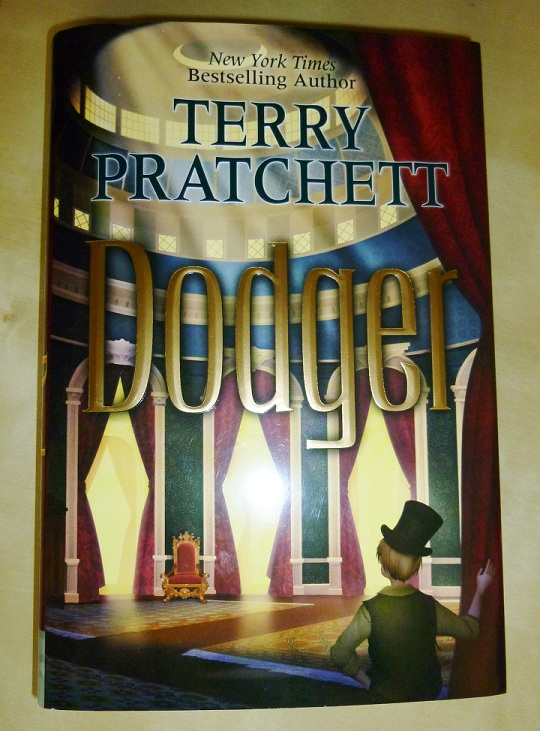
Considering how much I love Terry Pratchett’s Discworld books, I have been impatiently awaiting his latest book–even if it isn’t Discworld.  Dodger is not quite on the level of the best Discworld, but it was a fun read of its own.
To clarify one thing at the beginning, the book is not really about the Artful Dodger from Oliver Twist–at least, not exactly.  Say rather it’s a young man who could be the inspiration for the Artful Dodger–considering his connections to Charlie Dickens, and all.

Dodger is a tosher by trade, a seventeen year old boy who makes his living searching through the sewers of Victorian London in search of lost coins, jewelry and other treasure.  And if occasionally things happen to fall out of their owner’s possession and into Dodger’s hands, well, who is he to dispute with a bit of good fortune?  Everyone knows Dodger, and everyone knows Dodger never gets caught.

There’s no Fagin, but there is Solomon, a wise old Jewish watchmaker who gives Dodger a place to sleep and helps him stay on the straightish and somewhat narrow path.  There’s no Oliver Twist, but there is Simplicity, a young woman Dodger rescues from a couple of thugs–a young woman who turns out to have crowned heads of Europe intensely interested in her.  His efforts to help her will take Dodger into a whole new part of society and bring big changes into his life.

All in all, I didn’t love the book, but there is a great deal here to like very much.  There’s enormous fun in the various historical figures Dodger’s path crosses–from Fleet Street journalist Charlie Dickens to up-and-coming politican Benjamin Disraeli, and a host of others I didn’t have enough historical grounding to recognize (but there’s a helpful afterword).  We also wander into fictional territory when Dodger meets Sweeney Todd, more sad than demonic and a powerful lesson about the tendency of the world to create the story they want to hear.

Dodger’s character growth throughout the book is excellent.  At first, he seems a little too noble (in the character sense) for a boy on the streets, but as the book develops and his character does too, it fits more easily.  It’s not an easy growth, and Dodger finds a certain loss of identity (or at least uncertainty) in his sudden rise in standing and character.

My favorite things are a couple of character quirks.  First, especially near the beginning, Dickens has a tendency to make a remark, get a look in his eye, and hastily jot something down–as when he made a reference to “our mutual friend.”  I would have loved even more Dickens quotes sprinkled throughout–though there may have been more that I just missed.  Second, I love Solomon’s religious life.  He frequently explains situations to God, perhaps when someone is doing something a bit, well, dodgy.  But Solomon will make matters clear to Him, in a lightly humorous and never offensive way.  It has much the same feel as the beginning of the song “If I Were a Rich Man” in Fiddler on the Roof.

My least favorite thing…well, I found out a bit more than I really needed to know about Victorian sewers, and I could have lived with far fewer references to, shall we say, Victorian waste, human and animal, in and out of sewers.  The most recent Discworld book featured an interest in bathroom humor, and I sincerely hope this is a short-lived trend in Pratchett’s writing.  It’s more often nasty than funny, and frankly, I know he’s more clever than to need to resort to that.

Still, this is a fun trip through Victorian London with solid characters and a plot with a few good twists.  Don’t come here expecting the high hilarity of Discworld, but it is an enjoyable historical novel.

Author’s Site: http://terrypratchettbooks.com/

Other reviews:
Things Mean a Lot
Katie’s Book Blog
Wickersham’s Conscience
Book Aunt
Fyrefly’s Book Blog
Yours?

Reading Phantom in Paris

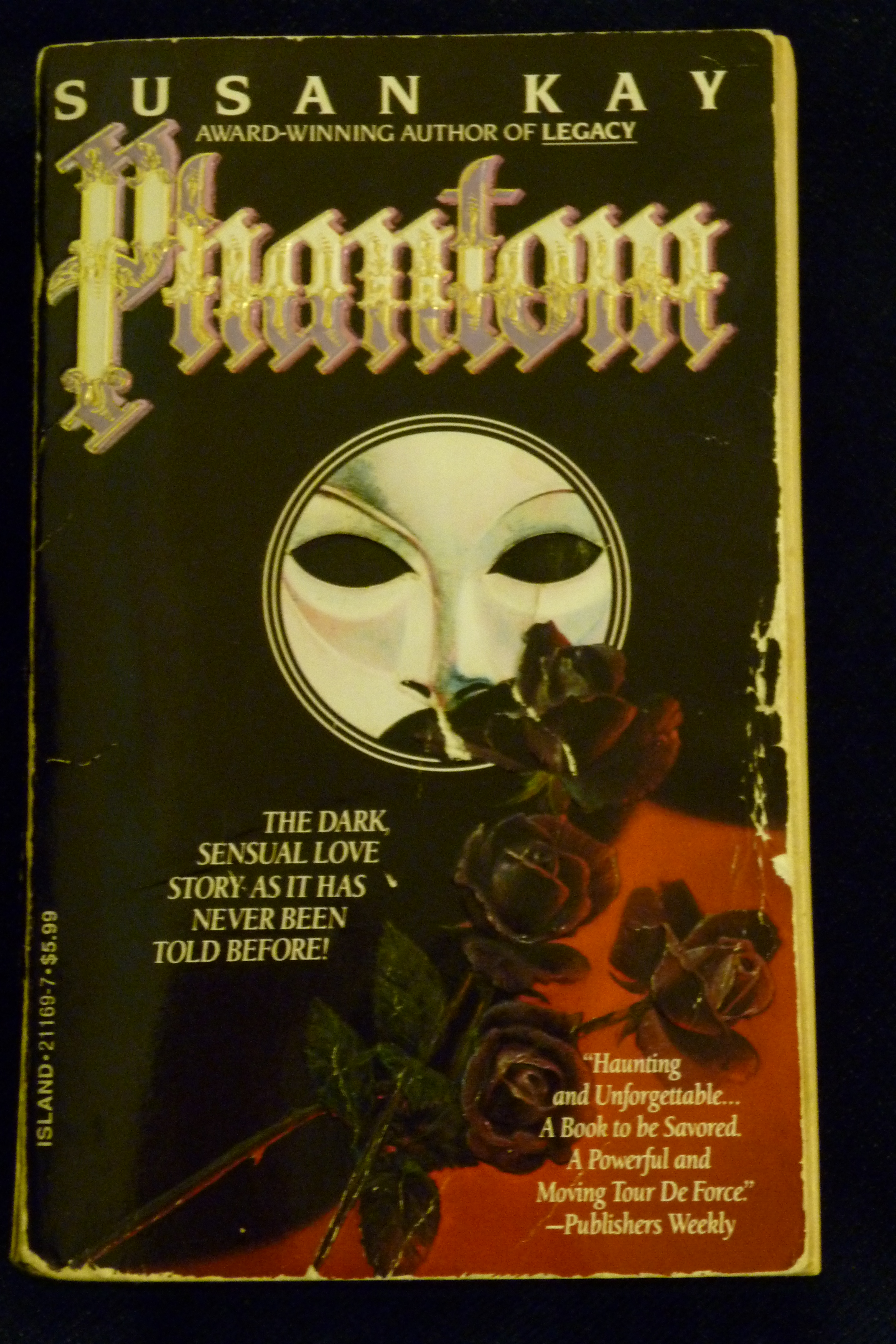
When I went to Paris in September, I decided it was a good opportunity to finally reread Susan Kay’s Phantom.  I read it once seven years ago, it completely blew me away, and it made such an impression that I always felt like it was too soon to reread–it was still there in my mind.  And I think I was afraid that I couldn’t repeat the experience twice!

But I brought it along to Paris to read again–and it was amazing.  I’m also counting it for the R. I. P. Challenge.  I reviewed Susan Kay’s Phantom once already, but I think it’s worth doing it again.  This review is basically going to be structured as a summary, a lot of gushing, and then circle back to Paris to talk about visiting the Opera House.  You’ve been warned if you want to skip some of the gushing!

My copy of the book doesn’t have a sub-title, but I’ve also seen this called Phantom: The Story of His Life, and that’s really what it is.  The story begins with the Phantom’s mother, goes on through his entire life and on past his death.  Kay brilliantly grounds us in each period, telling the story in sections with different first-person narrators.

First there’s Erik’s mother, Madeleine, telling her own story and taking us through his very troubled childhood.  Erik takes over the narration when he runs away from home at nine, falling in with a band of gypsies.  Later we see him as a teenager in Rome; this section is told by Signor Giovanni, the master architect who saw a spark of genius in this strange masked boy, and took him under his wing–for a time.  The Daroga tells us about Erik’s time in Persia, and a very sad and bloody time it is.  Erik picks up the thread again when he returns to France, meets Charles Garnier, and becomes obsessed with work on the building of the new Paris Opera House–which he ultimately decides will be his escape from the world.  And then Christine comes on the scene, and she and Erik tell the most familiar part of the story in alternating scenes, until the final section is narrated by–but perhaps I won’t give that away!

Kay does something truly masterful here.  Every narrator has his or her own story, with their own passions and tragedies, while at the same time the book never loses its focus on Erik.  It’s a brilliant balance that gives us the Phantom through so many eyes, and tells so many stories, without feeling fragmented or like we ever get lost on some side-plot. Every character is brought to life and I care deeply about all of them–even Madeleine.  I hate her, so caring might not be quite the right word, but I do feel deeply about her.  Although on a second read, I felt more sorry for her than I did the first time around.

The most significant character, of course, is the Phantom.  As on my first read, I fluctuate between finding him scary, and wanting to hug him.  He is so dark, and so unstable, and SO SAD.  And brilliant–completely, unbelievably brilliant.  Unlike other books I could name, Kay doesn’t pin all of Erik’s problems on the facial deformity.  That’s a huge part of the book, of course, but there’s so much more.  Erik is rarely shown kindness, so he doesn’t trust it when he sees it.  His biggest problem is not that he’s so ugly no one could love him; it’s that he believes he’s so ugly no one could love him.  It’s a fantastic, vital distinction that makes him so much more complex.  And something that’s not going to be solved by a moonless night.

The scope of the book is magnificent.  Without feeling long, it still feels like it crosses continents and covers decades.  When an adult Erik remembers his childhood dog, I don’t feel like I just read about her a hundred pages ago–it was years in the past!  Despite the huge scope, it doesn’t feel like an overview.  Everything is immediate and present as it happens.

There are so many very small, very wonderfully told moments.  The first to come to mind is Erik’s fifth birthday, when his mother insists that he tell her what he wants, and all he really wants is a kiss (one now, and one to save for later) and…it doesn’t end well.  And I hate Madeleine.  There are some nice moments of friendship with the Daroga, and later with Charles Garnier, the Opera House’s architect.  There’s a very funny exchange when Erik makes a joke to Garnier about how the then-under-construction Opera House really ought to have a ghost, and perhaps they should advertise.  Services of one ghost needed, tenor voice preferred.

And then near the end–just before everything goes horribly, horribly awry with Christine–Erik goes up to the roof of the Opera to pray.  And he doesn’t know how, because he hasn’t since he was a little boy, and the only prayer he can come up with is Please God, let her love me, and I’ll be good forever.  It just makes me want to cry and cry.

The book is so beautiful, emotional, moving–and so deeply tragic.  Phantom descends to the depths and aspires to the heights of human emotion, and does it beautifully and believably.  In 500-odd pages of dealing with that level of complexity, I felt like Kay hit a false note only once.  There’s a near-miss, where Erik might have been able to have a better relationship with his mother and the opportunity is lost; that was the only moment that didn’t feel real.  I didn’t believe Madeleine could make the leap, and it felt dragged in for tragedy’s sake.  However, I make that observation mostly to say how amazing the rest of the book is–because every other moment I completely believed and was swept along with.

It may also be worth saying that I’m completely invested in my own concept of the Phantom, who he is and how his life post-Leroux (if he wasn’t dead) ought to turn out–and this isn’t that at all.  But it’s so good, that doesn’t even bother me.

If I haven’t been clear enough yet, Susan Kay’s Phantom is easily among my top five favorite books I have ever read.  Maybe my absolute favorite.  I wouldn’t recommend reading this without either reading Leroux or knowing the Webber musical; there is an assumption of some knowledge, particularly once Christine comes in.  But if you have a little grounding and you’re intrigued by the Phantom–read this.  It’s mind-blowing.

Well, now that I’ve gushed plenty, let’s talk about Paris.  This is also a great book to read if you’re visiting the city, particularly the Opera House.  Most of it is actually not in Paris, but key sections are.  When I visited the Opera House, the guide was telling us about the history and I kept thinking, “I know, that was in Susan Kay’s Phantom!”  The book is set at the same time they were redesigning Paris, so it talks about the broad boulevards and the large-scale apartments, and they’re what you’re seeing as you walk around the city.  It gave me a nice grounding, and of course, it populated the Opera House for me.  There’s a monument to Charles Garnier near the visitors’ entrance, but Susan Kay’s Phantom brought him to life for me.  And it made me happy that, even though we call it the Paris Opera House here, in Paris it seems like they mostly call it the Opera Garnier.

If you’re interested in Paris history, architecture, music, or of course the Phantom of the Opera, the Opera House is great to visit.  It’s very beautiful on the inside–Garnier went way over budget!  I recommend the tour–they do one in English, and you get to see the theatre, the grand staircase, and the foyer, along with a few other rooms.  You don’t get to go into Box Five–but I did get the guide to point it out while we were in the theatre (Erik has good taste, it’s one of the best boxes), and I saw the door from the hall too.  And there’s the famous chandelier.

The foyer is gorgeous, all gold decorations and mirrors and yes, chandeliers.  But you know my favorite thing about the foyer?  It’s mostly gold paint.  Garnier was struggling with his budget!  Gold paint was cheaper!  But I LOVE that.  It’s an Opera House–everything’s illusion.  Stay tuned for pictures for Saturday Snapshot!

Final word on the subject: read Susan Kay’s Phantom.  It’s just the most beautiful of books, the most heart-rending of stories…and if you’re anything like me, you will be haunted by the Phantom of the Opera.

Other reviews:
The Written World
A Fair Substitute for Heaven
A Night’s Dream of Books
Anyone else?