A Book by a Family Friend–Distantly

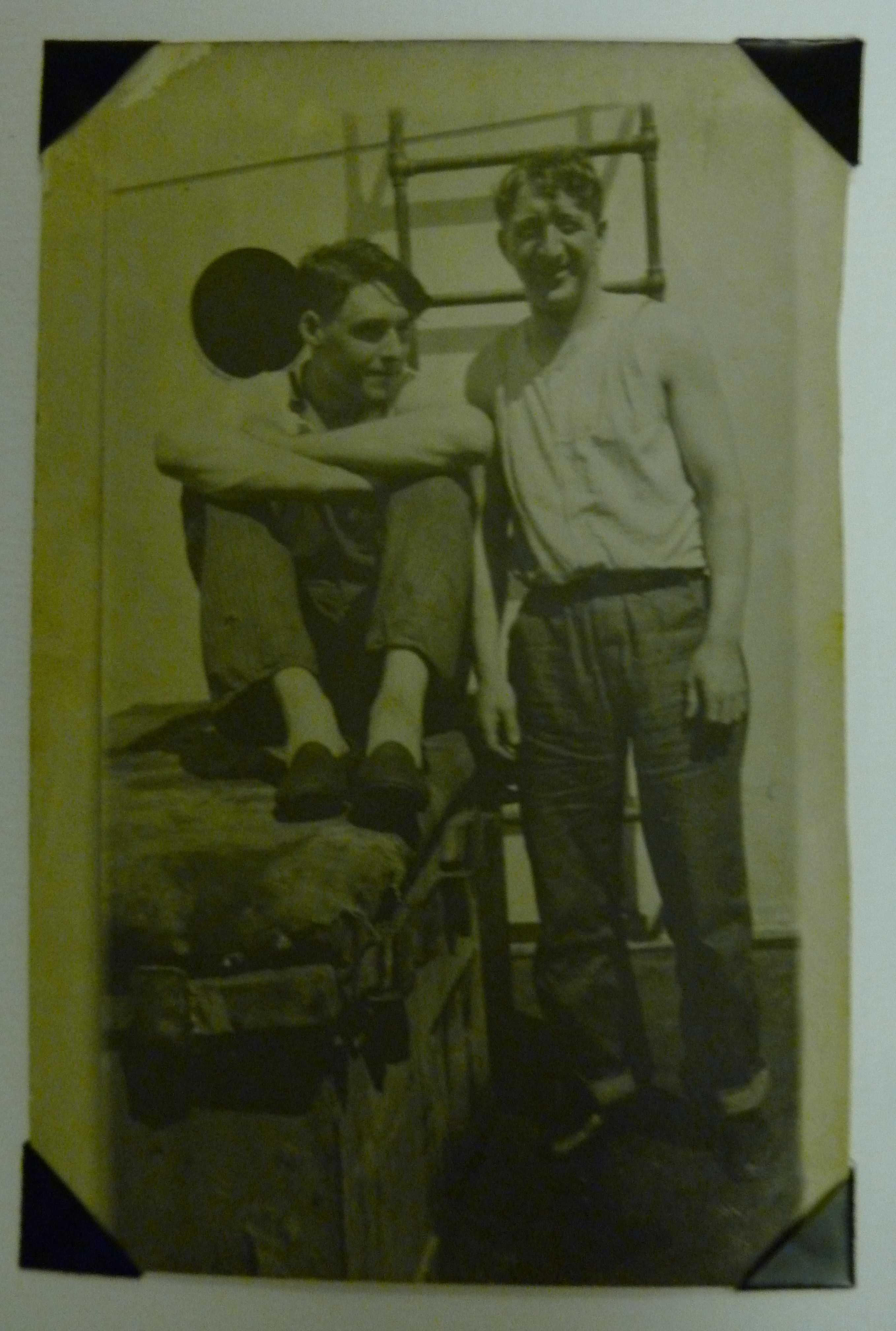
My great-grandfather is on the right. At left...anything's possible!

We have a family legend that my great-grandfather, who was in the Merchant Marines in the early part of the 1900s, was a friend of Jack London’s.  The embroidered version is that they were drinking buddies; the verified version is, well, non-existent.  But we do have several old pictures of my great-grandfather traveling the world, often with unidentified companions.  So who knows–one of them could be Jack London…

Despite the family connection, I’d only read one novel by Jack London (The Sea-Wolf), until recently when I delved into The Call of the Wild.  Ol’ Jack may have been great fun to visit a bar with, but I’m sorry to say he’s never going to be a favorite author of mine.

It was an interesting story, and the point of view of the dog brought a lot to it.  The picture of life up in the Klondike during the mining time was engaging (not that I’d want to visit, but it was fine to read about) and there were exciting moments.  But the nearly unrelenting harshness of it all was too much for me.

The story follows Buck, a family pet who is stolen and sold to become a sled dog.  Buck gradually sheds civilization, adjusts to life as a sled dog, and eventually finds his inner wolf, responding to the “call of the wild.”

As Buck passes from one owner to another, meets and (usually) fights with other dogs, and gets pushed through one test of endurance to another, the story is so bleak, and so harsh.  For most of the book, rarely is there an act of kindness or a pleasant word.  Buck does finally find a loving master who he worships in return.  If he hadn’t, I might have completely despaired of the book (or at least London’s opinion of humanity).  But, while I don’t want to give away spoilers, let’s just say it doesn’t end up happily with that master either.

I should have known what I was getting into, of course.  The Sea-Wolf  was not exactly cheerful, and, more significantly, I had read “To Build a Fire,” an incredibly bleak story about a man who managed to get wet in the Arctic and struggles, strains and strives to build a fire so that he won’t freeze to death.

Incidentally, you can also find a story by Mark Twain, I think part of Roughing It, called “Lost in the Snow.”  A group of men get lost in the snow and try to build a fire so that they won’t freeze.  Because it’s Twain and not London, it’s a very funny story.

I respect London’s knowledge and worldview…but it’s not a world I’d want to visit too often.  The Call of the Wild is a good book as a book, but not my style.  I’d rather hang out in Twain’s world.

Stealing Words

After two people, unrelated to each other, both recommended The Book Thief by Markus Zusak, I decided I ought to give it a go.  I’m not sure what I expected.  Possibly Fahrenheit 451 meets The Sting, with a little Diary of Anne Frank.  And maybe even a touch of Terry Pratchett, considering Death is the narrator.

It really wasn’t any of those.  It was the story of Liesel Meminger, a German girl living outside of Munich during World War II.  The book opens with her younger brother’s death, and Liesel being passed over to foster parents by her mother.  The story follows Liesel’s bonding with her foster family, and with Rudy, a neighbor boy and her best friend.  It also follows as she learns to read.  She does steal books, but it’s not really the organized crime or defiance of Nazi book-burning that some of the plot summaries of this book suggest.  It is about the power of words, though, and how certain books come to define Liesel’s life.

I liked the The Book Thief, but it is an overwhelmingly bleak book.  The single word that most comes to mind is grim, especially in the later sections.  There are happy moments, sweet moments…maybe even one or two funny ones (though this is emphatically not Terry Pratchett, despite Death narrating).  And yet there’s such bleakness.  Poverty is set against a backdrop of oppression, with a lot of Heil Hitler-ing for good measure.

I thought of a funny moment–Death reflects at one point that if everybody starts in on “Heil Hitler” in a crowd, it would be really easy to cause injuries from the arm movements, if you happen to be standing in the wrong place.  He’s not sure if it’s happened–all he can say for certain is that it’s never killed anyone.

But despite that,  it’s a bleak book.  If this was a movie, I think it would have to be in black and white.  Or else use a trick Tim Burton likes, of making color movies that are gray and washed-out, as though the world is perpetually overcast.  Think of Sweeney Todd or Sleepy Hollow.

I enjoyed the characters, especially Liesel’s adoptive father; Rudy, the neighbor boy who becomes her best friend; and Max, the Jewish man who hides in Liesel’s family’s basement.  I was also impressed by the portrayal of Liesel’s adoptive mother, who grows a lot as a character.  I don’t think it’s that she grows as a person–I think it’s that we see new sides and depths to her as the book progresses, so that even though she started out seeming completely horrible, by the end I was kind of fond of her.

The Book Thief has apparently been classified as Young Adult sometimes and for adults at others.  I think it could be YA, but older YA.  It’s not so much for any particular moment as for all that bleakness, and some of the darker plot turns.  It has “adult themes,” I suppose.

But it is a very good and complex book.  Just be careful that you don’t read it when you’re already feeling down about the world!

Author’s site: http://www.randomhouse.com/features/markuszusak/

Sensible and Sensitive–If Not Altogether Clear

A different sort of book today–if you’ve read my posts about my reading challenges for the year, then you’ll know that one of my goals is to read more classics.  Despite a college preparatory high school and an English major undergrad, there are a lot of classics I have somehow missed.  High on the list are Austen and the Brontes.  Somehow I was never assigned any of them (unless you count a seventh-grade book report on Pride and Prejudice, but even that I think I picked myself from a list of suggestions).

I reread Pride and Prejudice some months ago, and found out that Austen is not nearly as challenging as the impression given to my twelve-year-old self.  I shouldn’t have waited so long to pick her up again!  I enjoyed Pride and Prejudice–it’s quite funny in spots, very memorable characters (Elizabeth Bennett and Mr. Darcy!  Need I say more?) and the society was fascinating.  Although I did want to shake Jane when she didn’t give us dialogue in the final romantic scene…

After Price and Prejudice, I recently tried Sense and Sensibility for the first time.  The society was still interesting, maybe even more so.  What would it be like to spend all your time simply traveling about and living in other people’s houses, sitting around having tea or going shooting (depending on your gender) and to expect to live on your inheritance or your interest entirely?  Earning money seems to be out of the question.  And the endless societal rituals…although sometimes I think the boundless rules for interaction might almost make things easier, like knowing all the rules to the game and what it means whenever anyone does something.  The book was funny in spots too, sometimes because of the boundless societal rules.  All that said, though, I can see why Pride and Prejudice is Austen’s more popular book.  I wasn’t as attracted to the lead characters in Sense and Sensibility, for one thing, but the chief dilemma for me was the romances.

You see, there are two triangles in this one, one for each of the two sisters, Elinor and Marianne.  Marianne is the one represented by “sense”–emotive and dramatic to an extreme.  Elinor, by contrast is, well, sensible.  The trouble is, Elinor is so sensible and restrained that, when she fell in love, I couldn’t tell she’d done it.  Her romance begins earlier in the book, while Marianne’s (which is abundantly obvious when it happens) doesn’t come along until later.  So I was left for chapters trying to figure out which of the vast cast of supporting characters actually mattered.  I enjoyed the book more in the second half, after I’d worked out the two triangles and could see what plot threads I was following.  But it took some time to get there.

I watched the 1995 movie version after reading the book, and decided I should have handled things in the opposite order.  It would have been so much easier to discern the romances in the movie–when Hugh Grant walks onto the scene, you know he’s an important character!  The movie held up very well, even though I watched it immediately after reading the book (which doesn’t usually serve movie versions well).  I thought it was a faithful retelling, and the cast alone is impressive: Emma Thompson, Kate Winslet, Hugh Grant, Alan Rickman, Hugh Laurie…it’s just too bad they didn’t get Judy Dench into it somewhere; I thought all British movies based on classics required Judy Dench.  But no matter, it was a very good movie.

And it was a good book too, though I think I’ll like it better if I ever reread it, and already know which characters to pay attention to.  I have a new policy with my classics reading, to watch a good movie version first.  So far I’ve tried it with Jane Eyre, and found the book much easier to read because I watched the Orson Welles/Joan Fontaine version first.  And I ended up staying up late reading because I knew a good scene was coming and wanted to get there…

I can recommend Pride and Prejudice entirely, and Sense and Sensibility with a few reservations.  But possibly not at twelve years old, considering it did scare me off for a while…

A Shy Heroine, and a Hero Named for a Vegetable

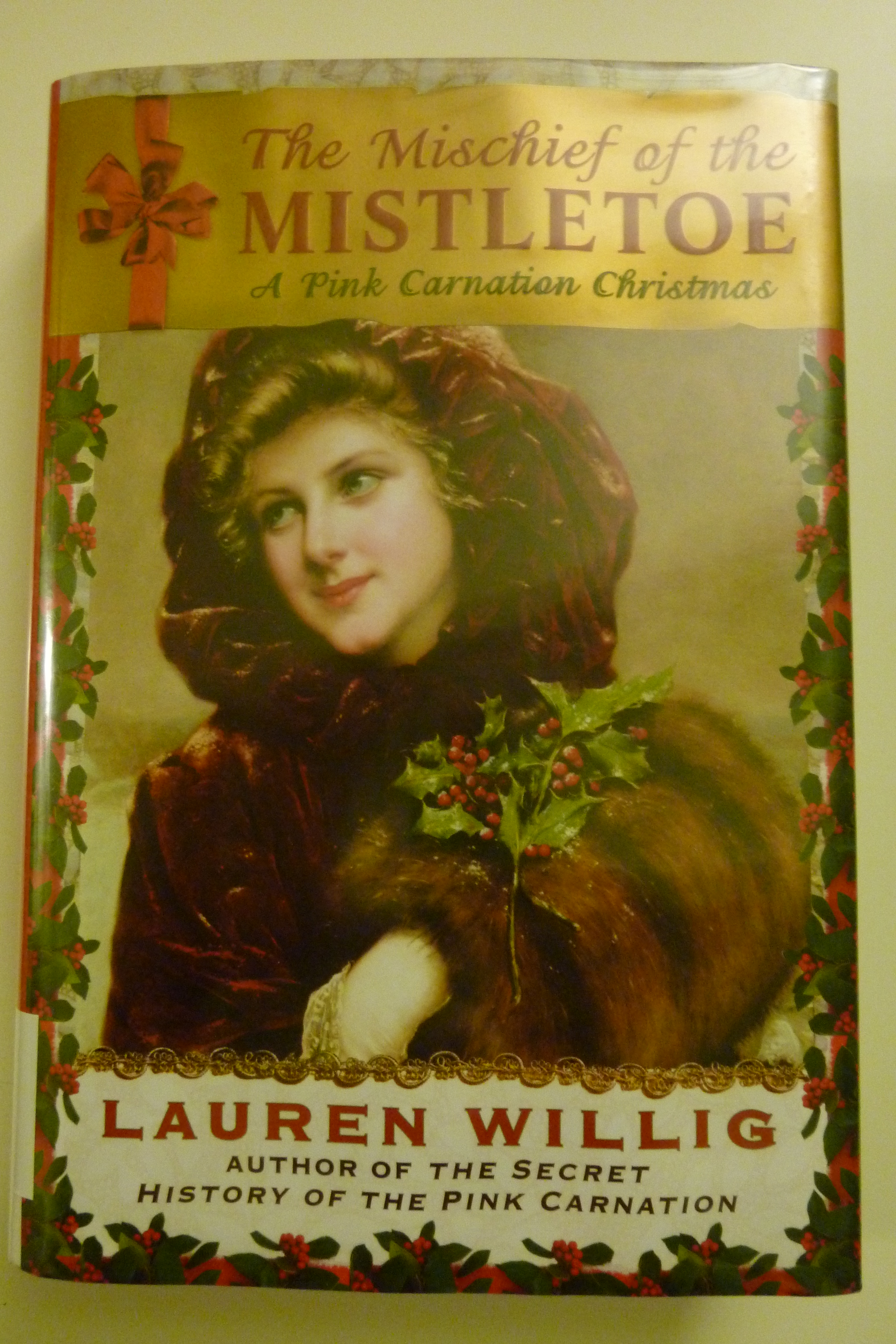
I had The Mischief of the Mistletoe by Lauren Willig on reserve at the library since before Christmas.  I added it when I saw it on a list of Christmas novels, and decided I wanted to read a good Christmas story.  Apparently other people had the same idea, and it didn’t reach me until mid-February.  But I’m so glad I didn’t decide to cancel my hold on December 26th, or even after Epiphany, when Christmas stories stopped really feeling appropriate.  For one thing, this wasn’t that strongly a Christmas story.  And more importantly, it was excellent!

The book is set in Regency England, what I can only think of as Jane Austen’s England.  Jane herself is in the book as a supporting character, as the sympathetic friend of the heroine, Arabella.  Arabella is the lead character of the book, but has clearly been a supporting character all her life.  A shy, unassuming wallflower, she’s the one at the party whose name no one can remember.  I have a soft spot for characters who think they’re unimportant.  I love watching them discover their inner depths and come into their own, and I loved watching Arabella find new strength and confidence.  Here we have the extra bonus of watching the other lead, Turnip, also discover Arabella’s value.

Reginald “Turnip” Fitzhugh…where to begin?  The name, I suppose.  I can’t tell you how much I love it that the hero has a vegetable for a nickname.  And not even a tough vegetable (I don’t know what vegetable would be tough–asparagus spears, maybe?–but I’m pretty sure turnips are not the heavyweight champions of the vegetable world).  It fits him–and he’s a wonderful character!  Endlessly well-meaning, charming and gallant, not a brilliant intellect, capable of throwing a punch when the situation calls for it, but not really all that good at derring-do and dashing exploits, frequently bumbling, very thoughtful, addicted to outlandish waistcoats.  Somehow, it works so well and is so much fun.  I love dashing heroes, but this time I really enjoyed a hero who stumbles more than he dashes–but rushes forward anyway, well-intentioned and grinning.

So you can check off the first requirement for a good book–great characters.  If you couldn’t tell already, lots of good humor too.  Occasionally this book tries a little too hard to be witty, especially in the dialogue, but most of the time it succeeds.  Third, we’re given a very sweet romance.  So, check, check, and check!

Fourth, there’s an engaging plot as well.  If it had been up to me to name this, I would have called it The Puzzle of the Pudding (to keep some nice alliteration).  Mistletoe barely features, while the plot is mostly set in motion when Arabella and Turnip discover a hidden message in the wrapping of a Christmas pudding.  This launches a series of intrigues and efforts to uncover the truth, which kept me and the characters guessing until the end about whether they were dealing with international spies and a threat to England’s security,  or with pranks among schoolgirls–or both.  Turnip staunchly believed the former, while Arabella mostly leaned towards the latter.

It turns out that this is actually Book Six, in the Pink Carnation series.  The Pink Carnation is England’s most elusive spy (in the style of the Scarlet Pimpernel).  As near as I can tell from reading plot summaries, the books are all set in the same social circles, but focus on different characters.  It’s obviously possible to start with the Mistletoe and enjoy it, since I did!  I probably missed a few things, but I don’t think it seriously impacted my reading. 

I read The Secret History of the Pink Carnation afterwards (it came much more quickly at the library) and enjoyed it as well–not quite as much, as I liked Turnip, Arabella and their romance better.  Good enough that I will definitely go on to the rest of the series though!  And if you go look up a plot description for the first book, every one I’ve read has been wildly misleading–it looks like it’s about a modern-day character doing historical research, and it is, but she’s only a very small part and most of the book is set in the past.

Since I normally review young adult books, one note I should make: this series is in the grown-up section, and while Mischief of the Mistletoe has a discreet,  Austenish feel that I think keeps it appropriate for younger readers, The Secret History of the Pink Carnation is not so discreet.  Fair warning given.

The Mischief in the Mistletoe was dedicated in part to “everyone who asked for a book about Turnip.”  I completely understand where those requests came from.  If I do a round-up of favorite characters met in 2011 at the end of the year, I expect Arabella and Turnip to be strong contenders.

Author’s Site: http://www.laurenwillig.com/index.php

Because It’s There

I want to begin this review by saying that I have never been mountain-climbing.  Nor do I ever plan to go.  The truth is, I don’t even like steep hills (which, believe me, can be a problem if you live in San Francisco).  I can walk very happily for miles on flat ground, but give me a hill and it’s all over.  But this is why I love books.  I love that they let me live lives I would never actually live, whether that involves casting magical spells, visiting a distant planet, or climbing a mountain.

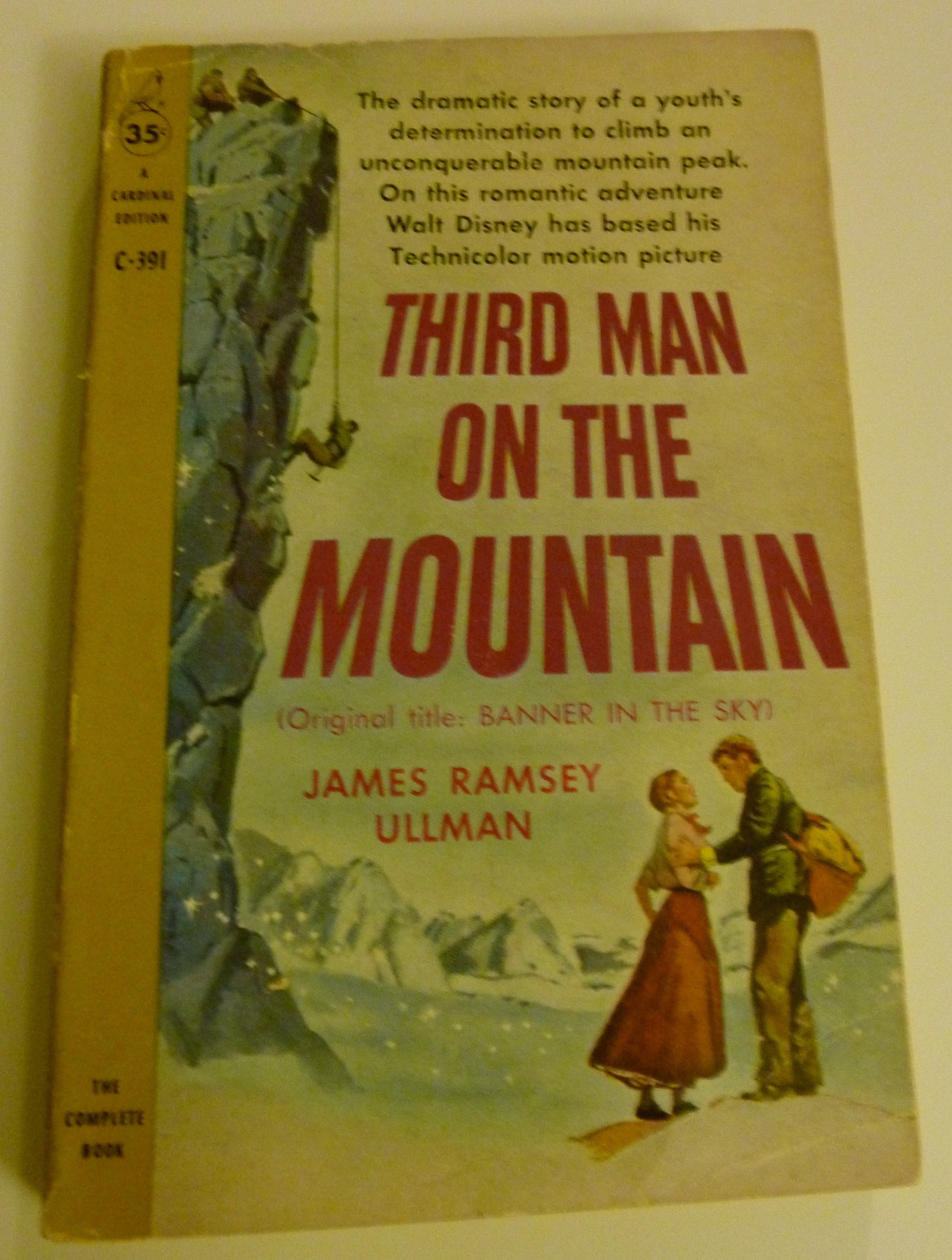
That last brings me to Banner in the Sky by James Ramsey Ullman.  You’ll notice I have a picture of Third Man on the Mountain.  Walt Disney changed the title for his movie version, and then they reprinted the book with the new title.  I like Banner in the Sky better–for one thing, I’m not sure what Disney’s title is even supposed to mean!

With either title, the book is about Rudi Matt, and about the Citadel.  Rudi is a teenager living in a small village in the Alps in the 1800s, and he dreams of climbing the Citadel.  It’s the one unconquered peak, the one no man has ever reached the top of.  No one has tried for years, since the failed expedition that killed Rudi’s father.  Rudi’s mother has forbidden him to become a mountain climber (and I do understand her viewpoint!) but when an Englishman comes determined to lead an expedition up the unclimbable mountain, Rudi is determined to go.

The book is as much about Rudi’s growth as it is about the mountain.  He learns that there’s more to climbing a mountain than just scrambling over rocks, learns about things like trusting others and never leaving a comrade.  He learns to follow his father’s footsteps in more ways than one.  My best guess on Disney’s title is that Rudi becomes a man on the mountain, rather than a boy–but I can’t quite figure out how Disney calculates him as the third one.

This makes it all sound like it’s deep and reflective, and occasionally it is–but there’s also plenty of scrambling over rocks, and getting caught on ledges, and even an avalanche or two.  It’s an exciting story as well as a meaningful one.

It reminds me a little bit of stories about Scott’s expedition to the South Pole.  Not because of the snow similarity, but because they’re both about men trying to achieve a feat that has been considered unachievable.  They’re about pursuing the impossible dream.  And while I personally don’t have any desire to climb a mountain or ski to the South Pole, when the story is told right, I can get very enthused about someone else’s dream.

Why does someone climb a mountain?  “Because it’s there” is always a good answer.  Because it’s there to be conquered.  For Rudi, it’s because he wants to take his climbing staff and his father’s red sweater, and plant them as a flag at the top of the Citadel–a banner in the sky.

Even though I need a good reason to climb a steep hill and can’t imagine climbing a mountain, Banner in the Sky makes me believe in Rudi’s dream, makes me see it as vital and important for him, and makes me want to see him succeed.