Finding a Book About Finding a Calling

I want to tell you a story about the wonders of the internet when it comes to finding books.  Many years ago I was in a religious book store, and I was passing the time waiting while my parents shopped by reading the picture books.  I found one about an acrobat who wanted to serve God, and somehow it stuck in my mind…but that was almost all that stuck–certainly no title or author name.

I was thinking about that book recently, and went hunting on Amazon for a religious book about an acrobat.  Within a matter of minutes I had found Tumbler by Liz Filleul, which I am 98% sure is the same book I read all those years ago–and as good as I remembered it.

Tumbler is about Tristan, a talented acrobat who travels with a troupe of minstrels in medieval France.  Everyone loves watching him, but Tristan himself admires the monks he sees helping the poor.  He believes that they’re doing work that’s really serving God.  When Tristan injures his leg one day and can’t do his acrobatics, he decides to join a monastery, believing that’s the best way to serve God.  Tristan turns out to be very unsuited to monastic life…and eventually realizes that doing what he does best is the best way to serve God.

I love the message in this book that everyone has a different purpose.  Think of it as a way to serve God or as a life calling or as what we’re each meant to do.  It’s not the same for everyone, and there isn’t any one right way to live, or one right thing to do.  I also love it that Tristan realizes he doesn’t have to force himself down a path–the right path for him is the one he already loves.

I’m reminded of a quote from L. M. Montgomery, in a letter to a friend who must have been questioning his own calling: “I do not think that you need feel worry because the line of work you take up may not be the highest.  It may not be the highest absolutely but–for you–it is the highest relatively.  The work God gives us to do and fits and qualifies us for doing must I think be our highest.”

I always like stories about following dreams and finding a purpose, and Tumbler is a simple, beautifully illustrated, profound story about exactly that.

Capturing Ten Moments in Time

How often do you really think about a photograph?  You’ll look at photos in a whole new way if you read Smile! by Geraldine McCaughrean–or, as I did, listen to the audiobook.

Smile! is about Flash, a photographer whose small plane crashes in a remote area.  He manages to save only one camera–a simple Polaroid, with ten shots.  Flash is taken in by a primitive village, which has rarely had contact with the outside world.  As he speaks to the villagers, he realizes that none of them have ever seen a photograph.  Accepted by the villagers as “the magician who fell from the sky,” Flash must decide what to spend his ten photographs on–what sights will he preserve for the villagers?

Flash comes to love the villagers, and it’s not hard to relate to that feeling.  There are Sutira and her brother Olu, two children who adopt Flash.  And there’s “the old, old man,” the village elder who helps Flash decide what pictures to take–and what shouldn’t be photographed.

Seeing the photographs through the villagers’ eyes is fascinating.  All of us, with our digital cameras and our Google image searches, are so used to the idea of photographs.  But through the eyes of the villagers and through McCaughrean’s gorgeous prose, a photo becomes something magical–a moment in time, frozen and preserved.  Through photos, “the dead can still smile in the land of the living.”  A little boy is ten years old forever.  When the village goes through hungry times, they can look on the feast in their past.  In sad times, the image of their joyful dance.

The book is about photos, and about Flash, as he learns from the villagers–about beauty, about memory, and about what’s really valuable.  It’s a simple, fairly short, and lovely book.

McCaughrean’s writing is beautiful, and I’m sure it was enhanced in the audiobook (available on iTunes) by the reader.  I was thrilled to discover this was read by Richard Morant.  He was the voice of Titus Oates in the audiobook for another of McCaughrean’s novels, The White Darkness.  I won’t wax on again–I’ve done it before–but suffice to say he has a beautiful voice.

This book is listed as a children’s book, and in its simplicity, perhaps it is one.  But it’s another wonderful example of a children’s book with depth, with meaning, and which can be read on so many levels.

Author’s Site: http://www.geraldinemccaughrean.co.uk/index.htm

Other reviews:
Big A little a

I couldn’t find others!  Any you’d like to share?

The Dolphin Girl

What makes us human?  The Music of Dolphins by Karen Hesse asks this question, by looking at the world through the eyes of Mila, a human girl raised by dolphins.

Mila is picked up by the Coast Guard one day, after living in the sea for 13 years.  She’s taken to a facility where scientists help her learn language, skills, and how to live among humans.  The story centers on Mila’s growth as she learns about the human world, and on her longing for the dolphin world she knew.

My favorite part of the book is the way it’s written.  Mila tells her story herself, in a journal, and it changes dramatically as she learns.  The earliest pages are very simple, “Dick and Jane” style writing.  The font size shrinks and the words grow longer and more complex as Mila develops greater skills.  It’s a similar device as Flowers for Algernon.  Mila’s journal is punctuated by three separate passages in Mila’s head, describing her life with the dolphins.

I read this as a child and loved the change in the font and in the words.  Rereading it now, I’m more conscious of the growth in Mila’s character, from a very simplistic view of the world to a growing complexity.  She asks more questions involving “why,” has her own opinions and her own desires, and demands to be seen, not as a test subject, but as a person.

I’m sure this is a more realistic portrayal than Tarzan or The Jungle Book (fun though those are).  I don’t know enough about psychology or dolphins to be able to fully judge how accurate this is, but it feels realistic.  The ending requires a suspension of disbelief, although as a child I don’t think I realized that.  And I still find it a satisfying ending, even if I know now how completely unlikely it is.

This is a short and simply written book–Mila never approaches Shakespeare even at her most complex writing–but despite that, it gets at deep questions.  There’s a character in Pratchett’s Discworld who is described as simple but not stupid.  I think that applies here too.  It’s a simple book, but that doesn’t mean it can’t be profound.

Today, a Warning

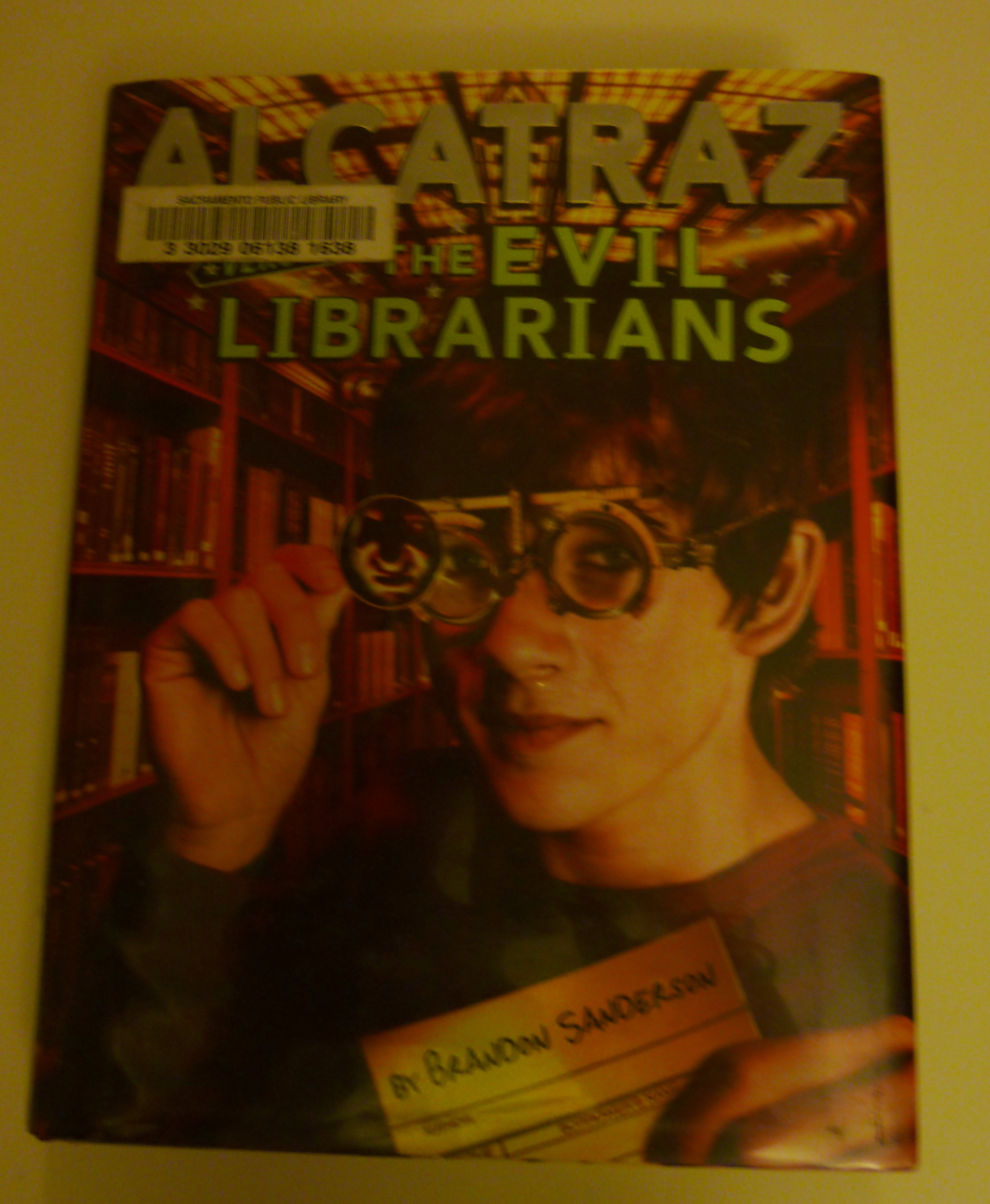
I suppose the title should have warned me.  One of my book club’s recent selections was Alcatraz vs. the Evil Librarians by Brandon Sanderson.  It was a departure from our usual genres.  I think we were all intrigued by the idea of evil librarians.

I for one was expecting it to be a group of really awesome evil librarians.  There are plenty of awesome villains out there, and a really cool group of sinister, book-wielding librarians sounds amazing.

Too bad that isn’t what this turned out to be.  First thing–Alcatraz is the lead character’s name, and the book has nothing to do with the island or the prison.  Second, and even more importantly–the evil librarians were a LONG way from awesome.  Nor were they an isolated group.  Instead, the premise of this book is that all the librarians of the world are engaged in a vast conspiracy to feed everyone misinformation.  And they’re painfully stereotypical librarians, with horned-rim glasses and buns, or bad bow ties for the men.

I cannot at all fathom why anyone would write a book insulting librarians.  I mean, they’re librarians! I may be particularly ill-suited for this premise, considering I have four friends who are librarians, and I can’t remember a time when I didn’t have an active library card.  But anyone likely to be reading this book probably likes books.  And if you like books, you probably like libraries and librarians–I mean, people who help you get free books, what’s not to love?

And what exactly is the message for kids here?  Librarians are evil and untrustworthy, libraries are dangerous, and almost any book you might pick up is both bad and foolish?  That’s the message that comes across.

Now, I do realize this book is not meant to be serious.  That comes across too.  But it never achieves quite that right tone of self-mocking to make it funny and not irritating.  It’s trying to give the reader a nice broad wink, and failing miserably.  I think it wants to be “Springtime for Hitler,” which is hilarious.  This book is not.

Not to mention, it’s just badly written.  Alcatraz is telling the story, and his goal is to prove that he isn’t actually a hero.  Rule #1 of writing is that the reader should like your lead character.  Or hate them, that works sometimes too.  If your reader is irritated and/or bored, your book is dead.  When your narrator states that his goal is to irritate the reader and he succeeds, there’s a problem.  Every chapter starts with a page or two of totally irrelevant introduction, in which Alcatraz interrupts the plot to ramble on about whether he’s a good person, whether the reader is irritated yet (answer: YES), tries to convince us everything going on is plausible and if we don’t believe it we’re just brain-washed morons, or points out the clever literary devices he’s using, for the purpose of being annoying.

Honestly, it’s like an example in how a book should not be written.

I haven’t even mentioned the plot, have I?  It’s not so bad, really.  Comparatively.  Alcatraz is an orphan with a talent for breaking things.  One day he meets his grandfather, who tells him he’s actually a member of a famous family who has special Talents, and Alcatraz begins to learn how he can use breaking things to his advantage.  His grandfather also tells him about the conspiracy of the Evil Librarians, and about an entire other society on a continent in the middle of the Pacific (knowledge of which the Evil Librarians have suppressed).  They set out on a mission to rescue a bag of really special sand that the Evil Librarians have stolen.

It’s not a terrible plot.  The Talents are entertaining, because they all sound like bad things (arriving late all the time) but turn out to be useful (the late person is constantly late for bullets, so he can’t be shot).  I like the idea of the secret continent.  I’ve often thought there was potential for a story in the idea that some basic fact is really false, but no one knows it, because how many things do we actually know from  first-hand experience?  How many of us have sailed across the Pacific?

It’s an okay plot in a terrible book.  And about that bag of sand.  The bag contains the Sands of Rashid.  You can definitely say “the sands of time” and I’ll accept “the Sands of Rashid” if necessary  But they keep on talking about the sands.  They have to rescue the sands and they have to get the sands back and the sands are really important.  “Sand” should not be plural!  It got to where I wanted to scream every time they said sands.

You know, I bet a librarian could have told Sanderson that you don’t make “sand” plural.

So why did I even finish this book?  Mostly because I knew that I’d be able to rant about it at Book Club and on my blog, and I figured I needed to finish it to be able to rant more effectively.

But you don’t need to.  Really.
Sympathy for the Devil

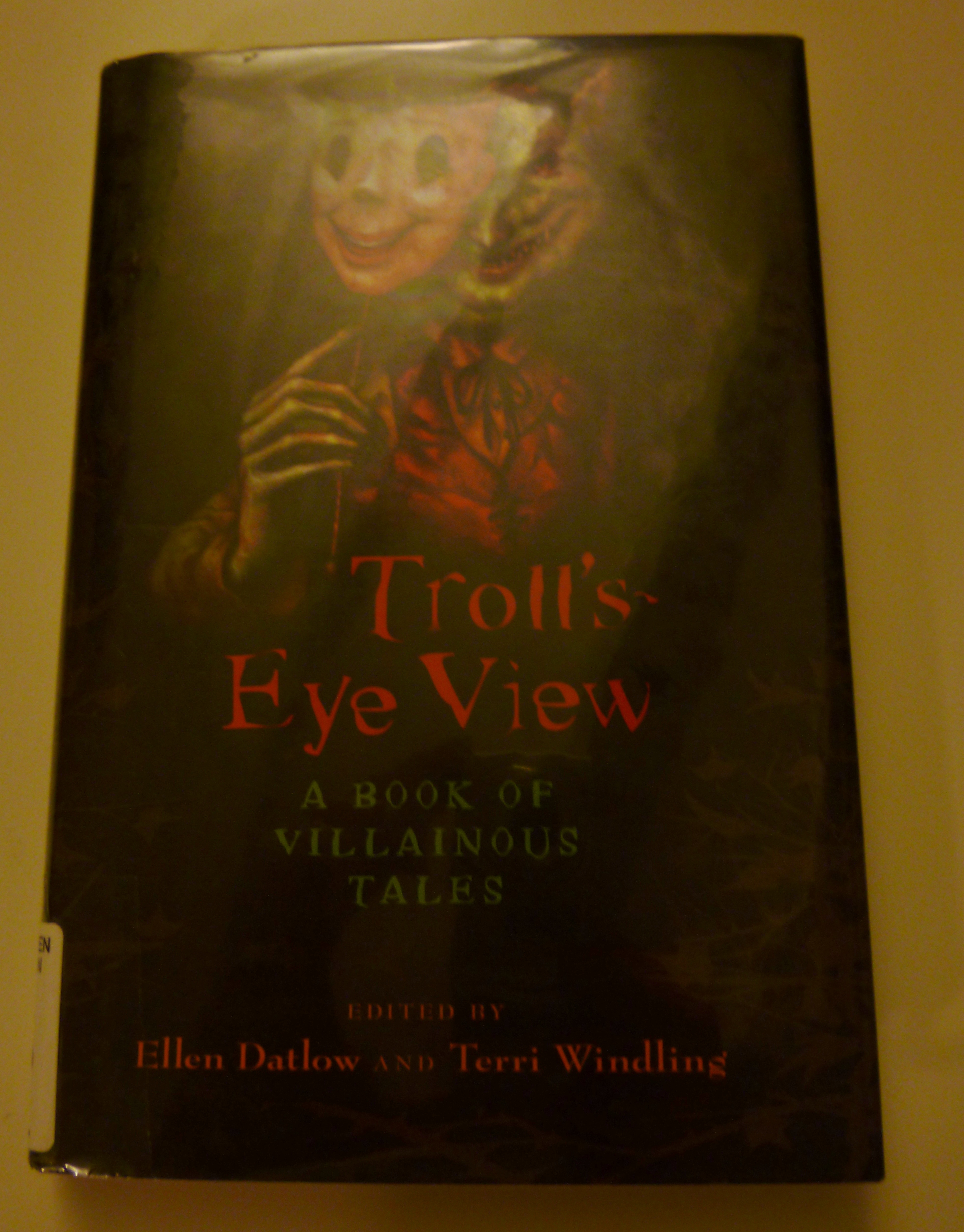
I found Troll’s Eye View in a very writerly fashion–I was doing research to see if anyone had come up with the same angle as I have for retelling “The Twelve Dancing Princesses.”  Subtitled “A Book of Villainous Tales,” it’s a collection of short stories, retelling fairy tales from the villain’s point of view.  That includes “The Twelve Dancing Princesses,” although calling the oldest princess the villain seems like a stretch (granted, she didn’t mind people being beheaded, in the original version).

The book is edited by Ellen Datlow and Terri Windling, and has some impressive writers included, like Garth Nix, Jane Yolen and Neil Gaiman.

There were some excellent stories in here, although I was dissatisfied with a number of them too.  I don’t know if you can tell from the picture, but it’s a slim book, and they fit fifteen stories into it.  I ended up feeling that several were nice ideas that didn’t get much development.  I think I’m the wrong age for those too.  I love children’s books, and very often find ones that are completely enjoyable to me as an adult.  Many of these stories, I think, really are better for just kids, who wouldn’t mind a simpler narrative.

And there were the excellent ones.  “Castle Othello” by Nancy Farmer is really clever meld of Bluebeard and Shakespeare, with a good twist to the ending.  Neil Gaiman contributed a dark poem based on “Sleeping Beauty.”  Nix and Yolen both had some good humor, although I think the shortness of the stories limited their scope.  Ellen Kushner’s “Twelve Dancing Princesses” retelling (actually, “The Shoes that Were Danced to Pieces” was how she titled it) was a clever idea, although another one with limited development–and not the same as my idea, fortunately.

My favorite, by far and away, was “A Delicate Architecture” by Catherynne M. Valente.  This would not have been the case when I was a kid, and in fact I think it probably would have given me nightmares!  But as an adult I can appreciate the creepiness of some of the images, and the beauty of the writing.  It starts out almost as a more poetic Charlie and the Chocolate Factory, with a little girl describing the wonderful creations of her father the candy-maker.  There’s beautiful, vivid imagery…until the story takes a darker turn, and then the images are just as vivid, but turn into nightmares.  (Spoiler warning, because I can’t resist telling you about it!)  The little girl becomes a young woman, until finally she learns that her father’s fanciful tale of creating her from sugar is all too true.  After that she’s treated not as a person, but as a cooking implement, and hung up on the wall of the kitchen at the royal palace, to be used for the desserts…and that’s the image that would have given me nightmares as a child!  Finally she becomes a gnarled old woman, who escapes into the woods to build a house out of candy…  It’s an excellent story, and makes me want to read more by Valente!

The book on the whole was more mixed.  But it was also a quick read, and worth it for the good ones!