Today’s review is a book about a boy who goes away to a school to learn to be a wizard. At the school, he makes a few close friends, including a freckled, red-headed boy. The school is run by a kind older wizard. The conflict of the story arises with an evil wizard who was a co-founder of the school who was cast out for being, well, evil. The hero turns out to be the fullfilment of a prophecy to fight the evil wizard.
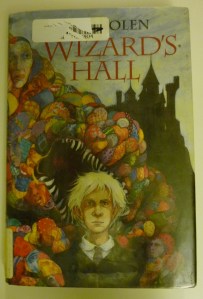
And if at this point you think I’m talking about Harry Potter…I’m not! I’m actually talking about Wizard’s Hall by Jane Yolen. I’ve no idea whether J. K. Rowling has ever read it, and would not dream of commenting…except to note that Wizard’s Hall came first.
Wizard’s Hall is about Henry (yeah, the name’s interesting too) who casually mentions to his mother one day that perhaps he’ll be a wizard. Next thing he knows, his mother has wiped the smudges off his nose, told him that the most important thing is to try, and sent him out the door to walk to Wizard’s Hall. After that, it’s the story of Henry trying to figure out whether he really belongs at Wizard’s Hall–and, of course, how to fight the evil wizard too.
Henry is pretty swiftly renamed–everyone at Wizard’s Hall has a special name, and they’re all plants, like Hickory and Gorse and Willoweed. Henry becomes Thornmallow, “prickly on the outside and squishy on the inside.” I think he’s a bit more squishy than prickly, in an earnest, well-meaning sort of way. I’ve actually been known to define characters in other books like this–I have a soft spot for tough characters with good hearts, who can sometimes be described as prickly on the outside and squishy on the inside.
Wizard’s Hall is a lot shorter than Harry Potter–133 pages, instead of, I don’t know, 4,000? It doesn’t have the same elaborate world or the multi-book epicness. But it is a very good book about a wizarding school, and about trying to find your place.
I wanted to like The Children of Green Knowe by L. M. Boston. It’s usually not a good sign when a review begins that way, is it? You see, I saw it reviewed on a blog I follow, and it sounded intriguing. Well…while I still respect that blogger’s opinion 🙂 I won’t be adding this to my list of favorite British children’s fantasy classics (a long list I ought to post some time!)
The book is about Tolly, a little boy who goes to live with his great-grandmother at his family’s ancestral home, a castle called Green Knowe (or Green Noah). His great-grandmother tells him stories about his ancestors who lived in the house, especially three long-ago children, Toby, Alexander and Linnet. Tolly quickly realizes that the children are still at Green Knowe, as ghosts.
I really like the concept, and I liked the setting. I loved one small bit, when Tolly first meets his great-grandmother, and she’s eager to see who in the family’s past he’ll resemble–because all the faces return to her eventually. I rather enjoyed the family stories the grandmother told.
But Tolly’s story fell pretty flat for me. It might have helped if I had known his age sooner. I finally figured out most of the way through that he’s six or thereabouts, when he comments that six-year-old Linnett is as big as he is. Prior to that, he seemed sometimes older, sometimes younger, making his more childish moments disconcerting. For that, and in a general way, it was hard to get a handle on the character.
But my bigger problem was the ghost children. They seemed to have no depth at all. They’re not creepy, scary ghosts; they’re not ghosts with unfinished business; they’re not ghosts who need something from the living, or even who want to do something for the living. They’re perfect paragons who never struggle. Gail Carson Levine, on her blog, often writes about the importance of making your characters suffer sometimes, and these characters never do. They simply wander through the book as happy ghosts who spend all their time playing. Their favorite game seems to be hide and seek, which doesn’t even facilitate getting to know someone. Even when they make themselves more available, I never felt that Tolly or I could really enter a friendship with them. I don’t think Tolly saw it, but they seemed to me to be just too self-sufficient unto themselves. They were friendly to Tolly, but they never seemed particularly interested in him either, simply taking him for granted as a new playfellow, if they felt like playing.
And the animals. You know that scene in the Disney Snow White when she makes friends with the entire forest? It was like that. The ghost children have a horse, and a deer, and a fox, and a rabbit, and a fish, and a hedgehog, and a whole flock of birds, including a peacock, and possibly one or two other animals I’m forgetting. It was a bit much.
It may be that I came to this book too late in life. If I had picked this up as a child, maybe I wouldn’t have seen some of the character issues, and to be honest I probably would have thought the menagerie was neat. But I had trouble coming to this book at an older age. My apologies if I’m pulling apart a beloved childhood favorite of anyone else–and by all means, tell me what you love about it that I managed to miss!
I saw yesterday on a blog I follow that Diana Wynne Jones died this past weekend. For those familiar with children’s literature, you probably know the name already. For those not, I’ve heard her described as “the queen of British children’s fantasy.” She was an incredible and prolific author–I’ve read more than twenty of her books, and they are truly excellent. If I’m browsing at the library and not turning up much, I’ll often wander over to her shelf. There aren’t many authors I do that with, and she’s probably the most reliable that I’ll find something sitting there I want to take home with me. She was still publishing–with one more due out later in this year–and it’s a wrench to realize there will be no more new books. She’s an author I will definitely miss.
By weird coincidence, I already had a review of one of her books planned for this week. It now seems especially appropriate.
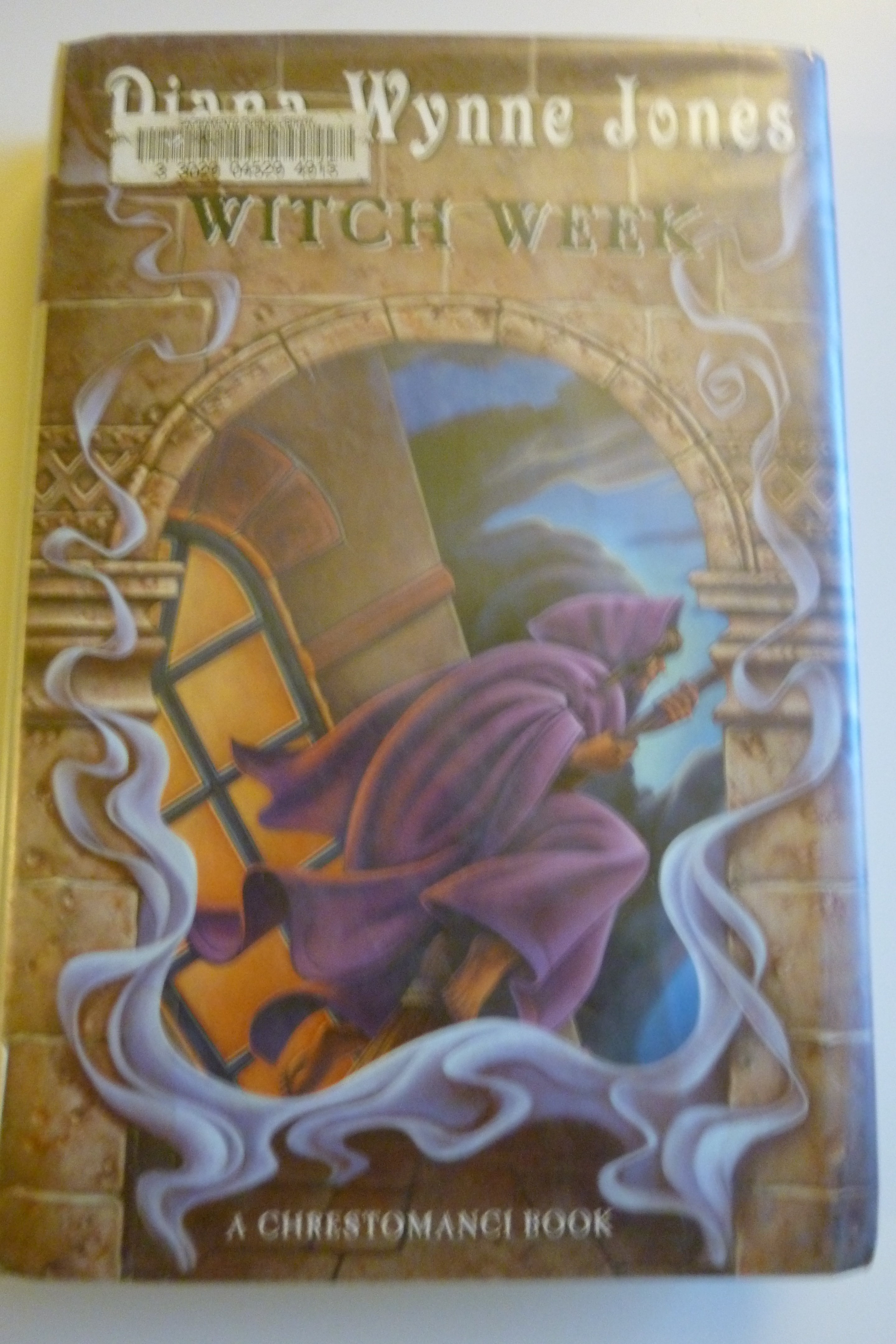
Witch Week was the first book I ever read by Diana Wynne Jones, and I read it long before I discovered her as an author. I read it when I was young enough to not know who Guy Fawkes was when he came up (more reading of British classics solved that gap in my knowledge!) Years later I happened across another Diana Wynne Jones book–though now I can’t remember which–and started searching for her others, thinking I had found a wonderful new author. And she is wonderful–but not so new, as I discovered that I had already read Witch Week. Which only leaves me to wonder why I hadn’t looked for more of her books earlier!
Witch Week is set in a world very like our own, except that some people have magic–and witches are routinely burned at the stake. The story occurs at a boarding school, where an accusation has been made that someone in a class is a witch.
Laying out the plot makes it sound all very dark and grim, like The Crucible, perhaps. But that’s not how it is at all. There are a few serious moments, but the book is a comedy. The boarding school does create a more bleak backdrop than most of Diana Wynne Jones’ books (which tend to be set in a quaint village or a lordly manor or some truly fantastical other world), but the plot is predominantly funny.
Various students discover throughout the book that they have magic, but that doesn’t mean they’re experts at using their new powers. Riding a broomstick involves a lot of scrambling to stay on it, and arguments with the broom about where to go. Casting a spell to summon a missing pair of shoes brings every shoe in the school raining down–thousands and thousands of shoes. Using magic usually has funny results–and the suspense is kept up because it could have tragic results too.
Witch Week is part of the Crestomanci series, about Crestomanci the nine-lived enchanter, who keeps magic in order across many worlds. It’s more independent than most of the books in the series though–he only has a supporting role. And obviously I never realized it was a series the first time I read it.
Witch Week is not a bad place to start with Diana Wynne Jones. Charmed Life is actually the first of the Crestomanci series, so you might be better served starting there. Or you could begin with one of her independent ones–a particular favorite of mine is A Tale of Time City. But whatever you pick up, you’re not likely to go too far wrong. In all those books I’ve read by her, since the days when I just read Witch Week, though of course I liked some better than others, I think I can pretty well recommend them all.
As you know if you visit here regularly, I love retold fairy tales. But…not always. Unfortunately, including fairy tale elements is not a guarantee of a high quality book (just a usually promising sign). Towards the end of last year, I read a book that made this abundantly clear: The Frog Princess, by E. D. Baker.
On Monday, I mentioned that I could name lots of characters from Patricia C. Wrede’s Enchanted Forest Chronicles. As for The Frog Princess…I can’t think of a single name. Granted, I only read it once and it was a few months ago…but I don’t think it’s entirely me.
Illustration from "The Frog Prince." Emma's not this pretty.
The princess (I’ll look up her name to make this easier to describe–Emma) is one of a big crop of ordinary princesses who seem to turn up in books often. She’s not pretty enough and she trips and she doesn’t like dancing. Without trying, I can think of three other books with princesses like that (plus one Cinderella), and most of them have more going on to make the heroines interesting. Cimorene, from Enchanted Forest, doesn’t like her princess lessons, so she bullies various people at the castle to teach her other things, like cooking and fencing and sorcery. That’s interesting. I’m not sure what Emma does, other than irritate her mother and run off to the swamp sometimes.
In the swamp, she meets a talking frog who claims to be a prince. After a lot of balking about kissing him (by the way–he’s a talking frog and all he wants is for you to kiss him so he can be human again–just do it, it’s not asking that much and what’s the worst that could happen?) she goes ahead and does. Only to turn into a frog herself (okay, I guess bad things could happen). Sound a lot like the Disney movie? I’m not sure the precise connection, but at least some editions of this have a label saying it’s the inspiration for the movie, so they must have bought rights or something.
Unfortunately, the book only had the one good idea. Disney, wisely, used that single idea and nothing else. Emma and the frog (Eadric, I looked him up too) go off to find the witch who enchanted him, and have a series of adventures along the way. Which is all well and good, but kind of like Emma doesn’t stand out at all as an ordinary princess, the adventures and the world they’re in don’t stand out either. There was nothing at all distinctive about it. I’m not looking for Tolkien, who invented entire languages for his magical races. But when you have a generic princess having generic adventures in a generic magical kingdom…not very memorable.
If all this genericness was the backdrop to something else–funny scenes or interesting relationships between the characters–this still might be passable. But it’s really not that funny. A few “help, I’m a frog” jokes.
The relationships were overwhelmingly flat too. No one had any depths of emotion. I’d forgotten the characters’ names, but I did remember a scene where they’re talking about something or other, and Emma tells Eadric he’s her best friend. This should be revelatory. They haven’t known each other long, they spend as much time arguing as not, it’s not like saying that to an old friend who already knows it. Yet Emma says it off-hand, and Eadric–doesn’t react! I think I actually stared at the page for a few seconds wondering if I’d missed something.
Sometimes I’ve heard someone comment that they don’t expect as much depth in children’s or young adult books. It’s a comment I actually disagree with–children’s and YA books may cover different emotions and perhaps explore them in different ways than books for grown-ups, but the good ones will still have depth. There is no reason a children’s book can’t sound deeper emotions in the areas of friendship, finding one’s place in the world, dealing with a life-altering situation, falling in love for the first time or going on an extremely dangerous quest. But I think those people who don’t expect depth are imagining a book just like The Frog Princess. It’s a kid’s book, so even though all that’s going on, we don’t really need to explore any of it.
I rarely recommend a movie over a book, but in this case, if you want a story about a girl turning into a frog, watch the Disney movie.
I was recently sketching over the plotline of The Enchanted Forest Chronicles by Patricia C. Wrede for a friend, and realized that I actually remembered all the character names. As I’ve mentioned in at least one other post, I am bad at character names. Oh sure, I remember the main character, but the main character’s best friend? Possibly not.
But, for The Enchanted Forest Chronicles…Cimorene is the heroine, and her best friend is named Alianora. And I could probably give you at least another six or seven names besides. All of which should say something about how great this series is!
Don't mind the creases--they're well-read
It all starts with Cimorene, a princess who decides that she’d rather be kidnapped by a dragon than marry the boring prince her parents picked out. Princesses are kidnapped by dragons sometimes, you know, so, taking advice from an enchanted frog, Cimorene goes off to find a dragon and volunteer. The dragon Kazul agrees to take her on, especially after hearing that Cimorene can cook cherries jubilee.
Is that already enough to convince you these are wonderful books? If not, I can also tell you that the story goes on with evil wizards, all manner of enchanted creatures, a magical forest (of course) and endless fun references to fairy tales. They’re funny, exciting, and even romantic in spots.
It’s not a romance with that boring prince from the beginning–Prince Therandil does turn up, but he stays insufferable. He comes to fight the dragon to rescue Cimorene; he would have come back earlier in the book, except that he was waiting for Kazul to defeat an impressive number of challengers first. He’s very put out when Cimorene explains no one’s actually fought Kazul–she’s been talking the challengers out of it, which has been very inconvenient and time-consuming.
Wrede has created one of those wonderful things in retold fairy tales–a world where there are strange and marvelous things like djinns and enchanted swords and magical caves and (of course) dragons, but where you also have to deal with getting the right pot for your cherries jubillee, and cleaning the dust out of (non-magical) caves.
The series is a quartet, plus a couple of short stories. I think my favorite book is the third, narrated by the witch Morwen, who has nine talking cats (who only she understands). This one also features a rabbit named Killer, who has a penchant for stumbling into spells, piling layer after layer of enchantment on himself. In a magical, rabbit sort of way, he’s not unlike my character, Jones.
I don’t think any of the books retell any specific fairy tale, but they’re all riddled with references, sometimes made quite casually. When Cimorene’s parents want her to get married, she says she’s too young. Her mother replies, “Your Great-Aunt Rose was married at sixteen…One really can’t count all those years she spent asleep under that dreadful fairy’s curse.” In the second book we meet a giant who’s very friendly as long as your name isn’t Jack, and a dwarf named Herman who tried the Rumpelstiltskin trade, but got stuck with tons of children when no one could guess his name (and he thought Herman would be easy).
I could probably go on citing incidents and examples for a long time…but better to just read the books. They’re good adventures, very funny–and obviously, have memorable characters!



 Tales of the Marvelous