The Strangest Family in England

Some of my favorite characters live inside of Ordinary Jack by Helen Cresswell.  Ordinary Jack is Book One of the Bagthorpe Saga.  The Bagthorpes are a family of geniuses, each with a precise number of “strings to their bows.”  That is, a number of talents.  All except for Jack, who is ordinary, and politely disdained because of it.  Jack is complaining about it to his Uncle (by marriage) Parker one day, who hits on a scheme to convince the rest of the family that Jack is in fact a gifted psychic who can see visions and predict the future.  Chaos, to a degree unusual even for the Bagthorpes, ensues.

Jack and Uncle Parker are a fairly rational pair, who will chart you through the madness of the rest of this cast of truly hilarious characters.  There’s Mr. Bagthorpe, a TV writer who loudly and frequently complains that everyone is disrupting the delicate vibrations he needs to write.  There’s Grandmother, who cheerfully starts an argument with everyone, and is in years-long mourning for her beloved pet cat Thomas, who everyone else remembers as the worst-tempered animal who ever lived.  There’s Uncle Parker’s daughter Daisy, who is four years old and likes to write on walls and set fire to things, often with literally explosive results.  There’s one scene involving a birthday party and a box of fireworks hidden beneath the table…  Daisy’s mother, Celia, is a poet and far too ephemeral and dreamy for this world.  She thinks Daisy’s spirit shouldn’t be restrained.   For reasons Jack never quite understands, Uncle Parker is madly in love with her.

That’s only a sampling.  They are all people I would never want to know in real life, and would definitely never want to let into my house (especially Daisy!) but they’re enormous fun to read about.

There are ten books in the series, of which I’ve read the first nine.  For reasons I can’t explain book number ten is extremely obscure and only available for very high prices.  The later books do vary in quality somewhat–they’re all fun, but at some point Cresswell stops having plots and just starts throwing the characters together and letting them react off of each other, and some of the books are better than others.  But the first few are excellent.

And Ordinary Jack is worth the read if only for the scene about the birthday party and the fireworks.
Getting Your Ears on Straight

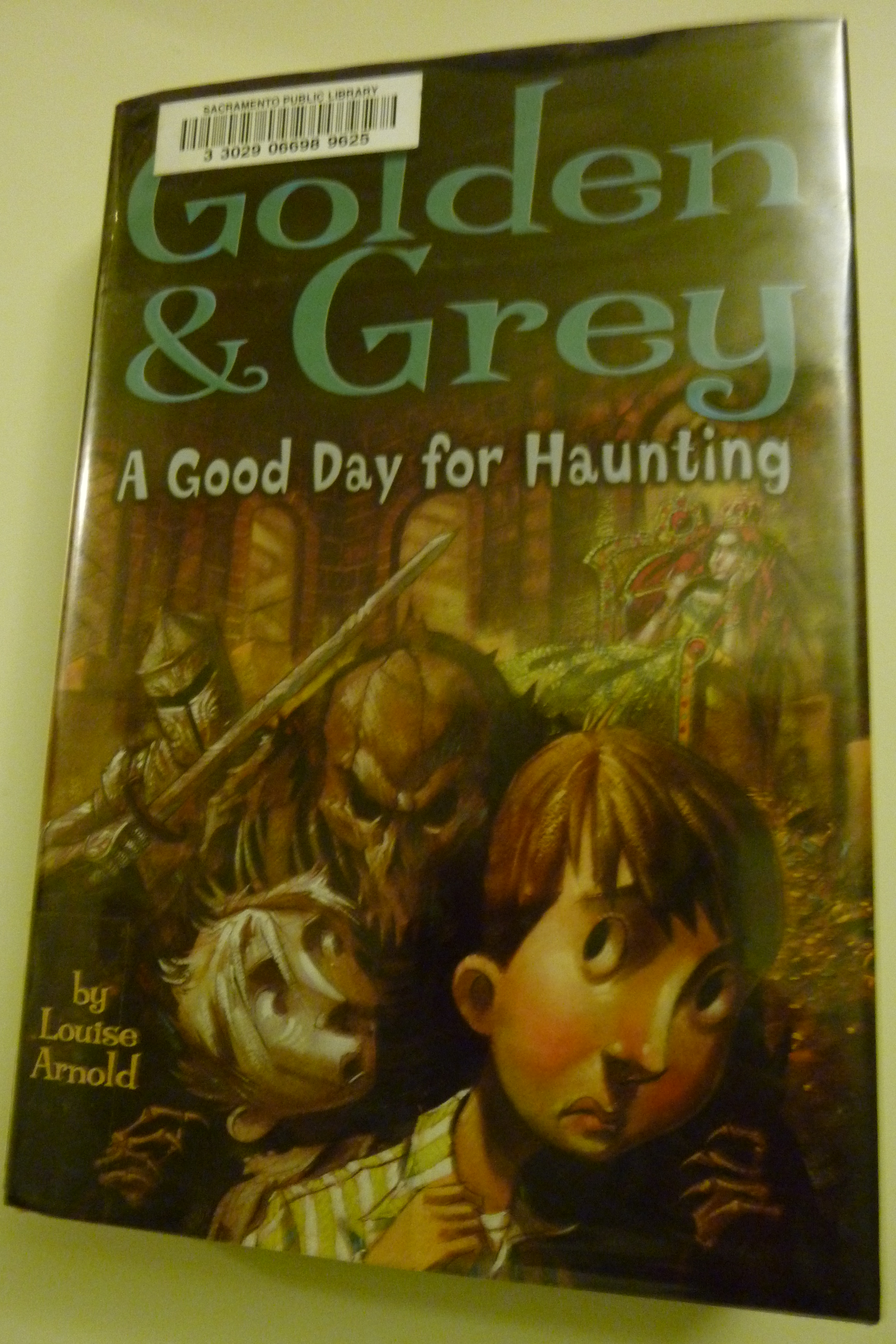
I’ve been having a bad run lately of books with bland characters.  Even some books I’ve enjoyed have had flat, not very memorable characters.  Golden and Grey by Louise Arnold, however, has been a glorious exception to the rule.

It may just be that Grey Arthur can’t get his ears to line up.  It really may be as simple as that.  But I think that’s just part of it.

Let me back up a little.  I don’t usually like to spend large swathes of time explaining plots, but this one has a particularly complicated premise, so here goes.  Golden and Grey is the story of Tom Golden and Grey Arthur, the story of the world we know, and the world of ghosts.  Ghosts are not what you think they are.  They aren’t the spirits of humans who have died; they’re simply another kind of people who exists side by side with humans, only back when people got very scientific and logical and realized that ghosts didn’t fit their scientific and logical rules, they decided it was easier not to see ghosts–and they haven’t ever since.

Grey Arthur is a young-seeming ghost who has been trying for 300 years to figure out what he is.  He tried to be a Poltergeist, but he kept feeling bad and returning the socks he stole, so that didn’t work out very well.  When he tried to be a Sadness Summoner, his attempts at depressing poems kept turning out to have happy endings…and so on like that.

Tom Golden is a perfectly ordinary and normal human boy, who nevertheless has found himself labeled Freak Boy and picked on by bullies at his new school.

When Tom Golden and Grey Arthur both mutter “Life isn’t fair” at the same moment, a connection is formed and Grey Arthur has a revelation.  His role is to be Tom’s Invisible Friend: pulling “Kick Me” signs off of Tom’s back, putting Tom’s forgotten lunch into his locker for him, and sitting with him in the cafeteria so he won’t be alone, even if Tom doesn’t know he’s there.  And then an accident occurs and Tom becomes able to see ghosts…and things really become crazy.

This is a delightful book on so many levels.  The ghost world is elaborate and varied.  Every kind of ghost from legend seems to be represented here, from funny to scary, each neatly labeled and categorized as a type, from Headless to Faintly Real to Screamer to Thesper (you don’t want to meet a Screamer, but a Thesper would be all right).

I think it’s a good element that Tom is normal but still a social outcast–because isn’t life just that irrational and inexplicable and unfair sometimes?  If he had a weird habit or a shadowy past it would be easy to explain but not as real somehow.  He becomes much more relatable by being normal.

The plot is a good one, with twists and turns that I didn’t even get into here.

And as I started out by saying, there are excellent characters in this story.  They’re memorable, fun, and vivid.  It’s even more impressive that they’re vivid, when you consider that a lot of them are invisible.  There’s cheery Grey Arthur with his mismatched ears and his host of ghostly friends; Tom and his parents (who are just quirky enough to be interesting but stay normal); and a handful of human characters at school.  I can bring most of their names to mind, which doesn’t sound impressive, but I’m bad at remembering names, so it actually does say a lot.

There are at least three books in the series, of which I’ve read the first two (and I plan to pick up the third!)  Arnold keeps up the quality and the interest in the second by introducing a new group of very amusing characters, as well as a new threat.

Whole-hearted recommendation for these books.  Funny, entertaining, well-worth the read.

Author’s site: http://greyarthur.com/

UPDATE: I recently read the third book (and added its cover picture), and was glad to see the high quality maintained.  Arnold continues with the characters she introduced in the second book, and raises the stakes for the conflict to keep things exciting.  And of course I LOVED some very funny references to Grey Arthur’s mismatched ears.

The Greek Gods in the Modern Day

I wish Percy Jackson and the Olympians by Rick Riordan had been around when I was twelve.  I went through a period when I was obsessed with Greek mythology, and I think I would have LOVED these books.  Or else I would have had fits over every tiny detail that was inaccurate–it could have tipped either way.  But since my 23-year-old self didn’t actually notice any inaccuracies, I’m guessing my 12-year-old self would have been a big fan.

I just read The Lightning Thief, the first book in the series, and while I don’t think I’m going to develop a raging obsession now, I did enjoy the book quite a bit.  The basic premise is that all the characters from Greek and Roman mythology have carried on into the modern world, still essentially doing what they’ve always done.  One of the things they’ve always done is to have children with mortals, which means there are still a lot of half-god children running around.  Percy Jackson finds out his absentee father is actually the water god Poseidon, just in time to get tangled up in a quest for Zeus’ stolen lightning bolt.  Its theft is perilously close to bringing on a war between the gods that could destroy the world as we know it.

I love the concept of these books.  I love the Greek gods brought into the modern day, and I’d really love to see more of how they’re fitting in with modernity.  Hermes has sneakers with wings and Ares rides a really tough motorcycle, for example.  I think it would be fantastic to find out, say, that Apollo (god of music) is completely obsessed with iTunes and thinks Rock Band is pretty awesome, or that Aphrodite (goddess of love) is actually running eHarmony.  How fun would that be?

Percy is good as a character; I can’t say he made a huge impression on me.  Maybe there’s too many slightly-screw-up characters who find themselves as heroes.  I’m not criticizing him as a character…but the one who I feel fonder towards is Grover, his satyr (half-goat) friend.  I think he’s more unique, as an environmentally-conscious satyr who really likes food, especially burritos and aluminum cans.  I also rather cherish the mental image of Grover careening through the air wearing Hermes’ out-of-control sneakers.

One criticism I do have of the book is that the quest felt a bit random.  Percy, Grover and their friend Annabeth set out, and along the way encounter several adventures, but they seem to just sort of bump into these adventures.  I would have liked to feel that there was a reason they were encountering the villains they were meeting, or going to the places they were reaching.  One caveat–I saw the movie first, and maybe I’m not the only one who felt this, because in the movie they definitely did have certain places to go and then set about going there.  This in turn may be why I felt particularly that they were a little aimless when I then read the book.

I actually haven’t heard Percy Jackson referred to as the next Harry Potter, the way everyone kept saying when Twilight became popular, even though it’s certainly closer in terms of themes and target audience.  I also think all three series have something in common, which may be a clue to why all three are popular.  It’s something Cleolinda Jones zeroed in on with her Twilight analysis, and that’s this element of suddenly finding your place.

You know you’ve been out of place and unpopular and kind of a screw-up your whole life?  That’s okay, you’re not really unworthy, you’re special!  And now you’re being transported to a new place where everyone realizes that what seemed like flaws are really gifts, and now you’re going to make new friends and be good at things and succeed like never before.  In some ways, Percy Jackson is even more transparent about this than Harry or Twilight (or Cinderella, for that matter).  Percy’s dyslexia is because his brain is wired for ancient Greek, and his ADD is to help him stay alive in battle.  When he goes to Camp Half-Blood, the training place for half-gods, he doesn’t become immediately popular (neither does Harry at Hogwarts, although Bella does in Forks), but he does become the prodigy of Chiron (trainer of Hercules, among others), and altogether begins to fit in.  And while I may poke at the idea a little bit as being a formula…it’s one that works very, very well.

A knowledge of Greek mythology would be helpful here, but I doubt it’s essential.  But you do need an interest, because by the time you’re done, you’ll have at least a little knowledge.  The Lightning Thief is a fun book, an exciting one, and even if I don’t love it as much as I might have at twelve, I plan to read the next one in the series.

Author’s site: http://www.percyjacksonbooks.com/

Floriat Etona!

Eton College

Sometimes we don’t want to find out that our favorite villain had a troubled childhood.  Sometimes we don’t want those shades of gray.  It’s better to just have black be black and white be white, and good is good and bad is bad.

But Captain Hook was always an elegant and melancholy sort of villain anyway.  And I’ve read that in the earliest version of the play he went to his death shouting “Floriat Etona!” so all the historical grounding is there besides.

Capt. Hook: The Adventures of a Notorious Youth by J. V. Hart rounds out my series on Peter Pan-related books with another prequel–a non-Barrie but successful one.  This gives us the boy who becomes Hook while he was at school at Eton, the prestigious school for boys.

Like Geraldine McCaughrean, J. V. Hart demonstrates a clear knowledge of the material he’s drawing from.  Hook’s first name is firmly established as James, which he signs Jas.  Hart tells us that his name is James Matthew B, and that he is the bastard son of a never-named Lord.  The name sounds to me like a none-too-subtle reference to James Matthew Barrie.  James’ best friend is Roger Peter Davies–again with the reference in the name, since Peter Pan was named after Peter Davies.  Roger swiftly acquires the nickname of Jolly Roger, and gives us the origin for the name of Hook’s pirate ship.

I find James a fascinating character.  He’s not exactly likable, yet I have to keep reminding myself that he’s the villain.  Hart has given us a character who can be dashing and gentlemanly, but also send a poisonous spider to inflict illness on an enemy.  James will go into the dark places the heroes won’t go, and perform the dastardly deeds a hero won’t do, and yet he also possesses the charm and the dashing airs that are usually reserved for the characters you want to cheer on unreservedly.  Hart has given us a villain who can fall in love, show deep loyalty to his best friend, and have dreams about a magical island–and yet who still has a dark side.  I don’t feel like he’s tried to make Hook out as a good guy…but he’s written about a very complex dark character.

He’s actually made me feel sad to know that, even though James will find his magical island one day, he’ll never get to rule it.

And then I have to stop and remind myself that I’m on Peter’s side.  That when it came down to it, I would root for Peter.  Because I would still root for Peter.  But I have to remind myself.  And I feel a little sad for Hook.

The first section (and majority) of the novel is set at Eton, where adventures center around conflicts with upperclassmen, the Wall Game (an extremely bizarre tradition), and James’ forbidden attraction for a foreign princess.  Later in the book James goes to sea, setting up his career as a pirate.  On the one hand, the adventures become in some ways more adventurous at that point, more in the style of Peter Pan, but I also think some of that conflict of James as the dashing villain is lost, as he becomes almost too much like a straightforward hero once he goes to sea.

This book makes me want to visit Eton one day.  I’m not exactly sure what I want to see there, aside from the memorial to Lawrence “Titus” Oates.  Apparently it’s good luck to rub his nose.  I swear I’m not making that up.  Anyway…even though I don’t know what I want to see, I would rather like to see the alma mater of Captain Hook.  Also the Davies boys, incidentally.

I’ve been hoping for a sequel to this novel.  The book itself sets you up to expect one.  Although there isn’t exactly a cliffhanger, much is left unresolved.  So far, nothing, and I haven’t been able to find any word on whether one might be expected.  Maybe one day…  This is J.V. Hart’s first and so far only novel, but he has written many screenplays, including Hook.  Less relevantly but most excitingly for me, he also wrote the screenplay for Muppet Treasure Island, which I have to say is the best version of the story I’ve ever found–even above the original.  Sorry, Robert Louis Stevenson.

If you’ve read Peter Pan and wondered about that scene where Hook’s wandering around the Jolly Roger and sighing because no little children like him, or noticed that Hook has this strange obsession with good and bad form, or wondered what Barrie was getting at when he made these veiled comments about Hook attending a very prestigious school…or even if you’ve never thought about any of that but just thought Hook was a pretty good character, Capt. Hook is a book worth looking into.

Finding the Way Back to Neverland

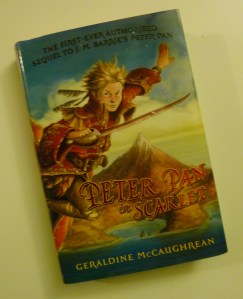
As a general rule, I’m against sequels to classic novels written by new authors, especially when the primary appeal of the original was the author’s voice.  How do you ever do that right?  I’ve only see it happen once.  Peter Pan in Scarlet by Geraldine McCaughrean is a beautiful sequel to Peter Pan.

I give a lot of the credit to her–and a lot of the credit to the way the sequel came to be.  That’s a fascinating story too.  In 1929, J. M. Barrie gave the rights to Peter Pan to the Great Ormond Street Hospital for Children, meaning that they receive all the royalty money, as well as controlling the rights.  Several years ago they held a contest inviting authors to submit a sample chapter and synopsis for a sequel.  All of this means that the people involved in the publishing had a primary interest, not in a later version, but in the original work–and you can tell.

I can’t say that Peter Pan in Scarlet feels like J. M. Barrie is telling the story, but I feel like the story is very much about the world and the characters that he created.  McCaughrean has done a very impressive job at staying true to the story J. M. Barrie gave us, and yet giving us another story that is, I think, what we all want.

Mr. Barrie was in some ways not kind to anyone who wanted to follow him with a sequel.  He left a lot of challenges behind him.  To name the chief ones–he killed off his villain, he grew up his supporting characters, and his heroine was rather annoyingly maternal all along.  So what is a sequel-writer, saddled with Wendy and knowing that readers really want to see Peter Pan and the (grown-up) Lost Boys fight (the deceased) Captain Hook, to do?

McCaughrean handles it all neatly and effectively, and with the kind of magical and whimsical solutions that are worthy of Mr. Barrie.  I don’t want to give it all away…but I can’t resist just a little.  Suppose a person wants to get back to Neverland but you can’t depend on Peter to show up at your window, how do you go about it?  Well, you’ve got to find a fairy for their dust, right?  And the best place to look…Kensington Gardens, of course.  And the way to find a fairy is to find a baby out with its nurse, and to catch the baby’s first laugh just as it turns into a fairy.  Brilliant, magical and whimsical.

Peter Pan in Scarlet opens with Wendy and the Lost Boys as grown-ups, but they’ve begun to dream about Neverland again.  They decide that something must be wrong, that perhaps Peter is in trouble.  They have to find a way to become children again so that they can return to Neverland and help him–and from there the adventures begin.  In Neverland they find that summer has turned into autumn, and something seems to be inexplicably wrong.

McCaughrean even handles Wendy well, successfully portraying her as simply a rather practical-minded child (after the grown-ups become children again), rather than a child who wasted all her time in Neverland darning socks.

After we return to Neverland and find everyone’s favorite Wonderful Boy, the adventures are “nicely crammed together,” and we have the chance to explore the greater geography of the magic lands.  Everyone’s favorite pirate captain appears too.  Again McCaughrean finds a way to stay true to the end of Mr. Barrie’s book, where the Crocodile eats Hook, and yet still bring the villain back.

Even if there was nothing else in this book to recommend it–which is obviously not the case!–there is a single line in here which would alone put it miles above Peter and the Starcatchers in my estimation.  At one point in the book, Wendy tells Peter and the Lost Boys a fairy story about a little white bird in the Kensington Gardens.  We don’t hear the story; we don’t even know what the story is supposed to be about.  But that doesn’t matter.  McCaughrean knew that a little white bird in Kensington Gardens is significant in Peter Pan lore.

Thank you, Geraldine McCaughrean, for knowing what you’re writing about, and for writing it so well.

Author’s site: http://www.geraldinemccaughrean.co.uk/