The Two Towers by J. R. R. Tolkien

Two TowersThe quest continues–I finished reading The Two Towers by J. R. R. Tolkien this weekend, continuing my journey through the very-intimidating Lord of the Rings.  I enjoyed Fellowship pretty well (review here), and I think I liked Towers better.  Tolkien is still not exactly a high-speed car chase of a book, but there is more of a sense of things happening in the second book.  I’m not sure why I think that, when the entire second half is Frodo, Sam and Gollum wandering about…but still, it felt like at least they were going somewhere.  And I actually really liked that half!

The big surprise for me here (after seeing the movie) was how divided the book is.  It’s really two separate novels–the first half focuses on Merry and Pippin with the Ents (tree shepherds) and Legolas, Gimli, Aragorn and Gandalf fighting against Saruman’s forces, most notably in the Battle of Helm’s Deep.  The other surprise was that Helm’s Deep was Chapter Seven of Twenty-one, instead of the big, final, epic battle!

It was still pretty epic, though.  I’m not one for war novels, and I can’t say that I normally enjoy a major battle (swordfighting is different).  However, Tolkien (and Peter Jackson) pulls it off very nicely.  He sounds some interesting notes here.  Helm’s Deep emphasizes the bravery and glory of the defenders, fighting off mindlessly evil Orcs.  But then we get a different side in the second half, in a battle between Men.  Sam sees an enemy soldier killed, and wonders who he is and what his story is and whether he believed in his cause too.  It brings much more humanity and realism to the warfare.  I’ve heard Tolkien was a soldier in World War I, so I imagine he knew of what he wrote.

After that somewhat heavy observation, the other big surprise for me was that Legolas and Gimli actually have a competition in the book over how many Orcs each can kill at Helm’s Deep.  By this point, I was assuming that anything funny in the movie would not be in the book…

This first section of the book also introduced us to Eowyn, and I was happy to see another female character.  She didn’t have much more screen time (page time?) then Arwen, but slightly more, and I thought Tolkien did a better job of painting her character even in a short time.  From Tolkien, that’s about all I can  hope for with a female character…

I loved Merry and Pippin and the Ents.  That was much funnier in the movie (of course) but was pretty fascinating in the book too.  In typical Tolkien-fashion, we got the whole history of the Ents, these incredibly long-lived creatures.  It was (of course) a divergence from the main plot, but I found their history very interesting too.

The second half of the book brings us over to Frodo and Sam, on their quest to get into Mordor to destroy the One Ring.  They’re guided for much of the book by Gollum, and he is such a wonderful character.  He’s so distinct, so weird and strange, so interesting to read.  Maybe it was the focus on a smaller number of characters, but I felt like Frodo, Sam and Gollum all emerged much more strongly in this second book.  I was especially happy to see a lot of it from Sam’s point of view.

With the exception of Boromir, I like all the characters from the original Fellowship (although that may be more Jackson’s influence than Tolkien’s), but if I had to choose a favorite, I think it’s Sam.  It was Frodo when I watched the movies back when they came out, and I still like him a lot, but on this go-around, I think it’s Sam.

I think it’s Sam because he’s not the strongest or the smartest or the heroic type who ought to be on a quest.  But he’s so loyal and he’s so plucky and he’s going to stick by Frodo right into the depths of Hell–literally.  He’s not a saint;  he doesn’t like Gollum and he makes mistakes.  He’s a Hobbit, but he’s very human.  And because he’s in many ways the most ill-fitted for the adventure, I think he may be the bravest too.

The fact is, I (and probably most people reading the book) am much more the “sit at home and garden” type, rather than the “stride through the wilderness seeking evil” type.  I’m never going to be an Aragorn, but if life thrusts challenges at me, I would hope to be a Sam.

I also love that Sam is so aware of stories.  He keeps thinking about the epic tales, and how their adventure is just like one…but feels so different when you’re actually in it!

My favorite moment of both books so far…is a spoiler, because it’s near the end, but you’ve been warned…is when Sam believes that Frodo is dead, and resolves that he will take the Ring into Mordor himself.  He doesn’t want to do it, he’s afraid to do it, it’s not what he ever signed up to do, but it’s what needs to be done, so he’s going to do it.  Tolkien makes a U-turn about two pages later and it turns out it’s not the path Sam needs to take, but still.  In isolation, taken as itself, that one moment is just so beautiful.

Yeah.  So I kinda love Sam.

In fact, I’m glad I’m writing this review, because the more I think about the book, the more I think I liked it.  I mean, I knew that–I didn’t love it, but I enjoyed reading it and didn’t have any big complaints (just still a little bit slow…) but as I think about parts of the book more, the more I think I really quite liked it!

And I have Return of the King sitting on my DVD player, and the book on top of my reading stack, so we’re good to go for the final installment…

Author’s Site: http://www.tolkiensociety.org/

Other reviews:
Rawr Reader
Snuggly Oranges
Books, Tea & Me
Anyone else?

Buy it here: The Two Towers

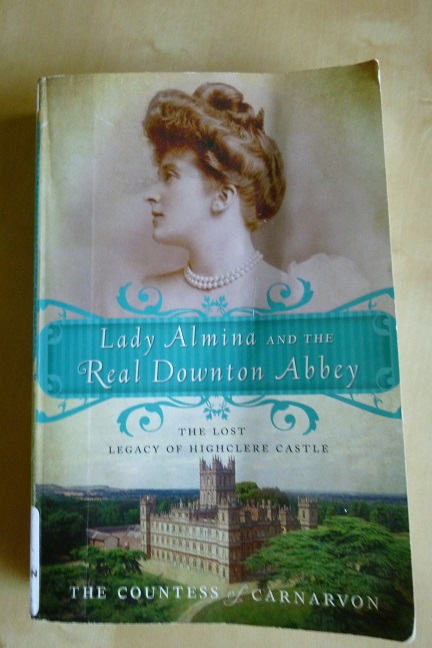
Lady Almina and the Real Downton Abbey

Lady AlminaAny Downton Abbey fans out there?  Personally, I’m eagerly awaiting Season Four…and in the meantime, my book club decided to read Lady Almina and the Real Downton Abbey by the Countess of Carnarvon.  Not sure I’ve ever read something written by a countess before!

The book is a historical account of the house used for filming Downton Abbey, Highclere Castle, home of the Earl of Carnarvon.  The focus is on one generation, centering around Lady Almina and her husband, the Fifth Earl.

The book opens with Lady Almina’s wedding in 1895, though it jumps back for some family history–rather scandalous history too!  Almina was a very wealthy heiress by way of her “godfather,” Sir Alfred…though her actual parentage was apparently an open secret.  With enough charm and money, you can even get past unmarried parents.  It was both her charm and her money that attracted the Earl, and apparently they went on to be very happily married.

It’s not unlike Lord and Lady Grantham’s history…although Almina was an English heiress (French on one side), not American.  She was about the same generation as the Downton Abbey parents too.

The book opened a bit slow for me–it’s a wonderful story, but I would have liked it better as historical fiction, rather than this somewhat skimming-the-surface historical account.  And every so often I got the sense that the Countess was dragging in a fact because she could; just because you have the account book from the wedding, that doesn’t mean we need to know exactly how much the flowers cost.

However, the book picked up as it got into more of what life was like for society of that time.  There’s plenty on life for the wealthy, and I especially liked the chapter on life for the servants at Highclere, and how the downstairs really functioned.  You get bits and pieces of it from the TV show, but there were different details and it was interesting to hear the real history.  I also got more invested in the characters (if I can call them that…) the more I read.

The book makes a major shift when World War I arrives (you know…Season Two).  Lady Almina found a calling for nursing, first opening up Highclere to wounded soldiers, and then running a hospital in London.  We follow the principle members of the family through the war, as well as accounts of some of the soldiers who stayed at Highclere.  It was fascinating and exciting, and I was really engaged for about three-quarters of that section.  There was nothing wrong with the last part, but it just began to feel like it went on a bit, for a book that is supposed to be about Highclere Castle, not a war memoir.  Still, it was interesting to see this view on WWI.

After the war ended, the Fifth Earl was free to pursue his long-time interest in Egyptian archaeology.  You may not recognize his name (I didn’t) but I’m sure you’ve heard his story before…he was one of the leaders of the expedition that found King Tut’s tomb.  As I’m sure you can imagine, that dominated the last section of the book.

The book is never quite Downton Abbey-level drama, but there are very good family stories and stories of the time.  It’s dry in spots but mostly interesting and sometimes  exciting.  Don’t expect too much of a tie to Downton Abbey.  It’s not directly connected, though I could draw my own lines a few times–like comparing Lady Almina to Lady Cora, or when they talked about the servants.  There were discussions on what the scullery maid’s duties were (so that would be Daisy…) or what the head housemaid did (Anna, of course–my favorite character).

If you like Downton but have no broader interest, I wouldn’t pick this up.  But if you do have an interest in the time period, this was a very readable, quite good slice of British history.

Author’s Site: http://www.highclerecastle.co.uk/

Other reviews:
A Cup of Ti
Book Group of One
2 Kids and Tired Books
Bailey’s and Books
Books in the Spotlight
The Printed Word
Found Between the Covers
Wow, who knew it was such a popular book!  Anyone else?

Buy it here: Lady Almina and the Real Downton Abbey

Heir to Sevenwaters by Juliet Marillier

Heir to SevenwatersOne of my goals for Once Upon a Time was to continue my way through the Sevenwaters series by Juliet Marillier.  It’s a wonderful series that has been taking me far too long to read!  I just finished Heir to Sevenwaters, and can happily report that it’s my favorite of the series so far.

This could possibly be read independently of the first three, but there would be spoilers for the earlier books, and sorting out the family members and their various backgrounds and context could be confusing without knowing the first three books.

The heroine of this story is Clodagh, one of the daughters of the Chieftain of Sevenwaters (and if you lose track of the family tree by this point in the series–I did–there are helpful guides at the beginning of the book).  Clodagh considers herself a rather dull, domestic type, unlikely to do anything of any great excitement or depth.  When her newborn baby brother is kidnapped, however, she must set off on a quest to rescue him from magical forces.  And meanwhile there’s the question of Cathal, a young man who plainly has some connection to the recent turmoil, but whether for good or ill is much harder to say.

This is Book Four, placing us beyond the original Sevenwaters Trilogy which all tied more closely together.  It felt slightly removed from the first three, in tone and focus.  Certainly it’s still part of the series, still in the same world, but it feels a little bit lighter and a little bit more focused.  Of course, when I say “lighter,” that doesn’t mean there isn’t still dark magic and grim adventures!  But it deals less with sweeping forces that will decide the fate of entire countries, and the magic has taken a less mysterious turn.

The magic in the previous books was certainly present, but there was a strong Otherworldly mystique to it.  We saw the magic folk mostly as very cerebral, very distant figures who drift on the edges of human affairs.  This book had more of  a straight fairy tale or folklore feel to it, with some elements reminscent of the ballad of Tam Lynn, and the magical creatures more resembling fairies or leprechauns of folklore.  I love fairy tales, so I enjoyed this brand of magic.

I liked Clodagh quite a bit, as I always have a soft spot for heroines who don’t realize their own strength.  I really liked Cathal as the book developed and we learned more about him.  Slight spoiler (though not much) to say that I inevitably loved him because I have an equally strong soft spot for grim, forbidding heroes who are hiding hearts of gold.  The romance fell together a little easily, but for the most part it was an absolute delight.

There are some clever plot twists in here that I don’t want to give away, and some very clever use of stories-within-a-story.  I love books that feature the power of stories, and of folk lore as the key to a riddle or the answer to a quest.  The novel is immensely engaging throughout, and I found it very difficult to put down during the last 150 pages or so (a common feature of Marillier’s writing, by the way).

So: unknowingly strong heroine, gruff but good hero, fairy tale elements and the power of stories.  Yeah, this is definitely my favorite so far…

Author’s Site: http://www.julietmarillier.com/

Other reviews:
Gilded Page Reviews
Zeitgeist Reviews
Caressing the Muse
Me and My Books
Anyone else?

Buy it here: Heir to Sevenwaters

The Blue Sword by Robin McKinley

Blue SwordContinuing recent trends, I reread The Blue Sword by Robin McKinley for Once Upon a Time, and for my goal to reread old favorites.  I’ve no idea when I last read this, but it may have been middle school.  By now, it’s like an entirely new book–not a bad thing, when it’s by one of my favorite (but not prolific enough!) authors.

The heroine of the story is Harry, who travels from what seems to be loosely Victorian England, out to the edge of the empire.  The Homeland has never quite conquered the desert and hills of Damar, where the natives still follow the old ways–and are rumored to have magical power.  When Harry is abducted by the Damarian king, she begins to forge a new identity among a foreign people she’s strangely drawn to–and finds a role in their coming war with the North.

I feel like this plot summary makes the book sound like Indian Captive, which it isn’t at all…but telling more would give too much away.

I like Harry as a protagonist–she’s intelligent and capable, and always puts on a strong appearance even when she’s secretly unsure.  She makes some leaps in learning and skills that are, um, improbable to say the least, but there’s a magical explanation so I’ll give that a pass…  McKinley also succeeds in making the Damarian king, Corlath, into a sympathetic character, when he very easily might not have been at all.

The romance comes slightly out of left field, but…it feels like it makes sense when it arrives, so I’ll accept that too.  Slightly sudden romances are a recurring feature of McKinley’s writing…

Besides lots of magic and swordfighting and epic legends, possibly the coolest part of the story is Harry’s animal companions.  She has the world’s most amazing horse, and if that’s not enough, there’s a wildcat too!

It was funny reading this right after Fellowship of the Ring, because in some ways the writing style seemed even more Tolkien than Tolkien himself–more what I expected Tolkien to be.  And by that I mean that there is considerable detail given to what the landscape looks like, the clothing styles, the exact details of saddles…  Most of the time that was all right and even interesting, and mostly the book still moved at a reasonable pace.

The only real trouble I had was at the beginning, and “trouble” might be putting it strongly.  It’s just that there’s a fair bit of set-up explaining the political situation and Harry’s personal past, and it all comes out rather dry.  This is particularly funny because McKinley is known for throwing readers in without much backstory or explanation…but this was an early book.  Evidently her writing evolved.  So if you pick this one up and find it slow, at least go on until Harry’s abducted–I found it picked up considerably then.

This book has made me very much want to reread The Hero and the Crown, which I only remember marginally better.  That one is a prequel, focusing on legendary characters who are frequently referenced here, and I look forward to reading their story.

This book also made me want a really amazing wildcat companion, but that want could be a bit more difficult to satisfy…

Author’s Site: http://www.robinmckinley.com/

Other reviews:
Lisa Godfrees
Bookshop Talk
Tor.com
Anyone else?

Buy it here: The Blue Sword

The Fellowship of the Ring by J. R. R. Tolkien

Fellowship of the RingDrumroll and fanfare…I have successfully finished reading The Fellowship of the Ring!  And yeah, that probably wouldn’t be a big deal to a lot of you fantasy readers out there.  But I’ve been intimidated by the Lord of the Rings for, oh, about ten years now, so I’m rather proud.  Not hugely surprising, the book wasn’t nearly as hard to get through as I was afraid it might be!

The plot is a classic quest, centered around the One Ring of Power.  The ring corrupts everyone who touches it, and if it falls into the hands of the Enemy, Sauron, the situation will be very (very) bad for Middle Earth.  Frodo and his companions set off to take the ring to Mordor, Sauron’s country, the only place it can be destroyed.

Having seen the movies, there weren’t many surprises for me in the plot, but I was hugely curious to see what Tolkien’s writing would be like.  It wasn’t as dense as I was afraid it might be–I found him an easier read than, say, Dickens.  In fact, I didn’t find Tolkien particularly slow on a sentence-by-sentence level.  At the same time, I didn’t feel like the book on a whole had a lot of urgency.

There was tension–there was clearly a rising threat and actions that must be taken to counter it, and there were sometimes moments of more immediate danger.  And yet, it seemed like there was always plenty of time for the characters to stop and think about their next move, or to recite an epic poem.  Even when they were on the move, often days and days would go by of just traveling.  And I was completely floored to discover that Frodo didn’t leave the Shire until seventeen years after Bilbo left.  I think the movie compressed that down to a week.

It’s almost odd how much tension there is, combined with so little urgency and such a slow pace.  I feel like this may be an indication of how culture has changed.  Tolkien was writing from a slower-moving time, one without high-speed planes, instant communication around the world, a 24-hour news cycle and 30-second YouTube videos.  On the other hand, C. S. Lewis wrote from the exact same time period and didn’t move as slowly, so maybe it’s not all culture!

As an aside, Tolkien spent years and years on LOTR, while Lewis wrote The Lion, the Witch and the Wardrobe in a few months, which I’ve heard annoyed the hell out of Tolkien.  That may just be a rumor, though…

Anyway, the slow pace didn’t precisely bother me, I just found it an interesting element.  I wouldn’t want every book I read to move this slowly, but I so completely expected it here (everyone warned me) that it wasn’t much of a problem.  Even the Council of Elrond was all right–and the most devoted LOTR fans had told me that went on.

I enjoyed Tolkien’s world, and the depth of detail about the different races, especially the Elves.  Many of the legends are really beautiful, and I was fascinated by the Elves’ role as incredibly long-lived, almost ephemeral beings in the midst of a changing world.  We got a bit more about dwarves, Hobbits and wizards too, all interestingly different from one another.

I did get a little stuck on the idea of all these apparently isolated settlements or fortresses, in the midst of vast stretches of empty wilderness…how exactly does your economy function?  Do you have an established import/export system?  But never mind that.

I find it very hard to talk about the characters, because I’m not sure what I’m getting from the movie versus from the book.  I feel like the book has amazing characters who are difficult to see clearly.  I know they’re amazing–but I’m not sure how much of that impression comes from the movies, and how much is, eventually, revealed within the book.

I was disappointed by the very tiny role of Arwen in the book.  It takes serious detective work here to figure out that Aragorn and Arwen have a romance going–and if I hadn’t seen the movie, I don’t think I would have picked it up at all.  I’m not at all sure that Arwen even had a line of dialogue.  Sigh.  Disappointing, but not surprising.  Women really are not Tolkien’s strong point.  After all, the Fellowship has five different races, but they’re all male.

If this wasn’t Tolkien (by which I mean Tolkien, classic writer and vast influence within the realm of fantasy…) I would probably not rush to read the next book.  I would eventually, no hurry.  But I did enjoy Fellowship pretty well, even if I didn’t love it, and because it is Tolkien and I’m immensely curious about the whole trilogy, I plan to go on to The Two Towers in a few weeks.  Stay tuned!

Author’s Site: http://www.tolkiensociety.org

Other reviews:
With Muchness
Words for Worms
Wondrous Reads
Snuggly Oranges
And no doubt many many more.  Tell me about yours and I’ll add a link!

Buy it here: The Fellowship of the Ring