In Between Star Trek – The Abode of Life

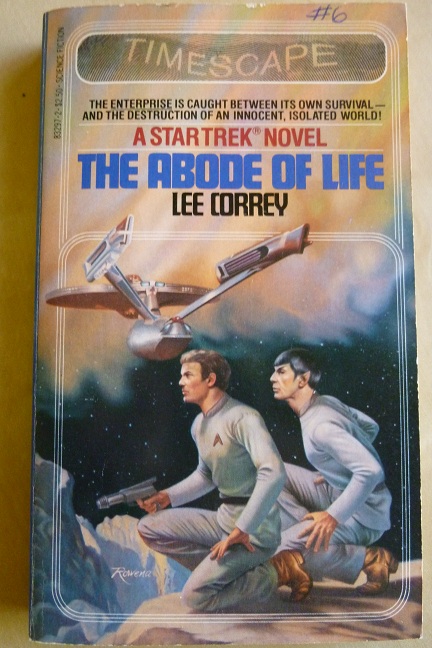
Abode of LifeSo far, my reading for the Science Fiction Experience has taken me to a galaxy far, far away, to the center of the Earth, and to the planet of Pern.  You had to know it would take me to the 23rd century eventually, right?  🙂  That’s where I went for my next book, Star Trek: The Abode of Life by Lee Corey.

I thought this was going to fit in for the Vintage Sci Fi challenge too, only to discover that it misses the cut-off by three years–it was published in 1982.  The best laid plans of mice…

I picked this one up because it promised me a planet with no stars.  The planet turns out to be Mercan, out on a very distant corner of the galaxy, which the Enterprise stumbles on when flung out by a fold in space (I don’t pretend to know what that means).  The Mercanians believe they are the only life in the universe, but the stability of their society is being threatened by new scientific discoveries casting doubt on that idea.  Kirk has his hands full trying to get help to repair the Enterprise, without setting off a civil war at the same time.

There’s a lot that’s fun here, and it met my absolute, cardinal, cannot-be-a-good-Trek-novel-without-this requirement: Spock and McCoy get to snipe at each other.  🙂  Also, Scotty gets to worry about his engines, and Uhura makes jokes about opening hailing frequencies, so I’m saying we’re doing well on the characterization here.

The Mercanians may have been the most interesting part.  They have a complex and unusual society, and I enjoyed seeing how some aspects of it played out.  Most especially, they have vastly advanced transporter technology.  As a result, they have no vehicles (why would you need them?) and no advanced communication (you can just go talk to people in person!)  Considering I was just on Carl’s blog talking about the ramifications of transporter technology, picking this book up shortly later was very well-timed (and not deliberate).

Oddly enough, one of the most fascinating (ahem) things about this book was where it fits in the chronology.  Not the internal chronology (which is somewhere on the five year mission), but the chronology of the Star Trek publishing world.  It’s somewhere between.

First there were some very early novels that I like to refer to as “Star Trek Lives” era, which are not always quite on top of characterization and often inconsistent with later incarnations (understandably), but also have a wonderful earnestness to them, and an obvious passion for telling one more Star Trek adventure.  Time went on, and later we got dozens and dozens of numbered paperbacks and particularly epic hardbacks, which tend to be of a higher quality and have a clearer picture of how they fit into the larger universe.

This one was in between, and it took me most of the book to figure out the distinctions.  The characters are spot-on, and the context all fits the larger universe.  At the same time, the book is a little more cerebral–Kirk spends more time thinking about things than I would expect in later books.

But I finally hit on what I think is the big difference.  This book felt obligated to explain things.  The Prime Directive must have been explained at least three times, and characters’ names, ranks and contexts on the ship are very carefully noted.  In other words, it reads like a Star Trek book that has no confidence people picking it up know about Star Trek.  Maybe it’s the last echo of the earlier era, when the show was canceled and the fanbase was relatively small and the show wasn’t a Thing yet, it was something that had to be saved.  This book wasn’t quite sure the job was done yet.

Or I’m just reading way, way too much into all of this, based on my impressions of different eras in Star Trek fandom.  That could be too.

I’d say the book fits in somewhere in between in a larger sense too.  It was not an epically fantastic adventure, but it was much better than quite a few Star Trek novels I’ve read too.  It was in between, and an in between-quality Star Trek novel is well-worth the read.

Buy it here: The Abode of Life

The Doctor’s Voice

My various posts about Doctor Who have already told you that I haven’t been able to get over David Tennant leaving the show.  I still enjoy the Matt Smith seasons, but…!  One symptom of this unacceptance is that I’ve been seeking out Doctor Who audiobooks.  Not novels–audiobooks.  Specifically, ones narrated by Mr. Tennant himself.

I’ve listened to three so far, and was delighted to find that not only is David Tennant perfect at delivering the voice of the Tenth Doctor (as you might imagine…), he’s quite good at doing other voices too.  Here’s a run-down on all three I’ve explored.

Doctor Who: Pest Control by Peter Anghelides

The Doctor and Donna land on a dark, muddy planet in the midst of a war between human colonists and centaur-like natives.  No, really–centaurs!  The Doctor and Donna get pulled into the conflict, especially when, in a Kafkaesque twist, humans start turning into giant insects.  Obviously, this is a bizarre one in some ways, and it has some dark (and gross) moments.  But there also some good moments between the Doctor and Donna (she does not appreciate the mud, or what it’s doing to her clothes), and even some Star Trek humor.  The Doctor initially introduces himself as Dr. McCoy, and Donna as Captain Kirk.

Doctor Who: The Last Voyage by Dan Abnett

This one is set in between seasons, possibly after Donna’s season, as the Doctor is without a regular companion.  As happens in the specials, he adopts a companion for the day.  In this case, it’s Sugar MacAuley, a flight attendant on the maiden voyage of an experimental new space craft traveling across the galaxy (in 90 minutes!)  When the engines go amok, most of the passengers vanish, and strange creatures start appearing, the Doctor and Sugar have to find answers, or be lost drifting between dimensions forever.

I particularly like the plot of this one.  It’s a good mystery with some neat details.  There’s just one drawback–first, Sugar suffers from a really dumb name, and Tennant compounds the problem by trying hard to make her sound distinctive and winding up giving her an annoying voice.  If you can look (listen?) past that, Sugar is actually a pretty solid character.  I would recommend reading this in book form, except–it’s worth it on audio to hear the Doctor’s voice.  He gets some really wonderful Doctorish lines that I loved hearing Tennant say.  There’s even an “allons-y!” at one point (and if that doesn’t excite you, you must watch this clip).

Doctor Who: The Stone Rose by Jacqueline Rayner

This is my favorite of the audiobooks so far.  As you might guess, it’s a Doctor and Rose story.  Mickey finds a stone statue of Rose in the British Museum, and when he shows it to the Doctor and Rose, they’re off to ancient Rome.  They meet an old man looking for his lost son, a young girl claiming to know the future, and a quite creepy sculptor…and the Doctor becomes convinced that the stone Rose is not a statue at all.

The-Doctor-and-Rose interaction here is brilliant, and I enjoyed the trip to Rome.  Tennant’s voice talents really shone here–he does great voices for Mickey and especially for Jackie.  His Rose voice was less distinct, but worked fine.  There’s a wonderful convoluted (but ultimately coherent) crossing of time lines, some good twists, and the last ten minutes is just lovely.  It’s a wonderful funny and sweet scene between Rose and the Doctor that’s adorable and just makes me smile and smile.  I listened to that bit twice.

As a means to an end, I can’t say that more Tenth Doctor adventures have helped me accept Tennant leaving the show…but more Tenth Doctor adventures are an end in themselves!

Dragonflight Group Read, Week Two

We’re back for the concluding week of the Dragonflight Group Read, put on by Carl at Stainless Steel Droppings.  There was a fantastic discussion ranging across several blogs last week (see my post and long comment thread), so I look forward to seeing everyone’s thoughts on the end of the book!

I gave a plot summary last week, so let’s just jump in today…

1.  The Threads are further explored and become very much the focal point in parts 3 and 4 of Dragonflight.  What are your thoughts on the Threads in general and how do you feel these worked as an enemy vs. the traditional enemies you see in SFF novels?

I wish we knew more about the Threads.  They’re generally treated as though they’re malevolent, and yet not sentient, or even properly “alive.”  So I guess the malevolence is mostly metaphorical.  At the same time, I wish I had a clearer picture of whether they are alive in a conventional sense, or have any kind of intelligence.  I think not–but there are just a few hints that make me think it would be fascinating if they were.  But presuming they’re not, I do think they work effectively as the antagonist in a man-versus-nature conflict.  They’re the ultimate natural disaster, capable of destroying all life completely, requiring an equally impressive protagonist in the dragons (and their riders) to fight back against them.

2. The science fictional concept of time travel becomes an important device in the later half of Dragonflight, how do you feel McCaffrey did in working time travel into the plot?

I really enjoyed the way the time travel played in, particularly the way Lessa and F’lar went back into their own pasts.  The circular nature of the way events played out will make my head hurt if I think about it too much, but ultimately I think it worked.  I would be skeptical about no other dragonriders stumbling on this–but I know in Moreta it’s revealed that other dragonriders did know in the past, so I’ll let that one go by.

3.  Of the new characters introduced in this second half of Dragonflight, who did you like/not like and why? 

I’m glad we have this question, because I really wanted to talk about some of the characters who came in later in the book.

Mostly I wanted to mention that I LOVE Masterharper Robinton!  He just has a small part here, but he’s one of my absolute favorite characters in all of Pern.  He’s so splendidly charming and just a truly good person and character.  Plus the harpers are really the storytellers of Pern, so how can I not love the Master Storyteller?  He has a much bigger part in The Harper Hall Trilogy, but his character comes through in Dragonflight too.

I also think Fandarel, the Mastersmith, is just wonderful.  He reminds me of Scotty, with his dedication to his craft.  He’s such a striking character too.  I can see him so vividly, physically looming and so entertaining in his mannerisms.

4.  We talked about it in the first discussion and there is no way we can get away from it in Part 2: What are your feelings on the progression of the relationship between F’lar and Lessa throughout this second half of the book?

I read the whole book before answering last week’s question, so the entire course of their relationship was influencing my earlier discussion on this subject.  I do think things get better in the second half of the book.  F’lar starts treating Lessa with more respect, and there’s more of a sense of the two of them working together on their problems.  And then, it becomes clearer that they really both care about each other.  I think I can ultimately like F’lar because he’s so devastated when Lessa disappears between times.  He does have a heart!

5.  And finally, what is your overall assessment of Dragonflight?  How does it measure up against other classic science fiction you’ve read?  Would you recommend it to modern readers, why or why not?

We talked some last week about this being influenced by its time of writing, but it doesn’t really feel like old science fiction to me, the way Burroughs or Asimov do.  I don’t know if it’s the style or the writing or something else, but it doesn’t feel particularly like it’s from another time in writing.

As to a recommendation, I probably would have recommended this before rereading…now I think if I want someone to read Pern, I’m going to push the Harper Hall Trilogy on them, and if they like that, then Dragonflight would be a good follow-up.  It’s not anything to do with whether it’s classic or not, but I think the Trilogy is a better introduction to the world, even though it’s set chronologically later (and I think I recall spoilers for Dragonflight).  Pern is a pleasanter place in the Trilogy, and I feel like I remember clearer explanations on some of the worldbuilding elements.

So I guess the conclusion for this question is that I’m recommending to all in the group-read that they should go on to read Dragonsong!

That actually segues nicely into the one other element I wanted to mention–the poetry!  I’m not a big poetry fan, but there are bits and pieces of Pernese Harper songs that have somehow worked into my mental landscape.  I really enjoy the peek it gives us into Pernese literature and culture.  And it’s often stirring or beautiful poetry!  Of course, part of the appeal of the Harper Hall Trilogy is that we get to explore life in amongst the people who write all that poetry.

I think that wraps things up…I really enjoyed revisiting Pern with the group, and I’m going to try to go back to a few other books throughout the year.

A big thanks to Carl for hosting, and to everyone who joined in–I’ve loved reading your thoughts. 🙂  Go here for everyone else’s posts!

The Callista Trilogy: Children of the Jedi

Children of the Jedi 1I’ve been having a delightful time in recent months, revisiting “a galaxy far, far away.”  For the Sci Fi Experience this year, I decided to revisit the Callista Trilogy.  The first book is Children of the Jedi by Barbara Hambly.  This book seems to get very little love from reviewers (based on some brief Googling) but while I don’t claim it’s perfect, I did have a wonderful time with it.

As usual for me, I remembered some details with absolute precision, while most of the book was full of surprises in things I’ve forgotten.  The story follows two plotlines that link up at the end.  And despite the title, it’s not at all about Han and Leia’s children.

Luke, C-3PO and two other friends set out to investigate a disturbance in the Force, ending up aboard the Eye of Palpatine.  It’s a massive battleship that has been hibernating in deep space for thirty years, and now has been mysteriously reactivated, intent on following its original programming to attack the planet of Belsavis.  Part of its programming involves picking up groups of Stormtroopers that were supposed to be waiting–but failing to find Stormtroopers, the ship picks up any sentient lifeforms it encounters, including Jawas, Tusken Raiders, a pig-like warrior race, and some even stranger creatures.  But the Eye of Palpatine also has another inhabitant–the spirit of a long-dead Jedi named Callista.

Meanwhile, Leia and Han are pursuing a rumor about a community where Jedi children were raised in the past.  It just happens to be on the planet of Belsavis…and there’s also intrigue and plots afoot.

This book has just about everything I could want in a Star Wars novel.  There are crazy-weird aliens–including a group that apparently resemble flowers, but have been indoctrinated to think they’re Stormtroopers, with hilarious consequences.  There’s an interesting enemy to fight–and in this case, mopping up traces of the Empire works, because it’s made personal and intriguing.  Leia gets to be awesome.  And Luke gets a girl!

We all know things really didn’t work out for Luke romantically in the movie trilogy, and most of the books seem not to have gone the direction of giving him much romance.  I actually like that–I think a “girl of the week” direction would have become old very fast.  So I think it makes it meaningful when there’s a romance here.  I don’t normally like stories where people fall in love very quickly, but somehow this one worked for me.  We get enough details on Callista and enough reflection from Luke that I felt fine with it.

I picked this one up again because I remembered the Luke-storyline, but I also found myself really enjoying Han and Leia.  Their storyline is good, but it’s mostly the two of them being together that I enjoy.  They’re a happily married romantic couple–how often do you see that in a book?  It seems like authors more often write about people who are falling in love, or people who are experiencing marital problems.  I love that there’s conflict in the story, but not between Han and Leia.

I’m very glad that the Star Wars novel universe at some point made the decision to have Han and Leia be together.  My guess is I have Timothy Zahn to thank for this, considering his landmark Thrawn trilogy has them married and expecting twins.  Of course the original film trilogy shows them falling in love–but it would have been so easy (maybe easier than not) to complicate things in the books, in order to create endless plotlines of falling in and out of love, bringing in triangles, and so on.  You know, the soap opera route.  The novels do have occasional bumps in the road (The Courtship of Princess Leia comes to mind), but on the whole, they seem to just be together.  And if they break up at some point later in the chronology than I’ve read, don’t tell me.  I don’t want to know!

Besides the Han and Leia pairing…every so often, I have these revelatory moments where it strikes me anew just how awesome Leia really is.  It’s not that I ever forget exactly–but now and then it just comes to me all over again.  It happened here when she had an opportunity to trail an enemy…and sets off to do it.  There’s no hesitation, there’s no moment of thinking maybe she should get one of the guys.  She just handles the situation.  Trouble ensues and, at the risk of a slight spoiler (but it’s not something surprising), Han and Chewie do eventually show up, more or less intending a rescue.  But when Han tells Leia to run, instead she comes up and hits the guy Han’s fighting with over the head.

There are other strong women in sci fi–but maybe I particularly love Leia in part because I love that she’s a cultural icon.  And she’s amazing.  She’s not amazing because she can hit a villain over the head.  She’s amazing because she’s married with three kids, leads the New Republic, doesn’t run around in revealing clothing most of the time (occasionally), can use the Force, is smart, capable and confident–and she can hit a villain over the head.  This is a fantastic woman to have as a cultural icon.  Love it.

This book also gives us some hints and bits about Leia’s life before the Rebellion, and now I want to read a prequel about Leia growing up.

If I have a criticism of the book, it’s that Luke is injured early on, and spends a lot of time dragging around fighting pain and fatigue.  The point gets a bit belabored.  I want to mentioned one other criticism I’ve seen elsewhere, which I would consider completely invalid–some of the references to the pre-trilogy time aren’t consistent with the new movie prequels.  But the book was written first, so you can’t blame the author for that.  And I’d just as soon pretend the prequels never happened, so I’m really not going to be bothered by something contradicting them.

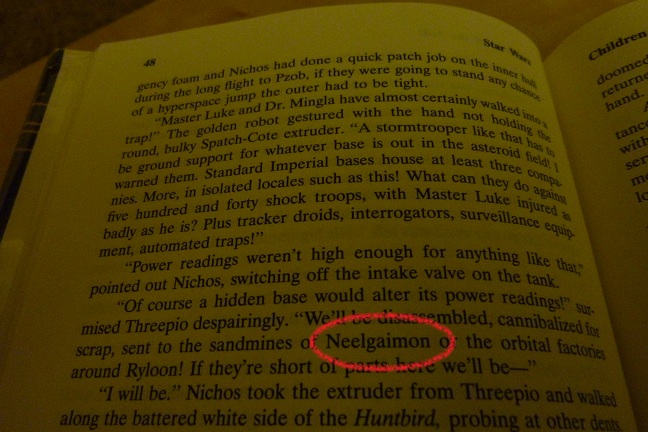
Children of the Jedi 2One other fun and random note: a planet is referenced here named Neelgaimon.  I actually looked up the timeline on Neil Gaiman’s career, and while there was plenty he hadn’t done yet when this was written, he was active in some areas…  Coincidence?  Or incredibly cool tribute? 🙂

So all in all, I look forward to finishing the rest of the Callista trilogy.  And then I need to finally track down the books where Luke gets together with Mara Jade…because I’m intrigued by that too!

DragonFlight Group-Read, Week One

As part of the fun for the Sci Fi Experience, I’m participating in the group-read of DragonFlight by Anne McCaffrey.  This was just the push I needed to revisit Pern…which I’ve been meaning to do for far too long.

First, a little context for those not reading along: DragonFlight is set on the planet Pern, where society is centered around small holds, traditionally guarded by the Weyrs, where the dragonriders live.  The dragonriders are a race apart, each one bound for life to his or her dragon.  The dragons’ mission is to protect Pern from deadly Threads, parasites which fall from the neighboring planet of the Red Star and burn everything in their path.  They’ve fallen at regular intervals for millenia, but 400 years ago the last pass of the Red Star ended, leading to a Long Interval; five Weyrs of dragonriders mysteriously disappeared, leaving only Benden Weyr to survive to the present.  Now the Red Star is looming in the sky again, and F’lar of Benden is looking for a woman to Impress the new queen dragon about to hatch.  Meanwhile, Lessa of Ruatha has been hiding in her ancestral hold, the only one of her family to survive slaughter ten years before when Fax invaded and took control–and her long quest for revenge is coming to a head.

DragonFlight is one of those books that I read several times as a kid or young teenager, but somehow haven’t touched in the last ten years.  It was very interesting coming back to it again.  Like my experience with The Giver, there’s a lot more to be disturbed by than I remember…  There are some undertones and details that are more worrying than my younger self perceived.  On the other hand, it’s still an exciting adventure on a fascinating world, with deeply engaging characters.

But perhaps I ought to get into Carl’s questions for the discussion…

1.   What are your thoughts on McCaffrey’s handling of the male and female characters in Dragonflight?

2.  F’Lar and Lessa are an interesting pair of protagonists.  What do you like and/or dislike about their interactions thus far?  What things stand out for you as particularly engaging about each character (if anything)?

I want to take these first two questions together, because they feel very interrelated–and related to my complex feelings mentioned above.  It’s an odd thing about women in this book.  There’s a definite feeling that women don’t have much power in society, that there’s a clear delineation between the genders, and that women cook and have babies.

In the Weyrs, the Weyrleader is the man whose dragon mates with the queen dragon.  First, that is a strange way to choose a leader for society.  Second, it is a far more disturbing prospect to consider that the queen rider’s mate is based on which dragon flies the fastest.  I’ve read many other Pern books and I know others end up suggesting that the rider’s preference has a lot to do with which dragon has a successful flight.  But that’s not in this book, so I’m not sure it’s a valid defense…

So all in all…not really liking the treatment of women.

But on the other hand–Lessa is amazing!  The one major female character is certainly as smart as any of the men, and stronger and more determined too.  But–she also spends a lot of the book trapped in a role, and when she breaks out there’s some sense that she’s declaring her independence…but there’s also a sense that she’s an impetuous child who’s rebelling.

In some ways F’lar acknowledges Lessa’s intellect and strength–he certainly sees it.  But he doesn’t treat her as an equal, and there are some very troubling aspects to their relationship.  I feel like if I really wrap my head around some of it, I’m going to end up hating F’lar and I don’t want to do that–so I am very curious to see how other people respond to this question!

3.  How do you feel about Pern to this point in the story?  What are your thoughts on McCaffrey’s world-building?

I already covered some disturbing aspects of Pernese society, but really I’m fascinated by it.  I actually don’t feel like this is a very good book to analyze Pern and McCaffrey’s world-building, because in large ways Pern here is in a crisis of society.  They’re going to figure things out in subsequent books.  I find Pern a more interesting place when it’s thriving, because then you get to find out more about different craft halls, how the Holds interrelate, how dragons fit into the mix…and women don’t seem quite as marginalized in other books.  All in all, a picture emerges of a society that is quite different from our own, marvelously intricate, and just seems to work and fit together in a wonderful fashion.

4.  For those who have already read Dragonflight how do you feel about  your return to Pern?  What stands out in your revisit?

I felt SO nostalgic when I opened to the Introduction and found “Rukbat, in the Sagittarian sector, was a golden G-type star.”  I think every Pern book has the paragraph that follows, and at the height of my Pern-fandom, I could have recited it.

It’s true that sometimes we can go back to books and find them different–although we’re the ones who changed.  I already touched on some of the parts that disturb me, that went right past me before.

But on the other hand, some parts are still the same.  Lessa is such a strong figure.  Dragons–I mean, they’re awesome.  That goes without saying.  I’m fascinated by…I guess I have to call it the shape of the world.  Pern is just an interesting place.

I think that wraps up a discussion of the first half of the book.  More to come next week!  In the meantime, read everyone else’s thoughts.