A Familiar Story at the Earth’s Core

At the Earth's CoreI’m exploring Sci Fi worlds in January, and my first review for the Sci Fi Experience and the Vintage Science Fiction month is At the Earth’s Core by Edgar Rice Burroughs.  First published in hardback in 1922, it’s definitely vintage–and it’s also quintessential Burroughs.

I usually try to avoid spoilers in plot summaries, but…for people who know Burroughs, you really can’t give spoilers.  At the Earth’s Core is about an unusually strong, gray-eyed Earthman who unexpectedly finds himself in a strange other world, where he meets bizarre creatures and multiple intelligent races.  He also meets mostly naked yet noble savages and of course a beautiful princess, who has been captured by a monster race.  He falls in love with the princess, but they’re separated–first because he accidentally offends her, and second by circumstances.  He fights his way through the landscape, succeeds to a place of high esteem in society and wins the princess, only to wind up at the end of the book back on Earth–and all we know at the end is that he may, or may not, have successfully returned to the other world.

Sound kind of familiar?  That’s because this is a faithful description in every particular of BOTH At the Earth’s Core and A Princess of Mars.  I love Burroughs–I always enjoy his books–but with very few exceptions, the man only had one story.  That’s okay, though.  You don’t read Burroughs in breathless suspense about whether the hero will win the girl.  You read it for the strange landscapes, the bizarre creatures and the beautiful prose.  I do, anyway.

This first book in the Pellucidar series follows David Innes on an adventure into the depths of the Earth, where hundreds of miles down his mole-like vehicle breaks out into a strange landscape.  The premise is that the entire inside of the Earth is hollow, presenting a vast expanse of land functioning with reverse gravity to what we know on the outside.  Rather than the horizon dipping down in the distance, it curves up forever.  Pellucidar is lit by a miniature sun at the very center of the planet, so that the world exists in perpetual noon.  All in all, it’s a great example of Burroughs’ wild and intriguing landscapes, be they on the moon, Mars, or the center of the planet.

David meets two different semi-intelligent species that resemble apes, as well as the required race of noble savages, primitive but immensely good-looking.  This race is treated as cattle by the most interesting race, the Mahar.  This is a race of lizard-like people who communicate by a kind of telepathy (but not quite) and have no concept of sound.  The Mahar, I am sorry to say, are at the center of what is probably the most disturbing scene I’ve ever encountered in Burroughs.  Remember I said the human-like race is treated as cattle?  There’s a pretty horrible incident relating to that, unusually horrible for Burroughs.

Besides the intelligent species, David encounters a wide variety of monsters.  He comes to the Earth’s core along with a helpful amateur paleontologist, who frequently recognizes species–although I suspect Burroughs made most of them up.

The positives of the book are definitely the weird landscape and creatures, along with plenty of action.  This book doesn’t share the problem of most of Burroughs’ other first-books-in-a-series, of starting slowly.  We get straight into the adventure.  This one also has an interesting concept about time not existing in a world with no celestial bodies and no clocks.  It frankly doesn’t make a bit of sense, but it’s interesting to think about.

On the negative side, there is a slightly disquieting element here of the noble white man bringing civilization to the savages–though to be fair, there’s no clear ethnicity among the savages, and the truth is that they aren’t fending all that well for themselves.  Still, David throws himself into changing a world that he really knows very little about.  And I’m not sure teaching weaponry is really the way to advance a people.

I can’t put my finger on why, but David didn’t appeal to me as much as his obvious counterpart, John Carter.  It sounds silly to say, when typical Burroughs heroes are nearly interchangable…but there was still something different.  David is upstanding and brave, as all Burroughs heroes are, but he maybe wasn’t quite as noble, or quite as capable.  Or he just didn’t come with that fascinating opening paragraph, about always being a young man, always a fighting man.  While I wouldn’t have said that Burroughs heroes were distinctive, David still didn’t have as strong a voice.

That may about sum up the book.  I liked it.  I enjoyed it.  It is, as all Burroughs novels are, a grand adventure in the finest tradition of pulp science fiction.  At the same time, it didn’t grab me quite the way other Burroughs books have.  I don’t know if that’s a flaw of the book, or if that’s just me–if maybe after forty-odd books, the usual Burroughs story is finally starting to feel old.

I’ll be going on to read the rest of the Pellucidar series…and perhaps it’ll grow on me!  Even if it doesn’t get any better than the first one, I still expect to have a perfectly rollicking time with it.

Author’s Site: http://www.edgarriceburroughs.ca/

Other reviews:
Luke Reviews
Book Addiction
Anyone else?

Buy At the Earth’s Core here, though I’d recommend buying A Princess of Mars instead.

When Redshirts Fight Back

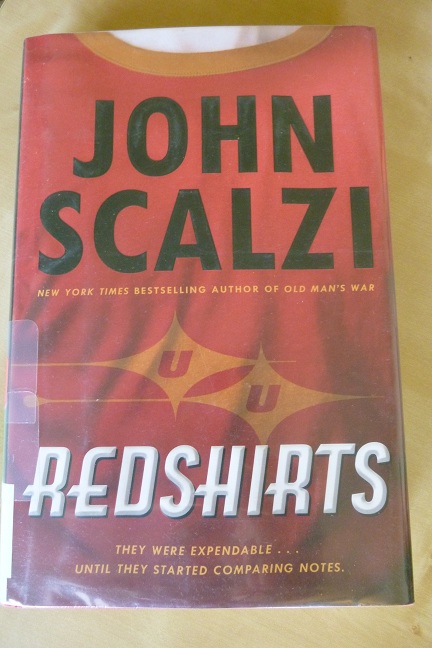
Redshirts by John Scalzi has one of the most fantastically brilliant premises I’ve ever run across.  As soon as I figured out that it really is about what I think of when I hear “redshirts,” I knew I had to read it.

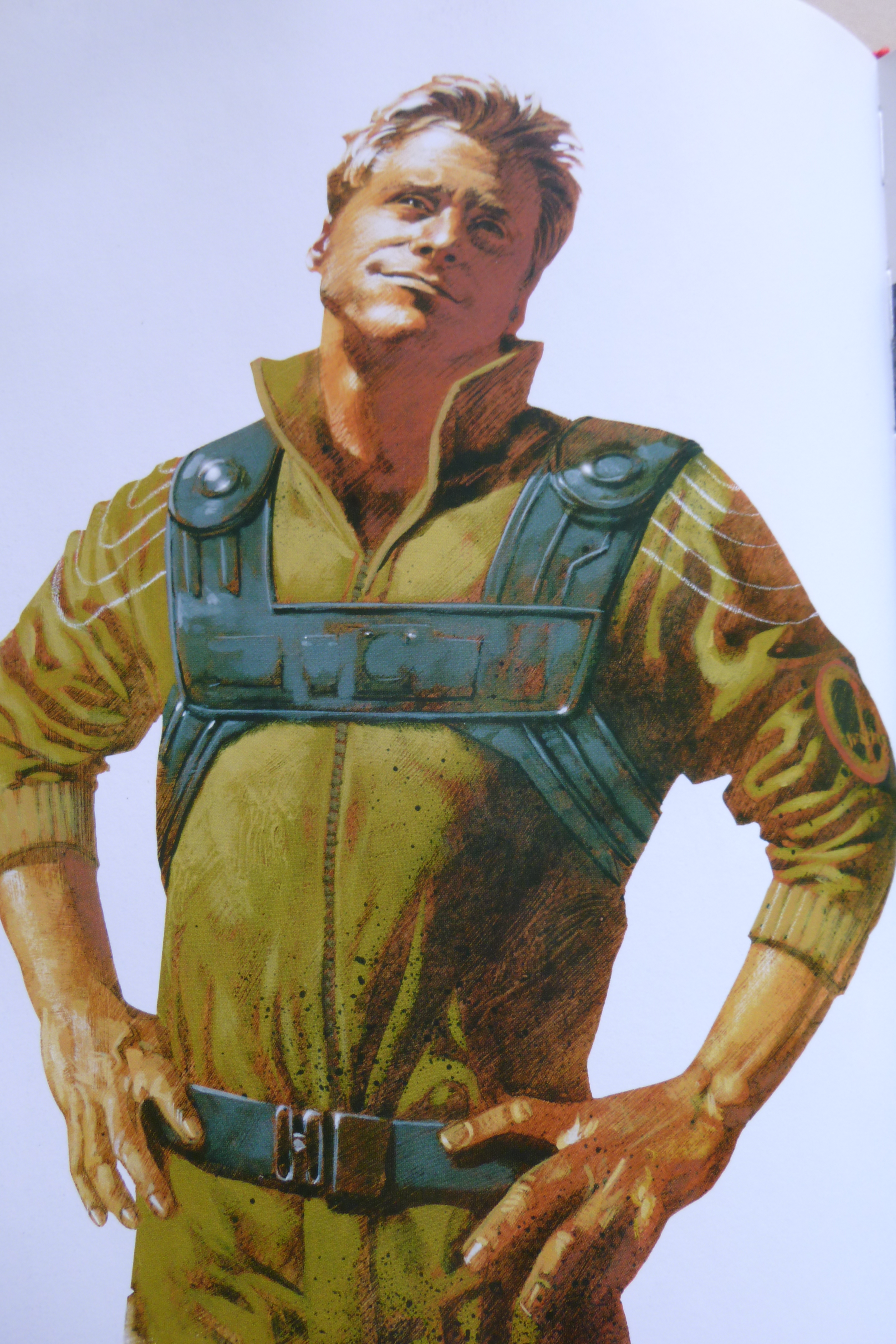
Ensign Andrew Dahl and his friends are newly arrived on the starship Intrepid, and swiftly realize that there are strange things going on.  There seems to be a strangely high number of casualties among the crew, events frequently defy the laws of physics or logic, and everyone gets awfully nervous about the subject of landing parties.  Dahl eventually connects with Jenkins, a crewmember who became unhinged after his wife was killed aboard the ship, and has taken to hiding in the crawlspaces–but who seems to have a firmer grasp on what’s really going on than anyone else.  Jenkins has figured out that their lives are dictated by the scripts of a TV show–a bad one–and Dahl and his friends conclude that the only way to escape a meaningless death is to go back in time and find their writers.

Two brilliant things here: this book takes all the weird absurdities of the original Star Trek and sci fi shows like it, drags them out to be even more extreme, and then has characters actually realize how irrational it all is.  Second, this is so meta–characters inside of a story have to deal with what it means to be characters.  I’m not sure if it’s applicable philosophy,  but it’s certainly intriguing philosophy.

Two criticisms: this will sound nitpicky, but Scalzi has a speech tag problem.  For non-editors, those are he said, she replied, he asked, etc.  Generally authors drop them when they can without losing clarity.  Scalzi keeps them, particularly in ‘s a scene near the beginning with two characters swapping dialogue back and forth and a speech tag at the end of every line.  It may be a deliberate stylistic choice, but it still made me twitch.  Second, and this is very ironic–I couldn’t keep Dahl’s friends straight.  They’re all redshirts, all with carefully crafted paragraph-long backstories, and I struggled to remember who was who, or see any depth in most of them.  Again, maybe deliberate–or Scalzi fell into the same trap he’s parodying.  We’ll say it was deliberate…

I did really enjoy Dahl as a character, as well as Jenkins.  In some ways I think I felt for him the most.  And then there was Kerensky, one of the TV show regulars.  He’s the regular character who gets injured or threatened but pulls through–again and again and again.  He’s also incredibly arrogant and very entertaining.

The main story comes to a close with a strange number of pages left in the book, because it’s followed by three codas.  The first is supposed to be the blog of one of the TV show writers.  I had trouble with this story.  The writer is very argumentative, and I’ve never liked narrators who come across as hostile to the reader.  The second is…harder to explain, but suffice to say it’s in second person (so the main character is “you”) and I couldn’t get into that somehow.

The third story, though, is about the actress who played Jenkins’ deceased wife, and I really liked her story.  She’s trying to grapple with this revelation about the characters of the Intrepid, and with larger life questions and…really fascinating.

All in all, for whatever its quirks and misfires, this book is still worth reading for that so fantastically amazing premise.  If you’re a Star Trek fan, at least.  I mean–the redshirts figure out what’s going on and try to save themselves.  And it’s fast-paced and funny and–well, how could that not be fantastic? 🙂

Author’s Site: http://scalzi.com/

Other reviews:
Stainless Steel Droppings
Little Red Reviewer
Tia’s Book Musings
Anyone else?

Keep Flying with Firefly

If you know anything about Joss Whedon’s Firefly, then you know that it ended much too soon.  There are 14 TV episodes and one movie, Serenity, and what exists is wonderful–but also makes it pretty clear that there was meant to be a much longer story arc, if only the show hadn’t been canceled.  With that context, you’ll understand why I was excited to hear there are Firefly graphic novels, written by Whedon.  Maybe some of those unexplained mysteries and lingering plot threads would be resolved!

So were they?  Well…yes and no.

To give you just a little Firefly context, it’s a space western, set in a future where humanity has left Earth and spread to new worlds–rich at the center, scraping along on the frontier.  Mal is the captain of Serenity, a Firefly-class spaceship, and leads a group of more-and-less misfits, theoretically merchants but not above smuggling or stealing–anything to keep flying.

Don’t read the graphic novels unless you’ve seen the show and the movie–there are spoilers, and possibly more important, there just isn’t much context provided in the novels.  So from here out, I’ll assume that you know the show.

The three graphic novels I read are Vol. 1: Those Left Behind, Vol. 2: Better Days, and The Shepherd’s Tale.  Don’t be fooled by the volume numbers–Better Days is chronologically first, though the plots aren’t directly related.

Better Days and Those Left Behind are essentially two new Firefly adventures, set between the TV show and Serenity.  In BD, the crew gets unexpectedly rich, and then has to figure out what to do when they aren’t scraping to get by.  My favorite part was seeing each character’s dream of what a better life would be.  And of course, complications ensue.  I found the ending confusing, though at least the poor plot conclusion is followed by a sort of epilogue with Mal and Inara that was sweet.  TLB is set closer to Serenity, and is mostly interesting because it explores why Inara and the Shepherd left the ship.  It does the most to fill in a missing chapter (though a couple more chapters wouldn’t have hurt!)

The Shepherd’s Tale had me the most excited.  I think he’s the one who got burned worst by the early cancellation of the show, because it’s obvious that he has a secret past they meant to reveal gradually–and then never had time for.  This book does reveal a lot–but left me wanting to know so much more.  There are some revelations, though at the same time some of it feels obvious once you hear it.  And I still don’t understand what exactly happened in “Safe,” when the Alliance seemed awfully respectful of him.

I do love the way TST is told, though.  It’s chronologically backwards.  We start at Serenity, then jump to a moment that could have been in the TV show, then jump to a moment before that and a moment before that…all the way back to childhood.  Each transition is tied together by a phrase or an action–Kaylee tells him, “You’re gonna come with us,” and from there he flashes to an earlier moment hearing that phrase.  It moves like memory, and it’s a neat way to tell the story–although it takes a little effort to follow.  I went through it again backwards after I got to the end.

I should also comment that I loved the artwork in BD and TLB.  There are beautiful drawings, and the characters look perfect.  TST is no doubt good artwork for its kind, but it’s a more minimalist, cartoon-style that doesn’t appeal to me as well.

All in all, if you like the series these are well-worth reading to get a couple more adventures and answer a few questions.  There are apparently a few more comics floating out there too, but I’m not sure how to get them and they don’t look like they’re going to resolve my remaining questions anyway.  You see, I still want more about the Shepherd’s past, and something post-Serenity to finally resolve the Mal/Inara romance, and also something to reveal that a certain character’s death was all a hideous mistake and never really happened.  Which is kind of where I was before I read these three.

Oh well.  At least I got a few more Firefly adventures.

Other reviews:
Ramblings of a Semi-Housewife
Stories Geek
Anyone else with a review, Firefly fans?

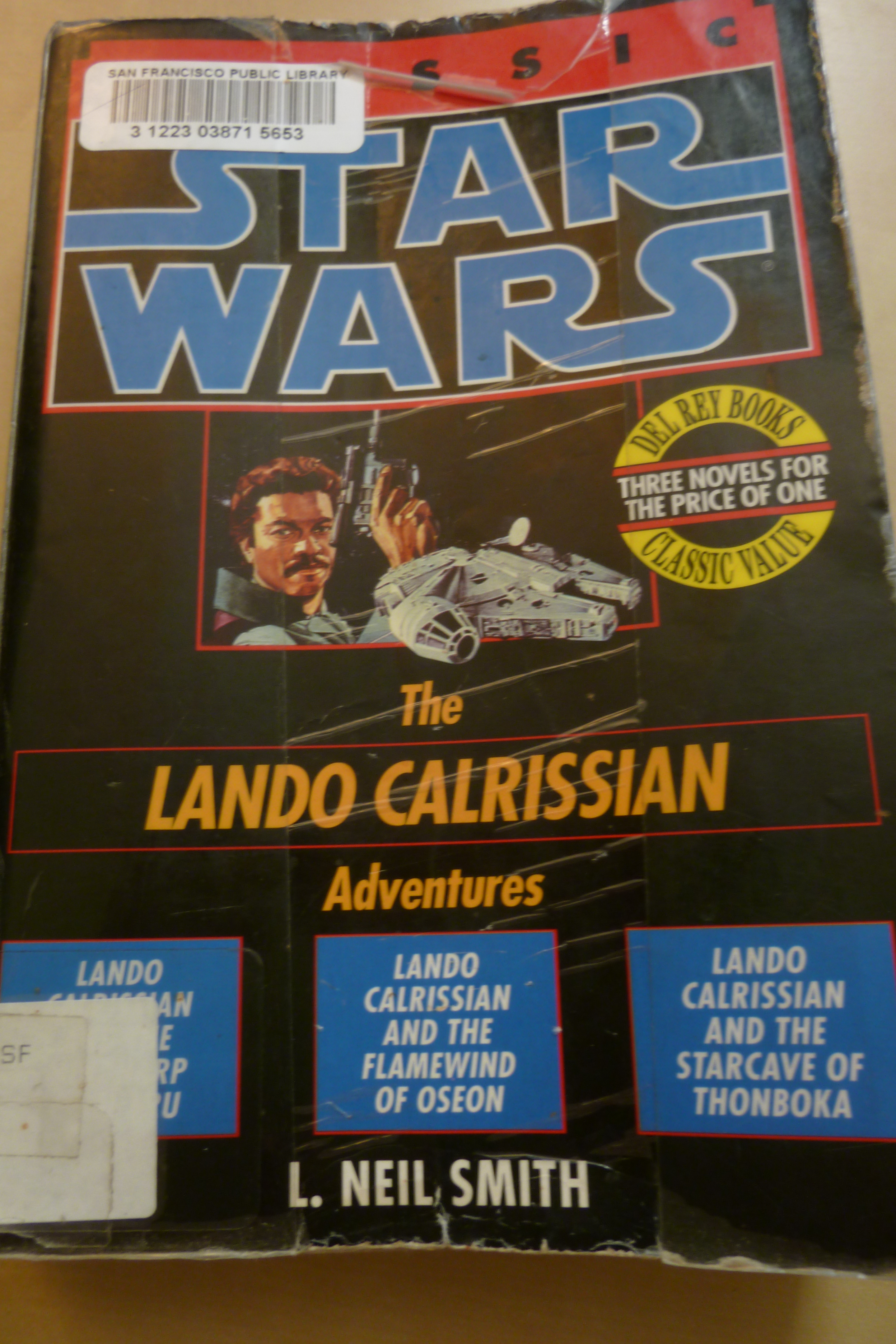
Traveling the Star Wars Universe with Lando Calrissian

An omnibus, the title I read is covered by a sticker…oh well.

I’ve had a Star Wars itch lately.  It might be because I was listening to Professor Fears talk about the fall of the Old Roman Republic, giving way to the Empire.  The parallels, in terms and sometimes beyond that, are pretty obvious.  Or it might be because Asimov’s Foundation books made me nostalgic for another galaxy with humans on every planet and an enormous empire spanning the systems.

I’ve also had a bit of a memory itch.  Some time very long ago I read a book about Lando Calrissian.  There was a robot in it, they were in the ruins of an ancient civilization, and at some point they got separated and time started moving at different speeds for each of them.  And that’s pretty much all I remembered.

My Star Wars itch made me decide it was a good time to try to hunt down this vague book memory, and fortunately it wasn’t nearly as hard as you’d expect.  L. Neil Smith wrote a trilogy, The Lando Calrissian Adventures, and the first one, Lando Calrissian and the Mindharp of Sharu, involves a search for an ancient artifact.  I decided to gamble that was the one I remembered, and sure enough–there’s Vuffi Raa as his android sidekick, and that bit about time moving at different speeds was exactly the way I remembered it.

This was a really fun idea for a book series.  I can only comment on the first one, but it starts well.  Lando is not really in the original movies all that much, and I haven’t seen him in other books a lot either.  But he’s got that charming rogue thing going on that Han Solo has working for him too.  He clearly has plenty of adventures in his past, so why not some books about them?  This trilogy (or at least the first book) is set well before the original movies.  Lando recently won the Millenium Falcon in a game of chance, and if he’s met Han yet, it hasn’t come up.

Other than the ship, and of course Lando himself, there’s minimal connection to anything recognizable from Star Wars.  The technology and the universe structure is right, but there are hardly any references to the Empire and I can’t remember a single one to the Jedi (which makes sense, as during this period they were wiped out).  For a Star Wars fan, this is an interesting delving into a supporting character, and for a non-Star Wars fan, I think this could easily be read as an independent sci fi book.  Apparently this was written very early on, which explains a lot.

I really enjoyed the characters here.  Lando is a gambler, not a fighter.  He’s a rogue and a conman and he can fight if he needs to, but he’d rather avoid trouble when he can.  Vuffi Raa, as frequently happens with Star Wars droids, is the most endearing character.  He’s a mix of programming and independent thought–for instance, he’s programmed to be unable to commit violence, but he occasionally finds a work-around when the situation calls for it.  He’s very loyal, has a sense of humor, and has deep compassion for other machines (which baffles Lando, prompting a stern and insightful lecture).

The plot, as mentioned, is about a search for an ancient artifact belonging to a lost race.  It’s a decent quest, though the characters, the ruins (which are on an impossibly large scale) and the mystery of the lost race were what grabbed me.  In a funny way, this felt more like a Star Trek book than a Star Wars one.  I’ve always thought it was all about that last word for each of them, and this book is more about the journey than the battles–and, like Trek, about the characters and the alien races.  That doesn’t mean there aren’t fight sequences, and there’s good tension and climactic moments.  It wrapped up a little quickly, but that’s a minor criticism.

All in all, a very good book I think I could recommend to a wide variety of sci fi fans–the dedicated Star Wars fan, the tentative Star Wars fan, a Star Trek fan, or anyone who’s feeling a bit of a Star Wars itch!

Other reviews (by more dedicated Star Wars fans than me!):
Expanded Universe Project
MiB Reviews
Rancors Love to Read
Anyone else?

Following the Foundation into Book Two

Another partly-read series I’m working on  is the original Foundation trilogy by Isaac Asimov (which also fits my goal last year to read more classic sci fi).  I just read the second Foundation novel, Foundation and Empire–not to be confused with Second Foundation, which is the third book!

The Foundation books are set in a distant future where humans live on planets across the galaxy, under the rule of a Galactic Empire.  The impetus for the whole series is Hari Seldon, a master of psycho-history.  Not the history of crazy people 🙂 it’s a discipline of applying psychology to entire societies, to look at sweeping trends and predict the future with startling accuracy.  Seldon predicts the fall of the Galactic Empire and a period of 30,000 years of barbarism before a new Empire will rise.  He calculates that the solution is to gather the great minds of the time together into two Foundations at opposite ends of the galaxy.  This will set in motion necessary events to shorten the period of chaos to only 1,000 years.

Throughout the 1,000 years, there are certain crisis points, known as Seldon crises, which must develop and resolve a certain way for history to continue as Seldon predicted.  The novels primarily deal with these crisis points.  Foundation deals with the founding and first two hundred years of the Foundation.  Foundation and Empire picks up at the next crisis point, as the last vestiges of the Empire make an attack on the Foundation.

That’s Book One.  In typical classic sci fi fashion, the book is really two novellas, and though both good, I found the second one the more interesting one.  In the second section, a shadowy figure called the Mule has begun conquering worlds, heading towards the Foundation itself.  Seldon’s predictions deal with trends, not individuals, and the Mule is poised to set awry all of Seldon’s calculations.

I find that I tend to enjoy Asimov on a cerebral level.  He has interesting plots, and he deals with intriguing theories of societal trends and human nature and big macro-level things (like Seldon).  He tends not to be as satisfying on a micro-level, by which I really mean that his individual characters rarely make an impact on me.  Part of it is that there are often a lot of them, and they’re mostly intellectual men having serious conversations all the time.

That being said, Foundation and Empire was a pleasant surprise for having more relatable characters!  The first section features a well-developed character in the general attacking the Foundation, and there was also a former revolutionary and a merchant trader who had my interest.  I feel like those two should have been a little more than they were, but I still liked them.

The second section had two very solidly engaging characters.  There’s Magnifico, the Mule’s court jester who is cringing and slightly pathetic and yet comical as well.  And there’s Bayta.  And she’s a girl!  After a book and a half, I was beginning to think that Asimov was writing about a future society consisting only of men.  There’s a complete absence of female characters until Bayta comes on the scene, and it’s nice that when she does arrive she’s intelligent, warm-hearted, and even has a bit of a sense of humor.

These are not comedic books, and they’re mostly not emotional books either.  They’re not exactly light, although I wouldn’t say they’re heavy in a depressing way either.  They’re interesting and they’re intellectual, and I’m pleased about the improving trend in this one, and hopeful for the next!

Other reviews:
Kinda Silly Books
Reviews and Ramblings
Sci-Fi Book Review
Anyone else?