Battles and Journeys Through the Stars

A double-feature today.  I recently read a Star Wars book and a Star Trek book, and it seemed natural to put them together in a post.  I don’t have a huge lot to say about either, so why not group up?
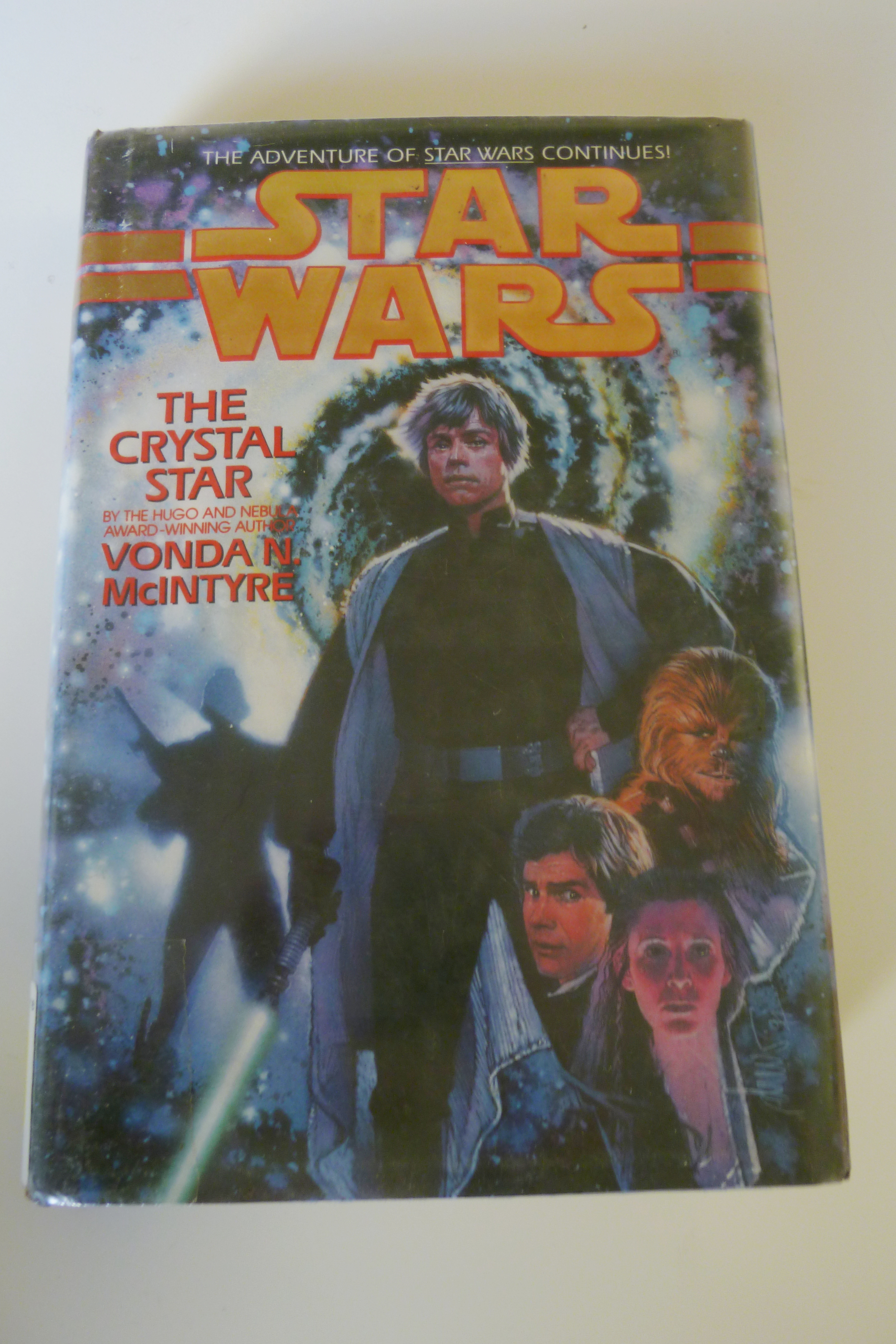
Star Wars: The Crystal Star by Vonda N. McIntyre

This is one of the Star Wars books I read long ago, although stumbling over it at the library was a stroke of blind luck, as I certainly didn’t remember the title or author!  I did recognize the plot, though.

Han and Leia’s children (five-year-old twins, Jaina and Jacen, and three-year-old Anakin) are kidnapped by a cultish group that wants to bring back the Empire.  Leia takes a ship in pursuit, disguised as a bounty hunter.  Meanwhile, unaware of the kidnapping, Han and Luke are off investigating rumors about a lost group of Jedi.  They find an old flame of Han’s, and a bizarre creature (even by Star Wars standards) with healing powers and malevolent intent.

The point of view moves between Leia, Jaina and Han, which I found a little disconcerting at first, but I got used to it.  The different plot threads eventually link up, in a way that’s somewhat far-fetched but does work.

The characterization was good here and, like with Star Trek books, I always enjoy books that let me revisit old friends (so to speak).  It was fun to see Leia go off to be heroic without the guys, and I really enjoyed Jaina’s point of view.  As I discussed in my review of Ender’s Game, Jaina is a very smart, brave little girl–who nevertheless seems like a little girl!  I thought that was very nicely done.

I’ve complained about Star Wars books usually being about mopping up the last traces of the Empire, and to some extent that was what happened here…but the group that kidnaps the kids could just have easily been a weird cult with no Empire connection, so that didn’t bother me too much.  The details of it were very different than just being yet another battle.

All in all, a fun Star Wars adventure–not fantastic or Earth-shattering, but a light, fun read.
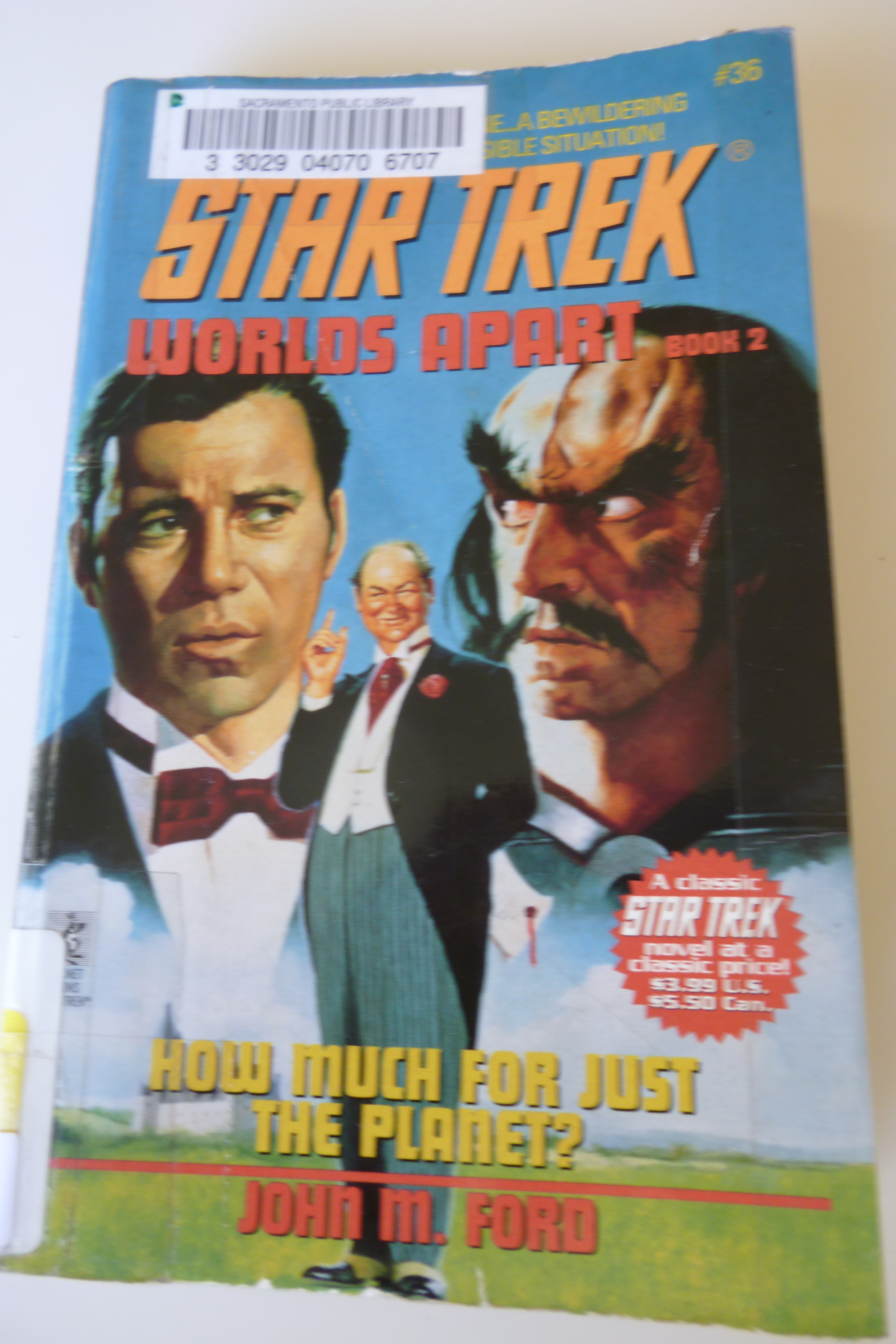
Star Trek: How Much for Just the Planet? by John M. Ford

I’ve been wanting to read more Trek books, and I’ve been seeing this one in used bookstores for a while.  Doesn’t the cover look good?  It makes you want to know why Kirk’s wearing a suit–and why he has that expression!  I haven’t read Worlds Apart Book 1, but as far as I can tell from a plot synopsis, they have no significant connection.

So I dived in here based on the cover and a recommendation–and sadly, the book wasn’t quite up to its promise.  It actually read a lot like fanfiction–in good ways and bad.  It started so well, eating breakfast on the Enterprise, where Kirk inexplicably wound up with blue orange juice and McCoy grumbled about early mornings.  Then we jump to a survey ship whose computer seems to be an escapee from a Douglas Adams book, and where a mix-up floods a shuttle with peppermint milkshake.

It’s silly and fun and it’s like fanfiction, where writers are more willing to push the boundaries of what’s reasonable for the sake of a laugh.  Believe me, I was the queen of that when I wrote fanfiction.  I flooded the Enterprise with orange juice–twice.

But then the book went too far.  It’s a very, very thin line between really funny, and dragging your characters out of character and into a universe that is, dare I say it, just too illogical.  (And I won’t swear that I never crossed that line myself!)

The actual plot centers around a human-colonized planet, where massive deposits of very valuable dilithium have been discovered.  Under the terms of the Organian Peace Treaty, the Federation and the Klingon Empire can compete for rights to develop the planet.  The Enterprise and a Klingon ship both arrive on the scene for a diplomatic mission.  They beam down into a small town apparently populated by lunatics who can’t quite decide if they’re in a Hitchcock film, a Laurel and Hardy silent comedy, or a Gilbert and Sullivan musical–complete with characters randomly bursting into song.

What works for Gilbert and Sullivan doesn’t work in a Star Trek novel.  Putting song lyrics into the middle of scenes is just odd.  In fact, the whole book is odd, and made worse by the regular characters not quite acknowledging just how odd it all is.  They do think it’s weird, but not to the extent they should.  It’s too bad because there are some funny parts in here–Scotty challenges a Klingon to an honor match of golf, for one example.  The whole novel finally winds up with a food fight.

Part of me wants to love that–but a bigger part of me says that there’s no way Kirk and a Klingon captain, in their right minds, would actually end up throwing pies at each other.  Ford had a good idea here–and then I feel like he ran too far with it.  I love funny Star Trek stories and I love slapstick humor and I might have accepted much more of this if it really had been fanfiction–but it’s not, and I expect something different from published novels and this one just didn’t quite ring true to me.

But that’s all right.  I’ve been asking everyone I can think of for recommendations on Star Trek books to read, and I have MANY more to explore!
Revisiting a Galaxy Far, Far Away

This sci fi kick I’ve been on lately has led me back around to Star Wars, which I must admit I haven’t paid much attention to for about ten years–and it had probably been that long since I watched the original trilogy.

First, a little history.  The trilogy was re-released in theaters when I was in elementary school, and me and everyone around me became Star Wars fans.  I read probably 10 or 12 Star Wars books too, but lost interest when it began to feel like every book was basically “let’s mop up the last traces of the Empire…and then the last last traces…and then this last one…”  More significantly, I also found Star Trek.  For me, the fandoms co-existed for a while, but in the end, the traveling turned out to be more interesting than the fighting (I’m convinced the difference really is all in that second word of the names).

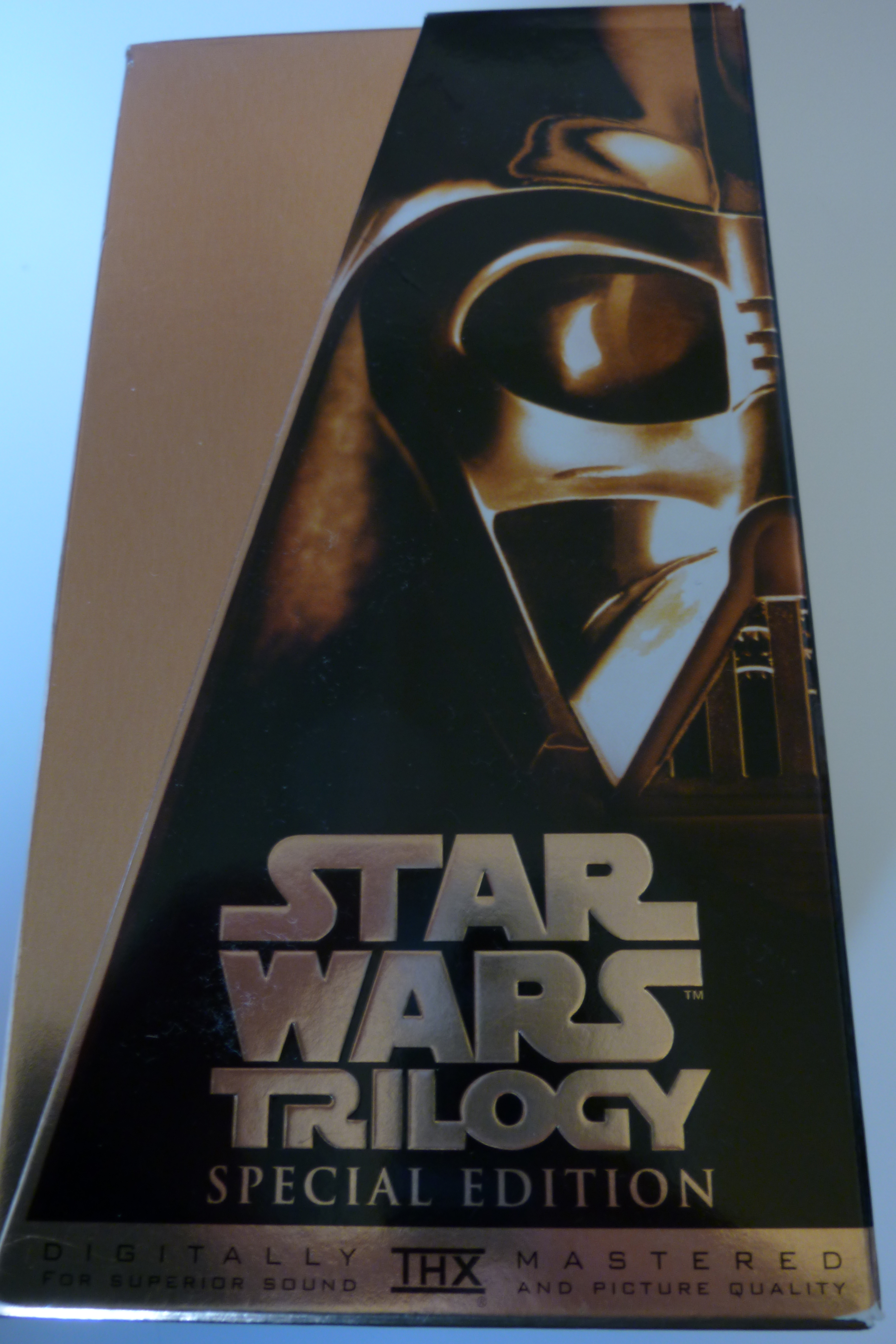
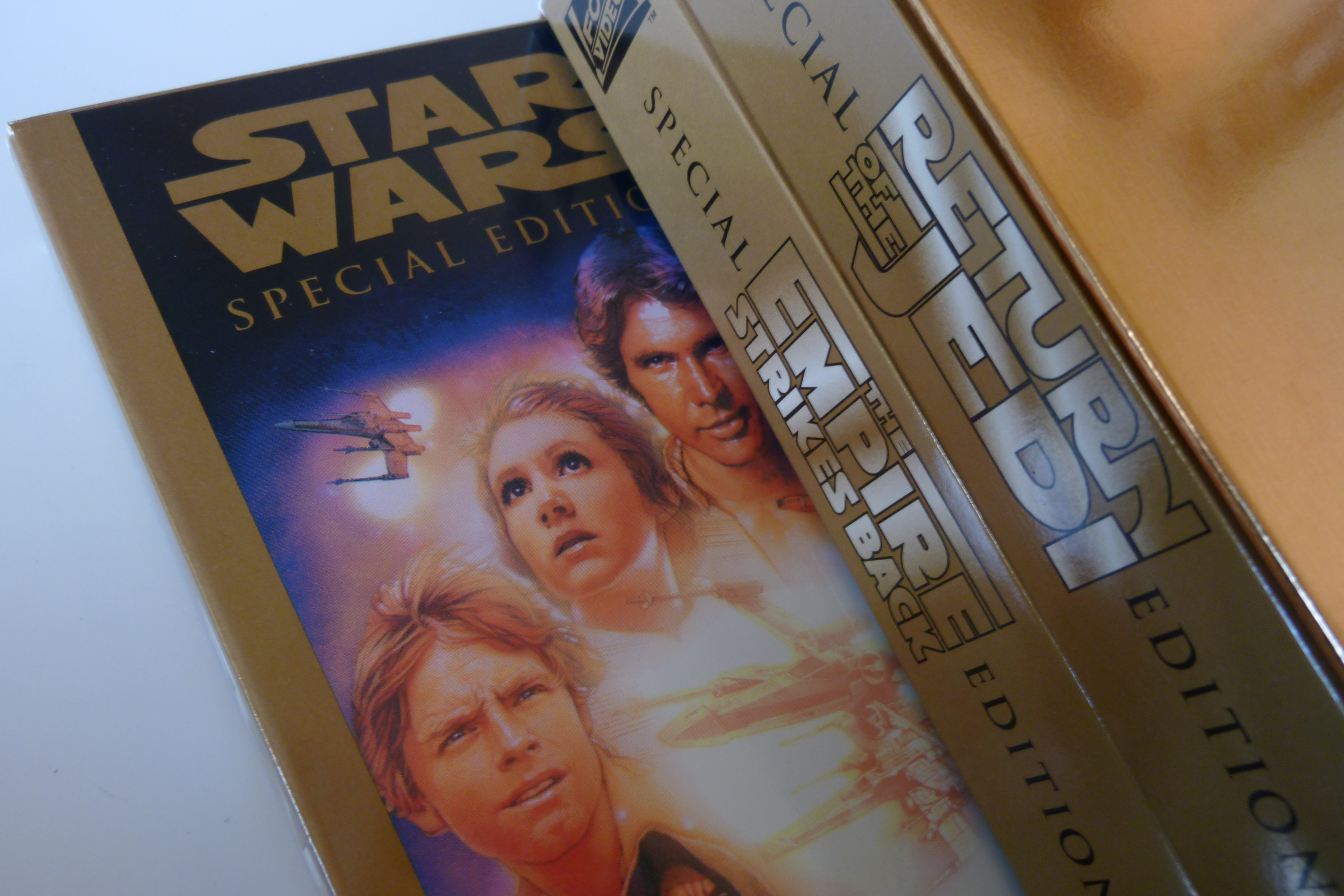
All of this is to say that I identify as a Star Trek fan, but I like Star Wars too, and there was a time when I really liked Star Wars.  And lately I’ve been thinking I’d like to revisit the galaxy far, far away.  So, over a recent weekend, I dug out my very old, shiny gold Special Edition VHS tapes of the original trilogy (a very big deal purchase when I was much younger!) and rewatched all three movies over three days.

And you know, they really are wonderful.  The characters, the strange landscapes, the magic of the Force…even the battles.  It’s often the characters that count most for me, so let’s start there.  Remember it had been ten years (or thereabouts) since I saw these movies.  The biggest “change” was Luke.  Han is right when he’s calling him a kid at the beginning!  You can’t see him the same way when you’re a kid yourself.  I think you have to be older to properly see Luke’s character arc, from a whiny kid on Tatooine (he really is whiny in spots) to the serene and confident Jedi Knight.  It’s the classic growth of a hero story, and it’s very well-done.  I enjoyed Han’s growth too, from refusing to stick his neck out for anybody, to General Solo of the Rebel Alliance–but still with some of that scoundrel edge.  The one who grows less is Leia–she’s awesome from the first moment and stays that way, whether it’s blasting Stormtroopers or making acid comments to Han.  I remembered she was great, but I think I forgot just how much so.

I thought other characters were excellent too–Threepio, with his constant worried commentary, gets some of the funniest lines.  And at the opposite end of the spectrum, you have the looming and menacing Darth Vader.  I don’t think I ever noticed before–his entrance gets more impressive with each successive movie.  I wonder if they didn’t quite know what they had in the first one.

I thought the plot rockets forward at a nice pace, and each time I finished one movie it made me want to watch the next one.  It’s fun to revisit all the iconic lines and moments, and my memory of the later two movies may have been part of why I wanted to go on to watch them.  The trilogy is also a great example of a story which is complete unto itself, despite previous events which influence the present.

Which leads me around to the newer trilogy.  I watched that as it came out, and I don’t think I had seen the original trilogy since watching Episodes 1-3.  Rewatching Episodes 4-6 largely brought home to me how irrelevant the first three episodes really are.  I don’t feel like they added anything to my viewing of the original trilogy.  It was a bit interesting to see the references in the original to the past, and to know how they expanded those references, except that mostly I don’t much like the way they expanded them.

If anything, the new episodes hamper viewing of the original; now when Leia talks about her mother, I’m stuck thinking about Padme’s really stupid death; when anyone talks about Anakin Skywalker, it’s now harder to think of him as a heroic Jedi when I’ve seen him as a sulky teenager who, after the age of nine, was never all that likable.  And even though I like Padme, seeing Leia again makes Padme look like a poor imitation.  It’s sad, really–the original trilogy points up how far the new ones fell short, and how we really already knew anything we needed to know about the backstory.

If I was going to get more backstory, I think I’d rather have it about the galaxy, not the individuals.  Star Wars has good character development, but not so much when it comes to races.  The Wookies, the Ewoks and the Jawas are the only ones I can think of who have their species name even mentioned in the original trilogy (maybe Jabba–is Hutt a species or a title?)  There are endless bizarre-looking creatures, but most of them we know pretty much nothing about.  We don’t need to know about all of them–but it would be nice to know about some of them.  I suppose that’s another reason I ended up as a bigger fan of Star Trek; there’s much more scope in exploring different alien cultures than there is in mopping up the last traces of the Empire.

But there’s plenty that’s good in Star Wars too, and I think I’m going to do a bit more revisiting.  The new trilogy added nothing to the old one for me, but what I remember of the books did.  I remember Wedge got to be a much bigger character, that Leia became a political leader, that Luke continued that character arc to found a new Jedi Academy, that Han kept trying to balance the general and the scoundrel.  I lost interest eventually in reading new Star Wars books, but I remember I liked several of the ones I did read.  So I think I’m going to track some of them down and see if they’re worth revisiting too!

A Child Commander

Another sci fi book I’ve been meaning to read for years is Ender’s Game by Orson Scott Card.  Now that I finally have, I enjoyed it very much–and had some serious issues with it too!

The book is set an indeterminate length of time in the future, when humans have begun to venture into space but have not yet spread as in, say, Star Trek.  They also haven’t met any aliens as nice as the Vulcans–instead, they’ve met the buggers, a race of bug-like aliens who attacked the Earth 80 years before Ender’s Game opens.  The International Fleet has been preparing for a renewed war ever since, sending ships to the buggers’ homeworld that are just now getting close to arriving.  With war expected within the next several years, the IF is looking for a supreme commander to direct their forces.  And they find Ender, a six year old boy with enormous potential.

They ship Ender off to battle school, held in a space station, where Ender and the other children are meant to learn to be soldiers.  Their chief focus is the Game, a sort of combination Capture the Flag/Freeze-tag/Paintball held in zero-gravity.  The book follows Ender’s very, very swift rise, heading towards the new war with the buggers.

First, this was an extremely engaging book.  Between the outside threat to add tension and the exploration of how the school works, and how life in the space station works, it stays interesting throughout.  Even the discussions about movement in zero-gravity were fascinating.  It’s a very grim, even harsh story, but it also has a momentum and an urgency that keeps pushing the book forward.

Ender is an excellent character, very conflicted and complicated.  I think he’s basically a good person, but he’s terrified by the darkness inside of him.  And that darkness does push him to lengths that are sometimes alarming and disturbing.  Ender is a good character in almost every way–except that he doesn’t feel like a child.  And that brings me to my issues with the book.

Let me start with a different though related issue.  The book requires an enormous suspension of disbelief in its primary premise: namely, that the IF is so intent on training up Ender to be their commander.  It reads almost like a story about a prophesized Chosen One, except there’s no prophecy and it’s solely based on their assessment of his abilities.  And fine, perhaps he’s extraordinary–but they need a commander now.  I don’t want to give spoilers, but suffice to say that the ultimate fight with the buggers happens years before Ender reaches adulthood.  The IF has been planning this war for 80 years, and now at the crucial moment they want to make a child their supreme commander?  That seems, um, unlikely.

But maybe they know what they’re doing, because, as I said, Ender does not much resemble a child.  It’s not just him, either, it’s all the children at the battle school.  Officially they’re seven or nine or ten, but they behave as though they’re in their late teens at least.  Which leads me to wonder why Orson Scott Card made them so young to begin with.  It’s not a young adult book, so they didn’t have to be that young.  Perhaps it was for shock value, or a comment on child soldiers, or to emphasize their manipulation by the IF.  Those are perfectly good reasons and the book has some elements of that–but it all has much less resonance when Ender doesn’t feel seven.

I’m reminded of two other books that have parallel elements but actually handled this issue better.  In The Hunger Games, Katniss feels like a teenager.  Rue, another girl in the games, feels twelve.  They’re intelligent, strong, capable, sometimes almost ruthless, thrown into situations no child (or anyone, for that matter) should be in, but they feel like young people dealing with a grown-up situation.  I also just read a Star Wars book (more on that in another post) which had a major focus on Leia and Han’s daughter, Jaina, who’s five and has been kidnapped.  Again–brave, capable, probably genius-level intelligence, but she still seems five.  She gets scared, she wants her mother, and when she is reunited with Leia, Jaina tells her about the kidnappers but also tells her that she lost her loose tooth.  If Ender ever loses a tooth, it’s not mentioned.

I also question the battle school’s methods.  They are harsh, and intended to isolate Ender and keep him from depending on anyone.  I don’t see that as a way to make a good soldier, let alone a commander–or a person.  He’s essentially taught not to trust anyone in authority.  And how can a child who is never shown compassion or kindness, who is actually prevented from forming close ties, be expected to lead people?  They’re trying to create a tool, but they need it to be a tool that is creative, determined, and has a deep understanding for others, and I don’t see where Ender learned any of that.

And now, as tends to happen, I’ve gone on and on about the issues in a book I actually liked!  Perhaps because the ways a book doesn’t work are the most interesting to explore, trying to figure out why and how it didn’t quite fit together.  But don’t get the wrong idea here–despite the various issues I had with the book, it’s very good.  Grim, dark, sometimes bloody (I warned you!) but intense, engaging, and with some very surprising twists at the end.  And after the complete devastation of much of the book, in the end there’s a surprising amount of hope.  If you like science fiction, it’s worth the read.

I know this is a popular sci fi book–who else has read it?  Did you have any of the same issues, or can you explain why they weren’t issues for you?

Author’s site: http://hatrack.com/ (no, really–it’s not orsonscottcard.com, apparently)

Other reviews:
Book Club Babe
End of the Game
Truly Bookish
And no doubt masses more–like yours?

Robotic Psychology

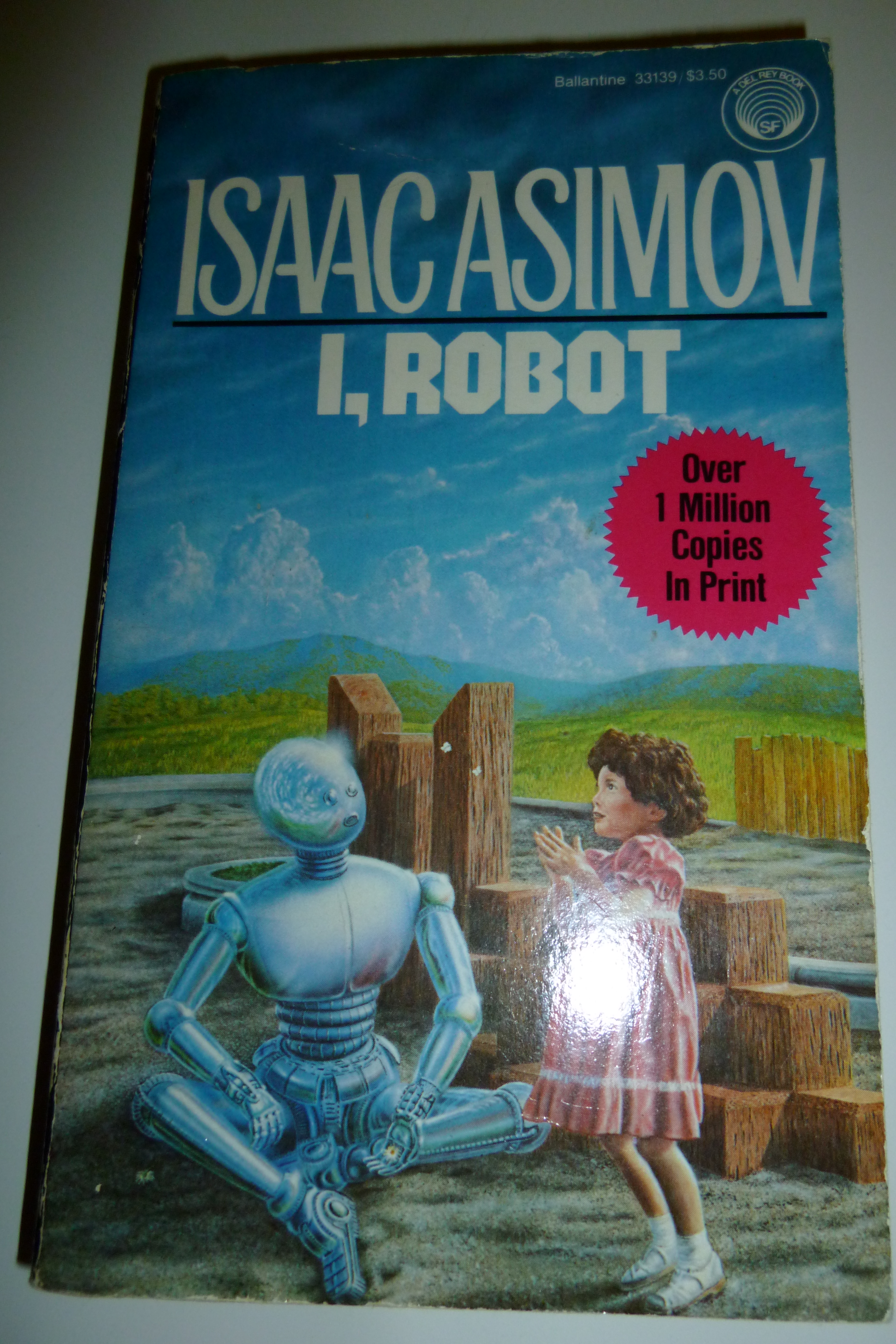
For my second Sci Fi Experience book, I read I, Robot by Isaac Asimov.  It hasn’t been sitting on my shelf, but it is one I’ve been meaning to read for ages.  And as with a lot of books like that, it turned out to be a faster read than I expected–and not much like my preconceptions of the book.

I always thought this was a collection of short stories, and it is, but they’re far more inter-connected than I had expected.  They’re set in what, at the time of writing, was the future (although we’ve since caught up).  It’s a world like ours, except humans have built advanced robots.  They’re exactly what you’d expect of science fiction robots (maybe they set some of the expectations!)–metallic, roughly humanoid, capable of walking and talking and performing a surprising amount of what at least looks like independent thought.  They’re governed by the famous Three Laws of Robotics.

In brief, the laws are: First, no robot can harm a human or allow a human to come to harm through inaction; Second, robots must obey human orders, unless they conflict with the first law; Third, robots must preserve themselves, unless that would be in conflict with the first or second laws.

The stories, not surprisingly, are mostly about robots that are malfunctioning or otherwise acting oddly, often because of an issue involving the Three Laws.  The stories are loosely linked by a frame-story, an interview with Dr. Susan Calvin, the leading robopsychologist.  She recounts stories from the history of robotics, primarily focusing on two groups of characters: either Powell and Donovan, two scientists who keep getting into trouble with robots on the fringes of civilization; or Dr. Calvin herself and the executives at U.S. Robots Inc.

The Three Laws seem straight-forward enough, but Asimov finds plenty of ways for their application to become confused, contradictory or otherwise corrupted.  There’s a robot who gets drunk when he can’t figure out which law to obey; another takes literally the order to go lose himself.

Characters, even though they are recurring, are not really the strong point of this book.  Most of the humans are not very distinctive.  It’s the robots who make the book interesting–and sometimes have more developed personalities than the humans!  One of my favorite stories is about a robot who doesn’t believe it when humans say they built him, and decides to reason out the truth of the world himself; he swiftly creates a kind of religion for robots, with himself as its prophet.

In some ways, the level of personality in the robots became a little disturbing.  This book is primarily about protecting humans from robots.  There’s nothing about protecting robots from humans–and when you have robots with independent thought, who appear as fairly developed characters, it gets hard to not look at them as people.  In particular there was one scene where Dr. Calvin was interviewing a robot.  She starts addressing the robot as “boy,” while the robot is calling her “ma’am.”  Suddenly you have the language of slavery, and it feels strange.  I know Asimov wrote other Robot books; I’ve read “Bicentennial Man,” which is largely about robot rights, so it’s not an entirely ignored issue…but it would be nice to see it addressed somewhere in this book too.

My favorite story is the first one, “Robbie.”  It’s certainly the sweetest, and is the one depicted on the cover.  It’s about a little girl and her beloved robot nursemaid, and what happens when her parents try to take the robot away.  (That makes it sound like Bradbury’s story, “The Veldt,” and it’s actually not at all like that!)

My last sci fi read made me think about humanity.  This one felt more like it was genuinely about the psychology of robots.  And how we relate to them, and what they say about us…but mostly how their minds work.  But that’s all right, because they work in fascinating ways!

And I think I can safely say that this one is not only classic sci fi, it’s a sci fi classic.  🙂

Other reviews:

Eclectic Reader Book Review
Expressions
Running Forums

Yours?

A Look at Humanity Through Sci Fi Lenses

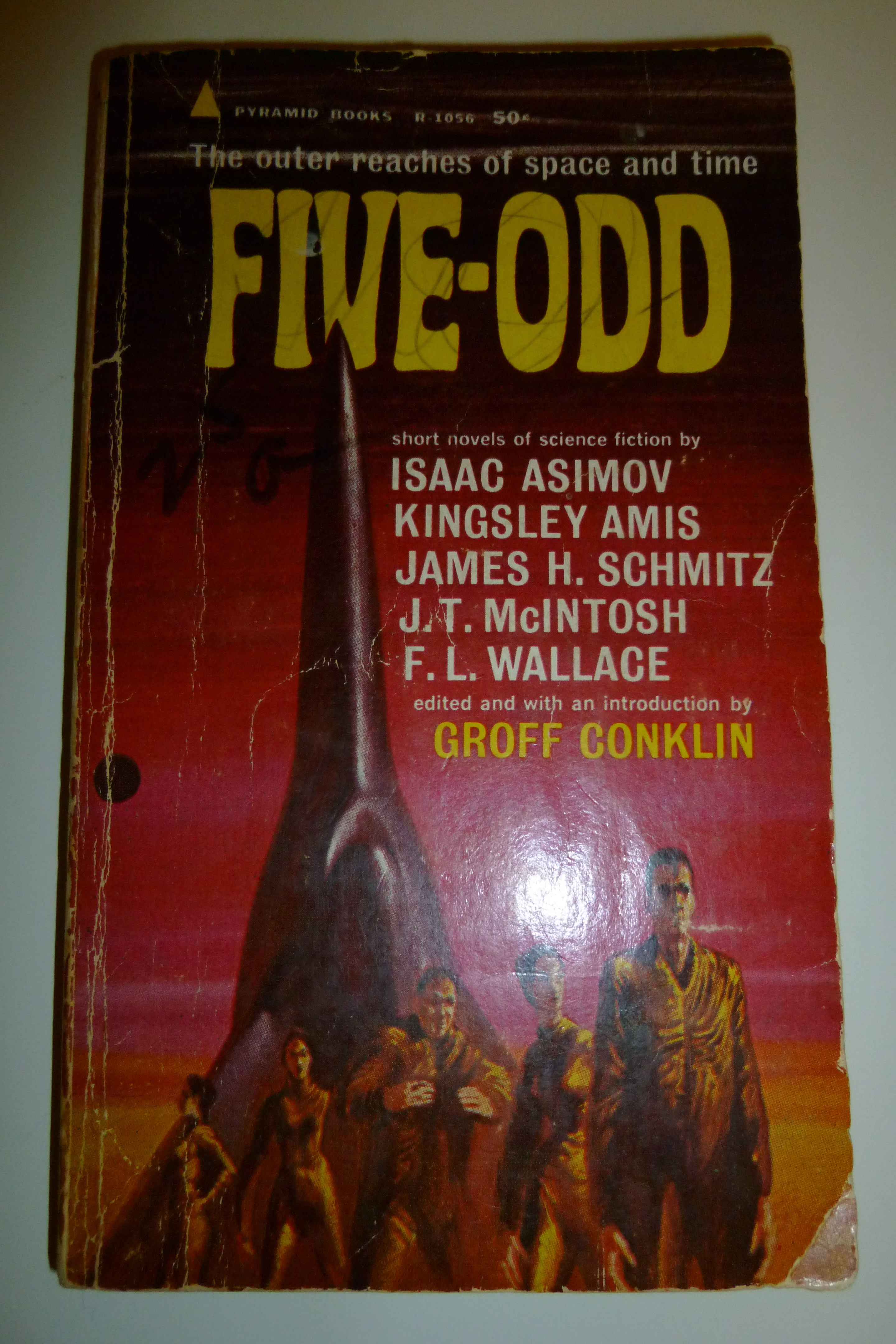
I finished my first book of 2012 and, feeling very virtuous, I managed to make it one which applied to two of my challenges!  Five-Odd, a collection of five (longish) short stories, edited by Groff Conklin, applies to both the Sci-Fi Experience and the Dusty Bookshelf Challenge.

I’ve decided Dusty Bookshelf reviews deserve a little back-story.

How long has it been on my shelf? Since August, 2011, so about four months.

I almost never buy unread books, so how did I get it? My Book Club had an all-holiday party in August (because there aren’t any major holidays in August), and I picked this up at the White Elephant gift exchange.

Now that I’ve read it, am I keeping it? I haven’t decided.  I liked it–but I have high standards about what books I own.  I’ll see how I feel about it when I have a little distance–say, next month.

Five-Odd is a nice mix of intriguing technology and of philosophy.  It’s definitely not action-adventure sci fi.  Most of the stories are about futures not so different from our present, except for some crucial advance in technology, and changes in thought because of it.  Almost every story made me think about some aspect of the world and, more often, of humanity.

Isaac Asimov’s “The Dead Past” asks whether the past really is dead, while also looking at government repression and the end of privacy–but not at all the way that sentence makes it sound.  The story centers around a fascinating device that will let anyone look at past moments.

“Something Strange” by Kingsley Amis felt like the weak link here to me.  It’s about four people living together on a small space station, but the characters were too surreal in some ways, and then the story ended just as it felt like it was coming to the most interesting part.

J.T. McIntosh’s “Unit” addresses a question about identity.  It then veers off into a story more about prejudices, piracy and collaborative intelligence, which was also interesting though I would have liked more about the idea the story started with–about people who choose to wipe away their entire past, and be entirely remade as new people with new personalities.

“Gone Fishing” by James H. Schmitz is about a conman who thinks he’s going to steal a transporter device from a befuddled scientist, only to wind up stranded on a distant planet for five years.  The transporter was interesting, but more interesting was the idea of how he would cope with five years of solitude.

“Big Ancestor” by F. L. Wallace is set the farthest in the future, when humans from Earth have reached the stars, and met humans from a hundred other planets.  A team of scientists from various planets goes in search of their common ancestor.  There’s an excellent twist to this, and I recommend not reading Conklin’s introduction, which blatantly hints at it.  There’s also an interesting passing line here, when one human mentions that most of the human races discovered space travel on their own, and then they helped the ones that didn’t.  After all my years of hearing about Star Trek‘s Prime Directive, General Order Number One, to never ever ever ever interfere with less developed races, this was shocking.  And yes, I know Star Trek does it all the time anyway 🙂 but it felt very different hearing it as an accepted thing!

I felt a little doubtful about reviewing this one because I wondered how easy it would be for anyone to find it.  But it turns out it’s available cheap on Amazon if you do want it (and no one paid me for that link!)  If you like philosophical sci fi, it’s a good read.  The stories were written in the ’50s and ’60s and have that flavor.  I don’t know that I’d call them sci fi classics, but they are classic sci fi…if you see the distinction there!  🙂