Bradbury’s Mars

I’ve been trying to broaden my horizons in science fiction reading, and this week I broadened them all the way to Mars, by reading Ray Bradbury’s The Martian Chronicles.  I saw the movie years and years ago, remembering it only faintly, and this was my first trip through the book.

I have great respect for Mr. Bradbury…but, and I may get myself into trouble saying this, I had enormous amounts of trouble with The Martian Chronicles.

First, the essential plot: the story of humans colonizing Mars, over the recent graves of the previous civilization.  There are a series of failed exploratory missions, whose crews disappeared mysteriously.  When one finally lasts, they realize that the previous visitors infected the Martians with chicken pox and, barring a handful of survivors, the entire civilization died.  Humans get on with colonizing, but just as they’re beginning to flourish, their efforts are disrupted by atomic war back on Earth.

The presentation of the story is interesting, a series of anecdotes with no major characters throughout and only a few recurring ones.  This is almost a series of short stories, and some apparently have been published as independent stories.  I liked Bradbury’s writing, and there was something about the concept I liked.  I did feel I was reading a classic icon of a certain kind of science fiction, when there were canals on Mars and interplanetary travel could be accomplished quickly.

A few of the stories, as independent stories, were very good.  The third (failed) expedition’s experience reads like an excellent episode of The Twilight Zone, and there’s a wonderful funny story about two people who believe they’re the only man and woman on Mars.

But I had two major problems.  First, I didn’t understand the Martians.  And second, I didn’t understand the humans.

The Martians were different every time we saw them.  I couldn’t figure out what the rules were.  They’re an advanced civilization and they’re telepathic, but beyond that…  In one story they’re almost comically absurd, with names like Mr. Zzz and Miss Ggg and Mr. Iii.  In another they’re classical philosophers, with keys to the meaning of life.  In a third they’re shapeshifters, telepathically assaulted by other people’s desires, and with little control over themselves.  There seemed to be a lack of internal consistency, and I didn’t ever feel I could clearly say, this is what Martians are like.

As to the humans, I didn’t feel they behaved in a believable way.  When they emerged as individual characters they did, usually, but the attitude of the masses was baffling to me.  When the fourth (and first successful) mission lands, they realize three things: 1) Mars was home to an intelligent civilization, on an equal or more advanced level than humans; 2) this civilization died two weeks ago, because of Earth-brought disease; 3) a few Martians have survived, to disappear into the hills.

Any one of those facts should change human history.  I mean–come on!  There’s a civilization!  On Mars!  We accidentally killed them!  A few of them are still out there if we want to try to talk to them!

Every scholar, every government official, every architect, philosopher, religious leader, psychologist, scientist, visionary and dreamer should be intensely interested.  Instead, with the exception of a few characters, the overall reaction seems to be: yeah, they had nice towns.  Shame they died.  Sorry about that.  Let’s get on with building our shops and houses and roads.

No one seems to be interested in seeking the remaining Martians out.  That, at least, seems like it would be the most basic of impulses, shared by everyone.  After the mere fact of seeking them, you’d get different reactions.  I’m sure you’d get the Fear of the Other, with people wondering what weapons they have or if they’re hostile (since we did accidentally kill most of them), and some people would want to kill them before they get us.  In a more idealized world, you can’t really apologize adequately for accidental genocide, but you can at least try.  And if the Martians were willing to forgive and make friends…oh, the questions.

What’s your religion?  What are your family structures like?  What was in your history?  What do you understand about science?  What do you eat?  How do you stay out of each other’s heads, if you’re all telepaths?  And for me, I might be most interested to hear–what are your stories?  What’s your mythology?  What are your fairy tales?  Do you have Cinderella or Sleeping Beauty?  Are universal stories really universal?  What stories does every Martian child know?

But no.  The humans are more interested in building shops and installing juke boxes.

I can accept telepathic Martians who live near canals, because that’s the world Bradbury has put us in.  But I have trouble with humans who don’t behave according to what I understand as human nature.

I respect Mr. Bradbury, and I appreciate his place in science fiction.  But in the future, if I want to read about some classic sci fi Martians, I’ll be spending my time with Mr. Burroughs instead.

Author’s site: http://www.raybradbury.com/
Watching the Hunger Games

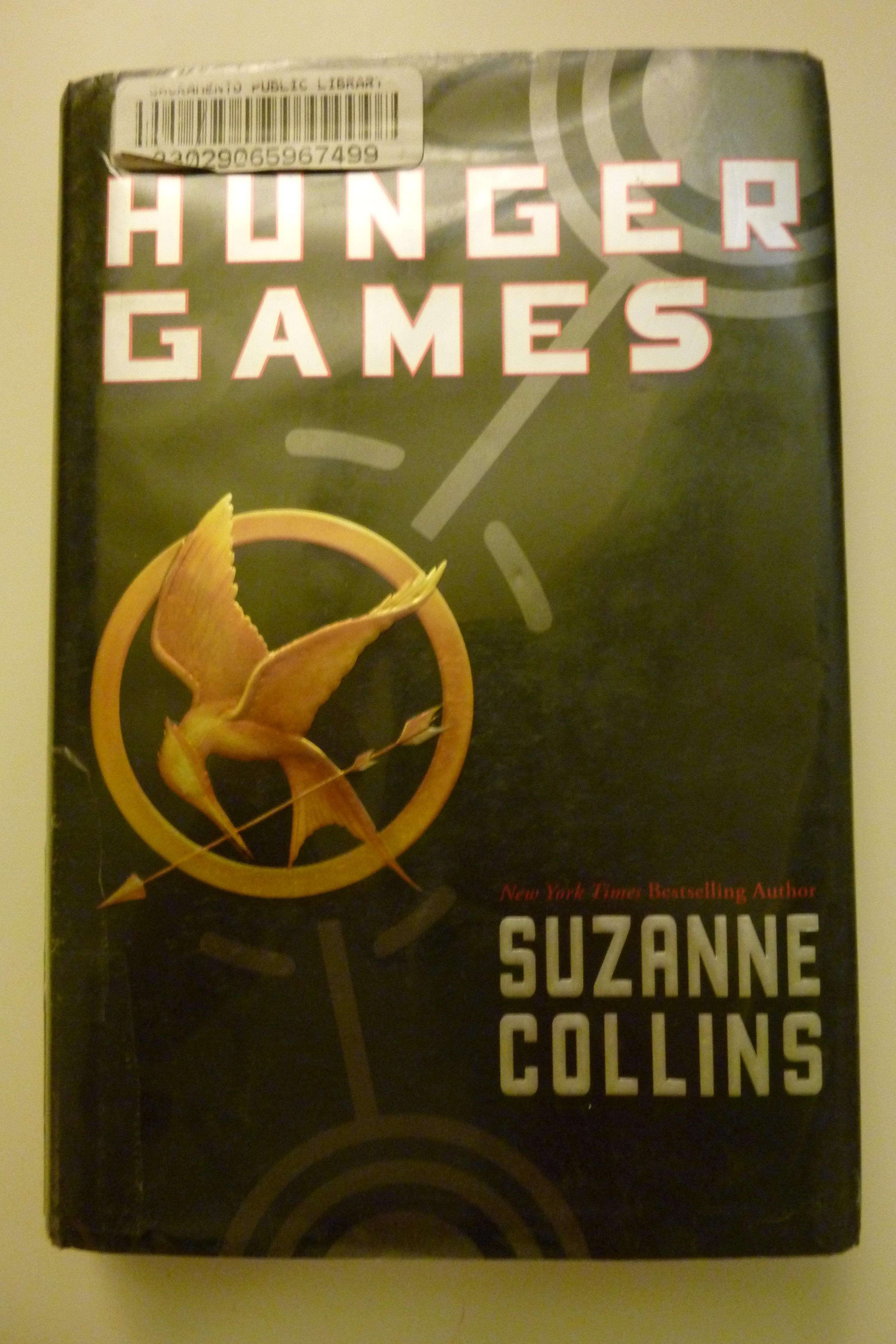
If you follow any other YA book blogs, odds are you’ve heard about The Hunger Games by Suzanne Collins.  They seem to be the latest sensation in YA literature.  I’m coming to the game (so to speak) a little late, as I finally picked up The Hunger Games just recently.  It’s darker than my usual fare–but it turned out to be excellent.
In case you haven’t heard about it, The Hunger Games is set in a future dystopia, where society is organized into one wealthy capital and twelve surrounding districts; it reminds me somewhat of ancient Rome and its provinces, and of South Africa’s townships.  Seventy-four years previously, the districts rebelled against the capital.  They were crushed, and ever since have been forced to participate in the annual Hunger Games.

A teenage boy and girl is selected by lottery from each district.  The 24 tributes are placed together in an enclosed landscape, where they have to fight nature–and each other–to survive.  Twenty-three will die.  Wealth will be showered on the single victor and his/her district.  And the whole thing is televised: entertainment for the capital, mandatory viewing in the districts.

The book centers on Katniss; when her beloved twelve-year-old sister is selected for the Games, Katniss desperately volunteers in her place.

You see by now why this seemed darker than what I normally read?  It is a very grim premise–but a brilliant book.  And not so unlike other things I’ve read; in fact, I kept getting the feeling I’d read it before.  Life in Katniss’ district (the very poor 12) reminds me of Gathering Blue by Lois Lowry.  The Hunger Games remind me a lot of Surviving Antarctica, though more cut-throat.  I’m even reminded a little of some aspects of Uglies by Scott Westerfeld.

But this one does stand out.  I think what impresses me the most are the characters, and the deft handling of multiple conflicts.

Almost every character, even the minor ones, felt vivid and alive.  Katniss is a powerful character.  Life is a struggle in District 12, and she’s been fighting to keep herself and her family alive since she was twelve.  Her father is dead and her mother provides limited material and emotional support.  Katniss is forced to be tough, and is in many ways wary of others–but she also fiercely loves her little sister, and cares about her best friend, Gale.

The conflicts Katniss is enmeshed in are many and varied.  There’s conflict on the political level–even if I hadn’t picked up information about the later books in this series, the society and the past rebellion make it clear enough that a new rebellion is coming.  That’s mostly in the background of this first book, but it’s there.

There’s the day-to-day struggle to survive, first to fight starvation in District 12, and then the even more immediate danger in the Hunger Games.  Katniss has to literally fight to survive, using knives, arrows and her wits.

And there’s the love triangle.  Did I mention her best friend Gale is a boy?  Collins develops their relationship well, as friends beginning to be something more; I’m especially impressed by how well Collins conveyed this, considering Gale is only in the early chapters, and briefly in memories and references later.  He’s left behind when Katniss goes to the Games with Peeta, the boy selected from District 12.  They play up being in love as part of a strategy for the Games–until Katniss begins to be unsure what’s the Games and what’s real.  I always like triangles best when a character is pulled equally in two directions.  When a girl’s madly in love with one boy and just really fond of the other (ahem, Twilight, I mean you), I don’t really see the point.  In this case, I really can’t tell how it’s going to come out–and no one tell me, I haven’t finished the trilogy yet!

All of the external conflicts lead to a lot of tangled internal conflicts for Katniss–wondering how she feels about Peeta, worrying about her family, resenting the capital, struggling to survive…and none of it feels foolish or superfluous.  It could very, very easily come out sounding stupid, with me yelling at the book, “Why are you worrying about romance while people are trying to kill you?!” but it really doesn’t feel that way.  The romance is given a little more weight than I’d like at the very end, but overall it’s handled beautifully in a way that feels very reasonable and natural.

This is a dark book, and I’d definitely consider it older YA.  Despite being about teenagers killing each other, most of the book is actually not too gruesome or graphic.  People bleed and die, but not too graphically.  However, there is a more disturbing scene near the end, so be warned.  Most of the book is powerful but not too far over the edge into horrible, and Collins actually manages well to throw her characters into a kill-or-be-killed scenario but keep them sympathetic and redeemable.

The televising of the Games is another element I found especially intriguing.  It’s sensationalism to an extreme.  There’s some forced comparison to Rome (officials involved in the Games tend to have Roman-reminiscent names) but I find it much more powerful to compare it to our culture.  Maybe it’s an easy comparison because I was reading this the same day Casey Anthony’s verdict came down.  Why are we, as a culture, fascinated by other people’s pain?  Why do we want to know the gory details?  It has nothing to do with our own lives–why is a murder trial in Florida front-page news 3,000 miles away in California?  All the horrible, sensationalist news stories are someone’s life, and it’s disturbing that it becomes a sort of entertainment for the masses.

The more I think about The Hunger Games, the more impressed I am by how well it’s put-together, by how clearly characters were painted in just a few strokes, by how absorbing the plot was.  I have the second book on reserve at the library–#70 in line, but there are over 80 copies in the system, so I hope to get it quickly!

Author’s site: http://www.thehungergames.co.uk/

Update: Read my review of The Hunger Games movie!

Journeying to Mars to Meet Tavia

Having just reviewed one of my favorite authors, L. M. Montgomery, it seems only fair to also review my other favorite author this week: Edgar Rice Burroughs.

They have some interesting differences and similarities.  The differences may be more obvious: Montgomery wrote about the small things of life in a rural village.  Burroughs wrote exciting adventures set in the jungle, or on the surface of Mars, or deep under the Earth.  But they both knew how to create a vivid world (albeit very different ones!) and how to write beautiful prose and wonderful descriptions.  Montgomery almost always has a young girl as her lead character.  Burroughs almost always has a strapping, warrior man as his hero.  But they both wrote sweet and very discreet romances–those warriors of Burroughs are also perfect gentlemen.  They also have in common that I’ve read book after book after book by them, and very, very rarely found one that wasn’t top quality.

An odd coincidence of a similarity: they were born less than a year apart.

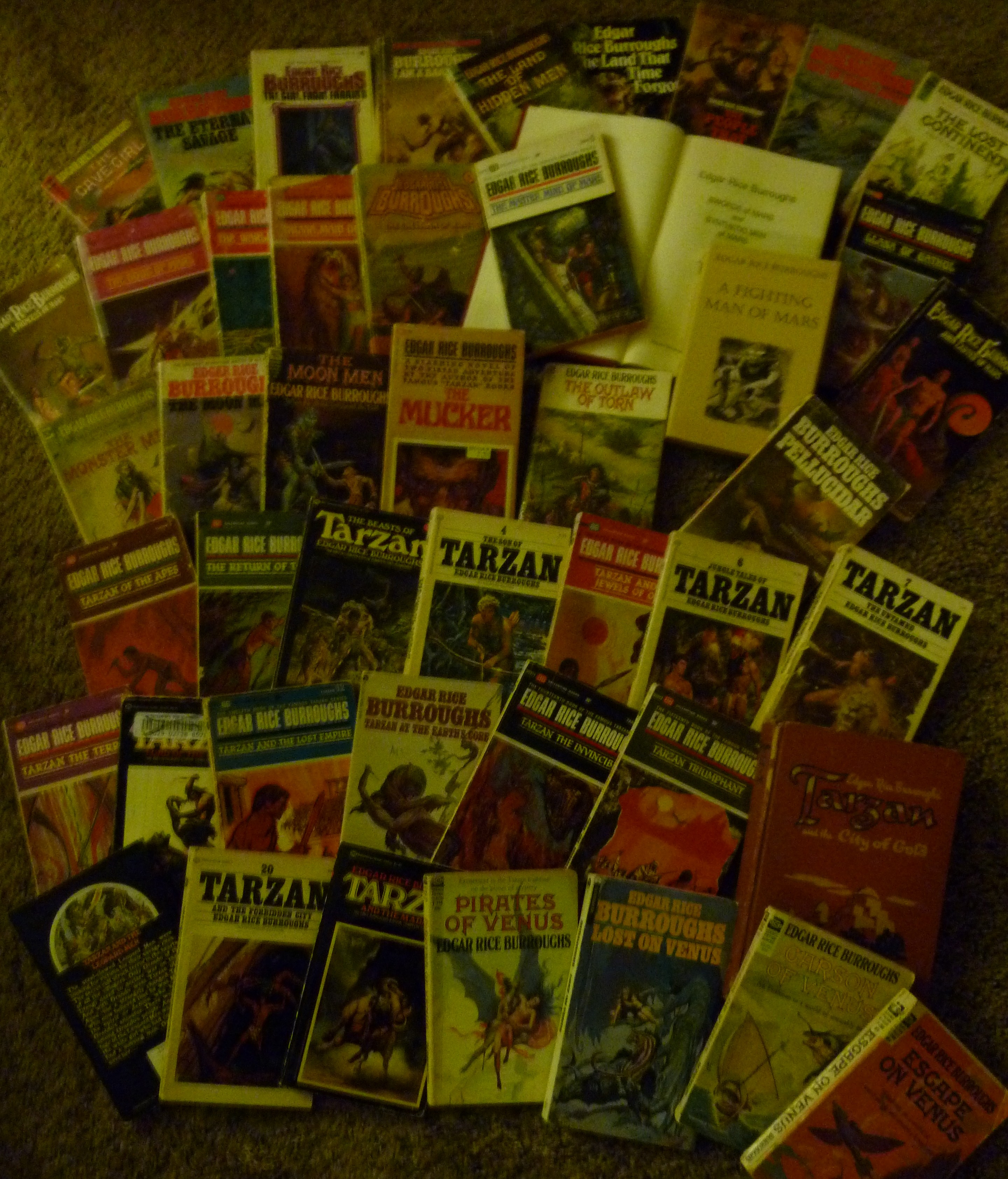
Since I showed all my Montgomery books, why not all my Burroughs books too.

I already reviewed Burroughs’ most famous book, Tarzan of the Apes.  As you can tell from the picture above, he went on to write a lot of sequels about the lord of the jungle–over twenty.  But what I really want to write about today is his other most famous series: his Mars books.

They begin with A Princess of Mars.  John Carter is in a desert in Arizona, where he has a strange out of body experience.  He looks up at the sky, and sees the planet Mars.  He holds his arms up to the sky, and wishes–and finds himself on the plains of Mars.  In Burroughs’ world, Mars (called Barsoom by the natives) is populated by a number of warlike races, from the red Martians who look much like us, to the giant, twelve-foot-tall green Martians.  There are all kinds of other strange animals with six legs or weird stripes or bizarre abilities.  John Carter goes on to have a series of adventures full of swordplay and races against time and endless hazards and escapes, all to win the beautiful Dejah Thoris, princess of Mars.

The first three books in the eleven book series, as well as a few later ones, focus on John Carter.  My favorite, however, is A Fighting Man of Mars.  John Carter is referenced, but the action focuses on Tan Hadron, a red Martian warrior.  In some ways it’s not unlike every other Burroughs adventure: swordplay and kidnapping and a desperate quest to rescue the girl.  (Burroughs only had two plot devices, kidnapping and castaways, but he spun them into 70 adventures.)  A Fighting Man of Mars, however, is different because of Tavia.

Image taken from ERBzine.com

People who have known me on the internet for a long time will know that when I need a fake name online, a username for example, I will usually use Tavia or some variation on it.  In a way it’s a habit–I started doing that at about thirteen, and it’s easy to carry on using the same name whenever this comes up.  And it got started because Tavia is a wonderful character in a wonderful book by one of my favorite authors who, I must admit, rarely wrote a really good heroine.

But Tavia is actually capable.  She escaped on her own out of a harem (fleeing when the King first noticed her–Burroughs heroines get into dangerous situations but are never actually harmed).  She’s pretty much as good with a sword as Tan Hadron.  She’s extremely capable at almost anything that needs doing on their adventure.  Though I do think she’s pretty, her internal characteristics are emphasized much more than her external beauty.  And I find this to be one of Burroughs’ more meaningful and compelling romances.

Sure, there are more impressive heroines when you look across the range of literature.  But Tavia is a great character in her own right, and she’s the best of the ones that Burroughs gave us.  It’s the combination of all of Burroughs’ strengths of writing and excitement and world-describing, combined with a much more appealing heroine, that makes A Fighting Man of Mars my favorite Burroughs book.  It’s the seventh book in the Mars series, but don’t feel obligated to read the first six first.  They’re great books too, but it’s an independent story and Burroughs even provides a helpful overview of Martian society in the foreword.  So I think you’ll do fine if you want to jump ahead to number seven to meet Tavia.

Following Scott Through Antarctica in 2083

As you may know from reading past posts, I’ve developed a small obsession with Antarctic explorers lately.  So when I was doing some writing at the library and my eye caught the word Antarctica blazing (freezing?) out of the fiction section, I had to investigate.  I found Surviving Antarctica: Reality TV 2083 by Andrea White.

The story is set in 2083, where five fourteen-year-olds are on a reality TV show recreating Captain Scott’s historic trek to the South Pole.  But in this dystopian future, reality TV has reached a whole new level of realism–where no one interferes, even when that means people die.  And when you’re sending kids to recreate a journey where five men did die…well, that guarantees some good adventure programming, right?

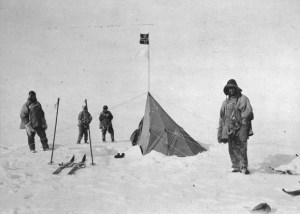
Scott and his men at the South Pole

They had me at Scott.

I admit I was in it for the Antarctic explorers side of things, so I was pleasantly surprised to find a fascinating dystopian society too.  In this future, the government has gone broke.  Since they can’t afford anything, like scientific research and schools, they’ve decided that the way to keep the people complacent and uncomplaining is to provide better entertainment, and keep them watching television all the time.

It’s a disturbingly insightful idea.  Over 97 million people voted in the most popular American Idol vote.  About 106 million people voted in the 2004 presidential elections.  Sure, this would be more impressive if those numbers were reversed…but that’s not a big gap when you’re talking about two things as different as a TV show, and deciding the leader of the country.

So between looking ahead to a disturbing potential future and looking back to a fascinating past, you’ve got something good here.

About that past–my particular Antarctic obsession (if you’ll let me go a little poetic about it) swirls directly around the bundled and slightly frosted (but still charming) figure of Captain Lawrence “Titus” Oates.  I think Andrea White’s interest in Antarctica would shift left a little to bring fellow explorer Birdie Bowers into more direct focus.  Titus, sadly, does not come up by name until 160-odd pages in.  But I respect her interest and bring this up not as a criticism and only as a comment on my personal preferences.  I’m sure Birdie was very nice too.

Ultimately I think the concept of this was more interesting than any individual characters, although the five kids (plus one not on the mission) were all good enough characters in their way.  But it’s mostly the ideas in this book that make it work, rather than the individuals, or even the plot.  The individuals are fine, and it’s a good plot, but it’s more about the ideas.  It’s a thought-provoking book.  It might make you think about your television, or about reality TV.

It also makes me wonder if I’m going to be able to hunt down any more novels set in Antarctica.

Author’s site: http://www.survivingantarctica.com/