Classic Review: A Semester in the Life of a Garbage Bag

One of my favorite funny authors growing up (and still, to some extent) was Gordon Korman.  Several of his books still make me laugh out loud, after repeated reading.  One of my favorites, for its humor and its philosophy, is A Semester in the Life of a Garbage Bag.  Gordon Korman understands stress.

He’s also an author who proved just how awesome he is–I emailed him after I posted this review, and got a very nice email back!

***********************************

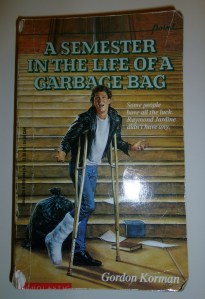
Every high school student should read this book.  Actually, everyone should read it, if only for the metaphor of the title.  A Semester in the Life of a Garbage Bagby Gordon Korman sounds utterly ridiculous–and it is.  It is a hysterical, hilarious, wonderful book.

My slightly battered, much-loved copy

But the title is actually remarkably profound.  It’s based on a one-scene reference (like To Kill a Mockingbird‘s title) when the main character describes a commercial for garbage bags.  The garbage bag is hooked up to a machine that keeps pumping in more and more pounds of pressure, and the smiling spokesman talks about how much pressure the bag is taking.  He keeps on cranking it up, while the poor bag is struggling to hold together.  Sound like high school to anyone?  Or life, for that matter?

The main character in the book is Raymond Jardine.  He has no luck.  Zero, zip, zilch.  His overriding dream is to somehow make it Theamelpos, an island in Greece which he is convinced grants extraordinary luck to all visitors.  Six students will be selected (methodology unknown) for a school trip this summer, and Jardine is determined to lie, steal, cheat, scheme, and connive his way into one of those six slots.

And that’s just the beginning of the story.  We’re guided through the book by the comparatively normal Sean Delancey, who is paired with Jardine for an English assignment.  Korman often takes the wise tactic of giving us someone relatively sane as a lead character, who can navigate us through the wild and wacky world of the book, where anything is possible.

Where it’s perfectly normal, for instance, for students to surf on trays down tables in the cafeteria–the temperature in the cafeteria is typically around 90 degrees, because the school is powered by the experimental SACGEN, which all the students know doesn’t work but which the school board is determined to insist is a great triumph.  That’s just one example of the world we find ourselves in.

The English assignment Sean and Jardine have to do together is a 30 page report on a poet of their choice.  Jardine is determined to pick a poet no one else will do (reasoning that if they pick a famous poet, another group will too, the teacher can compare the two reports, and his is bound to be worse).  Literally minutes before the deadline to choose, Jardine selects Gavin Gunhold, the author of “Registration Day.”  They rave to their teacher about how much they love Gunhold’s work, and find out later that he never wrote anything else, having died in a freak accident shortly after writing his only poem.  Their solution is start writing their own poetry in Gunhold’s style, using for inspiration words they pick at random from the encyclopedia.

As to Gunhold’s one original poem:

On registration day at taxidermy school
I distinctly saw the eyes of the stuffed moose
Move.

I’m not usually a fan of poetry, and I have probably quoted Gavin Gunhold more often than almost any other poet.

A Semester in the Life of a Garbage Bag is packed with memorable characters, funny scenes, and even an explosion or two.  You will get your money’s worth in laughs out of this book.  And surely everyone can relate, at least a little, to how Jardine feels about that garbage bag?

Author’s website: www.gordonkorman.com

Healing the Twelve Dancing Princesses

Two of my favorite fairy tales are “The Twelve Dancing Princesses” and “Beauty and the Beast.”  So of course I was intrigued by a novel that promised to retell both of them.  The Princess Curse by Merrie Haskell lived up to the promise, and it was a great book.

This is another version that tells the “Dancing Princesses” story from the POV of a girl removed from the curse itself (that is, not one of the princesses).  Reveka is the herbalist’s apprentice at the princesses’ castle, and dreams of one day having an herbary of her own.  She thinks she sees the way to achieve that dream by curing the princesses of their curse, and accepting the promised monetary reward.  As she uses her herbcraft and her wit to delve into the mystery, she finds that things are much less black and white than they seem, and that, of course, all of this will have very unexpected consequences for her.

As always with fairy tale retellings, I love the unique touches.  I love that there’s a monetary reward for women who solve the curse; most versions don’t consider how limiting a reward a princess’ hand in marriage really is.  The curse has an added dimension because people who stay in the princesses’ room either fall asleep, unable to waken, or disappear entirely.  That adds so much more risk to the story (and means that the King doesn’t have to behead anyone, something every re-teller finds a way around).  I love that there’s a handsome friend who’s in prime position to be the love interest…but it’s all more complicated than that.  And Reveka’s father–well, I should have figured out his role in the story much sooner than I did!

I felt drawn to Reveka as a heroine at once.  I’m realizing that strong girls who are unappreciated by the adults in their life immediately pull me in.  I want things to be better for them.  Reveka has a difficult (but normal for her time) past, and big dreams for her future.  She wants to solve the curse to help herself, but also to help the sleepers, so she has a realistic blend of motivations.

I liked the handling of the princesses as well.  Most blend together as an amorpheous mass (there are twelve of them, after all) but it works, because I don’t feel like I’m supposed to know who most of them are.  There are two that emerge as larger characters, and the rest mostly hover in the background.  Since they’re rarely brought forward, I’m not struggling to place them as I read, and it doesn’t bother me that I don’t know who they are.  Beyond that, they’re interestingly complex, neither the saints of most retellings or the (possible) villains of the original.  They’re real girls who are making difficult choices, and while they may do some villainous things, I don’t feel that they’re heartless or evil.

This is obviously a fantasy, but it also has a historical fiction feel.  It’s set in a fictional country, but one which is firmly planted in 15th-century Eastern Europe.  There are references to convents and saints, and a lot of historical herb-lore.  The herb-lore is never overwhelming or superfluous, and I think it serves a purpose to ground the story.  That level of detail and Reveka’s level of knowledge about it gives her more maturity and depth and gives the story more…solidity is the only word I can think of.  The premise (of the first half at least) reminds me of The Thirteenth Princess, but that one felt lighter and less plausible, and the heroine felt shallower.  The historical grounding isn’t the only thing making the difference here, but it helps.

The story wraps up in the end, but leaves some questions unanswered and…well, I can’t fully explain without a spoiler, but I wanted a more complete wrap-up.  So now I very much want a sequel!  Apparently I’m not the only one, because Merrie Haskell mentions the subject on her website–but all she says is that she promises a sequel if the publishers decide to put one out.  How very inconclusive!  So I’m hoping, and in the meantime, it was an excellent addition to my list of Dancing Princesses retellings!

Author’s Site: http://www.merriehaskell.com/

Other reviews:
Fairy Layers
Books Before Bed
Bookalicious
Maestra Amanda’s Bookshelf
Anyone else?

Classic Review: Wildwood Dancing

I reviewed some really good books when I first started this blog.  But most of you weren’t here yet!  Since I’m coming up on a busy month right now, I thought it was a good time to share again some of those early reviews.  Most of you probably haven’t read them before anyway…

Today, here’s the very first review I posted.  This book is largely responsible for my interest in “The Twelve Dancing Princesses” fairy tale, as it’s the one that got me started.  One person who read this review was Juliet Marillier, the author.  I wrote her an email and she sent me a very nice, personalized reply.  I knew she was awesome!

****************************

I plan to cover good and bad books on this blog, but for a first post, I thought I’d start with a favorite.  Wildwood Dancing by Juliet Marillier is a wonderful fairy tale retold–two fairy tales, in fact, artfully combining “The Twelve Dancing Princesses” and “The Frog Prince.”

I love retellings of classic fairy tales.  The original classics tend to have…certain issues, like helpless heroines and not entirely coherent plot lines.  But they usually have some spark that fascinates us–which I imagine is why they became classics to begin with.  For “The Twelve Dancing Princesses,” perhaps it’s the idea that you can escape your ordinary life every full moon to go dancing in a magic land (though the magic land is more or less threatening in different versions).  For “The Frog Prince,” transformation stories, changing what is into something that’s better, have an eternal appeal.

So when you can take that essential spark and reshape a new story around it, one with a vivid and intricate plot, and with an appealing and capable heroine, then you’ve got something really good.

Wildwood Dancing is about Jena and her four sisters.  They live in rural Transylvania, at Piscul Dracului, and for nine years they have been slipping away in the night to dance at the fairy court every full moon.  Jena’s closest companion is Gogu, who’s quite sweet and charming, as well as being an enchanted frog.  Jena and her sisters encounter conflict in both the human and magical world, from mysterious strangers appearing in the Fairy Court, and from an overbearing cousin who seeks to take over Piscul Dracului.

With vivid characters and exciting turns in the plot, this book stays engaging throughout.  And, on the whole, it’s at least as sweet and charming as Gogu.  I can’t say the biggest “twist” of the book surprised me, but that may be me–I’m usually good at guessing twists that I think are supposed to be unexpected.  That’s not always a bad thing though–sometimes when a twist does surprise me, I end up feeling rather like a victim of “bait and switch.”  This book, on the other hand, feels as though everything came out perfectly, gloriously right.  I read the conclusion to the romance twice–and again just now.  It’s that cute.  🙂

Author’s website: http://www.julietmarillier.com/

Abandoning the Abandon Trilogy

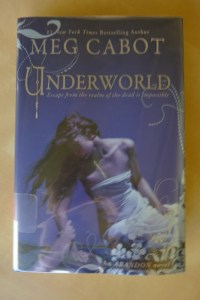
I almost never stop partway through a book.  But I got 65 pages into Underworld by Meg Cabot, and realized I was so irritated that there was no real point in going on.  I’ve never reviewed a book I didn’t finish, but…I review when I have a reaction, and I had a reaction to the first 65 pages of Underworld.  So you can view the following as venting, or as commentary on romance and female protagonists in YA fiction.  Take your pick.

Underworld is the recently-released sequel to Abandon, with one more book still to come.  The trilogy is a modern-day retelling of the Hades and Persephone story.  In the last book (spoiler alert), we met Pierce, who had a near-death experience, met John the Lord of the Underworld, and came back to the living world with John following her, intent on making her his consort.  There’s also a nasty group of Furies chasing her, and at the end of Abandon, John takes the still-living Pierce to the Underworld so that the Furies won’t kill her…which would send her to the Underworld.  It seems kind of like burning your belongings so that they won’t be stolen, but…all right, Cabot’s trying to follow the myth.  Fine.

I enjoyed the last book (read my review), though I thought Pierce was sadly lacking in depth, and I wanted to believe John was a brooding hero with a good heart, even though he hadn’t shown much evidence of the good heart part.  But all in all, I was interested in the sequel, even if my expectations weren’t high.  Low as they were, they weren’t met.

The book opens with a dream sequence (which seems like a silly place to start, for one thing).  Pierce dreams that John is drowning, and as he’s swept away, she comes to the realization that she really, deeply loves him.  Since books are often about the developing of feelings between characters, this seems like a strange place to open a book.  Also, having your character experience an epiphany moment in a dream sequence–I don’t know, it feels like cheating.

You’d kind of expect (I would, at least), that this kind of epiphany would have an impact when Pierce wakes up.  But not so much.  There’s plenty of opportunity for it to immediately have an effect, since she wakes up with John next to her in bed (shirtless, something very much dwelled upon).  Apparently he wasn’t there when she fell asleep; I don’t remember precisely how the last book ended.  Pierce doesn’t mention her epiphany, and there follows a very fragmented conversation about their relationship and their future.

Pierce cannot seem to figure out what she’s feeling.  It’s all, I love him but I don’t want to be here but I kinda want to be here but what about my mother but I don’t want to lose him but he’s also kind of pushy but maybe I shouldn’t say so and oh, he gave me a bird, that makes up for everything but then he didn’t tell me if I eat the food I’ll be trapped here and oops, I hurt his feelings, I’m a horrible person.

That’s basically a summary.  And sure, I suppose she’s meant to be conflicted, but it didn’t feel like a conflicted character.  It felt like we were skimming along on very shallow emotions which were never pursued, and changed so often that I was getting dizzy.

But the big problem–the really BIG problem, which you might be catching from my summary already–is the dynamic between John and Pierce.  It’s scary.  I mean, it’s making Edward and Bella look healthy by comparison, and that’s hard to do.

John is nowhere demonstrating to me that he has that good heart I wanted to believe in through the last book.  In fact, he comes off as manipulative, controlling and emotionally abusive.  He directly says that he only gets “wild” when he’s trying to protect her, which sets all my alarms going about an abusive boyfriend.

John pulled Pierce out of her life, took her away from all her friends and family, put her in his castle alone and locked all the doors so she won’t wander around…to protect her.  That is SO creepy.  He doesn’t give Pierce any real choice about all of this, doesn’t treat her with any respect, or like she has any right to make decisions about her own life.  He actually justifies locking her into the castle, because she might foolishly decide to venture out and put herself at risk.

And the scariest part is–I don’t think he’s supposed to be the villain.  I really think he’s supposed to be the romantic hero and all of this is well-meant.

CREEPY.

I know Cabot is tied into a tricky storyline from the original myth, but this didn’t have to be this bad.  I’m reminded of Robin McKinley’s Beauty.  The Beauty and the Beast story is similar, in terms of the Beast keeping Beauty in the castle, but I love McKinley’s Beast.  They have a lovely, sweet romance.  In a weird way, maybe it’s because the Beast never claims to be protecting Beauty.  He’s keeping her in the castle and it’s all above-board and honest, and it doesn’t have this emotional manipulation going on.

The dynamic in Underworld gets even more disturbing.  I find it most alarming that Pierce keeps blaming herself when John gets upset.  She tries to mention the whole thing about him in bed with her and maybe they should set some boundaries, and he’s deeply offended–because obviously he was only there because she had a nightmare and he was trying to comfort her, and why didn’t she figure that out?  And they can talk about boundaries, but it’s kind of pointless because they’re going to be together for eternity.

Then when they have breakfast, Pierce misremembers the Persephone myth, eats a pile of waffles figuring she won’t be trapped unless she eats a pomegranate, and then finds out any food ties her to the Underworld.  Granted, she was an idiot and should have checked on something like that.  But he also should have made sure she knew what she was doing, and “I thought you knew” is an incredibly lame excuse.  When they fight about it, he storms out after misinterpreting everything she says and she ends up berating herself for hurting him.  Um…what?

This is the second time I’ve seen a Cabot heroine (they don’t deserve the term–female protagonist, let’s say) fight with her boyfriend and then decide she was wrong–when she was RIGHT.  I don’t mind flawed protagonists, or characters who need to grow, but I can’t escape the feeling that Pierce and John aren’t going to grow at all, because they’re supposed to be fine the way they are.

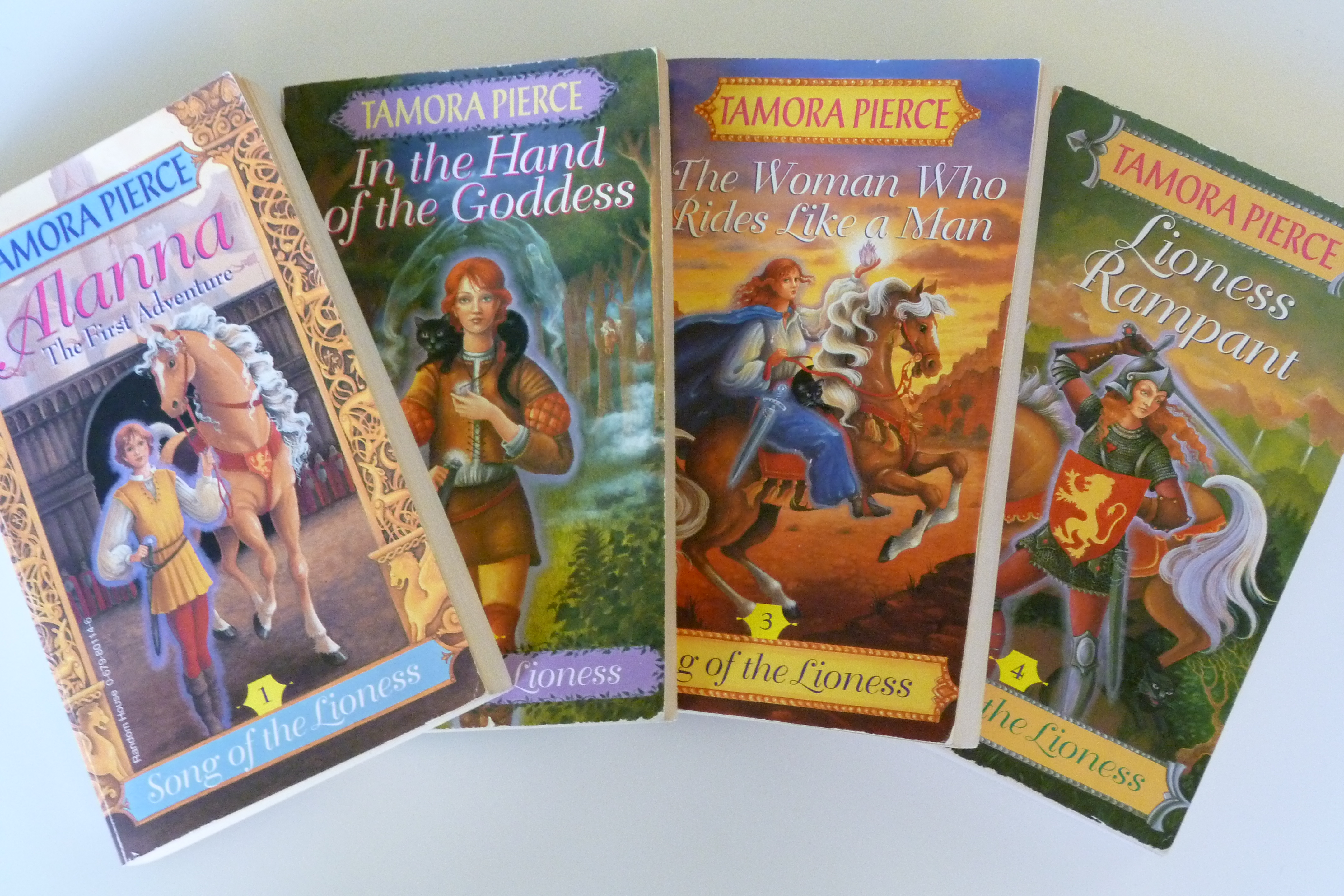
On the plus side (sort of), 65 pages of Pierce made me profoundly grateful for Alanna the Lioness and Princess Cimorene, for Valancy and Symone and McKinley’s Beauty, to name just a few of the so much better heroines out there.  And, for that matter, 65 pages of John made me grateful for George Cooper, King Mendanbar, Barney Snaith, Titus Oates and McKinley’s Beast.

This is why I stopped on Page 65.  By that point I wanted to throw something (maybe the book) at Pierce, and there are too many better books out there to waste time getting frustrated by a dysfunctional YA romance.  And if someone else finished it and knows that the relationship or the characters vastly improve–please, I’d love to find out I’m wrong here!

Author’s Site: http://www.megcabot.com/

Other reviews:
Reading with ABC
Dark Faerie Tales
The Page Sage
I’m a Book Shark
Dazzling Reads
Hippies, Beauty and Books, Oh My
And lots more…tell me about yours!
The Stories That Change Our Lives – Inspiration from Tamora Pierce

Today I have a post up on my company’s blog, PhilanthroPost, about how inspiring I found Tamora Pierce’s books when I was growing up.  I’d very much appreciate it if you’d drop past the blog to read it, and maybe leave a comment or a like!  Here’s the beginning of the post:

***************

“Girls are 50% of the population. We deserve to represent 50% of the heroes.”
– Tamora Pierce

Sometimes the people who inspire us never existed.  And sometimes it’s the people who created those fictional characters who furnish the inspiration.

Tamora Pierce is an author of young adult fantasy novels, and at the risk of sounding like I’m exaggerating, I can tell you that she changed my life.  Tamora Pierce writes books about strong women, or “sheroes.”

When Pierce was starting out in writing, there was (and to some extent, still is) a belief that books about boys were more marketable.  The theory goes that young adult girls will read stories about male heroes, but young adult boys won’t read about female leads—write about a boy and you have twice the market, meaning there weren’t as many stories about heroic girls, and not as many role-models for girls to read about.

But almost thirty years ago, Pierce wrote Song of the Lioness

Read the rest of the story on PhilanthroPost!