Magicians, Neo-Druids, and an Orphan Waif

What if a magician in the sideshow had real magic?  It’s a great premise…and just the smallest part of Mairelon the Magician by Patricia C. Wrede.  It’s an excellent book, but it will do you no good to read the plot summary (at least on the copy I had), as it only addresses the first twenty pages.  Sometimes I wonder who writes these things…

So, as to the actual plot: Kim is an orphan on the streets of London, a girl who disguises herself as a boy to avoid the wrong kind of attention.  A stranger hires her to spy on Mairelon the Magician, who puts on the aforementioned sideshow.  Kim quickly realizes, however, that Mairelon is not merely an illusionist, but a real magician.  That’s as far as the book jacket will take you.  That’s barely the beginning, though.  Most importantly, Kim doesn’t find it at all shocking that he can actually do magic.  You see, Kim lives in a London where magic is real–it’s an academic, rich man’s profession, but it’s real.

The setting is actually very similar to Wrede’s Sorcery and Cecilia books, a magical version of Regency England, although her blog says they are not proven to be the same world.  I’d kind of like to think that they are.  🙂

Back to the plot, beyond what the book jacket says: Mairelon apparently sees something of value in Kim, and takes her on to be trained as his assistant for his magic show.  Kim quickly finds herself enmeshed in Mairelon’s quest to find the Saltash group, several silver objects that together can do powerful magic.  The quest takes them out of London and into the countryside where everyone you trip over is also chasing the same objects, though for various reasons.

It’s an often very funny story, a good mystery, and I enjoyed the characters.  Kim is a smart girl who knows how to watch out for herself, while watching for a chance to improve her lot.  She has a soft side too, and gets fond of Mairelon, even if she’s not likely to admit it.  Mairelon is one of those flamboyant characters who can be serious underneath it, who means well and is also enormously stubborn.  So is everyone, actually, including Kim and Hunch, Mairelon’s combination guard, wagon-driver, assistant and friend.

It’s the interplay between the three of them that I like best.  Mairelon’s tends to rush blithely ahead, carefully oblivious to Hunch and Kim’s attempts to restrain him for his own good.  The result is a lot of glowering, cursing and deliberate misdirections of the conversation.  I imagine you can surmise who’s doing what.  Hunch and Kim start out disliking each either, but develop a mutual respect–but one not likely to be admitted.

The other best part is the Sons of the New Dawn, a neo-druid group who have no idea what they’re doing, but whose leader is wildly adamant about finding his Sacred Dish, which is unfortunately the same as the Saltash Platter Mairelon wants.  They’re very funny all around.

The book winds up with a final scene featuring at least a dozen people and probably the best example of written hubbub I’ve ever seen.  I confess I have trouble balancing dialogue with three or more characters–Wrede somehow writes twelve people arguing with each other.

The end is somewhat marred in that she winds up the hubbub and then spends pages explaining everything that happened.  It’s the same device as a detective story, where the detective unmasks the killer and then neatly lays out all the steps of the crime and the investigation.  It goes on a bit, though, and feels somewhat forced.  On the other hand, she gets points for not leaving the reader wondering what on earth was going on–I’ve seen books that could desperately use a few pages of someone explaining it all.

There’s a sequel to the book, which I haven’t read yet–but if anything, the plot (if I can trust the summaries!) looks even better, so I’ll be tracking that down soon.  🙂

Author’s Site: http://pcwrede.com/index.html
Following Beka to Port Caynn

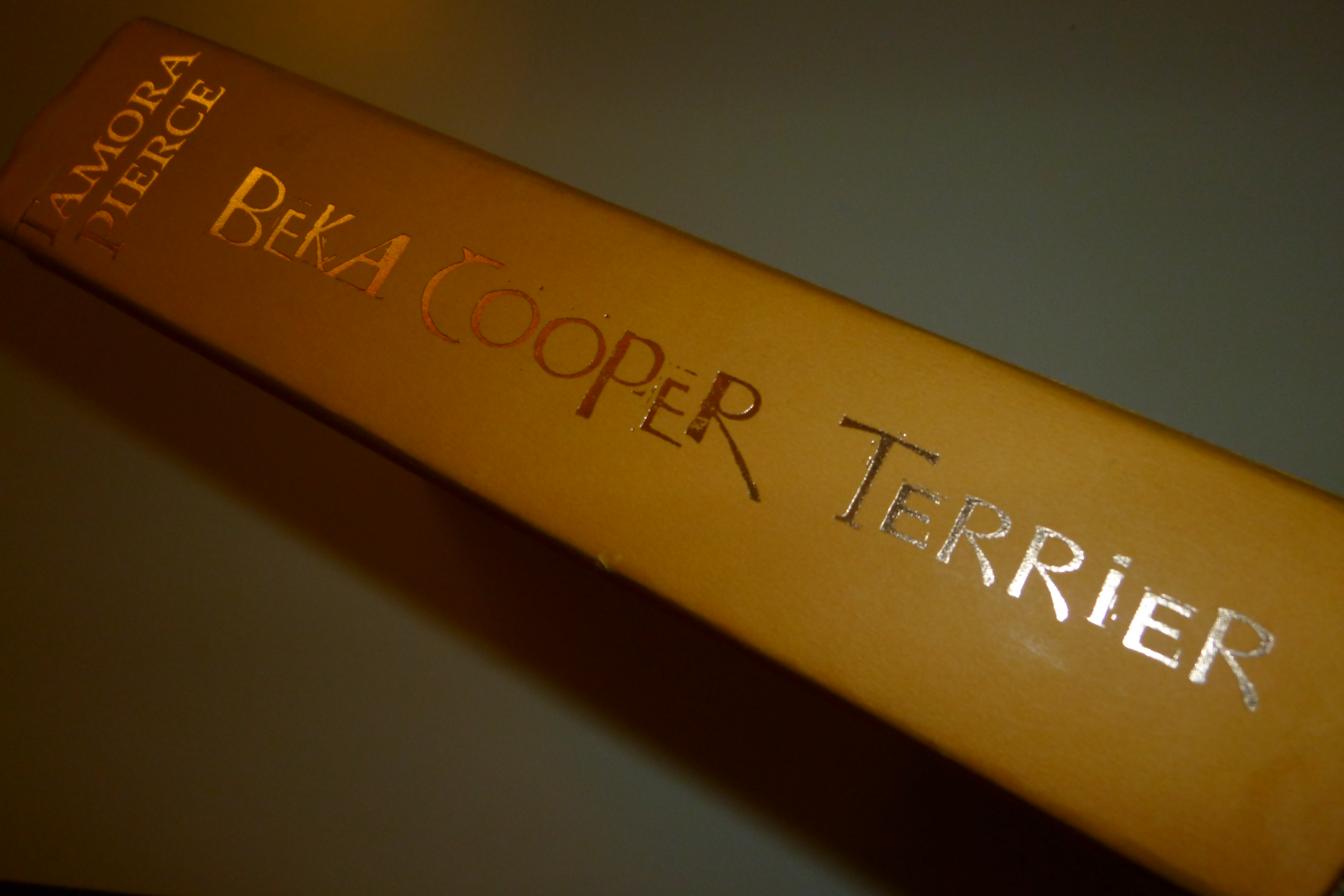
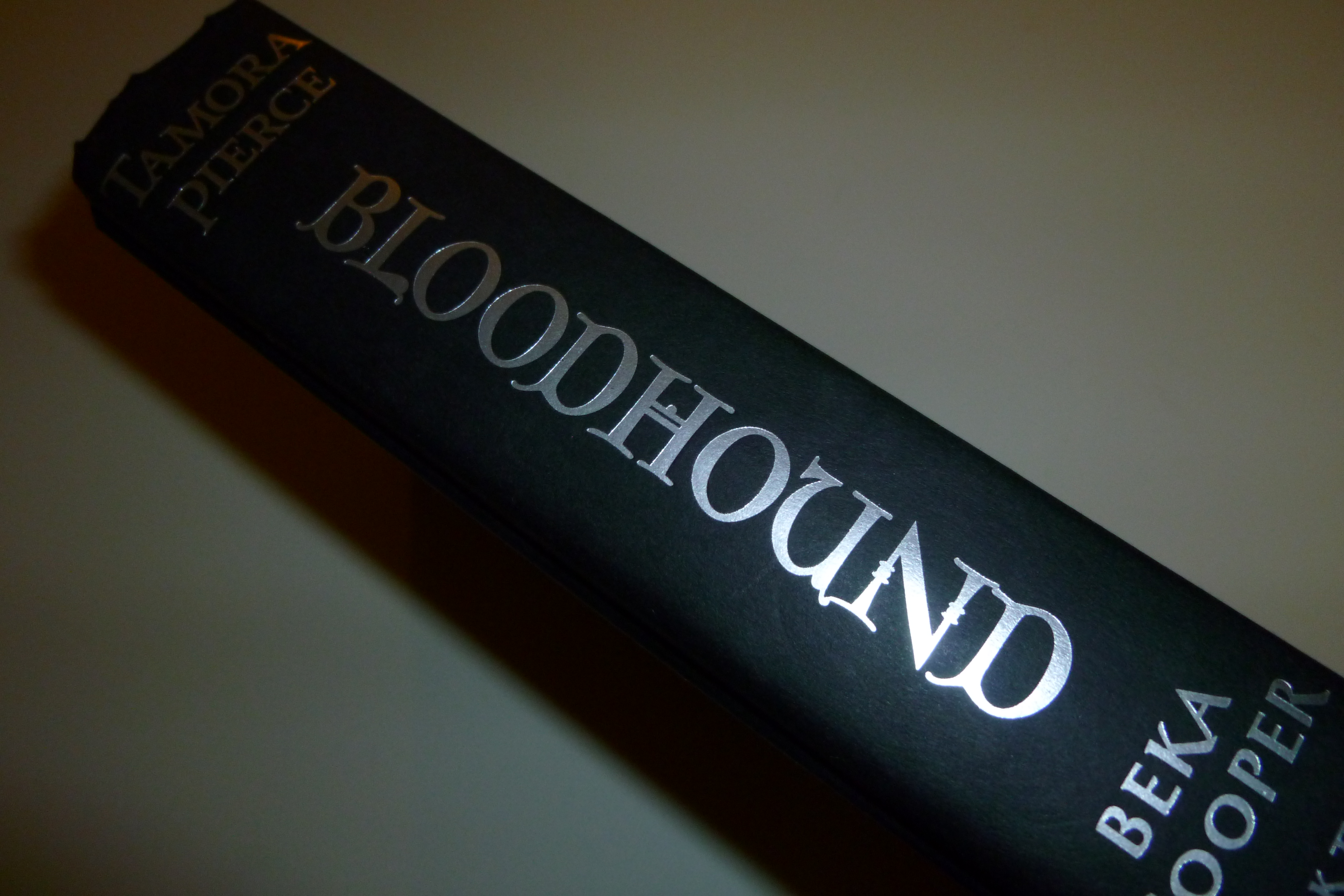
In anticipation of Tamora Pierce’s newest book, Mastiff (out last month–I’m behind in my reviews!), I recently reread the first two books in her Beka Cooper trilogy.  You can see my review of Terrier for more background.  Today, my subject is Book Two, Bloodhound.

The second book is set about a year and a half after the first.  Beka has finished her training year and is a full-fledged (though junior) City Guard, or Dog as the slang has it.  Beka is taken out of the world she’s familiar with when she and her mentor, Goodwin, are sent to Port Caynn, another city in Tortall, to track a ring of counterfeiters.

It’s a solid and exciting plot; Pierce mentions somewhere in the acknowledgments that she was afraid counterfeiting wasn’t exciting enough, but I think she does very well with it.  The dangers of inflation seem abstract in the extreme, but she manages to make it very concrete.  There’s a riot when bread prices go up, and frequent concern about food shortages and starvation.  In other words, the threat feels real.

Going to a new city means a number of new characters, many of them excellent.  The villains are particularly fascinating, and I wish some of them had been given more screen time, so to speak.  There was also a transgender character, possibly the first I’ve seen in YA fantasy.  I like it that Pierce takes a contemporary social issue and puts it into a very different setting–but any message she’s making with the character is still very clear.  It’s a perfect example of fantasy’s ability to comment on the real world–and sometimes it actually has more impact when it’s in the different setting.

My favorite new character (who was technically introduced in the last book, but just barely) is Achoo, a scenthound Beka adds to her menagerie.  Achoo is a brilliant tracker–and she’s also just lovable and adorable.  One of my favorite moments in the book is when a completely ruthless villain does a total about-face and starts fawning over Achoo.

There are probably those who would say that their favorite new character is Dale, although I disagree.  Beka has a romantic fling with Dale, and while I suppose it’s well enough, I never could get into it as a romance.  Beka doesn’t know him very well, and she doesn’t trust him, which is a problem right there.  He’s a nice enough fellow, good-looking, and he likes to gamble, but we don’t know much else about him as a character.  The relationship moves fast, and I didn’t feel like Beka or I knew Dale well enough to be going where it went.  It’s not terrible–it’s just not a great romance either.

On the plus side, Beka does seem to be shedding most of the shyness that didn’t quite work for me in the first book.  By this one, she seems to be mostly just nervous about public speaking, and it felt like a much more plausible character trait.

All in all, despite a so-so romance, it’s a very good book.  There’s plenty of excitement and tension, and many characters who were adequately developed.  I’m looking forward to diving into the conclusion of the story!  Stay tuned for a review very soon.  🙂

Author’s Site: http://tamorapierce.com/

An Urban Adventure from Tamora Pierce

I recently reread Terrier by Tamora Pierce, in anticipation of the third book in her Beka Cooper series coming out (Terrier is the first).  As I generally expect from Tamora Pierce’s books 🙂 it’s an excellent story with a strong female lead and solid characters of both genders.

For those familiar with Pierce’s Tortall books, Terrier is set a few hundred years earlier than her usual time period.  George Cooper is a major character in Song of the Lioness and the Trickster books, and this series is about one of his ancestors.  George is the King of Thieves, but his ancestor was a…well, I suppose policewoman is the right word, though it sounds too modern.  She’s a member of the City Guard, who are a little rough around the edges but work to keep the peace in Corus, Tortall’s capital city.

Terrier is about Beka’s first six weeks or so as a City Guard, or a Dog as they’re known in the slang.  She starts out as a Puppy, assigned to two more experienced Dogs who mentor her.  Beka is from the poor Lower City, and that’s where she chooses to work too, among the people who are often forgotten.  She quickly latches on to two crimes to investigate–one involving a string of child-kidnappings and murders, another involving mysterious, magical rocks and mass-murderings of the men hired to mine them.

I love the plot of this.  Many of Pierce’s books cover a longer scope of time, and pick up more threads.  I love that too, but I also enjoy the focus of this one.  It’s essentially a weaving of two mysteries, while Beka learns the ropes of being a Dog, and grows in the process.  Some of the character growth, especially at the beginning, seemed a bit swift, but in some ways I did enjoy the compressed timeline that made things move faster.

There’s a good cast of supporting characters, from Beka’s mentor Dogs, Goodwin and Tunstall, to her friends, among the Dogs and among thieves at the Rogue’s court–the Rogue is a bit like a mob boss, who has a tacit understanding with the Dogs because he keeps order among the criminals (that’s also George’s job, a couple centuries later).  Even the villains are well-drawn characters.  And I must say, I loved Lady Sabine, another female knight.  This was long before Alanna, when girls were allowed to hold the job.

There’s also Pounce.  Pounce is Beka’s enigmatic black cat, who has purple eyes and sometimes talks.  You may remember how much I love Faithful, Alanna’s purple-eyed, talking black cat.  Definitely not a coincidence, and we get just a little more insight into Faithful/Pounce’s origins here.  Much as I love Faithful, though, I’m not sure Pounce gets developed to the same extent.  I enjoy him immensely, but I don’t think he has the same bond with Beka that he had with Alanna.

Beka, however, is another good heroine.  She has big dreams and goes after them, and she’s a strong female role model, as Pierce is so good at writing.  She’s grittier than some of Pierce’s heroines, with her Lower City background.  This is the most urban Tortall book I’ve read–I’m not sure there’s a plant in the whole novel.  Usually other books set in Corus are at the Royal Palace, and somehow I think there’s more open park around there.  Beka has magic, but a new kind–and a grittier one!  She can hear ghosts.  People left with unfinished business–often those murdered–will end up as ghosts, inhabiting pigeons.  Beka has learned to seek out these ghosts to get clues to crimes.  She also can hear voices captured by dust devils, which apparently hang out on certain corners.

I did have one problem with Beka’s character.  She’s supposed to be shy.  I’ve read this book twice now, and I just don’t quite believe the shyness.  I find it hard to accept that a girl who grew up in the rough Lower City, who wants to be a City Guard, and who can leap into a tavern brawl, baton swinging…can’t look a new acquaintance in the eye and answer a direct question.  Fear of public speaking, sure.  Fear of approaching strangers, inability to come up with quick replies to saucy comments, sure.  But Pierce takes it one too far, I think, and it just doesn’t ring true to me with the rest of her character.

But that’s one flaw in an otherwise very good book.

There’s far less shining lights and dramatic magic and epic swordfights in this book than in many of Pierce’s others.  This is more a pound-the-pavement, get into fist-fights kind of book.  In some ways it’s darker, although there have been monsters and murders in earlier series too.  And next to something like The Hunger Games, this is a cheerful book.  I like the realism of fighting to make a positive impact in a tough world, and the hopefulness that it really is possible to do that–and to make good friends, chase your dreams, and have some laughs along the way.

Author’s Site: http://tamorapierce.com/

An Exploration on Being Dead

Halloween is coming up, and I’ve been thinking about appropriate books to review.  Halloween is one of my favorite holidays (Costumes!  And candy!), but not the easiest for me to get into thematically with book reviews, since I don’t like horror (movies are even worse than books).  But…occasionally I like something that drifts towards the spookier side, so I’ll try to give you a few reviews of books that are Halloweenish but won’t make you (by which I mean me) afraid of the dark.

Starting us off, Being Dead by Vivian Vande Velde.  What could be more Halloween-appropriate than a collection of short stories about ghosts?  In typical ghost fashion, most have unfinished business of some sort, but what and how they go about it varies widely.

The first story, “Drop by Drop,” is probably the creepiest, though it also felt a bit unfocused.  The conclusion in some way makes a lot of the rest feel irrelevant, although I don’t want to explain beyond that as it’ll give a lot away.

“Dancing with Marjorie’s Ghost” is a wonderfully traditional-feeling ghost story, the kind someone would tell around a campfire, while “Shadow Brother” takes a very different angle–the narrator’s brother died in Vietnam, and may or may not be haunting their father.

I found “October Chill” the saddest, about a teenage girl with a terminal illness who meets a ghost from the distant past.  The title story, “Being Dead” is the funniest–while having some pathos too.  It’s about a news boy who dies suddenly, and tries his hand at haunting to set a few things right before he goes on.  I think it was my second favorite.

My favorite story (and I don’t want to give you the title because there’s no way to talk about it without spoilers, if you knew which one I was talking about) started out feeling rather flat, but then had a final twist ending that was so clever I had to go back and reread the whole thing so I could see how brilliantly it was actually put together.

I enjoyed the variety of stories and the variety of takes on ghosts.  Many had a good undercurrent of creepiness or a clever twist of some kind.  None have been haunting me, and that’s a good thing!  It’s just a good collection of interesting and engaging ghost stories.

Author’s Site: http://www.vivianvandevelde.com/

A Suspicious Eye on Cinderella

Apologies for the placement of that sticker--I don't know what the librarian was thinking!

What ever happened to the twelve dancing princesses, after they quit dancing?  Well, according to Jessica Day George, one of them got mixed up in the plot of Cinderella.  Princess of Glass is a loose sequel to Princess of the Midnight Ball.  The plot is entirely different and so are most of the characters but the events of the previous book are mentioned so frequently, I think you’re better off reading it first–though you could probably start here if you really wanted to.

So, a quick summary of both stories, with a minimum of spoilers.  The twelve princesses are cursed to dance at the Midnight Ball, with twelve demon princes.  If you know the Grimm story, it’s no spoiler to say that a soldier breaks the spell on them, and marries the oldest princess.  The second book is about Poppy, another of the princesses, who is off to a fantasy country based heavily on England (complete with Tutingham Palace as a substitute for Buckingham).  Poppy is there as part of a royal exchange program.  When a serving girl shows up at a royal dance, decked out in finery and mesmerizing the prince Poppy had been growing fond of, Poppy and her friends have to investigate what spell is afoot.

This is a really clever and unique Cinderella retelling.  I love that we get it from such a different perspective.  And since Cinderella, as a person, completely annoys me in the original version, I love that this version is not such a sweet, innocent (and spineless!) character.  This book also addresses a key question the original fairy tale never answers–where did this fairy godmother suddenly appear from anyway?  The godmother’s ultimate motivations felt a little bizarre to me, but the things she does are so fascinating, I’ll forgive her doubtful reasons.

Poppy is an enjoyable heroine (aside from that dreadful name).  She’s tough and resourceful, but has emotional uncertainties too.  I particularly like it that she has all kinds of emotional issues when it comes to dancing–which totally makes sense, right?  Prince Christian is a sweetheart, even if not the most complex prince I’ve ever encountered.  There’s a good complement of secondary characters to round out the cast, including a Cinderella with unexpected depth.

One aspect that really sells me on this book is the description.  It’s lush and vivid, describing dresses, magical transportation, and truly strange glass shoes.

If I had to choose, I liked Princess of the Midnight Ball a bit better, but this was a very lovely follow-up.

Author’s Site: http://jessicadaygeorge.com/default.aspx