A Writing Lesson from Barry Manilow’s “Mandy”

As you learned from my recent review of 15 Minutes, I’m a Barry Manilow fan.  Much as I love 15 Minutes, one thing I thought it was missing was a really good “loved her and lost her” song at the climax of the story arc–and I commented that it’s not as though Barry doesn’t have plenty of songs like that to choose from.

That got me wondering about just how many he does have.  And in the process, I think I discovered a great example of a good lesson in writing.

I don’t have access to every Barry Manilow song, so I can’t give you a definitive answer, but I can tell you how many I have.  I have about 170 songs sung by Barry Manilow, probably around 140 of them original. I went through my collection to pull out all the “loved and lost” songs, using a fairly strict criteria.  Essentially: the storyline of the song is that two people were at some point happily in love; somehow things went awry, and now the singer is singing from a perspective of still loving a girl he has lost.

And the total count: thirty-eight songs.  That’s about 20% of my total Barry Manilow collection.

Of course there’s an obvious gibe here that Barry only ever sings one kind of song (which isn’t even true–after all, I have over 130 songs with a different storyline) but the point I actually want to make is how impressed I am by this–because that’s thirty-eight very different songs, all playing off of the same essential story.  I don’t know whether to compliment Barry or his lyricist, but either way–I am impressed.

Somewhere I read that there are no new stories.  It’s also been said that there are really only seven stories in the world.  So what’s the lesson for a writer, looking for something original?  It’s all in what you do with the story–how you interpret it–how you can put a different angle on it.

Let’s look at some of those “loved and lost” songs, and all the different angles.  There is, of course, the classic, “Mandy.”  Mandy used to be there for him, he got “caught up in a world of uphill climbing,” sent her away and now he realizes “I need you today, oh Mandy.”  A straight-forward tale of regret, loneliness and lost love.

Sometimes the singer has found someone new, but “Even Now” yearns for the girl he used to have.   Possibly he sought out this second girl in the interest of being “Lonely Together,” but I think she ought to pay some attention to “If I Should Love Again,” with its dreadful lines, “Although I hold her close, and want her now and then, I’ll still be loving you, if I should love again.”

At least one song borders on suicidal, with nothing to do but “Lay Me Down,” while other times there’s confident hope that “Somewhere Down the Road” they’ll be together again.  The romance in “London” apparently ended amicably but still leaves him wistful, while there may be a girl waiting for him “In Some Bar by the Harbor.”

Sometimes we see the romance still falling apart, and might yet be saved.  He feels that “We’re Losing Touch” but suggests, “Let’s Take Some Time to Say Good-bye,” and if she’d just “Talk to Me,” it all might work out.  Especially if he starts playing “The Old Songs.”

You can also find love lost at the holidays.  I have one Barry Manilow Christmas CD, and even there the same theme recurs.  It’s bleak December, but he remembers “When the Meadow Was Blooming” and they were together, and “The Bells of Christmas” are ringing for a past romance.  I also have to make a comment on “I Guess There Ain’t No Santa Claus.”  I don’t technically include this one in my list–the singer is clearly alone and lonely, but I can’t find any indication he was ever in love in the past.  It does, however, contain some real gems of lines, like “Sugar plums in my head, only me in my bed,” and “They sure got it right when they sing ‘Silent Night.'”

Occasionally the focus is on “Where Do I Go From Here?” when “I Don’t Want to Walk Without You,” and in fact, “I Can’t Smile Without You.”  Alas, sometimes, “When Love Is Gone,” all you can do is say, “Good-bye My Love.”

Point made?  🙂 Trust me when I say that this just scratches the surface.  One essential story line.  Thirty-eight songs.  Thirty-eight different angles on one theme.

Some things can get over-done, of course.  I think an awful lot of angles on paranormal teen romance have been explored recently.  But it’s still something to think about.  Writers sometimes beat themselves up looking for a new story–when maybe what they really need is a new angle on an old story.
2011 Reading Challenges – Halfway Point

I’m suspending Fiction Friday today because it’s July 1st, halfway through the year, and I want to update on my reading challenges.  So far, I’m having success–I’ve found some fun new series, enjoyed a variety of fairy tale retellings, and have knocked off some classics that I’ve been meaning to read for years.  Things slowed down for almost every challenge this quarter, but I’m still on track for halfway through the year.

The one I’m just barely keeping up with is the library challenge.  I’m still at the library weekly, but I’ve also been borrowing stacks of books from friends…which is great fun, but not helpful for the challenge!

Linked titles go to my review of the book.  If you see something you’re curious about that doesn’t have a review, let me know!  If I don’t feel like I have enough to say for a full post, I’ll at least let you know what I thought in a reply-comment.

Here’s what I’ve read so far Continue reading “2011 Reading Challenges – Halfway Point”

Update on the Once Upon a Time Challenge

It’s the beginning of summer, which means…a lot of things, actually, but among them is that the Once Upon a Time Challenge concluded yesterday.

I had a lot of fun finding some books to fit the categories.  Here’s how the reading went (links go to my reviews):

Quest the First: Read five books that are fantasy, fable, fairy tale or mythology.
Quest the Second: Read four books, one from each category.

It seems easiest to combine the lists for these two:

Fantasy

The Lies of Locke Lamora by Scott Lynch

Among Others by Jo Walton

The Colour of Magic by Terry Pratchett

The Seven Towers by Patricia C. Wrede

Johannes Cabal the Necromancer by Jonathan L. Howard

Artemis Fowl by Eoin Colfer

The Particular Sadness of Lemon Cake by Aimee Bender

Son of the Shadows by Juliet Marillier

The Light Fantastic by Terry Pratchett

Mythology

The Last Olympian by Rick Riordan (Greek)

The Red Pyramid by Rick Riordan (Egyptian)

Abandon by Meg Cabot (Greek)

Fairy Tale-Inspired

Fire and Hemlock by Diana Wynne Jones (Tam Lin)

The Stepsister Scheme by Jim C. Hines (mostly Cinderella)

Sleeping Helena by Erzebot Yellowboy (Sleeping Beauty)

Fables

Aesop’s Fables

Fables: Volume 15: Rose Red

Quest the Third: Quest one or two, plus reading or watching A Midsummer’s Night’s Dream in June.

I watched a BBC version from 1968 last week.  I’ve seen a number of versions, but this was a new one.  It was truly bizarre on several levels.  For one thing, the fairies were all painted green.  For another, it was full of actors who I know really well in much later roles, so it was a trip to see them forty years younger.  Most notably, a very young Helen Mirren plays Hermia, and a nearly nude (and green) Judi Dench plays Titania.  It was an…interesting version.  Worth watching, but probably not going to be my new favorite telling of the story.

Quest on Film: Watch any movies or TV that also tell stories fitting the categories.

Fairy Tale: Disney’s Beauty and the Beast

Mythology: Hercules and the Underworld, Hercules and the Amazon Women

Fantasy: Dragonheart, The Page Master, Disney’s Peter Pan, Pete’s Dragon

By the end of this challenge, I can only conclude that if someone was going to design a challenge which required reading everything I normally read…it would look a lot like this one!

We’re coming up on the end of June, so stay tuned for an update on other challenges next week!

Seeking vs. Browsing, Revisited

A couple of months ago I wrote about two methods of finding books to read: browsing, finding random books at a library or bookstore; and seeking, deliberately looking for specific titles.  I’ve always been a browser, but lately I’ve decided to give seeking a try.

I must be a pretty good browser, because I haven’t noticed a big overall change in the quality of what I read by seeking.  There’s been a few really great ones; a lot that are good; and a few that are so-so or just bad.  My reading seems to follow a bell curve in quality!  I feel like that’s about the same as it’s always been.

I have felt more anticipation about what I’m reading.  I’m much more conscious of what I have lined up next, and I’m looking forward to books more–which is a bit of a paradox, when I don’t feel like the overall books have actually improved drastically!

Seeking definitely makes it easier to get to those books I’ve been meaning to read forever, to make progress on my To Be Read list, and to keep up with my reading challenges.  I feel more accomplishment about what I’m reading, like it’s goal-achieving instead of strictly recreation.  But it’s also fun to browse through the library and stumble on something wonderful–and I’ve found plenty of favorites that way.

In the end, I suppose I’m not coming to any startling conclusions.  There are merits to both methods, and I’ll probably do a bit of both in the future.  But I’ll stay a staunch seeker of television.

Persephone Today

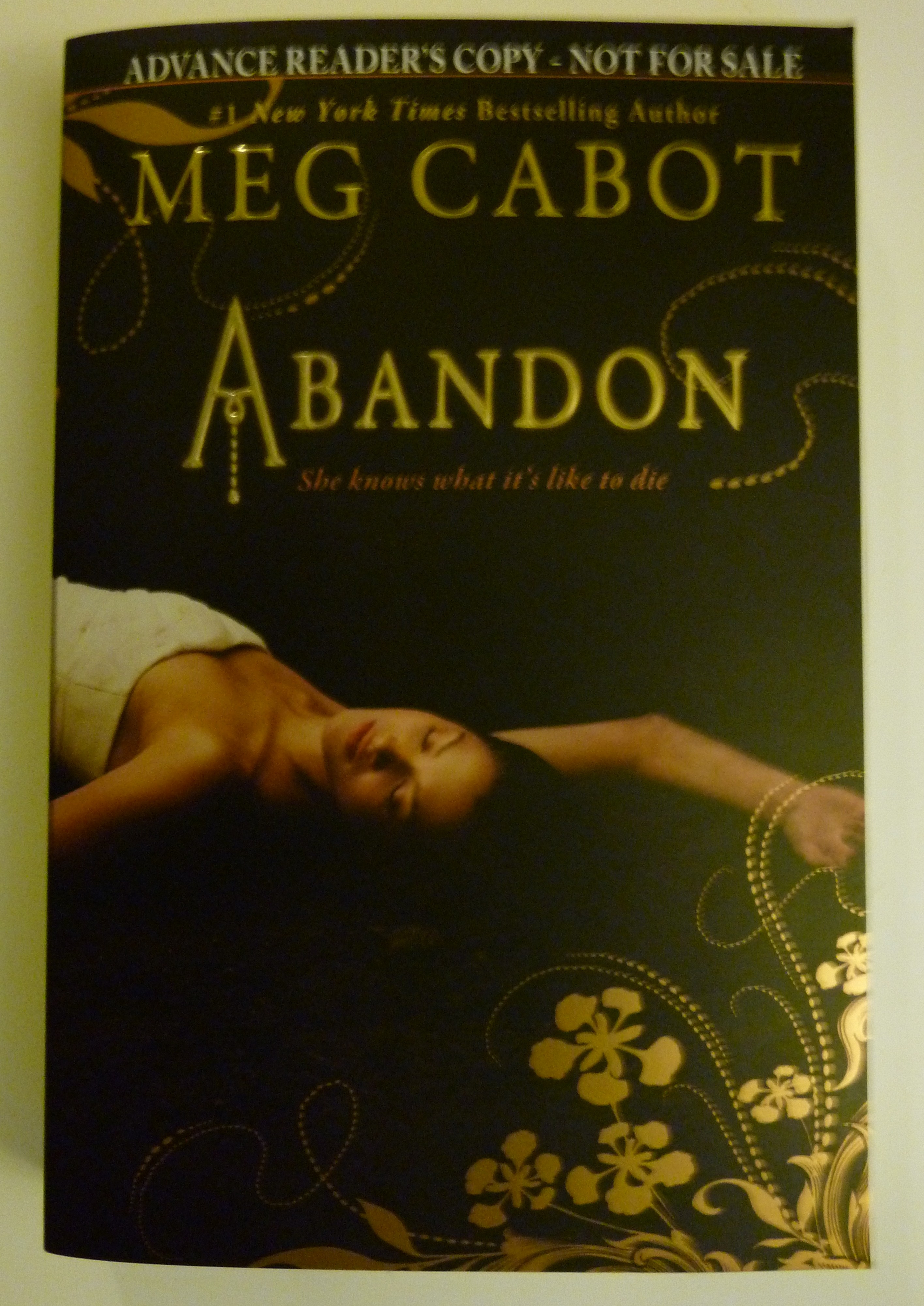
I seem to be on a mythology theme this week.  Heading back towards the Greek isles, in a way, after The Red Pyramid I read Abandon by Meg Cabot.

I’ve read a fair bit of Meg Cabot; she’s a good option when I feel like something light, fluffy and bubbly that I can read in a day or so.  Abandon turned out to be a very different Meg Cabot book.

Abandon is a retelling of the Hades and Persephone myth.  In case you don’t know it, Hades, the god of the dead and Lord of the Underworld, kidnapped Persephone, who if she isn’t the goddess of flowers (I can’t remember for sure) nevertheless gives that distinct impression.  Depending on the version, Persephone and Hades may or may not fall in love.  Ultimately, Persephone ends up dividing her time between the Underworld with Hades and being with her mother, the goddess of harvest, up on Earth.

Abandon retells this, loosely, in the present day.  The lead character, Pierce, is a teenager who had a near-death experience.  While she was dead, she met the Lord of the Underworld (who conveniently looks like an attractive 19-year-old man).  He isn’t Hades, but he has the same job.  He chooses Pierce to be his consort, but Pierce flees, the EMTs bring her back, and she tries to get on with her life.  Except that she’s convinced he is following her, hoping to bring her back to the Underworld.

The funny thing is, I very much enjoyed this while I was reading it.  Then afterwards I started thinking about all the flaws–well, the one big overarching flaw, really.  So I’m not sure where I come down on this one, except that I do feel sufficiently positive that I’ll probably try the sequel when it comes out.

I really like the concept of this, and the plot, though far-fetched in spots, is reasonably good.  It’s the characters that bring me to that big overarching flaw.

One character thing I do love–I love that the dark, brooding, fearsome and mysterious Lord of the Underworld is named John.  Not a dark, mysterious name–just John.  That’s fun.  And John is actually a decent character.  I like dark, brooding heroes with good hearts, so he at least has potential.  Although the more I think about it, the more I think I’m just assuming he has a good heart in there somewhere because it’s the only way this will work at all, not because there’s actually much evidence for it.

But John is all right.  The real problem, the big problem, is Pierce.  She’s one of those bland, underdeveloped heroines.  Other than an understandable obsession with death since her accident, and a concern for animals and other people, Pierce has almost no personality.

I made a possibly unfortunate comparison, and realized there’s a lot of similarity to Twilight–brooding, handsome, not-human hero falls obsessively in love with ordinary, undistinguished girl for no particularly compelling reason.  Edward thought Bella’s blood smelled good.  And John was totally blown away when Pierce asked how he was.

No, really!  She accidentally spooked his horse, he fell off, and she asked if he was all right.  Granted, he’s a death deity, who mostly deals with people who are dealing with the fact of their own recent demise, so he doesn’t get this sort of thing very often–but it doesn’t make her Mother Teresa!  Nor does it seem a reasonable basis for deciding that this is the person you want to–literally–spend eternity with.

Pierce does demonstrate caring for others at other times, but Cabot must have a poor opinion of humanity if she thinks it’s enough to mark Pierce out as an extraordinarily kind and giving person.  The times when Pierce does go over the top trying to help people, it’s either meddling, or totally stupid and ill-advised.

I think one reason this didn’t strike me much as I was reading is that the book went by so fast, I felt like I was still just starting when I was halfway through.  So it didn’t occur to me how undeveloped a character Pierce is until I got to the end–and she was still undeveloped.  It is part of a proposed series, so maybe she’ll get more depth in the next book…but she had an entire book, she could have gotten deeper here.

I do recommend Abandon–I enjoyed reading it–but don’t expect to find a new favorite character in the heroine.  Despite the similarity in how they met their heroes, Pierce is no Jane Eyre.

Author’s Site: http://www.megcabot.com/