Fables and Fairy Tales

Quest #2 of the Once Upon a Time Challenge was the trickiest.  This one required reading at least one book in each of the four categories–fantasy, fairy tales, mythology and fables.  The first two more or less fell into my lap, because I read those all the time, Rick Riordan took care of mythology for me, and that just left fables.  Fables was a genuine challenge.

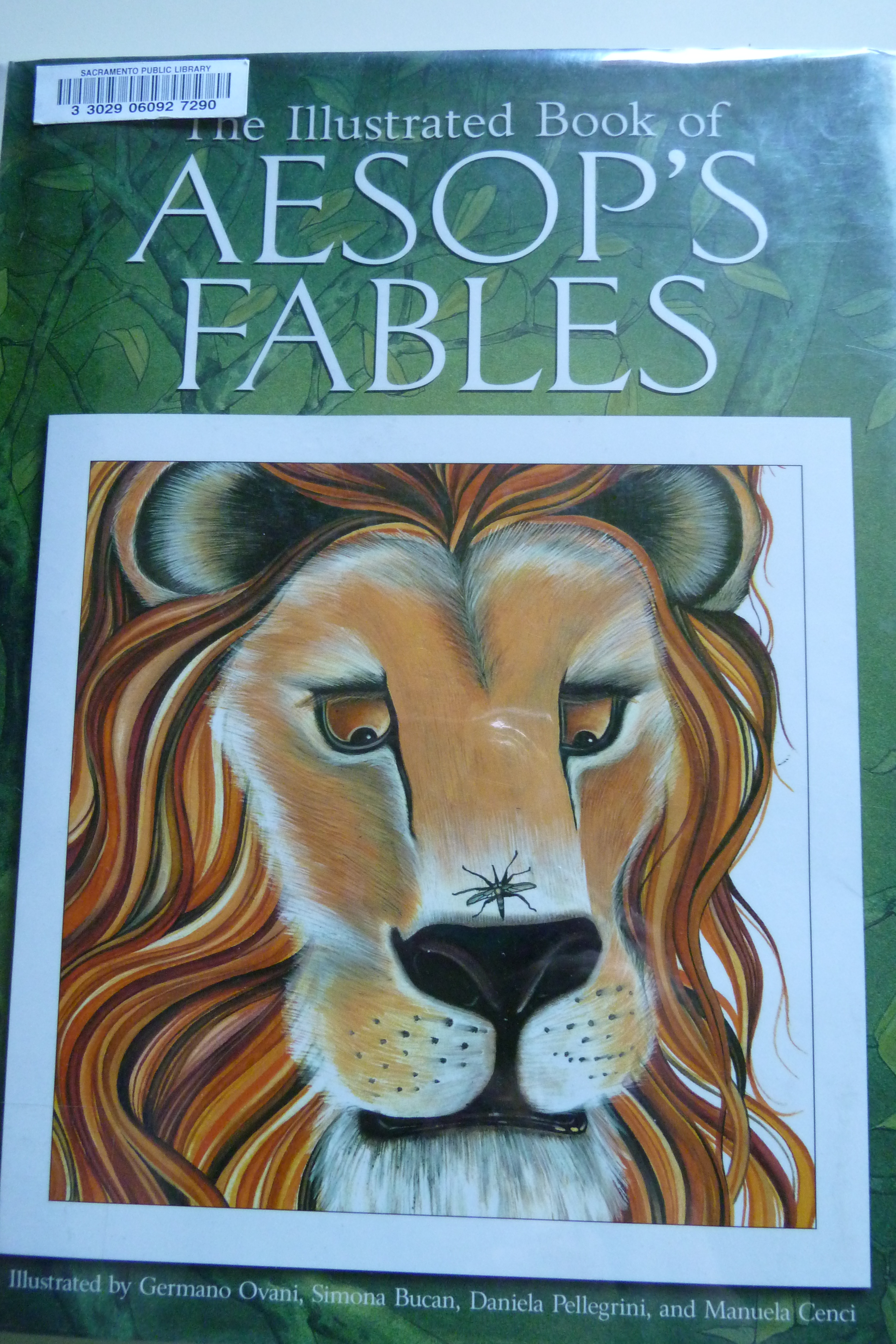
I don’t think I had a firm grasp on what would be defined as a fable, which left me somewhat at sea for finding a retelling or novelized version of one.  So I decided to simplify and pick up a book that had the category right there in the name–and read a collection of Aesop’s Fables.

I’m not nearly as familiar with Aesop as I am with Grimm or Perrault or Anderson.  And I don’t think I liked the stories as well either.  Maybe it was partially the particular collection I read, but Aesop seemed much more about teaching a moral–every story was focused on some lesson about what you should or shouldn’t do.  I like stories to have a moral, but I like it to be woven into an entertaining narrative, rather than becoming the primary focus.

Fairy tales sometimes have lessons too, but they’re usually more subtle, sometimes more complex–and sometimes more questionable too.  But then, I agreed with some of Aesop’s stories, and disagreed with others.

My sense now is that fables are more likely to be about animals or natural forces, focus on ordinary people, and have that aforementioned moral.  Fairy tales, on the other hand, often involve royalty, feature splashier magic like fairies and dragons, and are less obvious about teaching anything.  Which doesn’t explain at all why the graphic novel series Fables is called that, when they’re really more based on fairy tales, but oh well…

I suppose I could actually do some research and look up the difference between the two–but where’s the fun in that?  I’d kind of rather hunt my own conclusions based on what I’ve read.

In this collection, I only recognized one fable: the lion who spared a mouse, which later rescued him in turn.  Maybe there’s a reason that one has filtered into the culture more than others–it was my favorite!

The Once Upon a Time Challenge ends today, so I’ll be posting an update on what I read tomorrow!

Wizards and Luggage, Traversing a Disc

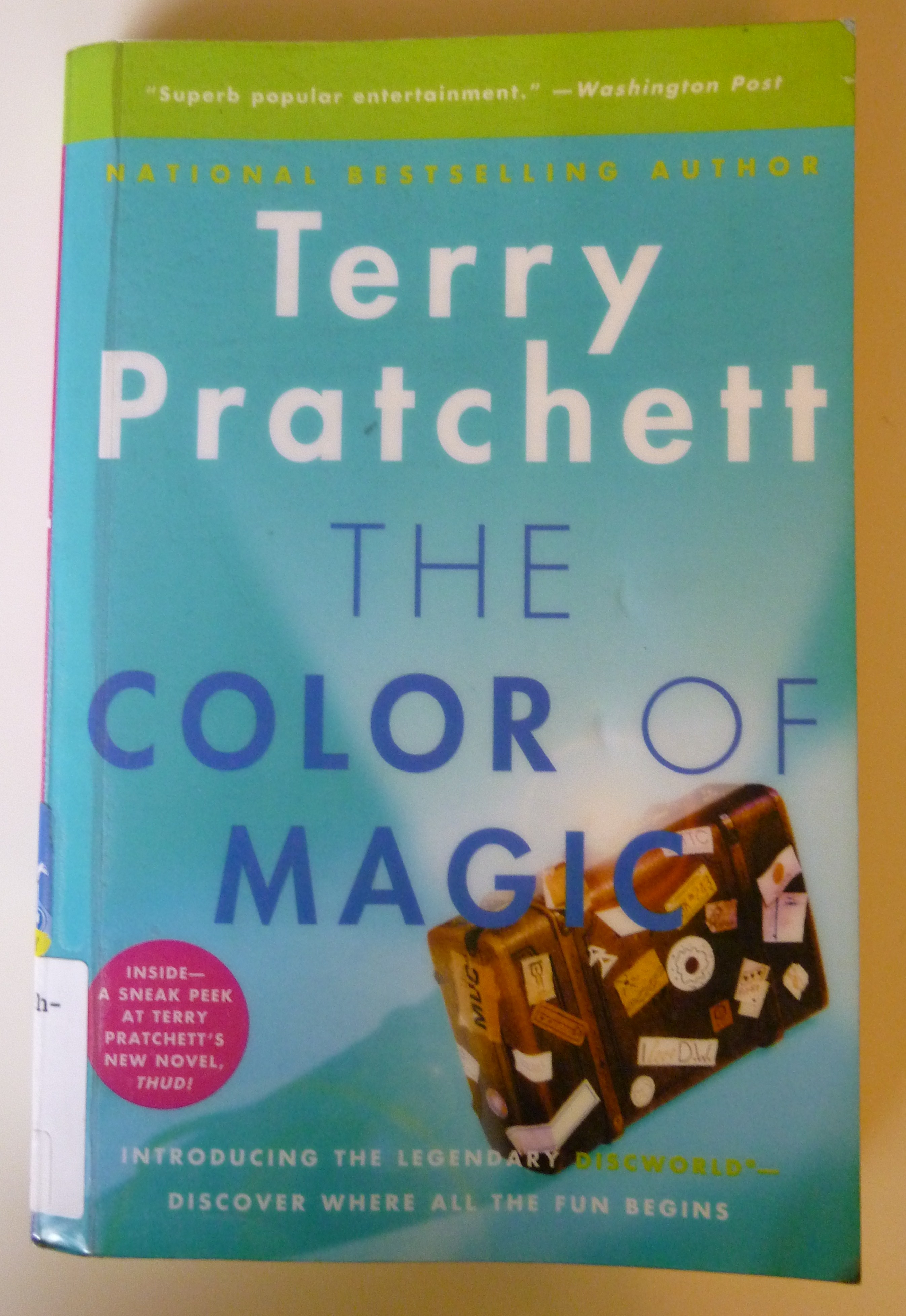
I’ve read upwards of ten books in Terry Pratchett’s Discworld series, but until recently I hadn’t actually read book one, The Colour of Magic.  It’s one of those series where you can really drop in at any point (though some books are better starting places than others).  I think there are over thirty books in the series, so if you, like me, feel a little baffled at where to begin, don’t bother–just grab something and go (though I recommend Guards! Guards! or The Truth as good starting points).  Or, of course, you could start with #1.

The Colour of Magic introduces us to Discworld, an alternate world which exists as a flat disc, riding on the back of four elephants, who are on the back of a giant turtle.  That right there may give you some idea of what we’re dealing with–a truly bizarre and wonderfully hilarious world.

The Colour of Magic begins in the ancient and cheerfully corrupt city of Ankh-Morpork, where Twoflower has come as the Disc’s first tourist, thrilled by the quaint bars and eager to meet heroes and see real Ankh-Morporkian brawls.  Rincewind the not-very-good wizard ends up roped in as his guide, and they embark on a perilous and hysterical adventure around the Disc.

It sounds almost reasonable, until I mention that Twoflower is followed everywhere by an animate trunk with hundreds of legs known as The Luggage, Death shows up every so often and is rather put out that Rincewind keeps stubbornly not dying, and at one point they encounter imaginary dragons who live inside a giant inverted mountain.  And that, of course, is only the half of it.

If you’re having a gloomy, depressing day, read a Discworld novel.  It will brighten everything.  Pratchett’s books are gritty but hilarious, have a grown-up feel but aren’t really inappropriate for young adults either.

There’s a vast cast of characters who wander in and out of the Discworld novels, and there are some subseries within the larger series (although good luck finding a comprehensive, helpful list of which books fall into which subseries), which focus on particular groups of characters.  There are the witches; the City Guard; the magicians; and let’s not forget Death.  I’m especially attached to the City Guard, led by noble but cynical Sam Vimes.

The Colour of Magic doesn’t focus particularly on any group of characters I recognize from later books, but it will definitely give you a solid introduction to the world of the Disc.

And, a random story: years ago I was on a bus, and overheard a couple of people talking about a book.  A wizard wound up in a tree, and was being visited by what seemed to be Death, but turned out to be a non-fatal disease.  The wizard objected that no one died of that disease, and he couldn’t be killed by him.  Sounds fun, right?  Of course I didn’t hear the book title, and I didn’t ask, and despite a little Googling I never could figure out what the reference was.  But now I’m reading along through The Colour of Magic and lo and behold: Rincewind lands himself in a tree, a cloaked figure appears with a scythe–but it’s not Death, it’s Scrofula.  Death was busy.  Rincewind objects, “I can’t die of scrofula!  I’ve got rights.”

Long-time mystery solved.  And almost as randomly as Discworld itself.

Seeking vs. Browsing, Revisited

A couple of months ago I wrote about two methods of finding books to read: browsing, finding random books at a library or bookstore; and seeking, deliberately looking for specific titles.  I’ve always been a browser, but lately I’ve decided to give seeking a try.

I must be a pretty good browser, because I haven’t noticed a big overall change in the quality of what I read by seeking.  There’s been a few really great ones; a lot that are good; and a few that are so-so or just bad.  My reading seems to follow a bell curve in quality!  I feel like that’s about the same as it’s always been.

I have felt more anticipation about what I’m reading.  I’m much more conscious of what I have lined up next, and I’m looking forward to books more–which is a bit of a paradox, when I don’t feel like the overall books have actually improved drastically!

Seeking definitely makes it easier to get to those books I’ve been meaning to read forever, to make progress on my To Be Read list, and to keep up with my reading challenges.  I feel more accomplishment about what I’m reading, like it’s goal-achieving instead of strictly recreation.  But it’s also fun to browse through the library and stumble on something wonderful–and I’ve found plenty of favorites that way.

In the end, I suppose I’m not coming to any startling conclusions.  There are merits to both methods, and I’ll probably do a bit of both in the future.  But I’ll stay a staunch seeker of television.

Traipsing through Greek Mythology with Hercules

As another foray on the Once Upon a Time Challenge‘s cinema quest, I’m going to review Hercules: The Legendary Journeys.  I recently watched Hercules and the Underworld, which fulfills the goal for the challenge.  It was a pretty good movie, but I think we’ll be better off here if I talk about the series at large.

If you’re not familiar with it, Hercules was a TV show in the nineties following the adventures of the mythological hero, as he journeys through ancient Greece.  There was a six-season TV show, plus five made-for-TV movie prequels, and two spin-offs (I’ll get to them later).

Hercules is basically the greatest guy you could ever want to meet.  He has super-strength from his father, Zeus, the king of the gods, “a strength surpassed only by the power of his heart,” as the opening sequence puts it.  And he’s brave, noble, thoughtful, ethical to a fault…but without ever being annoyingly nice.  Some characters come off as too good, and he’s not that–he’s just a really great guy.

Hercules’ wife and children were killed by his evil stepmother Hera (in a careful revising of the original myth), and now he’s decided to dedicate his life to fighting evil and helping people.  How exactly he makes a living at this I don’t know–but it’s great premise for a TV show.  Generally each episode features a new monster, or a new band of brigands threatening a village, or a new plot by Hera.  Hercules comes in to help, risks his life in feats of daring, and eventually saves the day…to go on to help the next group of people.  And there’s often a lot of humor mixed up in there too–sometimes campy, always fun.  The episodes rarely follow a particular myth, but they frequently weave in elements and ideas from mythology.

Usually Hercules is accompanied on his travels by another character who’ll play the major supporting role for that episode.  Sometimes it’s a character with a one-time appearance.  Most often it’s his best friend, Iolaus, who joins him fighting in battles and defeating monsters.  I was thrilled, reading Greek myths years ago, to discover that the original myth records an Iolaus who helped Hercules fight the Hydra.  I thought he was strictly an invention of the TV show.  Iolaus is a pretty great guy too–a little more flawed, a little more apt to lose his temper or do something foolish, but absolutely someone you’d like to know.

And here’s something I think is important–I think anyone watching the show can pretty clearly see that Iolaus is Hercules’ sidekick.  After all, Hercules is the one with his name in the title, and usually he’s the one who does just a little bit more, and is just a little bit better.  BUT–I don’t think Hercules knows that Iolaus is his sidekick.  I think he would maintain that he and Iolaus are equal partners.  It wouldn’t be false modesty–it would be very sincere.  I think that makes a difference in the character, and in the feel of the show.  Hercules never makes much of his own importance–he just tries to help people.  It adds a lightness to the show.  More on that later.

The other most frequent supporting character is Salmoneus, who is basically an ancient entrepreneur.  He always has a new get-rich-quick scheme, which he always wants to get Hercules involved in.  Hercules always declines (although you’d think that maybe he ought to join forces with Salmoneus some time, since he has no visible means of support himself).  It’s pretty much a guarantee of a comedic episode if Salmoneus turns up.

There’s also Autolycus, the cocky and exceedingly self-confident King of Thieves.  And of course the Greek gods turn up now and then too: particularly Ares, the surly (but very handsome) god of War, and Aphrodite, the beautiful and flirty goddess of Love.

As I said, Hercules has two spin-offs, the possibly more famous Xena: Warrior Princess, and Young Hercules.  I enjoyed Xena, but never as much as Hercules, even though it had a cool warrior girl for a hero.  I think it was that Xena took herself too seriously.  She was just never as much fun as Hercules.  And I think Xena and Gabrielle both knew that Gabrielle was the sidekick in the relationship, and I don’t like that as well as Hercules and Iolaus’ equal friendship.  Don’t get me wrong–it’s a great show too–but if you’re picking one, watch Hercules.  As to Young Hercules, it had a younger target audience so they made it more simplistic, and personally I could never get past the fact that young Hercules did not look like he could ever grow up to be Kevin Sorbo (the actor for the main show).  And I was right–he grew up to be Ryan Gosling, from The Notebook.

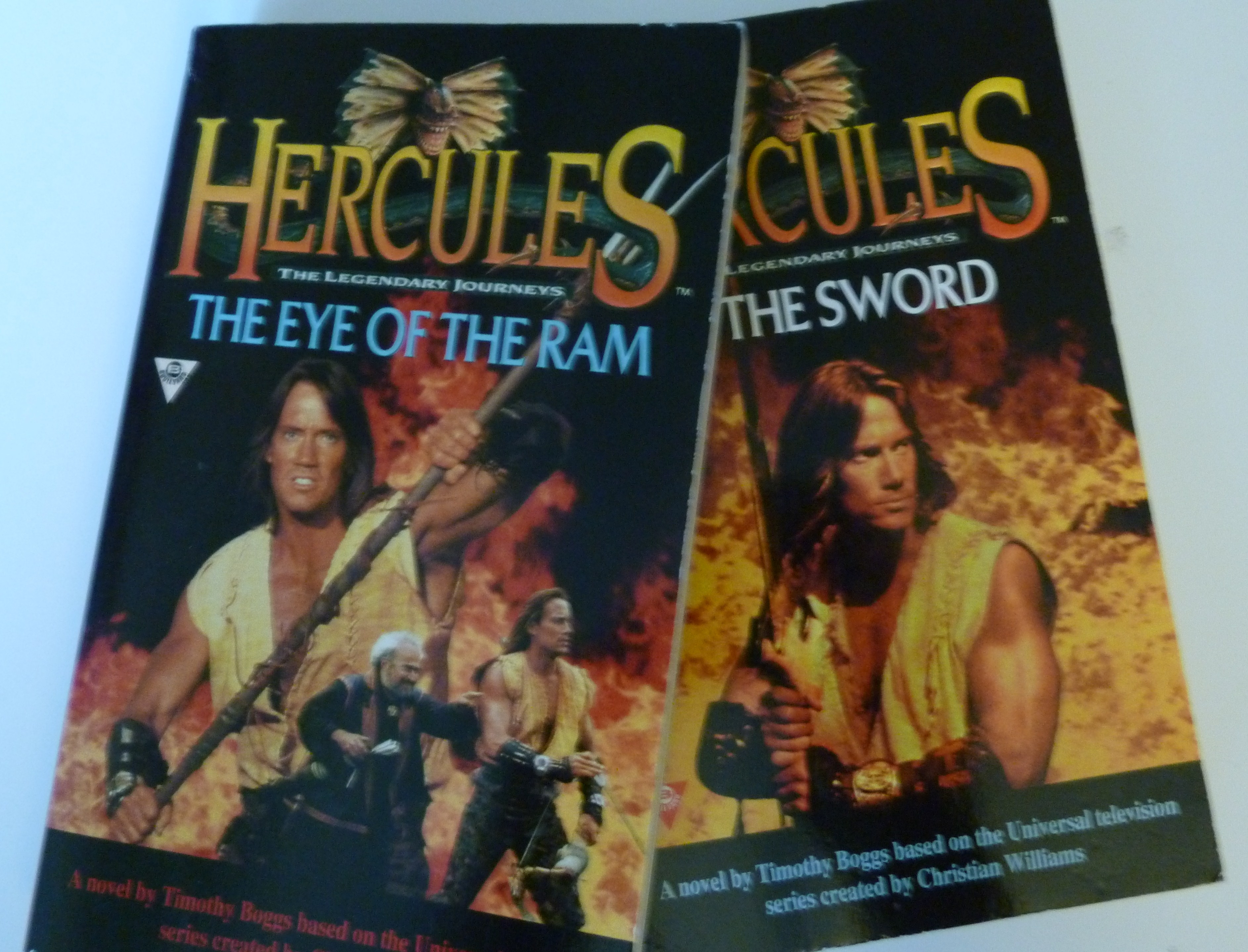
There are four novels as well, a couple of them pictured above, which are also great.  They’re not novelizations of episodes; they’re original stories, and it’s fun to get inside the characters’ heads more than you can in a TV show.

Hercules was my favorite show for a period as a kid.  I’ve been rewatching them recently, after years of not seeing them, and I’m convinced I had good taste.  🙂  They’re all available streaming on Netflix.  If you have any interest in Greek mythology, or funny adventure stories, check them out!

The Brontes’ Leading Men

To avoid a very lengthy post, I decided to save a discussion of Heathcliff and Mr. Rochester for a second post.  Click for my first post on Wuthering Heights and Jane Eyre.

After reading the two books, I was wondering what led both Bronte sisters to cast dark and brooding men as their heroes.  A friend told me that their father was rather dark and brooding too.  In fact, she told me that Heathcliff was based on their father–and for the Brontes’ sake, I sincerely hope not!

It wouldn’t be so bad if Mr. Rochester was based on their father.  A lot of the discussions I’ve had on Jane Eyre (and I’ve managed to have several!) have centered around whether or not Mr. Rochester is likable.  Jane’s likability is also an issue, but a liking for the book does seem to hinge on whether you consider Mr. Rochester a good romantic hero.

I come down on the side of yes.  Going into this, I expected to not like him because, after all–he has his first wife locked in a tower!  But I think I had a vague notion that he had driven her insane, which (unless there’s a lot going on Charlotte never told us) isn’t the case at all.  Considering the medical treatment of the time for the insane, I think locking her up in a tower is actually the most humane and merciful option.  Especially since, whatever Mrs. Rochester’s insanity is, it’s clearly a case of being a danger to herself and others.

So I don’t blame him for that.  Do I blame him for not telling Jane about the first wife, when he was planning to marry her?  Yes, definitely.  More on that in a bit.

And then of course he’s brooding and acerbic and unfriendly.  But he’s also had his life blighted by a marriage to an insane woman, who he hated prior to her insanity, and which society won’t let him out of.  That could give a person some issues.

When you come down to it, I believe that Mr. Rochester is basically a good guy, somewhat moody and not perfect, who got caught in a really, really difficult situation.  He immersed himself in unhealthy influences, and that comes out when he interacts with people.  I don’t believe that “the love of a good woman,” as the cliche goes, is going to save him–but I think getting him out of his situation and putting him around better, more positive people, will let the better person inside emerge.

Contrary to what the movies tell you, he’s also not very attractive–and I love that he’s so well-adjusted about it!  Near the end of the book, after he’s been beat up a bit (no details, trying not to give too much of a spoiler) he asks Jane if he’s very hideous.  And she says–“yes, but you always were.”  Which doesn’t seem to bother him at all!  I’m fascinated by the Phantom of the Opera’s issues with his appearance, but I also really enjoy a hero who doesn’t seem to mind being ugly.

As to that business of not telling Jane about the first wife, yeah, it was bad…but by the end of the book, Charlotte has punished him so thoroughly that I want to just forgive him and let him be happy.

And then there’s Heathcliff.  I believed there was a good man somewhere under Mr. Rochester’s brooding exterior.  I don’t believe that about Heathcliff.  For one thing, he’s even more caustic and unfriendly.  Mr. Rochester is generally just rather sarcastic and off-putting.  Heathcliff is out-and-out nasty and cruel.

I looked up “psychopathy,” and here’s what I found: “a mental disorder in which an individual manifests amoral and antisocial behavior, lack of ability to love or establish meaningful personal relationships, extreme egocentricity.”  That’s Heathcliff.

I wanted to like the poor, trodden-upon gypsy boy–but he wasn’t even a nice kid.  And Heathcliff just got worse when he grew up.  He treats everyone around him horribly, and never exhibits the slightest sympathy or remorse.  All of his goals seem to be about exacting revenge and inflicting pain.

His most significant relationship is with Cathy, of course–but I wasn’t all that convinced that they loved each other either.  I believed that Mr. Rochester loved Jane, would treat her well, and that they’d be happy together.  Cathy and Heathcliff never exhibit pleasant things like kindness, tenderness, or self-sacrifice, even to each other.  I think they’re obsessed with each other–but I don’t think it’s anything as healthy or positive as love.

Another friend tells me that Heathcliff is apparently a romantic lead archetype, which is a terrifying prospect.  This is where women get into trouble, isn’t it?  They think they’ve got Mr. Rochester, and he turns out to be Heathcliff.  It’s not always so easy to tell them apart in real life.

I also read The Eyre Affair recently, about a world where you can actually go into books.  I’d quite enjoy going to dinner at Thornfield Hall with Jane and Mr. Rochester.  You couldn’t pay me to go to dinner at Wuthering Heights.

I’m glad I read both books, though.  I’m glad I know more about Jane Eyre than that there’s a first wife locked up somewhere, and more about Wuthering Heights than that it has a character named Heathcliff–which is about where my knowledge stood a few months ago.  Even if my opinion of Wuthering Heights didn’t turn out very favorable, it’s nice to have an opinion about it.  And Jane Eyre was lovely.