When Princesses Take Over the Fairy Tale

I’ve read many (many) fairy tale retellings, but rarely have I come across fairy tale crossovers, mixing characters from more than one tale.  That’s exactly the premise of Jim C. Hines’ Princess Series, of which I just read the second one for the Once Upon a Time Challenge.  This also goes towards my Finishing the Series challenge (two more books in this series to go!)  Since I hate to start out by reviewing Book Two, I’ll just tell you a bit about both, and try for a minimum of spoilers for the first one.

The Princess series books (so far, at least) are about adventures after the traditional fairy tale ends.  The main character is Danielle, also known as Cinderella.  The first book, The Stepsister Scheme, opens with Danielle recently married to her handsome prince, Armand.  Her stepfamily, however, is not ready to accept defeat, as becomes clear when stepsister Charlotte attacks Danielle, and kidnaps Armand.  Fortunately, Danielle finds valuable allies ready to help her rescue her prince.  Her new mother-in-law, Queen Beatrice, likes to take princesses-in-need under her wing, and has a kind of secret service made up of Snow White, a powerful sorceress (she doesn’t like the term witch) and Talia (Sleeping Beauty), who has used her fairy-given gift of grace to become a skilled fighter.  Together, the princessess set off for the realm of fairies to rescue the prince.

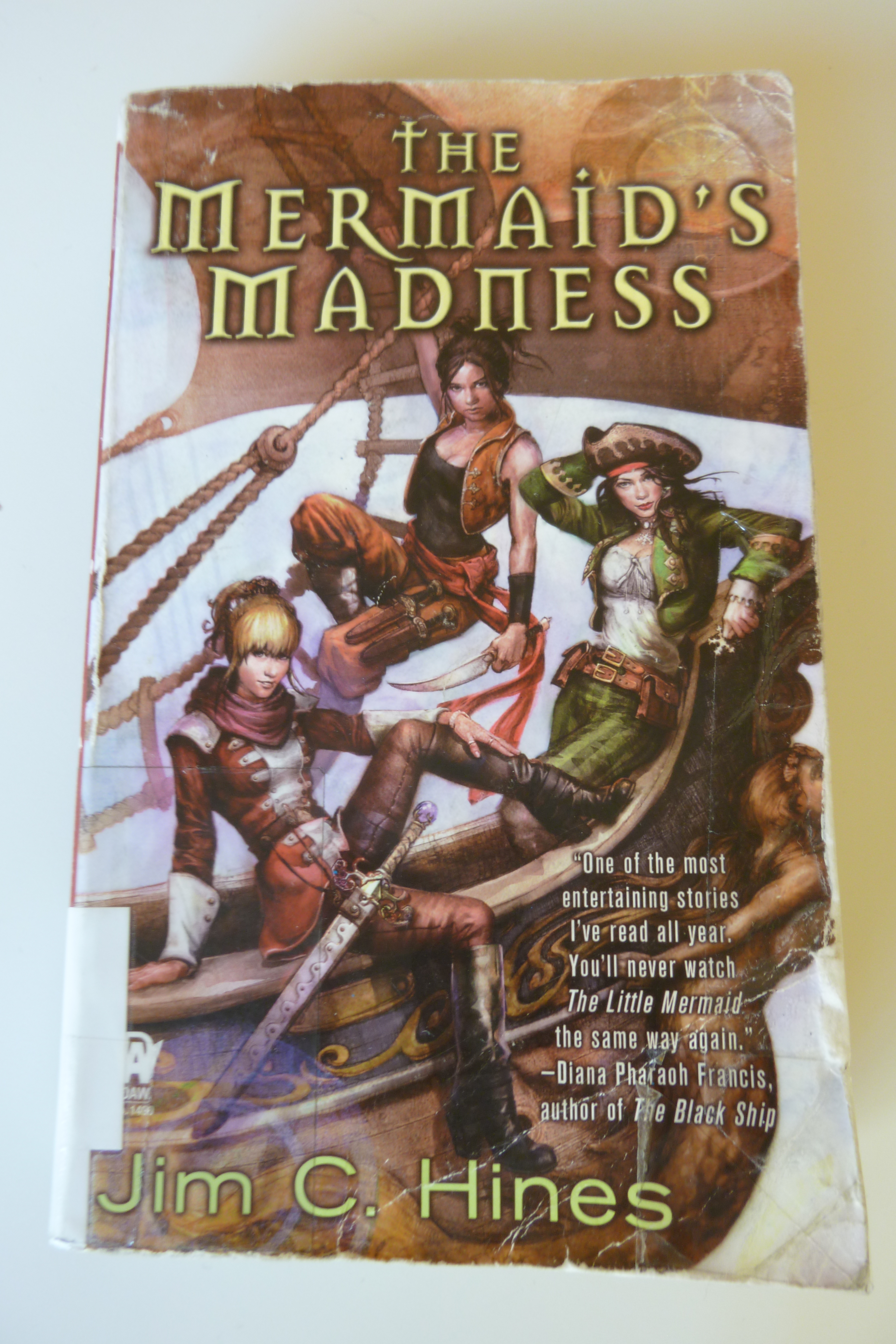
Book Two, The Mermaid’s Madness, brings in another fairy tale–and this is definitely not Disney’s version.  In the original story, the little mermaid can’t marry her prince, and instead sacrifices herself to save him.  Hines’ mermaid killed her prince, and went mad as a consequence.  With Queen Beatrice mortally wounded and a war brewing between humans and merfolk, the princesses have to find a way to capture the mermaid, the only one with power to save the queen.

There’s so much to enjoy about these books.  I love the interpretation on the princesses.  Their abilities are grounded in the original fairy tales (Talia gets skills from her fairy gifts, Snow White’s magic revolves around mirrors), but reinterpreted to make the girls so much stronger and more powerful than they ever were in the originals.  I love the gender reversal of the first book–not only are these princesses not sitting around waiting to be rescued, they’re setting out to rescue the prince!  When I was around ten, I started writing a short story about a knight who was rescued by a girl.  The story never went very far, but I feel like it was motivated by some of the same impulses that make me love this series.

The girls are complex characters as well.  We get bits and pieces of backstory for them all, and it becomes clear that these girls didn’t live Disney movies, and maybe not even the Brothers Grimm stories.  Talia, at least, is coming from an even older and much darker version of Sleeping Beauty.  They have tragedies and they have complexities.  But there’s also humor in here too.  The relationship between the three girls is often a lot of fun, and it’s nice to see a story focusing on female friendship.

Much as I enjoy that, it also brings me to the one thing I don’t like as well.  I feel like Armand is under-developed as a character.  With Danielle as the lead (though occasionally Snow or Talia will narrate as well), I feel like her husband should have a bigger part!  He’s in it just enough for me to notice that he’s not in it enough, if that makes sense.  I love the focus on the girls, but I’d like a little more balance to give Armand and Danielle’s relationship some time too.

That’s a minor complaint about an excellent series, though.  If you like fairy tales and strong heroines, these are the books to read.  They’re from the grown-up section (is there a proper term for that?) and I’d probably classify them as appropriate for older YA, because of some of the darker themes.  I’d recommend starting with the first book, as a better way to get to know the characters, though the plots are independent.  I think I enjoyed the second one a bit more, but more because I was getting to know the characters better than because it was an inherently better book.  They’re both great!

Author’s Site: http://www.jimchines.com/

Other reviews:
Shiny Book Review
Bookshop Talk
Bookish
Yours?

Friday Fairy Tale Round-Up: Cinderella

Last week I looked at a list of “Twelve Dancing Princesses” retellings, and this week I thought I’d look at what might be the best-known fairy tale in this culture–Cinderella.  I suspect if I really tried to gather up every version I’ve read, this would become completely unmanagable!  So, I’m highlighting the major ones and recent reads instead.  🙂

One thing I found interesting in searching out the “originals” (with due acknowledgement to earlier oral tradition) is that “Cinderella” is one of the few stories that’s in both Charles Perrault and the Brothers Grimm.  Between the two of them, they seem to account for almost every major fairy tale in Western culture, so maybe both of them presenting “Cinderella” is part of the key to its popularity.  And, of course, it plays right into the dream that life can be better–that no matter how dreadful your circumstances, everything can change (and the cynic in me says, without you even needing to do anything!)

Later versions have mostly been pretty consistent with the older ones, in the major strokes at least.  Cinderella is a kind, beautiful girl who is downtrodden by her nasty, ugly stepmother and stepsisters.  When the prince throws a ball to find a bride, Cinderella desperately wants to go.  And she does, aided by some kind of magic–either a fairy godmother, or the spirit of her deceased mother.  Cinderella charms the prince but has to leave early, and the prince uses her dropped slipper to identify her–which is a truly bizarre way to find anyone.

I have a lot of problems with the original Cinderella–the incredibly passive main character, the absentee fairy godmother, the prince who apparently can’t recognize his “true love,” and the really weird slipper element.  But often the strange bits of the story are exactly what new authors can use to spin off a brilliant retelling…

Ella Enchanted by Gail Carson Levine tackles Cinderella’s passiveness head-on.  Levine’s Ella is brave and determined, but cursed by an obedience spell.  She has to find her own strength to overcome it, and the story is more about her quest to take control of her life than it is to win the prince–who is a childhood friend, not a stranger at a ball.  There’s a movie version too, but don’t see it.  It bears very little resemblance to Levine’s wonderful book.

Just Ella by Margaret Peterson Haddix plays with how hard it would be to go from scullery maid to princess.  This is another smart and determined Ella, who made her own way to the ball, only to realize afterwards that the life of a princess is not what she expected–and that the prince isn’t either.

The Stepsister Scheme by Jim C. Hines is another one that looks at the story after the ball.  This Cinderella (Danielle, actually) got her prince and he is charming–but then he’s abducted by her evil stepsister.  Fortunately, a couple other fairy tale princesses are on hand to help get him back.  This is a great twist on the usual themes of fairy tales, with some truly awesome princesses.  I just read the sequel, so stay tuned for a review of both soon!

Princess of Glass by Jessica Day George tells the story from a very different point of view–a princess visiting the court, who notices how really creepy it is when everyone, especially the prince, are suddenly enamored of this mysterious woman in the glass slippers.  Because really–why exactly is everyone so blown away?

Disney’s Cinderella is probably the version everyone knows best, and it’s pretty close to Perrault.  It’s a cute fluff of a cartoon, although the mice are the best part.  Cinderella and her prince are pretty bland, and I just can’t take them seriously when they start singing, “So This Is Love.”  No, it’s attraction.  I can’t believe you got all that far exploring the depths of human emotion in just one dance.

Silver Woven in My Hair by Shirley Rousseau Murphy is, with Ella Enchanted, my other favorite retelling.  It somehow creates a very real, very practical world, tells about it with gossamer-beautiful writing, and even without magic is utterly enchanting.  Thursey has dreams, but they’re real ones.  Her friends are real people and she falls in love with a real man, not a shining prince out of a daydream.

There must be more Cinderellas out there–any recommendations?

A Former Cinderella Finds a Job

I don't actually like this cover...both characters look wrong.

The Fairy Godmother by Mercedes Lackey is a great two-challenges-for-one-book, fitting neatly into the Once Upon a Time challenge, and also my Finishing the Series challenge.  It’s actually the first book in Lackey’s 500 Kingdoms series, but somehow I contrived to pick up The Sleeping Beauty first, which is Book 5.  They seem to be self-contained, so I don’t think it much matters.

Life in the 500 kingdoms (I think that’s meant literally) is constantly influenced and directed by the Tradition, a nebulous force which wants everything to go as, well, tradition dictates.  In practice, this means that certain circumstances result in events being magically nudged (or shoved) along towards some very recognizable paths.  If a situation is starting to look like a Brothers Grimm or Charles Perrault story, the Tradition wants to make it go towards its proper conclusion.  Not that Grimm or Perrault are referenced, but that’s how it all plays out.  Only sometimes, it doesn’t quite work–and the Tradition can drive towards both happy and tragic endings.

The Fairy Godmother is about Elena, who should have been Cinderella–she has the stepfamily and the drudgery.  Unfortunately, the prince in her kingdom is only eleven, and Elena is stuck with an unfulfilled story, and a great deal of magical energy hovering around her.  Along comes Godmother Bella, who takes Elena under her wing to train her up as a Fairy Godmother.  Not necessarily fairies, the Godmothers nudge and influence and shape events, trying to push the Tradition towards the good stories and to mitigate the effects of the bad ones.

This book is really in two parts, first about Elena’s apprenticeship and then about her adventures as a Godmother, particularly in dealing with a difficult prince, Alexander, who she turns into a donkey and takes home to do farmwork in order to teach him a lesson.

I enjoyed the first chapters of the book very much, as Elena struggles with her Cinderella storyline.  The book bogged down for me a bit after Elena goes with Bella.  Lackey spent a lot of time on world-building, under the guise of telling about Elena’s studies to be a Godmother.  The funny thing is, it’s all fascinating ideas…only I don’t actually need to know the distinction between a Godmother, a witch and a sorceress unless it’s relevant to the plot.  I think this is a first-in-a-series problem, too much narration trying to establish the world, when many of the details aren’t based in any plot or character development.  It may not have helped either that I had read a later book in the series, so some of this I already knew.

The book picked up again in the second half, once Alexander came into it.  He brought an interesting dynamic into things; he certainly needed to go through some character growth, but I actually never thought he was as bad as Elena did.  Some parts are in his point of view, and I could quite often see where he was very reasonably coming from, while she was convinced he was being stupid or just generally nasty.  Also, Elena is supposed to be the heroine, but she fell into the same kind of behavior I always question about the traditional Fairy Godmothers.  You turned someone into a donkey to make him be more considerate of others?  Really?  That makes sense to you as a way to teach a lesson?  Of course it works out, because these things do, but I had a lot of sympathy for Alexander when he felt he was being badly treated.

The characters were good on the whole.  I liked Elena reasonably well, and Alexander was interesting and likable most of the time.  Elena also has a group of brownies working with her and they were rather delightful.

I really don’t think I’m giving anything away by saying that Elena and Alexander end up in a romance (it’s abundantly obvious, if only because there’s no one else she can get involved with).  I was a bit dissatisfied by that romance.  It turned out all right, but there wasn’t much basis for it.  It was mostly a matter of realizing they were physically attracted to each other, and that circumstances made them convenient romantic partners.  Sure, physical attraction can be fun, but I prefer a bit more substance when I read a romance.  The romance also takes this out of the YA category.

A good book–not a fantastic book–but a brilliant premise.  I’ll definitely be continuing with the series, because I do love the premise, and if we’ve got the world-building out of the way now, I hope for better things in later books!

Author’s Site: http://www.mercedeslackey.com/

Other reviews:
Reawrite
Book Buddies Online
Crooked Reviews
Anyone else?

A Retelling of Cinderella

Because it’s spring and I’m greatly enjoying the Once Upon a Time Challenge, I thought I’d post a fairy tale Fiction Friday this week.  This is a short retelling of Cinderella, which I posted about a year ago but thought I’d share again.  This started out as a Spanish class assignment, which I rewrote and expanded in English.  It has much of the same mentality that eventually led me to write novel-length retellings of fairy tales…

**********************************

Once upon a time in a far off kingdom there lived a maiden who was very beautiful and very kind.  Fairy tales always begin the same way, and the maidens are always very beautiful and very kind.  Often their name is Ella, as was the case for the maiden we’re talking about.  This particular maiden, as do most of them, had long blond hair, very fair skin and eyes of the deepest blue.  She didn’t have any initiative, spirit or goals for her life.

Continue reading “A Retelling of Cinderella”

A Suspicious Eye on Cinderella

Apologies for the placement of that sticker--I don't know what the librarian was thinking!

What ever happened to the twelve dancing princesses, after they quit dancing?  Well, according to Jessica Day George, one of them got mixed up in the plot of Cinderella.  Princess of Glass is a loose sequel to Princess of the Midnight Ball.  The plot is entirely different and so are most of the characters but the events of the previous book are mentioned so frequently, I think you’re better off reading it first–though you could probably start here if you really wanted to.

So, a quick summary of both stories, with a minimum of spoilers.  The twelve princesses are cursed to dance at the Midnight Ball, with twelve demon princes.  If you know the Grimm story, it’s no spoiler to say that a soldier breaks the spell on them, and marries the oldest princess.  The second book is about Poppy, another of the princesses, who is off to a fantasy country based heavily on England (complete with Tutingham Palace as a substitute for Buckingham).  Poppy is there as part of a royal exchange program.  When a serving girl shows up at a royal dance, decked out in finery and mesmerizing the prince Poppy had been growing fond of, Poppy and her friends have to investigate what spell is afoot.

This is a really clever and unique Cinderella retelling.  I love that we get it from such a different perspective.  And since Cinderella, as a person, completely annoys me in the original version, I love that this version is not such a sweet, innocent (and spineless!) character.  This book also addresses a key question the original fairy tale never answers–where did this fairy godmother suddenly appear from anyway?  The godmother’s ultimate motivations felt a little bizarre to me, but the things she does are so fascinating, I’ll forgive her doubtful reasons.

Poppy is an enjoyable heroine (aside from that dreadful name).  She’s tough and resourceful, but has emotional uncertainties too.  I particularly like it that she has all kinds of emotional issues when it comes to dancing–which totally makes sense, right?  Prince Christian is a sweetheart, even if not the most complex prince I’ve ever encountered.  There’s a good complement of secondary characters to round out the cast, including a Cinderella with unexpected depth.

One aspect that really sells me on this book is the description.  It’s lush and vivid, describing dresses, magical transportation, and truly strange glass shoes.

If I had to choose, I liked Princess of the Midnight Ball a bit better, but this was a very lovely follow-up.

Author’s Site: http://jessicadaygeorge.com/default.aspx