Wrapping Up the Sci Fi Experience for 2013

13sfexpIs February over already?  I don’t know about you, but January lasted forever and then I blinked and February was gone.  That means it’s time to bid farewell to another year of the Sci Fi Experience, hosted by Carl from Stainless Steel Droppings.

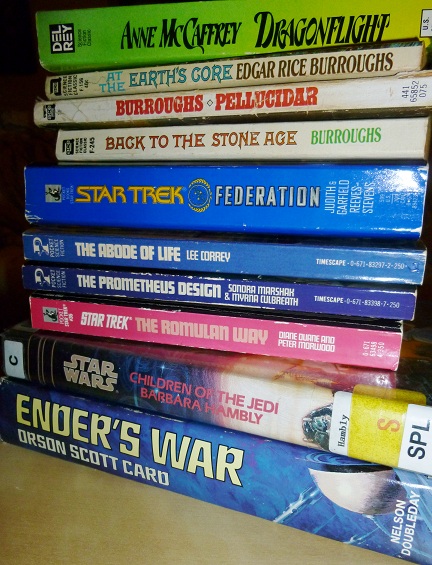
I’ve had an excellent time in sci fi reading over the last two months.  I started out with a big stack, and have read my way through nearly all of it.  I dropped a couple of titles from my plans (one Trek book, after looking more closely at the writing, and one Pellucidar book when I realized it was later in the series than I thought) and I have one unread Star Trek book still sitting on my shelf and patiently waiting its turn.  But other than that…  Well, here’s the full list with links to reviews:

P1020254Dragonflight by Anne McCaffrey (reread) – Group Read, Week One and Week Two

At the Earth’s Core and Pellucidar by Edgar Rice Burroughs

Speaker for the Dead by Orson Scott Card

Star Trek
Federation by Judith and Garfield Reeves-Stevens (reread)
The Abode of Life by Lee Corey

Star Wars: The Callista Trilogy
Children of the Jedi by Barbara Hambly
Darksaber by Kevin J. Anderson
Planet of Twilight by Barbara Hambly

I also got some Sci Fi on Screen viewing in.

I’m a bit sad to wrap up the Sci Fi…but mostly I’m looking forward to diving into some fantasy!  And I have no doubt I’ll be continuing to read more science fiction anyway…if only because I added so many titles to my To Be Read list throughout the Experience. 🙂

Back to Pellucidar

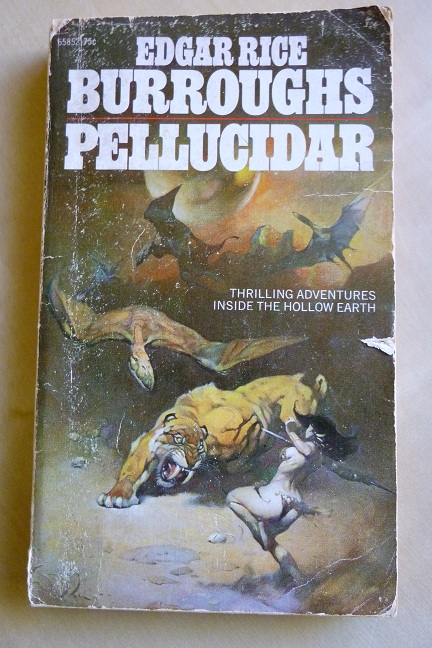
PellucidarFor my second Vintage Sci Fi read, I went back to the world at the Earth’s core, with Pellucidar by Edgar Rice Burroughs.  This picks up where the first book left off, following the further adventures of David Innes in the world within the Earth.

There’s not much to be said about the plot–after all, it’s Burroughs, and that tells you most of it.  David makes it back to Pellucidar where he sets off through a hostile landscape to search for old friends, encounter new and old enemies, and of course to rescue (repeatedly) his poor beleagured true love, Dian, who is captured on at least three occasions.

It’s all good fun and good adventure, with strange landscapes, a never-ending parade of action, and quite a lot of death but nothing gruesome.  Like the first book, Pellucidar is striking me as a kind of Barsoom-lite.  The same basic shape, still very entertaining, but somehow not quite as striking as John Carter’s adventures on Mars–and this may have more to do with which order I read the books in than the books themselves.

Rather than dwell on the plot and the characters, I want to talk about some of the themes.  Lately it’s been uncanny how books I’ve picked up have unexpectedly fit into the larger discussion going on.  First it was Star Trek: The Abode of Life and the examination of transporter technology.  Now Pellucidar hits on a number of points that have come up recently.

First, The Abode of Life and Pellucidar both present a man from a more technologically-advanced society choosing what effect he will have on a new world he’s encountering.  Kirk went to great lengths to not be a conquistador (his words) for Mercan.  David plunges into precisely that role with abandon, becoming David I, Emperor of Pellucidar, and using advanced weaponry to conquer all the natives.

I realized long ago that I can’t look too closely at Burroughs’ philosophy, if I want to continue enjoying his books.  Still, I don’t feel like I can just pass right over the last twenty pages of Pellucidar, which are especially, um, troubling.  David simply takes it for granted that as the civilized man, he has both the right and the knowledge to assume a leadership role and impose an entirely new form of civilization on the natives.  His attempts to eradicate the Mahars, the dominant, lizard-like race, are particularly disturbing.  Though the Mahars do treat humans badly, they mostly seem to be condemned for the crime of not being human.  The emphasis is much more on their lizardness than on their actions.

It’s also a bit interesting that David doesn’t introduce money (calling it “the root of all evil”), but doesn’t mind introducing guns and cannons.  He does insist that his real interest is to spread education and trade and the Industrial Revolution…after obtaining peace by conquering everyone.

While I look askance at all of this, at the same time, I know Burroughs is a product of his time–Pellucidar was written while “the sun never set on the British Empire,” and decades before Kirk got his Prime Directive in the 1960s.  For the Dragonflight group-read, we discussed extensively how classic books carry into the modern day, and Burroughs definitely requires acknowledging that this was a different time.  In a way, it may help him that he’s so obvious about it–it makes it easier to draw a line around the objectionable bits, and move on.

That’s something I have to do most of the time with Burroughs’ heroines too.  The portrayal of the genders was a fascinating discussion with Dragonflight, and it was interesting to still have some of that in mind reading Pellucidar.  Burroughs heroes never treat women badly, or with the disdain that the dragonriders show–they generally worship the ground their heroines walk upon.  And yet, at the end of the day…the heroine is pretty much a beautiful face who plays the role of a prize to be won.

I noticed here that Dian is more than once referred to as very fierce and brave–but she never actually does anything.  She brandishes a javelin now and then, but is completely ineffectual at actually accomplishing anything (including using the javelin to fend off a kidnapper).  As comparison, Lessa is frequently marginalized and often treated (and depicted) as childish…but she does things!

To be fair, Dian may be a bit two-dimensional…but so is David, so it’s not entirely a gender thing.

And to be fair on another point, I don’t read Burroughs for his brilliant political insight, or his explorations of the human character.  I read him because he tells an exciting adventure story–and he’s never yet failed me at that!

Author’s Site: http://www.edgarriceburroughs.ca/

Other reviews:
SFF Audio
I couldn’t find others!  Anyone else?

Buy it here: Pellucidar

What Are You Reading…in January?

itsmondayIt’s been a few weeks since I posted for the What Are You Reading meme from Book Journey, so now seems like a good time for a new installment.

I’ve been making all sorts of headway with my science fiction reading.  I’ve managed to dip into just about every type of sci fi I was planning: Pern, Star Wars, Star Trek and two Burroughs books.  I also finally finished Reflections by Diana Wynne Jones, a wonderful collection of essays about storytelling.

On audio, I’m about halfway through Walden by Henry David Thoreau.  It’s a funny thing–sometimes he seems to just drop brilliant gems every two sentences.  Other times he loses me for five minutes at a time.  But overall I’m enjoying listening.

Pat BooksIt turns out to be a good thing after all that I decided to join the L. M. Montgomery reading challenge…after three weeks of sci fi, my excitement was flagging.  So I was all set to jump into Pat of Silver Bush, which is a completely different world.  I’m midway through now, and may or may not (but probably will) go straight on to Mistress Pat.

After that, I expect to  have renewed eagerness for sci fi, so it’ll be back to Star Wars for Darksaber, the next volume of the Callista Trilogy.  And then…more Star Trek or else Speaker for the Dead by Orson Scott Card.

Still lots of good books in the stack!

P1020254

A Familiar Story at the Earth’s Core

At the Earth's CoreI’m exploring Sci Fi worlds in January, and my first review for the Sci Fi Experience and the Vintage Science Fiction month is At the Earth’s Core by Edgar Rice Burroughs.  First published in hardback in 1922, it’s definitely vintage–and it’s also quintessential Burroughs.

I usually try to avoid spoilers in plot summaries, but…for people who know Burroughs, you really can’t give spoilers.  At the Earth’s Core is about an unusually strong, gray-eyed Earthman who unexpectedly finds himself in a strange other world, where he meets bizarre creatures and multiple intelligent races.  He also meets mostly naked yet noble savages and of course a beautiful princess, who has been captured by a monster race.  He falls in love with the princess, but they’re separated–first because he accidentally offends her, and second by circumstances.  He fights his way through the landscape, succeeds to a place of high esteem in society and wins the princess, only to wind up at the end of the book back on Earth–and all we know at the end is that he may, or may not, have successfully returned to the other world.

Sound kind of familiar?  That’s because this is a faithful description in every particular of BOTH At the Earth’s Core and A Princess of Mars.  I love Burroughs–I always enjoy his books–but with very few exceptions, the man only had one story.  That’s okay, though.  You don’t read Burroughs in breathless suspense about whether the hero will win the girl.  You read it for the strange landscapes, the bizarre creatures and the beautiful prose.  I do, anyway.

This first book in the Pellucidar series follows David Innes on an adventure into the depths of the Earth, where hundreds of miles down his mole-like vehicle breaks out into a strange landscape.  The premise is that the entire inside of the Earth is hollow, presenting a vast expanse of land functioning with reverse gravity to what we know on the outside.  Rather than the horizon dipping down in the distance, it curves up forever.  Pellucidar is lit by a miniature sun at the very center of the planet, so that the world exists in perpetual noon.  All in all, it’s a great example of Burroughs’ wild and intriguing landscapes, be they on the moon, Mars, or the center of the planet.

David meets two different semi-intelligent species that resemble apes, as well as the required race of noble savages, primitive but immensely good-looking.  This race is treated as cattle by the most interesting race, the Mahar.  This is a race of lizard-like people who communicate by a kind of telepathy (but not quite) and have no concept of sound.  The Mahar, I am sorry to say, are at the center of what is probably the most disturbing scene I’ve ever encountered in Burroughs.  Remember I said the human-like race is treated as cattle?  There’s a pretty horrible incident relating to that, unusually horrible for Burroughs.

Besides the intelligent species, David encounters a wide variety of monsters.  He comes to the Earth’s core along with a helpful amateur paleontologist, who frequently recognizes species–although I suspect Burroughs made most of them up.

The positives of the book are definitely the weird landscape and creatures, along with plenty of action.  This book doesn’t share the problem of most of Burroughs’ other first-books-in-a-series, of starting slowly.  We get straight into the adventure.  This one also has an interesting concept about time not existing in a world with no celestial bodies and no clocks.  It frankly doesn’t make a bit of sense, but it’s interesting to think about.

On the negative side, there is a slightly disquieting element here of the noble white man bringing civilization to the savages–though to be fair, there’s no clear ethnicity among the savages, and the truth is that they aren’t fending all that well for themselves.  Still, David throws himself into changing a world that he really knows very little about.  And I’m not sure teaching weaponry is really the way to advance a people.

I can’t put my finger on why, but David didn’t appeal to me as much as his obvious counterpart, John Carter.  It sounds silly to say, when typical Burroughs heroes are nearly interchangable…but there was still something different.  David is upstanding and brave, as all Burroughs heroes are, but he maybe wasn’t quite as noble, or quite as capable.  Or he just didn’t come with that fascinating opening paragraph, about always being a young man, always a fighting man.  While I wouldn’t have said that Burroughs heroes were distinctive, David still didn’t have as strong a voice.

That may about sum up the book.  I liked it.  I enjoyed it.  It is, as all Burroughs novels are, a grand adventure in the finest tradition of pulp science fiction.  At the same time, it didn’t grab me quite the way other Burroughs books have.  I don’t know if that’s a flaw of the book, or if that’s just me–if maybe after forty-odd books, the usual Burroughs story is finally starting to feel old.

I’ll be going on to read the rest of the Pellucidar series…and perhaps it’ll grow on me!  Even if it doesn’t get any better than the first one, I still expect to have a perfectly rollicking time with it.

Author’s Site: http://www.edgarriceburroughs.ca/

Other reviews:
Luke Reviews
Book Addiction
Anyone else?

Buy At the Earth’s Core here, though I’d recommend buying A Princess of Mars instead.

What Are You Reading…in 2013?

itsmondayWe’re about to turn the calendar to January, making this the perfect time to look ahead at reading plans for the beginning of the new year.  So here’s a new installment of the What Are You Reading meme from Book Journey!

I have been on a mad quest to clear up final reading plans before the end of the year, and so far, it’s going pretty well.  I read Superior Saturday and am midway through Lord Sunday by Garth Nix, to finish off one last series.

I reread Mischief of the Mistletoe by Lauren Willig over Christmas, and I just madly, madly love this book.  It’s so sweet and adorable and witty and funny and the characters are so good and…well, I just madly love it.

I’m still working on Reflections by Diana Wynne Jones, but since it’s a series of essays, it’ll be an easy one to intersperse among new reading plans…because I start new reading challenges on January 1st and look forward to diving in.

P1020254First of all, I’m joining the Sci Fi Experience, so that should tell you the general trend of my reading for the next couple of weeks.  I think I’ll start with the Pellucidar series, reading At the Earth’s Core by Edgar Rice Burroughs, followed by Children of the Jedi by Barbara Hambly, then maybe whichever Star Trek book is appealing to me.  Somewhere in there I also plan to read Dragonflight by Anne McCaffrey for the readalong, but I haven’t quite decided where yet.  Then I might circle back to the next Pellucidar book, or else I’ll take a break for something completely different…and read Pat of Silver Bush by L. M. Montgomery.

Pat BooksYou see, all against my better judgment, I have also decided to join in with the L. M. Montgomery Reading Challenge at Reading to Know.  It only runs for the month of January which is terrible timing…but it’s an L. M. Montgomery reading challenge!  To paraphrase one of her characters, her writing is in the very core of my heart.  I can’t resist.  So, I’ll definitely be fitting in some LMM short stories and poetry in the next month, and hopefully the Pat books in there somewhere too.

WaldenWhile all of that is going on, I also want to get started on my Chunkster Challenge…because if I don’t start in the first month, I’ll never reach my goal there!  The thought of fitting a 1,000 page book into January is making me feel faint (sorry, Les Mis) so I got an audiobook of Walden instead.  I can’t see listening to Thoreau while I’m driving (it just doesn’t feel right…) but while I’m taking a morning walk…yeah, I think that’ll work.

Whew.  If I didn’t enjoy all of this so much, reading plans would be exhausting to contemplate!  But since I very often feel like I want to read all of the books right now, it’s actually quite exciting to have a big stack to pounce on.  I know how I’m spending January 1st!

Addendum: apologies for sending you two posts in one day!  This one accidentally got scheduled a day early.  Oh well…I guess I’m really looking forward to the new year!