Lost on Mars with John Carter, and Four-Armed Green Martians

Regular readers know that one of my favorite authors is Edgar Rice Burroughs–so I was both eager and wary regarding the new movie inspired by his Mars series, John Carter.  Fortunately, in the end I think it was a well-handled retelling of Burroughs’ A Princess of Mars.  They took a few liberties, as filmmakers will, but the spirit was good.
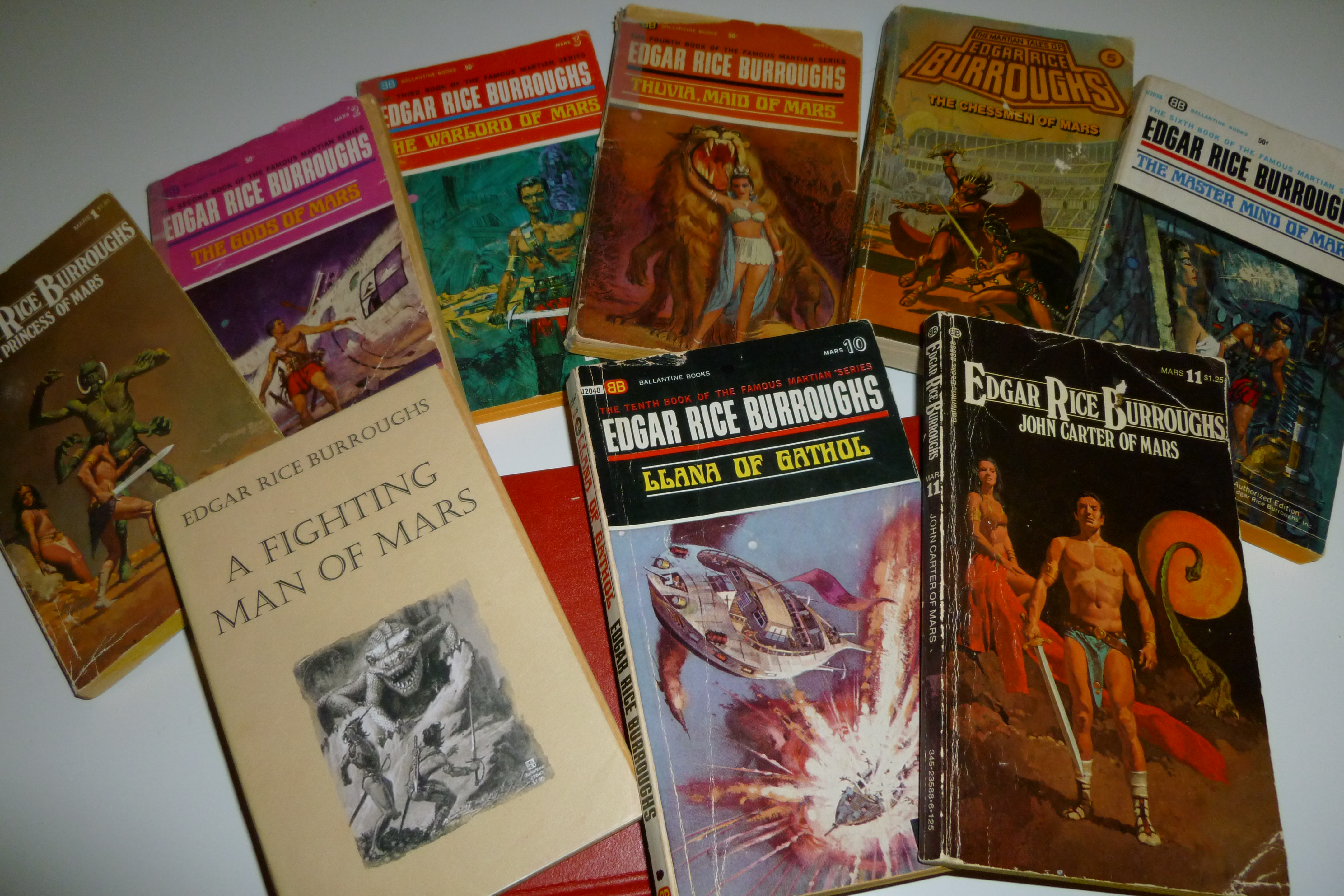
My Burroughs Mars Collection

The plot was essentially accurate to the book.  John Carter of Virginia is a Civil War veteran who goes out west prospecting.  Out in the wilderness, he finds himself mysteriously transported to a new wilderness, with a red tint.  He eventually realizes he’s on Mars (Barsoom), where he meets the Tharks, giant green men with tusks and four arms (Burroughs was the first to have green Martians, incidentally).  It isn’t long before he also encounters the beautiful Dejah Thoris, Princess of Helium.  Not green and without tusks, she’s a member of the red Martians, who look human apart from red skin.  Adventures involving swordfights, epic battles and a villain intent on marrying Dejah Thoris quite naturally ensue.

The movie kept all of that from the book, along with many other details, although they also threw in some extra bits.  I can only conclude that they felt they had to explain John Carter’s transportation, which Burroughs never does.  Part of me loves it that John Carter just looked at Mars and wished and was there, but I can see how the filmmakers felt they needed to give a more complete explanation.  So they introduced the Therns, priests of the Martian goddess Issus, who have medallions which allow them to transport between worlds; one of the medallions takes John Carter on his journey.  The Therns also tie the plot together a bit more, by giving a weapon to Helium’s enemies and presiding over the resulting destruction.  They’re brought up in the first five minutes of the movie and gave me a few bad moments–but I felt better once their mysterious goddess was named as Issus, because then I could place them.  Issus and the Therns show up (albeit in a different capacity) in the second Mars book.

I’m generally much more forgiving of movies making changes if they also demonstrate that they really, really know their source material.  Anybody who can get all the minor characters’ names right and very carefully depicts Martian animals according to Burroughs’ descriptions has earned the right to tweak things a little–and I think it was essentially effective, once I figured out what they were trying to do.

The characterization was well-handled.  They gave John Carter (Taylor Kitsch) a tragic past, to create a character who was lost in more ways than one when he lands on Mars.  He was a bit surly for a Burroughs hero, but they got a little of the Southern gentleman in, and his prowess in battle was perfect.  In a strange way, my favorite moment may have been when he turns to face an oncoming horde of hostile Tharks, buying time for the fleeing Dejah Thoris.  It’s straight out of the book, and only a Burroughs hero could plunge into an oncoming army, alone, armed only with a sword, and come out of it alive.  I’ve heard it commented before that the biggest mystery of the Mars books is how the South ever lost the Civil War when they had John Carter on their side.  The scene was well-shot too, splicing battle shots with flashes of John Carter’s past, and piling up the bodies without being grotesque (more on that in a moment).

I also enjoyed Dejah Thoris (Lynn Collins).  Heroines are not usually Burroughs’ strong point.  She was always beautiful, but she was never much else.  The movie made her both smarter and tougher.  Dejah Thoris the scientist throws me for a loop a little, but Dejah Thoris the swordfighter is pretty much awesome.

The more minor characters were well-done too, particularly among the green Martians.  Tars Tarkas, John Carter’s green Martian friend, was excellent, as was Sola, a more sympathetic green Martian female.  The green Martians were all CGI and there were excellent effects throughout.  I avoided seeing this in 3D so I don’t know how that would change things, but in 2D the effects were convincing, for creatures and landscapes and technology.  I thought the green Martians all looked a bit scrawny for a warrior race, but they did wonderful things with the four arms.  I also absolutely loved Woola, John Carter’s dog-monster.  He was delightful, and added some comedy.  Comedy is not really one of Burroughs’ strong points either, but the movie got some good moments in.

On the whole, I thought the movie picked up as it went.  The opening on Earth was not as interesting (although big points for including John Carter’s nephew, a fictionalized Edgar Rice Burroughs, who’s included in a foreword in the book) but it got better on Mars, and eventually accelerated to some wonderful epic battles and excitement by the end.  That was done perfectly and completely in the spirit of the books.  Burroughs wrote about men who lived by their swords, who would fight their way literally through armies and across planets, have clashes featuring casts of thousands and deaths of hundreds–but he wrote it all with a Victorian sensibility that never dwelled on the blood, and was never gruesome or disturbing.  This movie managed to do the same thing.

This is one of the biggest reasons I’ve always been wary of a movie version–the blood, and also Dejah Thoris’ clothes, or lack thereof to be precise.  Burroughs wrote about plenty of scantily clad women, but again, with a Victorian sensibility that kept it all very clean.  It would be very easy to make a movie with half-naked women and disturbing fight sequences, technically accurate to the book but not at all in the right spirit (and nothing I’d want to see, though I’m sure that would have a market too).  So I was so relieved to know that this was being produced by Disney; it even opens with a red-tinted view of the Disney castle logo.  I figured they’d do it right, and they did.  Dejah Thoris’ costume designer seemed to be looking at the same book covers I have; the princess was scantily clad (and for that matter, John Carter spent plenty of time shirtless) but somehow it didn’t feel exploitative either.

So, to sum: good characters, good effects, good Burroughsian spirit.  A few changes but acceptable ones.  If they do a sequel (and they always do sequels of action features, right?) I’ll be watching it.  I hear it’s not doing well at the box office, but we’ll see!

And in the meantime, there are so many exciting movies coming out this month!  Next up I’m looking forward to The Hunger Games, and after that Mirror, Mirror, a Snow White retelling.  If they live up to their potential as well as John Carter did, it’s going to be a good month at the movies.

Other reviews:
Screen Rant
Angelocracy
Eclipse Magazine
The Oregonian
Stainless Steel Droppings
More?
Favorites Friday: Prolific Writers

Since I’m working on writing a novel this month, it seems appropriate to do a Favorites Friday on very prolific writers–who must be writing their books quickly too.

Most of my favorite authors seem to get a book out about once a year, sometimes less.  And when I’m eagerly awaiting a new installment, that seems like a very long time!  But I can think of three favorite authors (two living, one dead) who seem to manage a faster rate.  I know frequent publishing is normal in the Romance section–but that’s one reason I don’t read romances.  I find it hard to believe an entire genre’s-worth of writers can really publish three books a year without ruining their quality.

But here are three writers who do write good books at an astonishing pace.

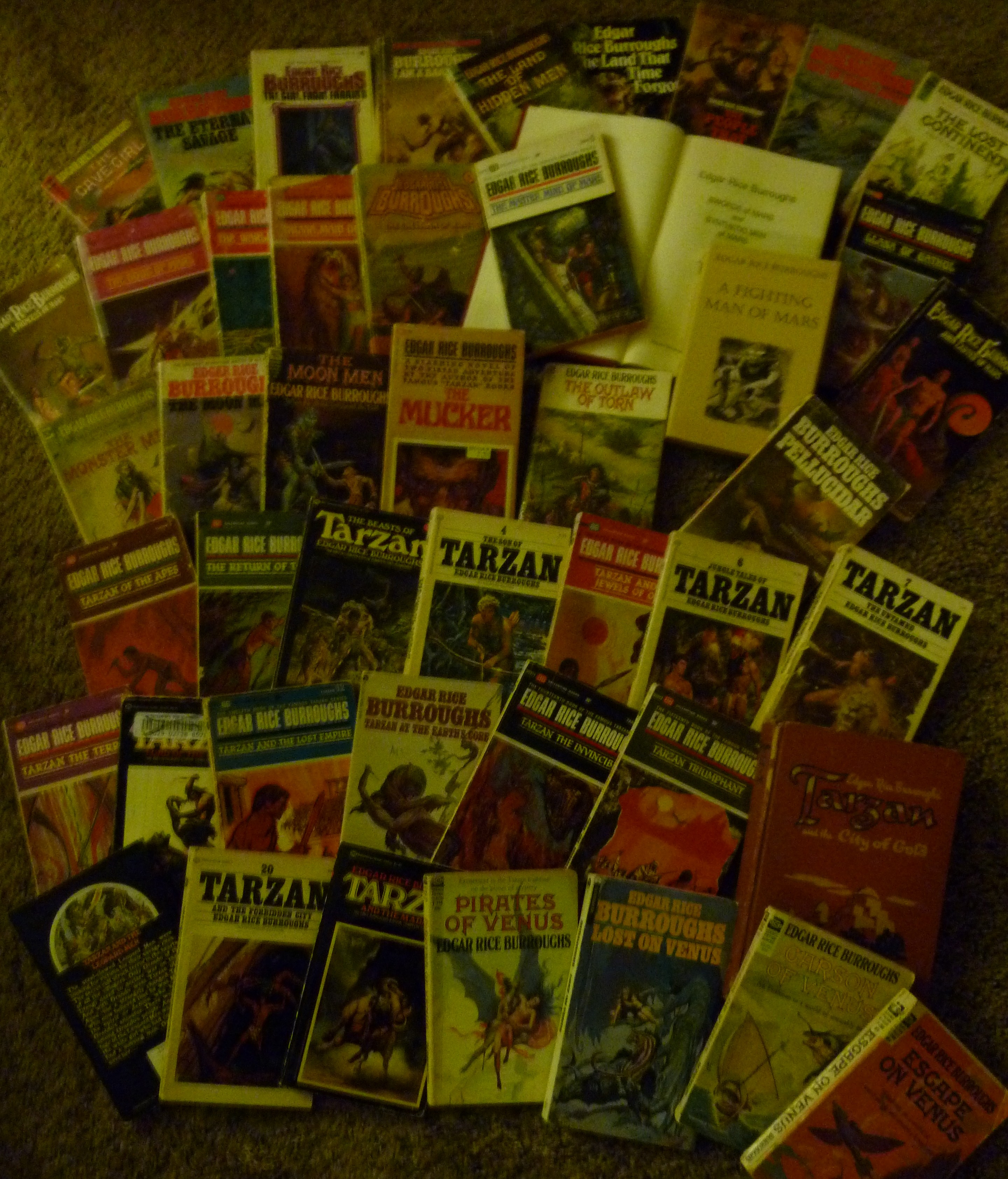
Edgar Rice Burroughs wrote over seventy books in his lifetime, typically two a year.  Granted, they almost all have the same plot, but the quality of the writing and of the adventure is solid.  I’ve heard that Burroughs defies everything writing teachers want to tell you about the importance of revision.  He’d typically write a draft, re-read for punctuation and the occasional word change, and that was it.  His novels are practically first drafts.  Once in a while it shows, but most of the time it doesn’t.  And since I’ve read 47 of his books so far, I’m so glad he wrote as many as he did!

Author’s Site: http://www.tarzan.org/

Geraldine McCaughrean knocks me over every time I look at her book list.  It just goes on…and on…and on!  Seriously, check it out–you have to scroll for a long time.  🙂  Her “About Me” on her website says she’s written 160 books (that really is one-six-zero).  I’ve been meaning to read more of her books…so now I just have to decide where to start!

Author’s Site: http://www.geraldinemccaughrean.co.uk/index.htm

L. A. Meyer has a shorter booklist, having written nine books in the Jacky Faber series.  They do come out about once a year, but somehow they feel more frequent–and I include him here mostly because he has a wonderful knack for always having a new book coming out just when I happen to think of looking for one!  Perhaps they feel more frequent than other authors’ books because he only writes one series–so I never have to wait an extra year while he’s writing something I’m less interested in!

Author’s Site: http://clairdeloon.com/

I know there are other writers who write/wrote a lot–Isaac Asimov and Piers Anthony both come to mind as having very lengthy bibliographies.  So, who am I missing?  Any other favorite writers who put books out at a fantastic rate, and still keep up the quality?

Journeying to Mars to Meet Tavia

Having just reviewed one of my favorite authors, L. M. Montgomery, it seems only fair to also review my other favorite author this week: Edgar Rice Burroughs.

They have some interesting differences and similarities.  The differences may be more obvious: Montgomery wrote about the small things of life in a rural village.  Burroughs wrote exciting adventures set in the jungle, or on the surface of Mars, or deep under the Earth.  But they both knew how to create a vivid world (albeit very different ones!) and how to write beautiful prose and wonderful descriptions.  Montgomery almost always has a young girl as her lead character.  Burroughs almost always has a strapping, warrior man as his hero.  But they both wrote sweet and very discreet romances–those warriors of Burroughs are also perfect gentlemen.  They also have in common that I’ve read book after book after book by them, and very, very rarely found one that wasn’t top quality.

An odd coincidence of a similarity: they were born less than a year apart.

Since I showed all my Montgomery books, why not all my Burroughs books too.

I already reviewed Burroughs’ most famous book, Tarzan of the Apes.  As you can tell from the picture above, he went on to write a lot of sequels about the lord of the jungle–over twenty.  But what I really want to write about today is his other most famous series: his Mars books.

They begin with A Princess of Mars.  John Carter is in a desert in Arizona, where he has a strange out of body experience.  He looks up at the sky, and sees the planet Mars.  He holds his arms up to the sky, and wishes–and finds himself on the plains of Mars.  In Burroughs’ world, Mars (called Barsoom by the natives) is populated by a number of warlike races, from the red Martians who look much like us, to the giant, twelve-foot-tall green Martians.  There are all kinds of other strange animals with six legs or weird stripes or bizarre abilities.  John Carter goes on to have a series of adventures full of swordplay and races against time and endless hazards and escapes, all to win the beautiful Dejah Thoris, princess of Mars.

The first three books in the eleven book series, as well as a few later ones, focus on John Carter.  My favorite, however, is A Fighting Man of Mars.  John Carter is referenced, but the action focuses on Tan Hadron, a red Martian warrior.  In some ways it’s not unlike every other Burroughs adventure: swordplay and kidnapping and a desperate quest to rescue the girl.  (Burroughs only had two plot devices, kidnapping and castaways, but he spun them into 70 adventures.)  A Fighting Man of Mars, however, is different because of Tavia.

Image taken from ERBzine.com

People who have known me on the internet for a long time will know that when I need a fake name online, a username for example, I will usually use Tavia or some variation on it.  In a way it’s a habit–I started doing that at about thirteen, and it’s easy to carry on using the same name whenever this comes up.  And it got started because Tavia is a wonderful character in a wonderful book by one of my favorite authors who, I must admit, rarely wrote a really good heroine.

But Tavia is actually capable.  She escaped on her own out of a harem (fleeing when the King first noticed her–Burroughs heroines get into dangerous situations but are never actually harmed).  She’s pretty much as good with a sword as Tan Hadron.  She’s extremely capable at almost anything that needs doing on their adventure.  Though I do think she’s pretty, her internal characteristics are emphasized much more than her external beauty.  And I find this to be one of Burroughs’ more meaningful and compelling romances.

Sure, there are more impressive heroines when you look across the range of literature.  But Tavia is a great character in her own right, and she’s the best of the ones that Burroughs gave us.  It’s the combination of all of Burroughs’ strengths of writing and excitement and world-describing, combined with a much more appealing heroine, that makes A Fighting Man of Mars my favorite Burroughs book.  It’s the seventh book in the Mars series, but don’t feel obligated to read the first six first.  They’re great books too, but it’s an independent story and Burroughs even provides a helpful overview of Martian society in the foreword.  So I think you’ll do fine if you want to jump ahead to number seven to meet Tavia.

A Trip to Burroughs’ Jungle

I had a running joke with one of my English professors at USF; he could never fathom my attachment to Edgar Rice Burroughs.   And I was never willing to relinquish said-attachment.  It’s not that I don’t think my professor had some valid points; Burroughs’ books are not without flaws.  But nevertheless, if you’re looking for beautiful prose and a ripping good yarn (that’s really the only way to put it), Burroughs is the best.

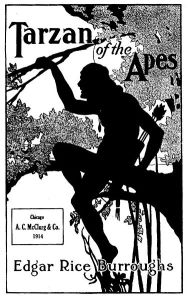
In discussing Burroughs, I feel like I have to start with Tarzan of the Apes.  He has others I like better, but that’s certainly his best known–and one of his best.

I think everyone has an idea of the basic plot of Tarzan–a child is raised by apes, becomes Lord of the Jungle, and romances Jane.  So far, true.  Before going further though, two Tarzan concepts to clear up.

He never says “Me Tarzan, you Jane.”  Before he ever meets Jane, he has taught himself how to read English, but can’t speak any.  They’re separated for a while, and by the time they meet again, he’s completely fluent in both English and French.  (That’s a usual Burroughs Implausability–he likes to throw people from totally different cultures together, but he needs them to talk to each other, so in Burroughs’ world it takes about two weeks to learn a foreign language fluently.  You just have to go with it.)

Second, Tarzan doesn’t shriek while swinging on vines.  He does swing on vines.  And he does shriek–but that’s the cry of the Great Bull Ape after a kill.  He doesn’t do both at the same time.

Now that we cleared that up…Tarzan of the Apes follows Tarzan from birth, to his adoption by the Great Ape Kala, how he grows up among the apes, becomes Lord of the Jungle, and, eventually, how he romances Jane.  Along the way, I lose track of how many lions and gorillas and other apes he fights.  Burroughs’ books are nothing if not exciting–there will be blood.  But it’s not graphic.  There will be heart-pounding action, obstacles to surmount, and lots of hand-to-hand combat.  And, of course, some romance.

All of it is against the backdrop of Burroughs’ African jungle.  Along with his prose, one of his great strengths is in creating bizarre and fascinating landscapes–the surface of Mars, the interior of the moon, the interior of the Earth.  And I include the jungle as one of his landscapes, because it’s not accurate to Africa.  But I think it’s the way everyone who doesn’t know the jungle (me included) imagines it, with great vaulting canopies of trees, dangerous beasts lurking behind every bush, and adventure always at hand.

So the great virtues of Tarzan, and most Burroughs books, are the prose, the action, and the landscape.  I should probably warn you of the most prevalent flaws as well, at least as relevant to Tarzan.  If you want a strong heroine, you’ve got the wrong writer.  Jane spends a lot of time being carried off by people–literally.  There are also some racist parts about the African natives.  Without condoning that, I think we also have to accept that Burroughs was a product of his time.  We can’t expect 2010 enlightenment in a novel written in 1912.  I’ve never found it severe enough to interfere with my enjoyment of the story.

That’s all, really.  And trust me, the positives of the story make it worth it.  Two more practical things to note, before you pick up Tarzan.  I have a used copy of the book–I can’t remember where I got it anymore, but it’s missing the first 12 pages.  This doesn’t bother me, because, despite being completely action-packed later on, Tarzan starts slow.  My advice is, if you feel like it’s dragging, just skip to the last page of chapter 3.  In the first three chapters, John Clayton (also known as Lord Greystoke) and his wife are on a ship; there’s a mutiny; they end up set ashore in Africa; he builds a cabin and she has a baby; she dies of an unspecified illness when the baby is a year old.  That’s all you need to know.

And if you get to the end, and think–wait, that can’t be the end!–you’re right.  They ought to just publish The Return of Tarzan in the same volume, because the story continues.

Author’s site: http://www.tarzan.com/