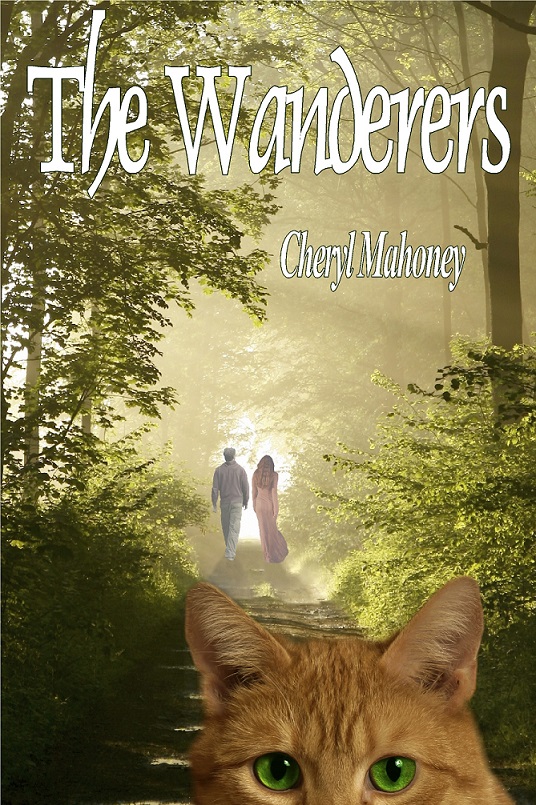
Today’s Blog Wander takes us over to A Library Mama with blogger Katy, for an interview about fairy tales, Walt Disney, and what to expect after The Wanderers. Katy asked some great questions (and I hope my answers are good too!)
Katy is a “public librarian, bookworm, and mother of two, among other things.” Her About Page has a lovely story about what inspired her to begin her blog, and the goals behind it.
Along with the interview, we’re offering an ebook giveaway, so head over to A Library Mama for the opportunity! And come back next week for Katy’s review of The Wanderers as well. 🙂
In another wandering today, we’re heading over to The Bookworm Chronicles, for something a bit different… So far, there have been interviews and an excerpt–for today, I wrote a guest post about retelling fairy tales. You already know I love writing and reading retold fairy tales, and this post explores some of the different approaches for tackling those original Grimm stories to create something new.
The Bookworm Chronicles shares the reading of Jessica, self-confessed bookworm. She recently read The Complete Brothers Grimm, and her rereading of the Narnia series helped inspire my journey through the audiobooks. She writes a great blog I hope you’ll enjoy exploring!
And if you wander over for the guest post, you can get a coupon for The Wanderers too…
One of the rereads I planned this year was Patricia C. Wrede’s Enchanted Forest Chronicles, which are among the very best fairy tale retellings I’ve ever read (and that’s saying a lot!) I’m midway through a reread right now, so because of that and because I consider this series an inspiration for my soon-to-be-released fairy tale novel, it seems an appropriate time to share this particular review again!
**********************
I was recently sketching over the plotline of The Enchanted Forest Chronicles by Patricia C. Wrede for a friend, and realized that I actually remembered all the character names. As I’ve mentioned, I am bad at character names. Oh sure, I remember the main character (maybe!), but the main character’s best friend? Probably not.
But for The Enchanted Forest Chronicles…Cimorene is the heroine, and her best friend is named Alianora. And I could give you at least another six or seven names besides. All of which should say something about how great this series is!
Don’t mind the creases–they’re well-read
It all starts with Cimorene, a princess who decides that she’d rather be kidnapped by a dragon than marry the boring prince her parents picked out. Princesses are kidnapped by dragons sometimes, you know. Taking advice from an enchanted frog, Cimorene goes off to find a dragon and volunteer. The dragon Kazul agrees to take her on, especially after hearing that Cimorene can cook cherries jubilee.
Is that already enough to convince you these are wonderful books? If not, I can also tell you that the story goes on with evil wizards, all manner of enchanted creatures, a magical forest (of course) and endless fun references to fairy tales. They’re funny, exciting, and even romantic in spots.
It’s not a romance with that boring prince from the beginning–Prince Therandil does turn up, but he stays insufferable. He comes to fight the dragon to rescue Cimorene; he would have come back earlier in the book, except that he was waiting for Kazul to defeat an impressive number of challengers first. He’s very put out when Cimorene explains no one’s actually fought Kazul–she’s been talking the challengers out of it, which has been very inconvenient and time-consuming.
Wrede has created one of those wonderful things in retold fairy tales–a world where there are strange and marvelous things like djinns and enchanted swords and magical caves and (of course) dragons, but where you also have to deal with getting the right pot for your cherries jubilee, and cleaning the dust out of (non-magical) caves.
The series is a quartet, plus a couple of short stories. I think my favorite book is the third, narrated by the witch Morwen, who has nine talking cats (who only she understands). This one also features a rabbit named Killer, who has a penchant for stumbling into spells, piling layer after layer of enchantment on himself. In a magical, rabbit sort of way, he’s not unlike my character, Jones.
I don’t think any of the books retell any specific fairy tale, but they’re all riddled with references, sometimes made quite casually. When Cimorene’s parents want her to get married, she says she’s too young. Her mother replies, “Your Great-Aunt Rose was married at sixteen…One really can’t count all those years she spent asleep under that dreadful fairy’s curse.” In the second book we meet a giant who’s very friendly as long as your name isn’t Jack, and a dwarf named Herman who tried the Rumpelstiltskin trade, but got stuck with tons of children when no one could guess his name (and he thought Herman would be easy).
I could probably go on citing incidents and examples for a long time…but better to just read the books. They’re good adventures, very funny–and obviously, have memorable characters!
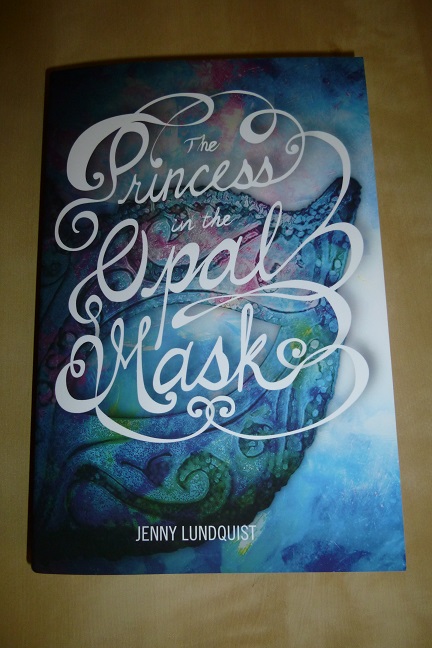
A couple of common threads around here include retold fairy tales, and the masked Phantom of the Opera…so The Princess in the Opal Mask by Jenny Lundquist, with its Cinderella spin and masked princess, seems tailor-made, no? 🙂 It also turned out to have strong female characters, a well-developed world and an excellent fantasy feel, all things I enjoy in a book!
The story alternates narration between two girls: Elara who has a Cinderella-like existence among her adopted family, and no knowledge of her birth parents; and Wilha, a princess who has never been allowed to show anyone her face, not even her own father. And…it’s hard to say more without spoilers, but suffice to say both girls end up central players in a tentative and uncertain peace treaty with a neighboring kingdom. There’s intrigue and romance and backstabbing and conspiracies–and Wilha’s mask is only the most visible one.
I really loved the idea of the princess in the mask, and was so intrigued by the mystery–even Wilha herself doesn’t know why she has to wear a mask all the time. All sorts of rumors fly, that her face is cursed or blessed, and the book explores Wilha’s own confused feelings and fears. The Phantom of the Opera at least knew why he was hiding his face–Wilha has no answers, except a fear that showing her face will mean death for anyone who sees her.
Wilha also struggles to be seen as a person, not as The Masked Princess. Most of us don’t go around in physical masks all the time (or hardly ever…) but the struggle to be seen as our true selves is much more universal.
Clearly I warmed to and related to Wilha right away. Elara took longer–part of her struggle is that she doesn’t want to let anyone get close to her. Considering her life, that does make sense. Unfortunately, I felt like I couldn’t get close to her as a reader either. However, she emerged more in the second half of the book, making more connections to others–and me!
The worldbuilding is another very strong element of the book. Much of what happens, particularly with the neighboring kingdom, is grounded in the country’s history. Lundquist does a nice job conveying a lot of information about past events, without getting bogged down or dry.
Description is a strong element here too. Those masks may be imprisoning Wilha…but they’re beautiful too. I want an illustrated version of this, mostly just to see the masks. The cover is pretty, but it really doesn’t do justice to the elaborately-described masks!
There were plenty of unexpected turns in here, and it genuinely kept me guessing in the romance department. A sequel has been promised for next Fall, and I’m looking forward to it! Wilha and Elara are both on paths towards claiming their own lives and I can’t wait to see where they go next–and I’m hoping the sequel will pick up some threads (romance included) that were left unresolved here. If this book was any indication, more twists and mysteries will be in store!
Disclaimer: I received a copy of this book from the publishers in exchange for an honest review.
I think my reasons for reading A Tale Dark and Grimm by Adam Gidwitz should be fairly self-evident in the title…Brothers Grimm-inspired, and dark and spooky for Readers Imbibing Peril!
The premise is very clever, promising to tell the true story of Hansel and Gretel, and then setting off through several Grimm fairy tales. When Hansel and Gretel’s father learns that his faithful servant, previously turned to stone in his service, can be restored if he chops his children’s heads off…he goes ahead and does it. Hansel and Gretel are restored to life, but (quite understandably) decide it’s time to run away from home. They encounter the wicked witch with her candy house, but also go on adventures through other fairy tales, struggling against dangerous magic and frightening or fantastically irresponsible adults.
With the exception of the original Hansel and Gretel story, these are not the best-known Grimm fairy tales, like Sleeping Beauty or Cinderella. I recognized most of the stories, but I’ve read a good bit of the original Grimms…and considering my audience here, you might recognize them too!
There’s definitely constant excitement in this novel, with a new twist and villain at every turn. It actually didn’t feel as episodic as you might expect, though. With the constant thread of Hansel and Gretel as the main characters, the different tales wove together surprisingly well. There’s also an amusing narrator who occasionally stops the action to make remarks to the reader about the story. I might have liked a little more subtlety in weaving the narrator into the story…but that’s a choice, and once I got used to the narrator, the device worked well.
For all that’s good here, I do have one BIG reservation–I really don’t know who the target audience is meant to be. The style of the writing is clearly juvenile. There’s a simplicity to the language, Hansel and Gretel seem to be about 10 or 12, and there’s just a very strong juvenile feel to the book. However–there is a LOT of blood.
I feel a little strange pointing that out, because the narrator points it out too, in a very sarcastic, tongue in cheek kind of way. Early on, he keeps advising that little kids should be kept out of the room because they’ll be disturbed by upcoming sections. Those remarks read like jokes…but they’re true! The blood and the violence are told in the matter-of-fact style of the original Brothers Grimm, and there’s probably nothing here that wasn’t there…which still leaves you with blood, beheadings, dismemberment, two (unrelated) severed fingers, and all in all quite a bit of nastiness.
As far as I can tell from Gidwitz’s website, the blood is supposed to be a large part of the appeal. All the same, I haven’t the slightest doubt that if I had read this when I was actually the target age suggested by the writing style, I would have been thoroughly disturbed. There’s a bit in here about skinning a monster that I find slightly disturbing now. Conclusion: although I liked aspects of this, apparently I’m not the target reader.
So…I guess the natural reader is either a kid who doesn’t mind gore (and I’m sure there are ones less squeamish than I was), or an adult who doesn’t mind a simplistic writing style. If you pick it up, there’s plenty that’s well-done, but be warned that this really is inspired by the Brothers Grimm, not Walt Disney!
 Today’s Blog Wander takes us over to A Library Mama with blogger Katy, for an interview about fairy tales, Walt Disney, and what to expect after The Wanderers. Katy asked some great questions (and I hope my answers are good too!)



 Tales of the Marvelous