NaNoWriMo Day 20: Plot Bunnies

Just a quick update tonight.  I am well and truly into Part Two of the novel now.  As hazy as some aspects of Part One were, Part Two is even more so.  Things are starting to come together–or spiral all apart, it’s a little hard to tell.

I have been discovering plot bunnies, as the NaNo community calls them, those threads of ideas that have a way of multiplying.  I had been without any real plot for the second half of the book.  Now I seem to have fallen into two plot threads, sort of three, and I’m not quite sure how they’re going to fit together.  Either this is great, or I have completely lost control.  I can’t tell which yet!

So I am trying to trust the process, and we’ll see what happens…

One thing I am enjoying–I’ve found a way to bring in a character who originally only existed as a throw-away line in my other novel draft.  For that story, I had to explain why Prince Randolph was on a quest when he had neither the skill nor the inclination for the task.  So he mentioned in passing a battleaxe aunt who had pushed him into it.

Randolph himself is not in this year’s NaNo novel, but I decided I was getting too many royal families and it would be wise to make the princess of this one Randolph’s sister.  Which means she has the same battleaxe aunt…and I’ve decided the aunt should appear in this novel, and be responsible for one of my new plot threads.  Whatever else I do with these plot bunnies, I’m pretty sure the aunt is staying in some form!

For tonight’s excerpt…how about meeting the Battleaxe?  There have been a great many developments since my previous excerpt, and Maggie is traveling to the castle in Rokinley, Michael’s country, with Michael and his brother Laurence.  They’re about to meet a traveling party from the royal court, which sends Maggie into something of a panic because she’s still pretending to Laurence that she’s the Princess Evangelina, and has no idea how she’s going to get out of that once she tells it to the entire court.  Michael’s only advice is to keep smiling…

And Maggie smiled, and kept smiling and promised herself she would ask for an audience with the king immediately when they got back to the castle, that was the only way to handle this now, and Michael had better come because she was really going to need some kind of support now, especially if it all came to throwing herself on someone’s mercy, and all she had to do right now was just smile and…

And then the door to the largest of the carriages, which had rumbled up a few minutes behind the faster horses, opened.  A woman stepped regally out, and Maggie stopped smiling.

The woman who came out of the carriage did not take the help of the footman standing ready to hand her down.  She was a tall woman with severely pinned-back hair, wearing a gray dress cut on stern lines.  She was not unusually large, though people tended to forget that when she’d been out of their sight for any length of time.  Her eyes were a startling blue.  She had a kind of beauty, but the word people more often used was imposing.

Maggie stared at her, paralyzed.

It was Lina’s aunt.  The king’s sister, the one everyone knew really ran Giramm, the one everyone in the court—but never to her face—called the Battleaxe, with equal parts respect and terror.

The Battleaxe stalked directly towards Maggie, and the laughing, cheery court of Rokinley parted like the sea to let her pass.  Maggie knew that courtesy demanded she get down from her horse, but she clung to her perch as the only possible high ground she could command.  At least she was above the other woman, and could make a galloping escape if she had to.

The Battleaxe stared up at her in silence for a long moment, and Maggie wasn’t sure if the rest of the group had fallen silent or if she just couldn’t hear them over the pounding of her heart in her ears.

Then the Battleaxe smiled and said, “My dear Evangelina, it’s so good to see you.”

NaNoWriMo, Day 4: Lightning Bolts (the good kind)

We’re finishing up the first weekend of NaNoWriMo!  I was lucky to have a fairly quiet couple of days, so I’ve been able to get a nice jump on my word count–even though I also went to my writing group on Friday.  🙂  Right now I’m about 2,000 words ahead of the goal, which is very good because I know I’ll have a couple of days next week with very little time to write.

So far I’m enjoying the pace, especially the way the process moves so much faster when I write like this.  Inspiration has been coming at a rapid rate so far, and those lightning bolt “oh, that’s how it should work!” moments are among my favorite parts of writing.  I don’t know if I could sustain this long-term, but it seems to work for a month–or at least four days so far…

My biggest lightning bolt up to now has helped me (I think) work out one of my biggest plot problems previously.  You see, my premise got me into a very particular corner.  The whole concept of the book started when I was reading fairy tales and somehow sparked off this idea about an imprisoned hero who has no actual ability to fight the monster, but keeps standing up to defend the heroine anyway.  The villain finds that funny, and backs off–until the next day.  And so it keeps repeating day after day.

I loved the dynamic of that interaction, and I think I’ve been able to write it to really work for the hero.  The trouble was, it didn’t work at all for Maggie, my heroine.  For the dynamic to work, Michael can’t have an actual chance when he stands up to the evil king, which means that there’s really no place here for Maggie to do anything.

I can’t stand passive heroines, and there I was in a corner with a heroine who had to be passive, at least for the first section of the book.  This was probably the biggest thing that got me stuck the first time I tried to write this book.  But, on about November 2nd, lightning inspiration hit me.  I’m frustrated by this–and Maggie can be frustrated too.  I don’t have to have a passive heroine–I can have an active heroine who’s being forced by circumstances to be passive, and she damn well doesn’t have to like it!

It was a really helpful breakthrough for the character, and for the feel of this part of the novel.  And I’ve come up with a few things Maggie can do or at least try to do, around the fringes of this focus-point conflict.

There are more plot holes farther down the line, both things don’t make sense and sections I just don’t know what to do with yet…but with any luck lightning will continue striking!  For tonight, here’s an excerpt.

           Maggie woke up the next morning to find that she was still here.  The idea was somehow even more oppressive the second day than it had been the first.  She lay in the ridiculously large bed, stared up at the canopy, and tried not to roll over onto her stomach and cry into the pillow.  If she managed to resist that impulse, then maybe she could muster enough will to get up.

            It might not have been as bad if she didn’t feel so aimless.  She wanted to do something, and she was at a loss to know what.  It was entirely possible that this current situation, exactly as it was, was going to go on for days or even weeks.  If the last two days were any indication, she could stay in this sort of limbo, not quite slipping into further hells, for the foreseeable future.  At least until Michael developed a stronger sense of self-preservation or, as seemed vastly more likely, King Maurus decided to stop being amused.

            So she had some space.  And it made her want to claw the walls that she couldn’t think of anything to do with it.  Escape plans and exploring were all well and good in theory and no doubt would be just the thing in a story, but the fact of the matter was she had no real direction and no clear ideas, and wandering around this castle, well…how likely was it really that she was going to find a secret tunnel, or a magic sword, or…anything, really.

            She had always been the instigator.  She had always been the one who made things happen if there wasn’t enough going on.  It was a byword in Beaumont, that she and Lina always got into some kind of enormous trouble in February.  One year it was nearly drowning trying to skate on a frozen pond; another year all the hunting dogs around the castle became decidedly drunk when their water was not-too-mysteriously spiked; and then there was the time she and Lina actually snuck along on a hunt and then got lost and…it was really just as well that no one knew about the time she’d dared Lina to climb out on the roof of the highest tower, and then of course she had to do it herself too.  If they had slipped, that would have been a story to top them all, one they probably wouldn’t have lived to tell.

            Things happened in February because winters were quiet and by February Maggie got tired of waiting for someone else to make things happen.

            Now here she was in the most awful February of them all, metaphorically speaking, and found her hands completely tied.  She wanted to do something besides stand there silently while King Maurus smirked and Michael went all noble.  She wished she knew how to do magic, or even how to fight.  Sure, one February she had tried to get one of the guards to teach her and Lina swordplay, but that had been stopped long before March.  A talent for instigating mischief seemed hardly likely to help her here.

            She didn’t cry, and she did eventually muster up the willpower to drag herself out of bed.  She pulled on the first dress her hand touched in the wardrobe, some frothy blue concoction, obviously not designed for anyone who actually did anything.  Fine.  It was perfectly suitable, then.

Classic Review: Ella Enchanted

I’ve reviewed a lot of retold fairy tales on this blog.  One of the first was Ella Enchanted, and I still think it’s one of the best!

***********************************

Cinderella, in her traditional form, is a character who drives me absolutely up the wall.  Come on, woman—I know you lived in a pre-feminist culture, but don’t you have any backbone at all?  Your life’s awful—so do something about it!  And the fairy godmother—where was she all these years while Ella was being mistreated?  The fairy only shows up when the girl wants to go to a party?  (Because obviously that’s something of paramount importance.)

But, like all great fairy tales, Cinderella does have that spark of eternal appeal.  Who can’t relate to the dream of being lifted out of your ordinary or even unpleasant life, because that one person (the prince, the book editor, the boss for the dream job, the head of the club…fill in your own relevant personality) sees you and says, yes, you’re special above all others.  That’s the core of Cinderella.  But Cinderella herself is irritating.

So when you can take that eternal spark and improve on the character and the plausibility—well, as I said when discussing Wildwood Dancing, then you’ve got something.  And Ella Enchanted by Gail Carson Levine is one of the best retellings of Cinderella I’ve ever read.

Ella is cursed at her christening—if anyone gives her a command (from “eat this cake” to “go jump off a roof”) she has to obey it.  And with that one brilliant stroke, Levine has a heroine who, like the traditional Cinderella, does everything her wicked stepfamily tells her to do—but who also has a mind of her own.  No one could accuse Levine’s Ella of lacking backbone.  She obeys, but I don’t think I’d describe her as obedient.  She can think for herself and, as much as she can around the limits of her curse, takes control of her own life.

There’s a good plot, with ogres and adventures and a kind of quest in Ella’s search for a way to overcome her curse, but I think what mostly stands out in my mind are the characters.  Ella, of course.  And her fairy godmothers (both of them), her more-than-usually complex wicked stepfamily, her absentee father, and, of course, Prince Charmont—because what’s a Cinderella story without a true love, right?

Ella Enchanted probably belongs in the juvenile category, rather than young adult.  But, kind of like the original Cinderella, it has a wide appeal, even if you’re not really the target age group.

I unfortunately can’t quite just ignore the movie here.  There is one, but let’s all just pretend that there isn’t.  Don’t see it.  Really.  I did, and I think I spent most of it twitching and saying, “No, no, no, that’s wrong.”  Besides getting the details wrong, it got the spirit wrong, and while I can sometimes forgive a movie for changing the facts a little, it’s much harder to forgive a movie for maiming of the spirit of a story.

Because what Ella Enchanted really is is a very practical, plausible (once you accept the existence of magic) retelling of Cinderella.  The movie isn’t.  But the book is, and it’s well-worth the read.

Author’s site: http://www.gailcarsonlevine.com/

Healing the Twelve Dancing Princesses

Two of my favorite fairy tales are “The Twelve Dancing Princesses” and “Beauty and the Beast.”  So of course I was intrigued by a novel that promised to retell both of them.  The Princess Curse by Merrie Haskell lived up to the promise, and it was a great book.
This is another version that tells the “Dancing Princesses” story from the POV of a girl removed from the curse itself (that is, not one of the princesses).  Reveka is the herbalist’s apprentice at the princesses’ castle, and dreams of one day having an herbary of her own.  She thinks she sees the way to achieve that dream by curing the princesses of their curse, and accepting the promised monetary reward.  As she uses her herbcraft and her wit to delve into the mystery, she finds that things are much less black and white than they seem, and that, of course, all of this will have very unexpected consequences for her.

As always with fairy tale retellings, I love the unique touches.  I love that there’s a monetary reward for women who solve the curse; most versions don’t consider how limiting a reward a princess’ hand in marriage really is.  The curse has an added dimension because people who stay in the princesses’ room either fall asleep, unable to waken, or disappear entirely.  That adds so much more risk to the story (and means that the King doesn’t have to behead anyone, something every re-teller finds a way around).  I love that there’s a handsome friend who’s in prime position to be the love interest…but it’s all more complicated than that.  And Reveka’s father–well, I should have figured out his role in the story much sooner than I did!

I felt drawn to Reveka as a heroine at once.  I’m realizing that strong girls who are unappreciated by the adults in their life immediately pull me in.  I want things to be better for them.  Reveka has a difficult (but normal for her time) past, and big dreams for her future.  She wants to solve the curse to help herself, but also to help the sleepers, so she has a realistic blend of motivations.

I liked the handling of the princesses as well.  Most blend together as an amorpheous mass (there are twelve of them, after all) but it works, because I don’t feel like I’m supposed to know who most of them are.  There are two that emerge as larger characters, and the rest mostly hover in the background.  Since they’re rarely brought forward, I’m not struggling to place them as I read, and it doesn’t bother me that I don’t know who they are.  Beyond that, they’re interestingly complex, neither the saints of most retellings or the (possible) villains of the original.  They’re real girls who are making difficult choices, and while they may do some villainous things, I don’t feel that they’re heartless or evil.

This is obviously a fantasy, but it also has a historical fiction feel.  It’s set in a fictional country, but one which is firmly planted in 15th-century Eastern Europe.  There are references to convents and saints, and a lot of historical herb-lore.  The herb-lore is never overwhelming or superfluous, and I think it serves a purpose to ground the story.  That level of detail and Reveka’s level of knowledge about it gives her more maturity and depth and gives the story more…solidity is the only word I can think of.  The premise (of the first half at least) reminds me of The Thirteenth Princess, but that one felt lighter and less plausible, and the heroine felt shallower.  The historical grounding isn’t the only thing making the difference here, but it helps.

The story wraps up in the end, but leaves some questions unanswered and…well, I can’t fully explain without a spoiler, but I wanted a more complete wrap-up.  So now I very much want a sequel!  Apparently I’m not the only one, because Merrie Haskell mentions the subject on her website–but all she says is that she promises a sequel if the publishers decide to put one out.  How very inconclusive!  So I’m hoping, and in the meantime, it was an excellent addition to my list of Dancing Princesses retellings!

Author’s Site: http://www.merriehaskell.com/

Other reviews:
Fairy Layers
Books Before Bed
Bookalicious
Maestra Amanda’s Bookshelf
Anyone else?

A Mermaid and a Princess

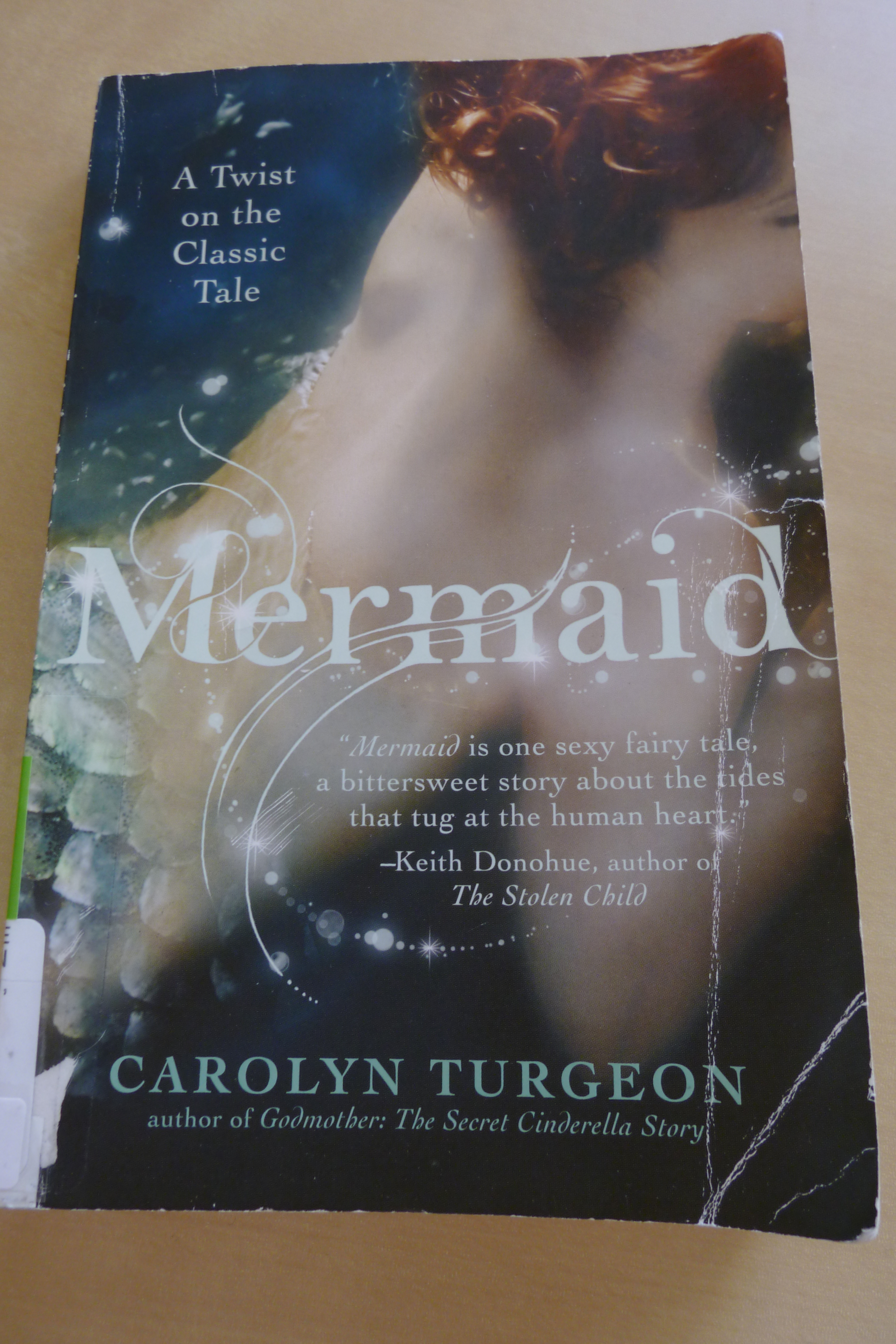
Since it’s hard to ignore Disney while talking about fairy tales, perhaps I should begin by saying that this is not a review of The Little Mermaid.  It’s not a review of Andersen’s fairy tale either, but that’s a closer relative.  Mermaid by Carolyn Turgeon is a re-imagining and expansion on the Andersen tale, with all the dark parts retained and deeper characters developed.

The original story is about a mermaid princess who falls in love with a human prince.  She gives up everything and goes through torture to gain legs and be with him, only to lose him to a human princess in the end.  This book looks at the story through the eyes of both the mermaid and the human princess, bringing an added dimension to the tale.  It’s definitely an adult version of the fairy tale, both for the sensuality and for the torment the mermaid goes through.

The story opens when Princess Margrethe, hidden at a convent to protect her from her country’s enemies, sees a mermaid drag a human man onto the shore below.  Mermaids are mythical creatures in this land, and Margrethe is drawn in by all the magic that the mermaid represents.  She feels sure that the mermaid brought the nearly-drowned man to her for a reason, and is shocked when she finds out the handsome stranger is the prince of an enemy country.  Meanwhile, Lenia the mermaid princess has always been fascinated by the land, and now can’t stop thinking about the man she rescued.  She seeks a way to be with him, while Margrethe looks for a way to prevent war.  Unfortunately, they’re both sure that destiny is calling them to the same man.

Margrethe and Lenia are the center of this book, telling their stories in alternate chapters.  While they’re both in love with Prince Christopher, the dynamic between the two women has in some ways a stronger emotional impact.  Margrethe especially is drawn to the magic and mystery that Lenia represents.  I very much enjoyed Margrethe’s character.  She’s not a passive princess, but rather one who sets out to arrange destiny herself.  She doesn’t wait for the prince or get dropped on him by her father, but rather actively orchestrates events, even when that means taking risks and making difficult choices.

Lenia is an intriguing character as well, with her divided longings for both the sea and the land.  She also takes active steps (literally and metaphorically) to take the destiny she wants.  She goes through far more torture than Disney’s Ariel.  She gives up her voice, but not as a pretty ball of light–instead her tongue is cut out.  Once she gains feet, walking inflicts terrible pain.  All this is in the original, and wasn’t too gruesome…but definitely dark!

Christopher is a handsome, reasonably charming prince, though less complex than the two women.  It would be easy to not like him, because in some ways he does take advantage of Lenia once she arrives on shore.  However, I actually found myself not holding that against him.  While I don’t think it was particularly admirable, I do think he was operating from a culture where there’s an expectation about relationships between princes and commoner girls, and it simply never occurred to him that Lenia wouldn’t have that same understanding.  And he does show quite a bit of loyalty to her at points in the story.

I was not totally satisfied with the ending, and it’s a little hard to explain without spoilers.  In some ways it tied up too neatly, with characters deciding they can accept things they previously couldn’t, and yet in other ways it didn’t give me quite the happy romantic ending I wanted.  The whole premise is set up so that someone has to be disappointed, and instead of giving a happy ending to one girl and a tragedy to the other, we ended up with an ending where both are kind of settling…which works, but I think I might have preferred something a bit sharper.

Still, this was a very solid retelling of Andersen’s story.  I recommend reading the original first, and then picking up this one for all its added depth and details.

Author’s Site: http://carolynturgeon.com

Other reviews:
Anita Book
Postcards from Asia
Fairy Layers
Anyone else?