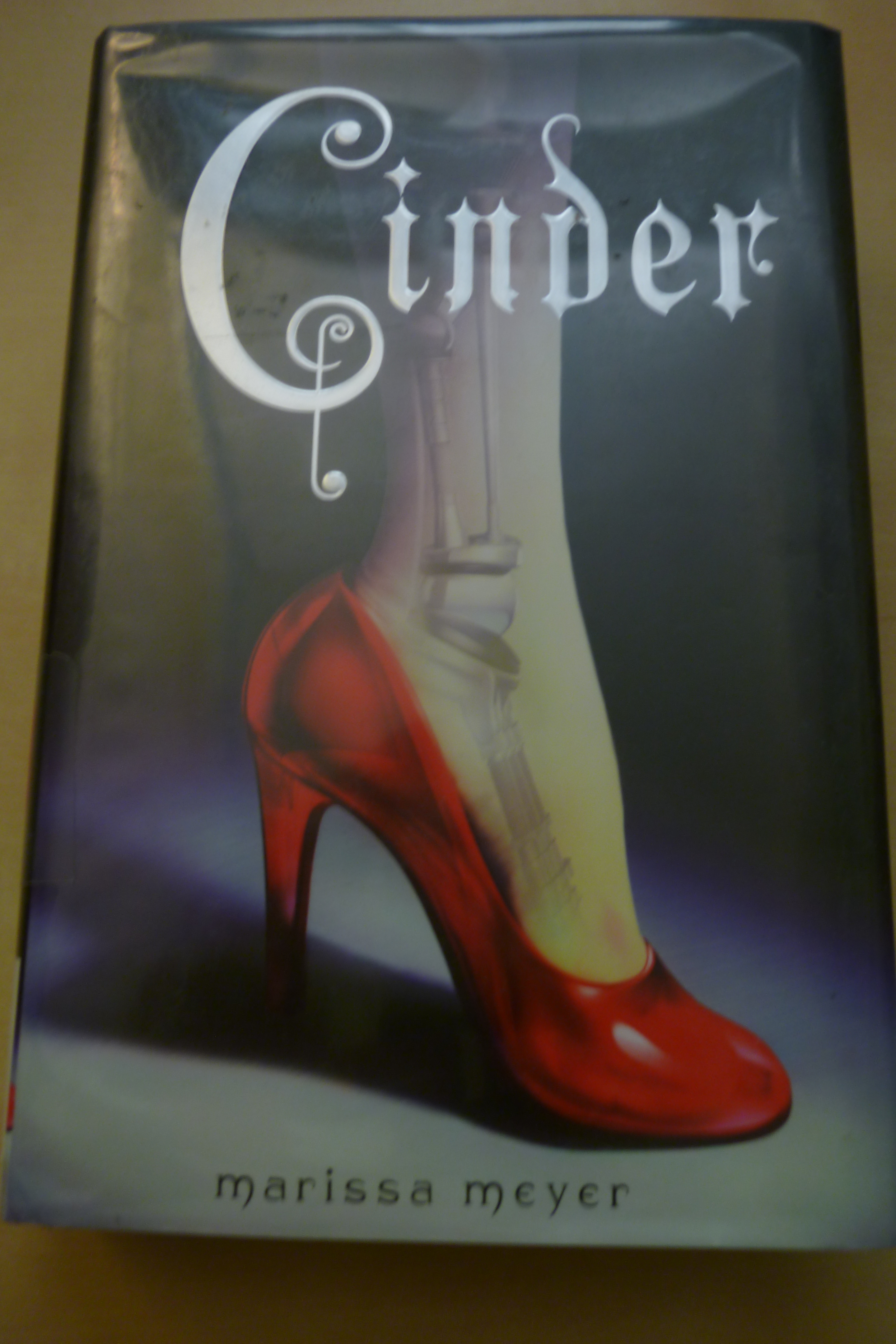
A Sci Fi Retelling of Cinderella

First, a bit of business–the first post for the Going Postal group read goes up a week from tomorrow.  I contacted everyone who let me know they were interested, but there’s still plenty of time to join in–so let me know if you’d like to!  Now, on to the review…

I put Cinder by Marissa Meyer on hold at the library at the beginning of the Once Upon a Time Challenge–in mid-March.  It’s only fair to say that my library usually runs through hold lists pretty quickly…but in this case, the book finally got to me in mid-June.  I managed to read it about five days before the OUaT Challenge ended!

So was it worth the wait?  Yes–because I was very curious about it.

As you may have guessed or known, Cinder is a retelling of Cinderella, though I was surprised by how loose a retelling it actually was.  Set a vague distance into the future, Cinder is a cyborg, mostly human but with a mechanical hand and leg, and circuitry in her brain.  While she is downtrodden by her (adoptive, not step) family, and there is a prince and a ball, the book mostly focuses on the search for a cure for a pandemic sweeping the globe, as well as rising tension with Lunars, the human moon-dwellers who have developed mental powers to manipulate others.

I quite liked Cinder.  She’s a strong Cinderella who’s plotting escape from her family and doesn’t actually care that much about the ball–she has bigger problems to think about.  I loved the cyborg-ness too, and wanted more of that element.  What was there was fun, from the low-tech (storing things in a compartment in her calf) to the high-tech (she can mentally connect to the internet, and her body warns her when she’s overheating).

Prince Kai was a nice guy, though a bit bland.  He served his role in the story perfectly well, and had a little more complexity in his uncertainties about how to fulfill his position as prince (and soon to be emperor), but he didn’t strike me all that much either.  In a bit of a reversal of that, my one biggest issue with the book was that I wasn’t sure why he was so struck by Cinder.  He starts singling her out almost as soon as he meets her–and I do appreciate that they meet and start developing a relationship well before the ball.  It’s just that I’m not sure what prompted him to pursue that relationship.  I mean, I like Cinder–but I’m really not sure why the prince, who has every girl in the country to pick from, decided he liked this particular one.  I’m all in favor of the idea that he saw something special in her, only I don’t feel like the book ever made clear what exactly it was, or even if there was something–I’m just assuming there must have been.

So it wasn’t a heart-stopping romance, at least not for me, but I am curious to see where it goes.  This book is the beginning of a series, and there are a lot of threads still to be explored.  There are some good tensions in Cinder and Kai’s relationship, like the political marriage he’s being manuevered into with the Lunar Queen, and the small fact that Cinder is trying to hide being a cyborg from him.  Cyborgs are looked down on as somehow less than human, in what I’m sure is intended to be a reimagining of the social structure of Cinderella’s original setting.

I would be remiss if I didn’t also mention Iko.  She (it?) is Cinder’s friend and somewhat fairy godmother-like figure, and she’s a robot.  She’s a robot who is also a hopeless romantic, quite forward, and often funny.  She wants Cinder to go to the ball more than Cinder does, and she’s really rather adorable at times.  The most moving moment in the book for me involved Iko’s personality chip–and that’s all I’m going to say, to avoid any spoilers!

So, to sum–fascinating concept, good characters (especially Cinder and Iko), okay romance, pretty good plot though at times it stretched on a bit, and one late-in-the-book twist was really obvious (maybe that was just me–but I don’t think so).  I liked the book–I didn’t love it–but I am adding it to my list of series, and plan to read the next one when it comes out!

Author’s Site: http://www.marissameyer.com/

Other reviews:
Stella Matutina
At Home with Books
Book Journey
Andrea’s Book Nook
Book Nut
I saw this on a LOT of blogs before it finally got to me…did I miss yours?
Once Upon a Time VI – Wrap-up Post

I’m really quite sad that the Once Upon a Time Challenge has ended.  It’s been so much fun sharing reviews, and reading everyone else’s!  This challenge focuses on some of my very favorite kinds of books (fairy tales!) and I’ve loved putting the emphasis on them for the last few months.  (Although now that it’s ending, maybe I’ll finally get back to the Foundation trilogy…)

Another reason I’m sad it’s ending…I’m not done reviewing things!  Too many books and movies, and I got behind, so stick around–more reviews are coming.

For now, here’s the wrap-up of everything I read.  Links go to reviews, starred titles mean a review is coming soon.  Feel free to ask if you’d like to know more about anything!

Let’s look at this by category, shall we?

Fairy tales:

Rose Daughter by Robin McKinley (Beauty and the Beast)
Enchantment by Orson Scott Card (Sleeping Beauty)
The Fairy Godmother by Mercedes Lackey (Cinderella)
The Mermaid’s Madness by Jim C. Hines (The Little Mermaid)
The Thirteenth Princess by Diane Zahler (The Twelve Dancing Princesses)
Red Hood’s Revenge by Jim C. Hines (Little Red Riding Hood and Sleeping Beauty)
The Goose Girl by Shannon Hale
Mermaid by Carolyn Turgeon (The Little Mermaid)*
Cinder by Marissa Meyer (Cinderella)*

Mythology:

The Serpent’s Shadow by Rick Riordan (Egyptian)
Underworld by Meg Cabot (Greek) – abandoned, but I’ll tell you about why*

Fantasy:

Fairies and the Quest for Neverland by Gail Carson Levine
The Magical Misadventures of Prunella Bogthistle by Deva Fagan
Equal Rites by Terry Pratchett
Trickster’s Choice and Trickster’s Queen by Tamora Pierce
The Magician’s Ward by Patricia C. Wrede
Kenny and the Dragon by Tony Di Terlizzi
The Catswold Portal by Shirley Rousseau Murphy
The Freedom Maze by Delia Sherman
The Secret Country by Jane Johnson

Quest on Screen:

The Thief of Bagdad, 1924 (Arabian Nights, loosely)
La Belle et la Bête, 1946 (Beauty and the Beast)
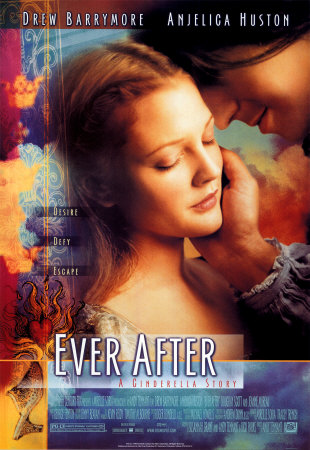
Ever After, 1998 (Cinderella)
Alice, 2009 (Alice in Wonderland)*
Red Riding Hood, 2011
Puss in Boots, 2011
Mirror, Mirror, 2012 (Snow White)

A Midsummer Night’s Dream:

Lords and Ladies by Terry Pratchett
Shakespeare ReTold: A Midsummer Night’s Dream, 2005

So that’s…20 books, and 8 movies.  Like I said–this challenge exactly covers my favorite things to read!  And there were so many, many good stories.  🙂

Retelling Cinderella on Screen

When I did my Fairy Tale Round-up for Cinderella a few weeks ago, I forgot a perfectly lovely movie.  Beedrill pointed it out, which sent me off to Netflix to request a disc and re-watch Ever After.

It’s a charming retelling of Cinderella, starring Drew Barrymore as Danielle, a smart young woman trodden-down by her stepfamily.  Set in Renaissance-era France, there’s no magic but plenty of whimsy, and definitely a fairy tale feel.  The plot is pretty standard fare, but the characters really shine.

Danielle is a wonderful Cinderella, well-read and keenly aware of the injustices of the society around her.  I do wonder a little why she never set out to find a place away from her stepfamily, but this is mostly justified by her circle of friends among the servants and her obvious attachment to her home.  There’s also an interesting dynamic between Danielle and her stepmother, the Baroness, as Danielle longs for acceptance from “the only mother she’s ever known.”

The stepfamily is wonderful–the Baroness is nasty, demanding, and selfish, while bemoaning how hard she tries and how little everyone around her appreciates all that she does for them, and can’t everyone just put in a little more effort, please.  It reminds me a bit of The Devil Wears Prada, actually.  The older stepsister, Marguerite, is beautiful but horrid and self-absorbed, while the younger stepsister, Jacqueline, is a sympathetic if largely passive character.

Danielle’s friends among the servants are mostly minor characters, but it’s so nice that they exist–so many characters, Cinderellas and others, seem to be utterly alone in the world, which just isn’t realistic.  Danielle’s friends collectively serve the role of fairy godmother, with some help from Leonardo Da Vinci.

Danielle’s prince is Henry, and if there’s an implausible aspect of the story it’s in what Danielle sees in him.  He’s handsome enough, and he’s a prince of course, but in the beginning of the story he’s also arrogant and immature.  He grows rapidly under exposure to Danielle’s philosophy and far more mature view of the world, so I suppose he does seem to have potential.  They have a good chemistry so I believe she likes him…I’m just not always sure why!

There are some excellent funny moments in here, especially involving Da Vinci, or the stepfamily.  There’s also a sequence near the middle involving a group of gypsies that I don’t want to spoil for anyone…so I’ll just say it’s wonderful!

Any criticisms…well, the dialogue is remarkably formal at times.  It’s occasionally off-putting, though mostly I think it works with the style of the movie.  The post-ball timeline is very unclear and it’s hard to tell how much time is elapsing between events.  I’m also a bit doubtful about how quickly they contrive to hold royal weddings, and the apparent ease with which people can get in or out of royal engagements…  But all of those are minor points, far secondary to the drive of the story.

This movie reminds me a little of Robin McKinley’s Beauty.  It’s not anything too radical or innovative, but it’s a lovely retelling with a strong heroine and a sweet romance.  And any comparison to a McKinley book can be considered a high compliment!

Fairy Tale Round-Up: Beauty and the Beast

One of my favorite fairy tales is “Beauty and the Beast.”  If you read the original by Jeanne Marie Leprince de Beaumont, it has as many weirdnesses as any other fairy tale.  But it also has a heroine with more spirit than most (and who likes to read!) and a romance with at least the potential for more depth.

The story is pretty consistent, about a girl who goes to live with a Beast to save her father’s life.  She sees past the Beast’s forbidding exterior to fall in love with him, breaking the spell and turning him into a handsome prince.  And usually there are roses in it somewhere!  In the original, the Beast is kind of scary and manipulative, not to mention far too attached to his flowers.  But the retellings are some of my very favorite stories…

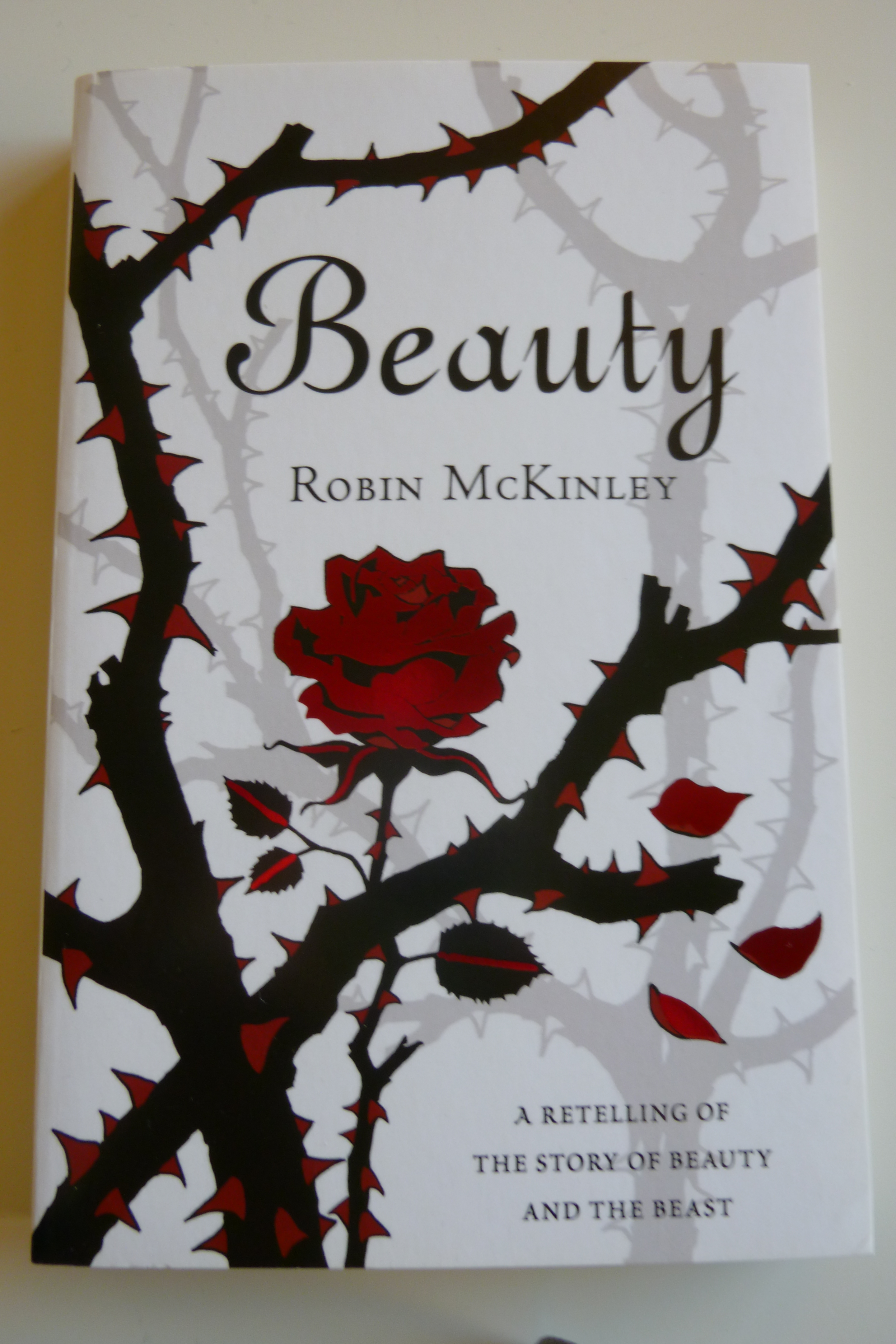
Beauty by Robin McKinley was probably one of the first fairy tale retellings I ever read.  It’s a beautiful book that’s as much about Beauty, her family and her own growth as it is about her romance with the Beast–which is still quite sweet.  The non-magical world feels very real, and even the enchanted castle, while appropriately magical, has a somewhat homey feel.  It’s a cosy book, sweet and lightly humorous.

McKinley returned to the story for Rose Daughter, another (unrelated) retelling.  This version is gorgeously written, and far more surreal.  If Beauty is all pastels and greens and browns, Rose Daughter is all vivid scarlets and purples and strange shadows.  The Beast’s castle is truly another world, where rules of magic supercede little things like the rules of physics.  I didn’t like the romance quite so well and there was a lot about roses, but it’s still an absolutely lovely book.

I’m not as fond of La Belle et La Bête, Jean Cocteau’s 1946 movie version.  It has a very surreal feeling too, but to some extent that kept me at a distance from the story.  The characters felt too much like archetypes and some parts were unexplained–and I don’t think it was a problem of the French dialogue.  The sets and effects are wonderful and it’s a landmark in fairy tale films, but it’s more interesting as an academic view than as simple entertainment.

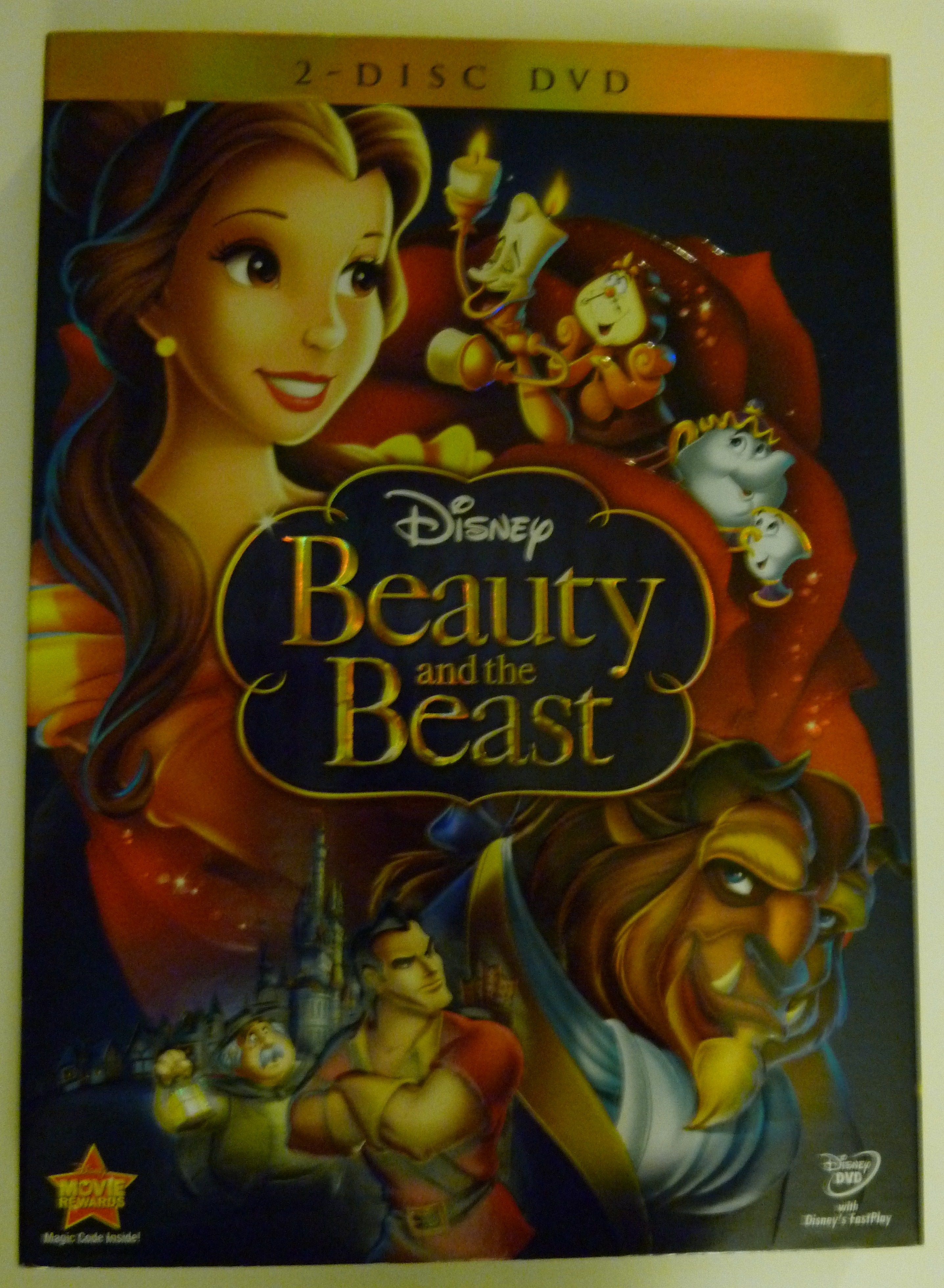
I do love the much lighter Disney Beauty and the Beast.  It has gorgeous scenery, excellent songs, and wonderful characters.  Belle, the Beast and the assortment of talking objects are all delightful characters, and the plot is much improved by the introduction of Gaston as a convincing villain.  This may be my favorite Disney cartoon (though there’s some stiff competition out there!)

Heart’s Blood by Juliet Marillier is a much looser, more mature retelling.  Caitrin comes to the castle to work as a scribe, fleeing her abusive family and an unwanted suitor.  She meets Anluan, crippled in body and even more so in spirit, and learns about his family curse that populates the fortress with ghosts.  It’s “Beauty and the Beast” only in the broad strokes, but there is an enchanted mirror and a curse to overcome–even though it’s really more about finding strength within than it is about meeting requirements to break a spell.

I’d love to find more good “Beauty and the Beast” retellings!  Any suggestions?

The Girl with the Geese

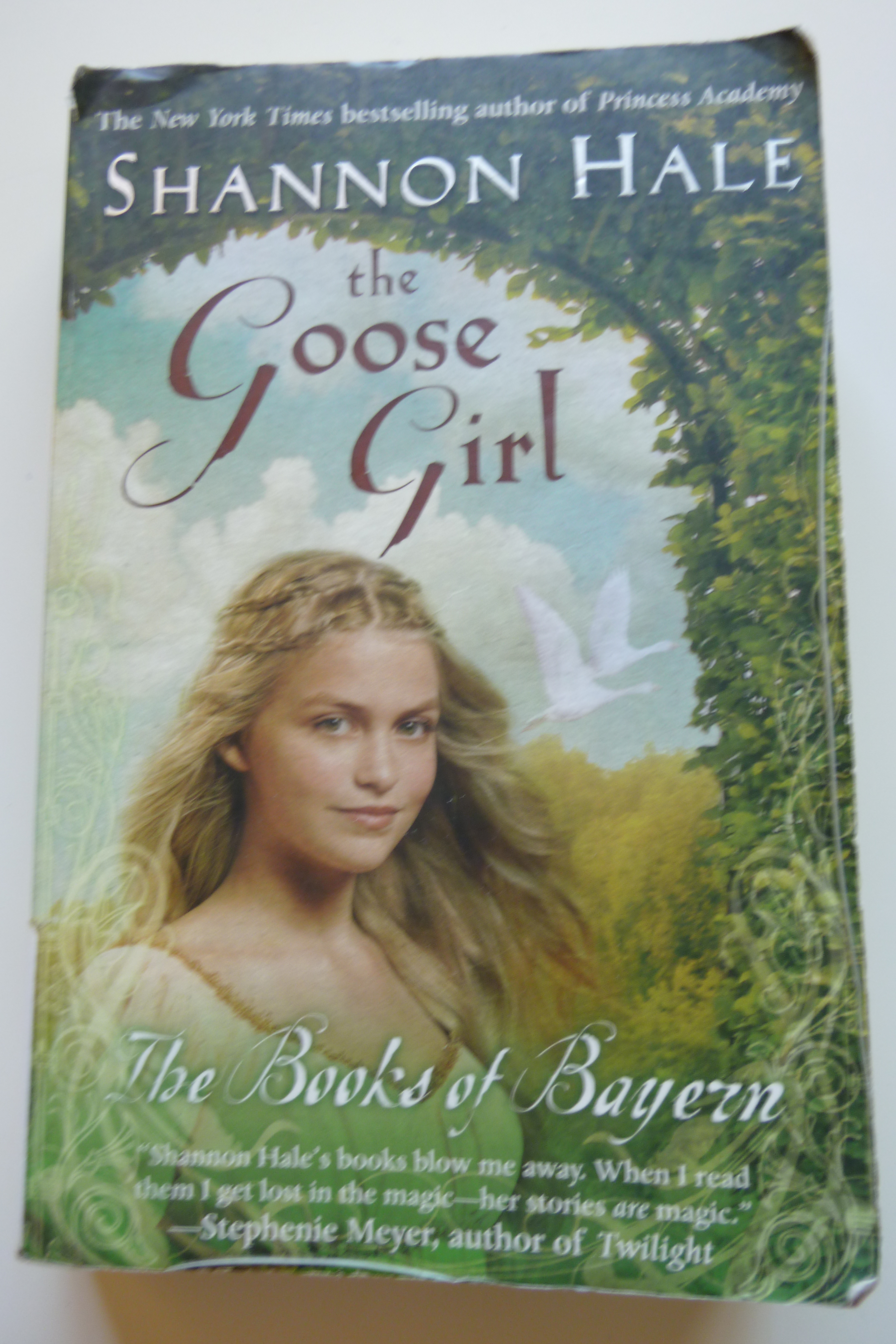
It made me a bit sad that my library’s copy of The Goose Girl by Shannon Hale was blurbed by Stephenie Meyer.  It’s a much better book than Twilight.

As you might guess from the title, this is another retold fairy tale, suitable for the Once Upon a Time challenge.  The Goose Girl is about Ani, a princess who’s never been very good at the job.  Her mother sends her to a neighboring kingdom to be married, but along the way her lady-in-waiting, Selia, stages a mutiny and usurps her place.  Ani makes her way to the capital, but has to hide from her enemies in the role of Goose Girl, tending to the royal flock.  And that’s where she begins to find friends–and her own strengths.

This book reminds me of a lot of other books, while being very uniquely itself.  It’s a story about a none-too-successful princess who has to find a way to save the kingdom.  There are plenty of books like that, but Ani and her particular path feel very different than most of them.  Most ordinary princesses are freckled tomboys.  Ani is a beautiful blonde who desperately wants to be a proper princess, but has lived all her life in the shadow of her strong-willed and charismatic mother.  Even though Ani tries very hard, she just doesn’t have her mother’s charm and poise, or talent for handling people.

Ani isn’t a plucky heroine who immediately sets about to save the day when the situation goes bad.  She spends much of the book hiding, with her primary goal being to save herself.  Somehow I liked that about her–she feels very real, and her challenges (and ultimate solutions) feel believable.  She’s a likable heroine with depth, and strength that emerges over the course of the book.  There’s some magic in the story (Ani can understand birds, and talk to her beloved horse), but it feels largely secondary to Ani’s personal growth, as she realizes her own abilities and begins to look beyond herself as well.

Hale’s writing is beautiful, with a nice fairy tale flavor while having much more detail and plausibility than the Brothers Grimm usually go in for.  She created a vivid world, with two countries that have clear cultures and customs.  And there’s some humor and romance in here too.

I thought the last hundred pages or so were somewhat dragged out, though the ultimate climax is exciting.  It’s a little hard to explain without spoilers; there was a plot twist that seemed unnecessary to me, and just pulled the story out longer before we got to the final confrontations.  The romance turns out rather convenient–but it IS a fairy tale retelling, so it’s just about what I would expect!  And it’s a sweet romance for all that.

If you like retold fairy tales, I’d recommend adding this one to your list.  The original “Goose Girl” has never been a particular favorite of mine, and I still thoroughly enjoyed this book.  Hale has made a wonderful story out of it–something she does consistently in other books too.  When people ask me about excellent fantasy authors, I’ve really got to start adding Shannon Hale to my litany (which goes something like, Tamora Pierce, Robin McKinley, Gale Carson Levine, Patricia C. Wrede and Diana Wynne Jones, if you were wondering!)

Author’s Site: http://www.squeetus.com/stage/main.html

Other reviews:
Reading for Sanity
This Blonde Reads
Liberating Libris
Anyone else?