Friday Fairy Tale Round-Up: Cinderella

Last week I looked at a list of “Twelve Dancing Princesses” retellings, and this week I thought I’d look at what might be the best-known fairy tale in this culture–Cinderella.  I suspect if I really tried to gather up every version I’ve read, this would become completely unmanagable!  So, I’m highlighting the major ones and recent reads instead.  🙂

One thing I found interesting in searching out the “originals” (with due acknowledgement to earlier oral tradition) is that “Cinderella” is one of the few stories that’s in both Charles Perrault and the Brothers Grimm.  Between the two of them, they seem to account for almost every major fairy tale in Western culture, so maybe both of them presenting “Cinderella” is part of the key to its popularity.  And, of course, it plays right into the dream that life can be better–that no matter how dreadful your circumstances, everything can change (and the cynic in me says, without you even needing to do anything!)

Later versions have mostly been pretty consistent with the older ones, in the major strokes at least.  Cinderella is a kind, beautiful girl who is downtrodden by her nasty, ugly stepmother and stepsisters.  When the prince throws a ball to find a bride, Cinderella desperately wants to go.  And she does, aided by some kind of magic–either a fairy godmother, or the spirit of her deceased mother.  Cinderella charms the prince but has to leave early, and the prince uses her dropped slipper to identify her–which is a truly bizarre way to find anyone.

I have a lot of problems with the original Cinderella–the incredibly passive main character, the absentee fairy godmother, the prince who apparently can’t recognize his “true love,” and the really weird slipper element.  But often the strange bits of the story are exactly what new authors can use to spin off a brilliant retelling…

Ella Enchanted by Gail Carson Levine tackles Cinderella’s passiveness head-on.  Levine’s Ella is brave and determined, but cursed by an obedience spell.  She has to find her own strength to overcome it, and the story is more about her quest to take control of her life than it is to win the prince–who is a childhood friend, not a stranger at a ball.  There’s a movie version too, but don’t see it.  It bears very little resemblance to Levine’s wonderful book.

Just Ella by Margaret Peterson Haddix plays with how hard it would be to go from scullery maid to princess.  This is another smart and determined Ella, who made her own way to the ball, only to realize afterwards that the life of a princess is not what she expected–and that the prince isn’t either.

The Stepsister Scheme by Jim C. Hines is another one that looks at the story after the ball.  This Cinderella (Danielle, actually) got her prince and he is charming–but then he’s abducted by her evil stepsister.  Fortunately, a couple other fairy tale princesses are on hand to help get him back.  This is a great twist on the usual themes of fairy tales, with some truly awesome princesses.  I just read the sequel, so stay tuned for a review of both soon!

Princess of Glass by Jessica Day George tells the story from a very different point of view–a princess visiting the court, who notices how really creepy it is when everyone, especially the prince, are suddenly enamored of this mysterious woman in the glass slippers.  Because really–why exactly is everyone so blown away?

Disney’s Cinderella is probably the version everyone knows best, and it’s pretty close to Perrault.  It’s a cute fluff of a cartoon, although the mice are the best part.  Cinderella and her prince are pretty bland, and I just can’t take them seriously when they start singing, “So This Is Love.”  No, it’s attraction.  I can’t believe you got all that far exploring the depths of human emotion in just one dance.

Silver Woven in My Hair by Shirley Rousseau Murphy is, with Ella Enchanted, my other favorite retelling.  It somehow creates a very real, very practical world, tells about it with gossamer-beautiful writing, and even without magic is utterly enchanting.  Thursey has dreams, but they’re real ones.  Her friends are real people and she falls in love with a real man, not a shining prince out of a daydream.

There must be more Cinderellas out there–any recommendations?

Fairy Tale Round-Up: The Twelve Dancing Princesses

I focus on fairy tale retellings often, and right now it’s the season for them, since I’m participating in the Once Upon a Time challenge.  I thought it would be fun–and maybe useful to someone–to spend a few Fridays gathering together lists of the retellings I’ve read.

I decided to start with a relatively minor fairy tale that has been getting a lot of press lately, “The Twelve Dancing Princesses or The Shoes That Were Danced to Pieces.”  It’s certainly not on a level with Cinderella as a cultural touch-point, but I stumbled on a number of retellings in the past few years, and then when I decided to write my own version, I started seeking them out.  It seems to be a popular story at the moment.

The Brothers Grimm story is “The Shoes That Were Danced to Pieces,” and is about twelve princesses who are wearing out their dancing slippers every night, even though they’re locked in their bedroom.  Their father the king puts out a call for champions, who will each be allowed to spend three nights in the princesses’ chamber.  If they can solve the mystery, they get to marry a princess.  If they fail, they lose their heads.  After a number of champions fail, an old soldier comes to try.  With the help of an invisibility cloak, he’s able to follow the princesses through a magic forest of silver, gold and diamonds, across a lake to a castle where they’re dancing with twelve princes.  By telling the king what’s happening, the soldier breaks the spell and marries the oldest princess.

It’s fascinating to see what is and isn’t in the original story, compared to the retellings.  There are definite trends in how the story has been retold.  The original is entirely the soldier’s point of view, but most of the retellings are from the princesses’ perspective, or from a new, female character who’s seeking to help them.  In the retellings, the king is well-meaning and at worst a bit stern; I’ve yet to read a retelling where heads are actually being chopped off.  The princes in the castle are usually cast as demons or monsters, although I personally don’t think that’s clear in the original.  And almost everyone struggles to develop twelve princesses as characters, which really is a remarkably large number to deal with.

So let’s see what’s been done more specifically…

Wildwood Dancing by Juliet Marillier was one of my first retellings, and a very loose one.  Only five girls, they’re not princesses, and they go dancing at a fairy court that is not as terrible as in most versions.  This story combines with a retelling of The Frog Prince, so that brings in some significant different elements.

Princess of the Midnight Ball by Jessica Day George is a much closer retelling, and one of the few that gives at least part of the story from the soldier’s point of view.  It does better than most at developing the relationship between the soldier and the oldest princess–and I rather love that the hero is brave and strong and also knows how to knit (soldiers have to get socks from somewhere!)  It also has some of the best-depicted princesses.

The Twelve Dancing Princesses by Marianna Meyer and illustrated by Kinuko Craft is a very beautiful picture book.  It doesn’t do anything too exciting with the story (though it is another one from the champion’s point of view) but the illustrations are exquisite.

“The Twelve Dancing Princesses” by Robin McKinley is a longish short story in her book, The Door in the Hedge.  I had such high hopes for this one (I mean, Robin McKinley!) and they were only partially met.  It’s a beautifully-written retelling with vivid imagery and all the details of description and character emotion that the Grimms always leave out.  But…there’s really nothing innovative about it either.  It’s pretty much precisely the original story (minus the head-chopping).

The Thirteenth Princess by Diana Zahler supposes that the princesses have a thirteenth sister, Zita.  Their mother died when she was born and their father banished her to be a servant in his grief.  She evades the spell that captures the rest.  It’s a cute version in some ways, although the twelve princesses are unusually undeveloped as characters.  The focus on Zita’s story means less focus on the twelve princesses’ adventure.

The Phoenix Dance by Dia Calhoun is another one that brings in a new heroine, this time the royal shoemaker’s apprentice.  Her master’s reputation is being ruined by the constantly worn-out dancing slippers–which, by the way, is a fantastic idea!  The original fairy tales never address that kind of detail.  I loved that premise, but then I didn’t love the heroine as well.  This is also a fantasy look at bipolar disease, and while I respect what Calhoun was trying to do, I actually had difficulty getting a sense of the character through the mood swings.

Entwined by Heather Dixon is one of the latest retellings, which made the rounds of all the blogs I follow.  This one more than any other I’ve read emphasized the beauty of the dancing, and played with the princesses’ love of dancing.  There are twelve princesses named in alphabetical order, which was very helpful for keeping track of the relatively bland younger nine.

The Night Dance by Suzanne Weyn meshes the dancing princesses with Arthurian legends. It’s a clever idea, but the book is hampered by some very slight characters.  They served their roles, but I can’t remember a single character’s name anymore.

Troll’s Eye View has “The Shoes that Were Danced to Pieces,” a short story by Ellen Kushner.  Mostly pretty light and silly, this captured better than any other version how annoying it could actually be to have eleven younger sisters.  The princesses are universally devoted to each other in other versions, and it was fun to see an oldest princess who finds her clamoring crowd of sisters overwhelming.

There you have probably more versions than you could ever actually want.  🙂  Recommendations…if you want a close retelling, go for McKinley’s short story.  If you want something close but more elaborated upon, read Princess of the Midnight Ball.  If you want to look at beautiful pictures, definitely get Craft’s picture book.  And if you just want to know which book is overall the best read…it’s only a loose retelling but a wonderful book…Wildwood Dancing.

And if I’ve missed a version–let me know!

A Former Cinderella Finds a Job

I don't actually like this cover...both characters look wrong.

The Fairy Godmother by Mercedes Lackey is a great two-challenges-for-one-book, fitting neatly into the Once Upon a Time challenge, and also my Finishing the Series challenge.  It’s actually the first book in Lackey’s 500 Kingdoms series, but somehow I contrived to pick up The Sleeping Beauty first, which is Book 5.  They seem to be self-contained, so I don’t think it much matters.

Life in the 500 kingdoms (I think that’s meant literally) is constantly influenced and directed by the Tradition, a nebulous force which wants everything to go as, well, tradition dictates.  In practice, this means that certain circumstances result in events being magically nudged (or shoved) along towards some very recognizable paths.  If a situation is starting to look like a Brothers Grimm or Charles Perrault story, the Tradition wants to make it go towards its proper conclusion.  Not that Grimm or Perrault are referenced, but that’s how it all plays out.  Only sometimes, it doesn’t quite work–and the Tradition can drive towards both happy and tragic endings.

The Fairy Godmother is about Elena, who should have been Cinderella–she has the stepfamily and the drudgery.  Unfortunately, the prince in her kingdom is only eleven, and Elena is stuck with an unfulfilled story, and a great deal of magical energy hovering around her.  Along comes Godmother Bella, who takes Elena under her wing to train her up as a Fairy Godmother.  Not necessarily fairies, the Godmothers nudge and influence and shape events, trying to push the Tradition towards the good stories and to mitigate the effects of the bad ones.

This book is really in two parts, first about Elena’s apprenticeship and then about her adventures as a Godmother, particularly in dealing with a difficult prince, Alexander, who she turns into a donkey and takes home to do farmwork in order to teach him a lesson.

I enjoyed the first chapters of the book very much, as Elena struggles with her Cinderella storyline.  The book bogged down for me a bit after Elena goes with Bella.  Lackey spent a lot of time on world-building, under the guise of telling about Elena’s studies to be a Godmother.  The funny thing is, it’s all fascinating ideas…only I don’t actually need to know the distinction between a Godmother, a witch and a sorceress unless it’s relevant to the plot.  I think this is a first-in-a-series problem, too much narration trying to establish the world, when many of the details aren’t based in any plot or character development.  It may not have helped either that I had read a later book in the series, so some of this I already knew.

The book picked up again in the second half, once Alexander came into it.  He brought an interesting dynamic into things; he certainly needed to go through some character growth, but I actually never thought he was as bad as Elena did.  Some parts are in his point of view, and I could quite often see where he was very reasonably coming from, while she was convinced he was being stupid or just generally nasty.  Also, Elena is supposed to be the heroine, but she fell into the same kind of behavior I always question about the traditional Fairy Godmothers.  You turned someone into a donkey to make him be more considerate of others?  Really?  That makes sense to you as a way to teach a lesson?  Of course it works out, because these things do, but I had a lot of sympathy for Alexander when he felt he was being badly treated.

The characters were good on the whole.  I liked Elena reasonably well, and Alexander was interesting and likable most of the time.  Elena also has a group of brownies working with her and they were rather delightful.

I really don’t think I’m giving anything away by saying that Elena and Alexander end up in a romance (it’s abundantly obvious, if only because there’s no one else she can get involved with).  I was a bit dissatisfied by that romance.  It turned out all right, but there wasn’t much basis for it.  It was mostly a matter of realizing they were physically attracted to each other, and that circumstances made them convenient romantic partners.  Sure, physical attraction can be fun, but I prefer a bit more substance when I read a romance.  The romance also takes this out of the YA category.

A good book–not a fantastic book–but a brilliant premise.  I’ll definitely be continuing with the series, because I do love the premise, and if we’ve got the world-building out of the way now, I hope for better things in later books!

Author’s Site: http://www.mercedeslackey.com/

Other reviews:
Reawrite
Book Buddies Online
Crooked Reviews
Anyone else?

A Retelling of Cinderella

Because it’s spring and I’m greatly enjoying the Once Upon a Time Challenge, I thought I’d post a fairy tale Fiction Friday this week.  This is a short retelling of Cinderella, which I posted about a year ago but thought I’d share again.  This started out as a Spanish class assignment, which I rewrote and expanded in English.  It has much of the same mentality that eventually led me to write novel-length retellings of fairy tales…

**********************************

Once upon a time in a far off kingdom there lived a maiden who was very beautiful and very kind.  Fairy tales always begin the same way, and the maidens are always very beautiful and very kind.  Often their name is Ella, as was the case for the maiden we’re talking about.  This particular maiden, as do most of them, had long blond hair, very fair skin and eyes of the deepest blue.  She didn’t have any initiative, spirit or goals for her life.

Continue reading “A Retelling of Cinderella”

After Waking the Princess

What happens after the hero kisses the sleeping princess?  It’s far more complicated than “they lived happily ever after,” especially when the hero is from the modern world and knows nothing at all about swinging swords or fighting evil witches!

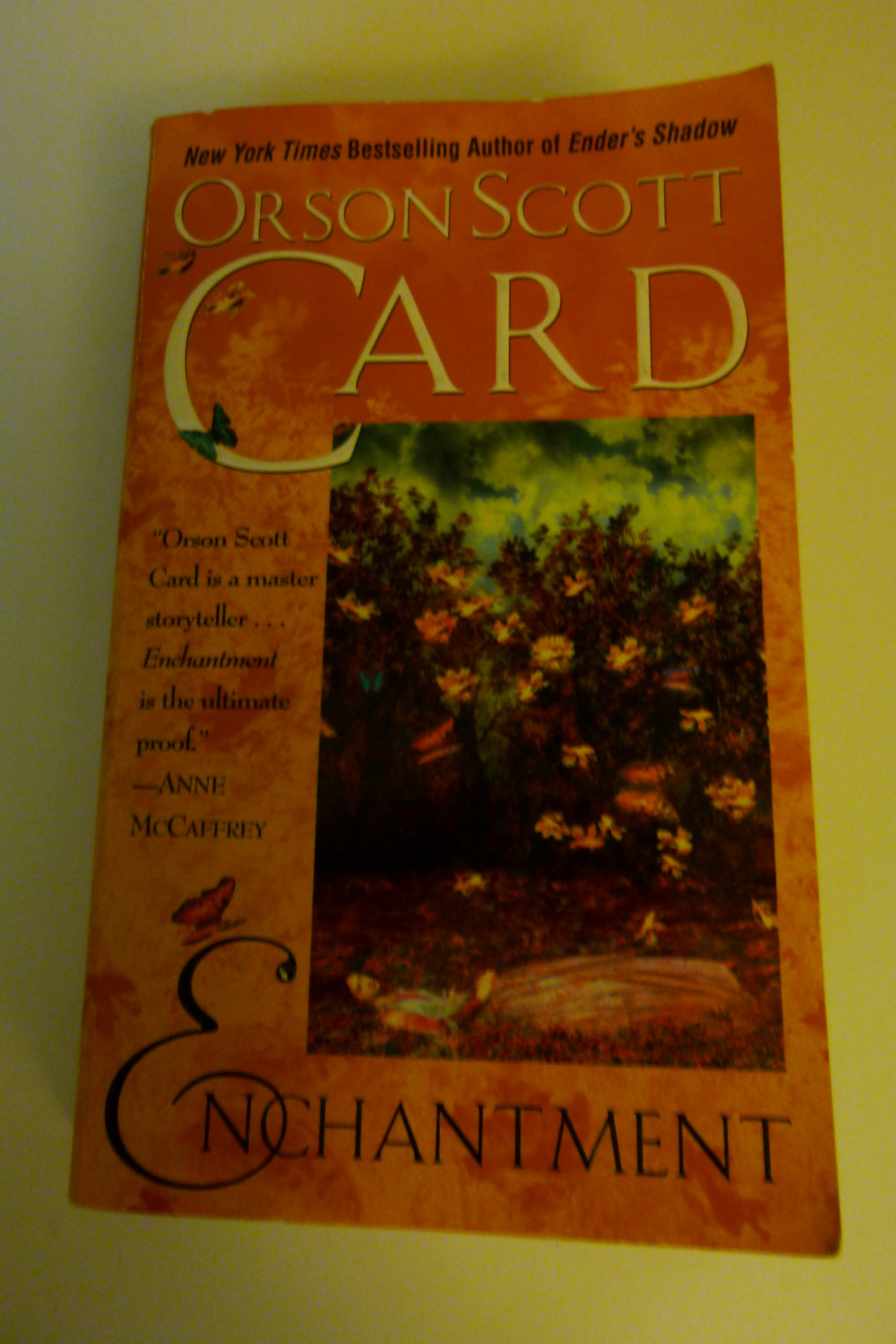
Enchantment by Orson Scott Card was my second book for the Once Upon a Time Challenge, and it also goes towards my Dusty Bookshelf challenge.  Abridged background: I picked it up at a book swap my book club did, I think roughly last summer.  I picked it up because, well–Orson Scott Card!  At the time I actually hadn’t read anything by him, but I had been hearing about Ender’s Game forever (which I did finally read).  I was also intrigued by the plot summary: as a child, Ivan sees a sleeping princess in the forest one day, and runs away.  But then years later, he comes back…

That was all that was in the summary, and it turns out to be only the very beginning.  It also wasn’t clear until I turned to Page One that Ivan lives in the modern world.  He’s from Eastern Europe, though his family emigrates to America when he’s a child.  He returns to Ukraine to work on his dissertation on fairy tales, and ends up drawn to a clearing in the woods, where he finds the sleeping princess he had convinced himself he imagined.  He fights the bear guarding her and wakes up Katerina, a princess from the 9th century.  He ends up back in her time, where the imminent threat of Baba Yaga is just part of his troubles.

I love the concept of this one.  It gets at some great questions about the original fairy tales, and points up a fundamental problem usually ignored–the man waking the sleeping princess is not necessarily at all suitable to be king, or to marry the princess!  Ivan goes through a lot of trials trying to deal with the society of the time, from his lack of prowess with a sword to disconcertingly different views on nudity.  I especially liked it that Ivan goes into this with a scholar’s knowledge–his focus is old fairy tales, so he knows how the stories work, a fair bit about the history, and also what Disney says about it.  One of my favorite moments is when he arrives in Katerina’s village and is trying to reconcile what he’s seeing with his historical knowledge, and with Disney’s Sleeping Beauty.

I did have some trouble getting into this book.  The beginning is spent on Ivan and his life in the modern world; it’s necessary, but it also dragged a little.  It picked up when he woke up Katerina.  I liked the part in the past (although I think I liked the IDEA a little more than the actual handling of it).  The book really got good for me when Ivan and Katerina come back into the modern world (slight spoiler, but it’s only halfway through).  Besides how interesting it is to watch Katerina deal with the modern world, there are some fascinating revelations about Ivan’s family and, perhaps most important, the story gets much more focused on the fight with Baba Yaga.

The characters didn’t make a huge impression on me, good or bad.  Katerina and Ivan’s relationship was ultimately satisfying, although at times I thought Card was a little heavy-handed about it.  They spent much of the book misunderstanding each other, and there was a little too much of “Oh, I thought he meant THIS but what if he meant THAT and in that case maybe I’ll feel THIS way instead of THAT way…”  Less explanation and analysis probably would have been preferable.

Despite being a fairy tale, this is definitely an adult book.  It’s adult-level writing, and also Baba Yaga has a thing for torture.  There isn’t huge detail, but there’s enough.

On the whole, a good book.  I liked it.  I didn’t love it.  I don’t plan to keep it because I don’t see myself as likely to revisit it–but it was good to read once.

Author’s Site: http://hatrack.com

Other reviews:
Breathing Fiction
Wynter Adelle
Semicolon
Anyone else?