Spinning Stories from Straw

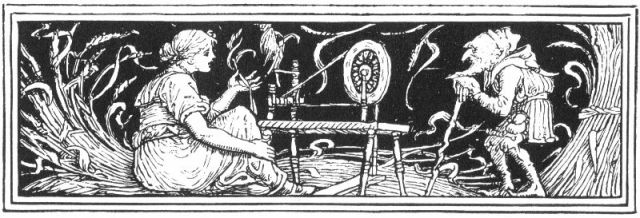
I think Vivian Vande Velde and I have similar feelings about fairy tales–wonderful stories, except for all those parts that don’t make sense.  She explores all those weird bits of “Rumpelstiltskin” in The Rumpelstiltskin Problem, and to very funny effect.

This book excellently shows the versatility of fairy tales.  This is a book of six short stories, all retellings of “Rumpelstiltskin,” and all very different.  Sometimes Rumpelstiltskin is well-meaning–sometimes the villian–once even a woman.  We meet a host of different miller’s daughters, clever and stupid and greedy.  Some kings are nice and some are cruel.  Some stories have magic, some don’t.  But all the stories follow the basic premise of “Rumpelstiltskin,” and all are funny.

I think my favorite part of the book is actually the introduction, when Velde discusses the inspiration behind the book–and analyzes all those parts of “Rumpelstiltskin” that don’t really add up.  Why does the miller tell the king his daughter can spin straw into gold when she can’t?  Why does Rumpelstiltskin want a baby?  Why does the miller’s daughter want to marry the king, after he kept threatening to cut her head off?  Why did Rumpelstiltskin agree to the name-guessing contest when, according to their original agreement, he’s already won, and has nothing more to gain?

I love fairy tales.  But they often don’t make sense, and I enjoyed Vivian Vande Velde’s discussion, and then retelling, of one I haven’t thought as much about.

I do believe that classic fairy tales, especially the best known ones, must have something in them that makes us keep telling them.  Some core truth, or spark of an idea that appeals.  What do you think it is for “Rumpelstiltskin”?  In a way it’s a “deal with the devil” story, so perhaps it’s that story of being pushed to desperation, making a questionable deal, and then the forces of good still triumphing in the end.  Well, assuming you consider the miller’s daughter and the king to be on the good side.

And that depends how you interpret the story–or which of Vivian Vande Velde’s retellings you’re reading.

Author’s Site: http://www.vivianvandevelde.com/
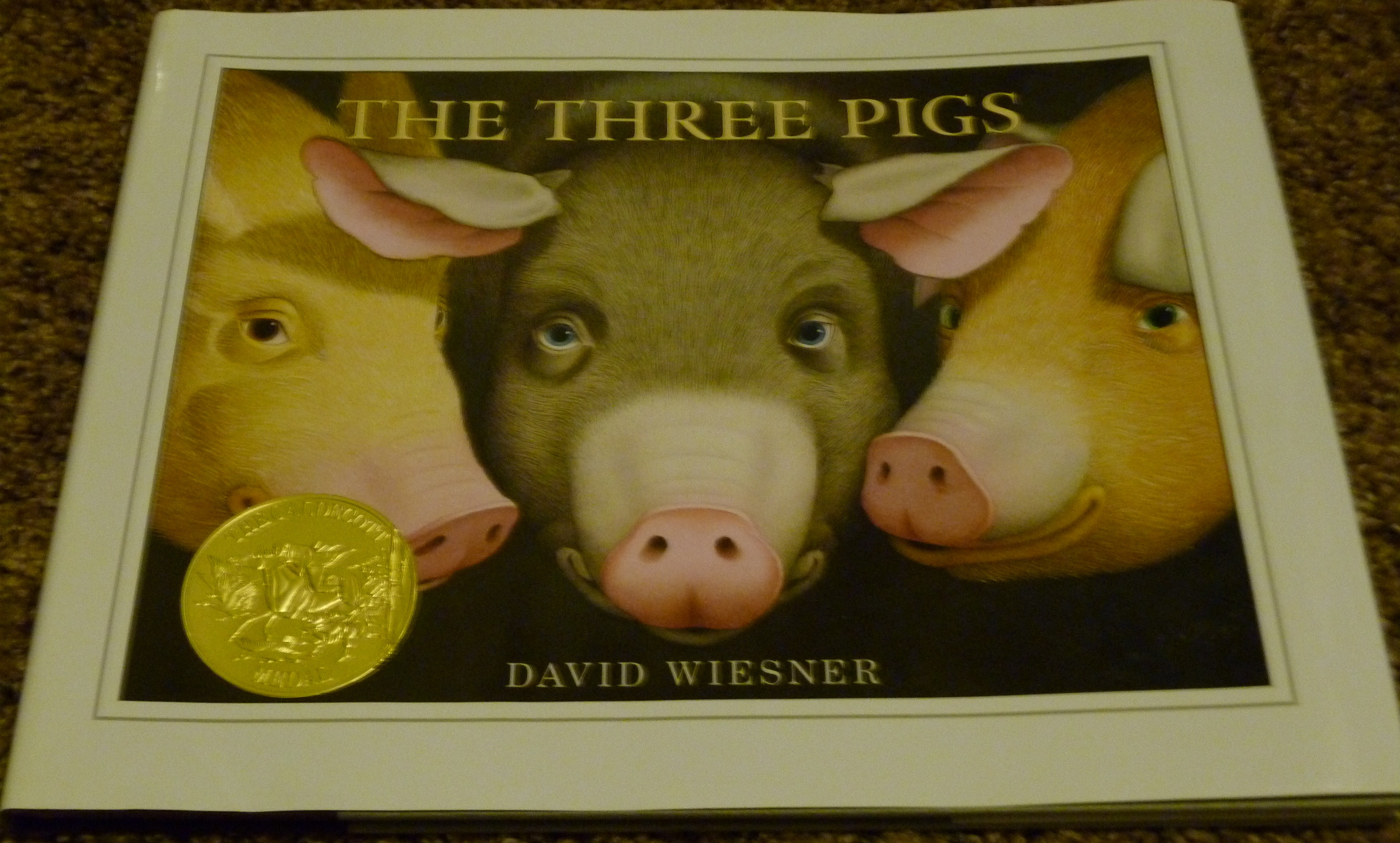
Breaking Out of the Story with the Three Pigs

For my second post on picture books this week, I want to talk about The Three Pigs, written and illustrated by David Wiesner.  Unlike the Grandpa and Uncle Wainey books, this wasn’t a beloved childhood story for me–but that’s because it wasn’t written until I was already a teenager.  I somehow managed to stumble on it later in life, and I’m glad I did.  I’m pretty sure this would have been a beloved childhood story if I had been born twelve years later.

The story begins like the story always does, with the wolf coming to blow down the houses of the three pigs one by one.  But this time, the wolf blows the first pig right out of the story and into the margins.  He runs to get his brothers, and they escape from the wolf and go on an adventure out beyond their original storybook.  The pigs fold up one of the pages to make a paper airplane, and fly off into other stories.

I love the concept of characters coming out of the original story.  I love the absolute shattering of the fourth wall that entails.  I love the three-dimensional feeling of the book–the art makes you feel as though you can reach into it, or as though the pigs can lean out to look at you.

The art itself is beautiful.  I’ve read several books by Weisner, and he’s an incredible illustrator.  It really feels like there are works of art on every page.  He also does something very clever here where the art style changes as the pigs go in and out of different stories.  They go into a pen-and-ink drawn story at one point, and change to fit that art style.

I love retellings of traditional stories, and this is one of the most innovative and imaginative ones I’ve found.

Author’s site: http://www.hmhbooks.com/wiesner/index.html

Writing Advice from Gail Carson Levine

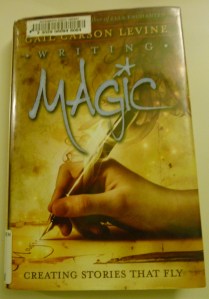
If I had read Writing Magic by Gail Carson Levine when I was twelve, I think it would have changed my life.  Unfortunately, it wasn’t published until I was several years past twelve, and I didn’t read it until I was in college.  But it was still an excellent read then.

Writing Magic, as you may have guessed, is a book about writing, by one of my favorite authors.  I reviewed her best-known book, Ella Enchanted, early on in this blog.  Writing Magic is a wonderful book for kids who want to write.  It’s filled with good advice of all sorts: save what you write; jot down ideas; pay attention to details; make your characters suffer sometimes.  She covers coming up with ideas, writing the actual story, and working through revisions.  The book discusses practical things like the best way to write dialogue, and discusses why you might feel inspired to write to begin with.  And there are writing prompts at the end of every chapter.

This is a great book on writing, and I think it would also be a lot of fun for anyone who has read Levine’s novels–at least, it was for me!  She illustrates writing lessons with examples from her own books–not only by plucking scenes out of the published books, but also sharing pieces of earlier drafts, or talking about what a story started out looking like, and how her ideas changed along the way.  I love knowing the story behind the story.

If you get to the end of the book and want more, there’s good news: Levine has a blog.  It’s a lot like an extension of this book, with discussions on aspects of writing (and writing prompts at the end of each post).  One thing I particularly enjoy about it is the emphasis on young adult/children’s fantasy.  It makes sense–that’s what she writes, after all–and it’s fun to see a genre written about which is not so much a focus in more literary writing books I’ve read, and not at all a focus in most of my writing classes.  And don’t feel that you have to write children’s fantasy to get anything out of her blog (or her book).  The advice is good across genres; it just has a flavoring of children’s fantasy, and is more likely to use fairy tales than Virginia Woolf to draw an example.

The only reason Writing Magic didn’t change my life was that it reached me at a point when I had already read other books on writing, taken a lot of writing classes, and just had already heard a lot of the advice Levine gives.  It was still helpful!  Just less life-altering than it would have been at a younger age.  The gift of this book is that she’s put all this advice I picked up piecemeal together in an engaging way that I think kids will find appealing and relatable.  It might have got me farther along faster in my writing to have all of this advice dropped in my lap at a younger age.  So if you know a kid who likes to write–send them to get advice from Gail Carson Levine.

Author’s blog: http://gailcarsonlevine.blogspot.com/ (and it’s linked over in my list too!)

Bear and Psyche, Sort Of

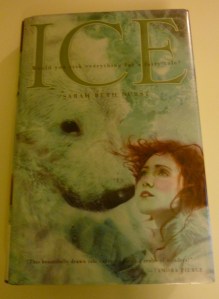
As you might know, one of my reading challenges for the year is to read novels that are fairy tales retold–because I really need to read more than I already do!  🙂  But, that goal is what led me to Ice by Sarah Beth Durst.

Cassie lives in the Arctic, at a research station with her scientist father.  Her mother, she believes, died when she was young.  Her grandmother, however, tells a fairy tale about Cassie’s mother–she was the daughter of the North Wind, and was promised to marry the Polar Bear King.  But she fell in love with a human, Cassie’s father, and bartered with the King–he could marry her daughter instead.  And when the North Wind found out that his daughter married a human, in his fury he blew her away to the castle of the trolls.

Such is the swiftly-established backstory, which probably could have been a novel (or at least Part One of a novel) in its own right.  But Ice really starts when Cassie is eighteen, and past believing in fairy tales–until the Polar Bear King actually shows up and wants to marry her.

As you might guess, the Polar Bear King is in fact a magical polar bear.  He asks her to call him Bear, and can conveniently change shape to a human on occasion–although there are complications.  Durst created a very interesting magical framework for her tale, which I enjoyed.  The unfolding romance was sweet as well, and when some of those complications separate Cassie and Bear, Cassie’s quest to find him is an exciting one.  It’s also implausible in certain ways I don’t want to get into to avoid spoilers, but if you suspend disbelief, it’s a good read.

Ice has a very strong fairy tale feel, complete with the fairy tale backstory and a castle of the trolls located “east of the sun and west of the moon.”  But it wasn’t actually immediately apparent which fairy tale this was.  A video interview with the author describes it as “Beauty and the Beast,” and from the initial premise I went into it expecting that.  Maybe I shouldn’t argue with the author, but I have to say, the farther I read the more I think it’s actually “Cupid and Psyche.”  Granted, Cupid is not usually a polar bear, but that complication involving Bear’s human shape was that Cassie couldn’t see what he looked like–which is straight out of “Cupid and Psyche.”  It also wouldn’t shock me to find out there’s a minor tale somewhere in Grimm’s that this follows even more closely.  It just has that archetypal fairy tale feel to it, and I imagine some of the elements have come up in a lot of different places.

I did have a few reservations about the book.  One of the biggest involves Cassie’s mother.  It’s not giving too much away to reveal that she does come back from the castle of the trolls–it happens fairly early on in the book.  Not knowing her mother was a huge motivation for Cassie at the beginning of the book, but then when her mother actually comes back, I didn’t feel like that was adequately developed.  It’s fair enough to say that meeting your mother for the first time at eighteen does not necessarily lead to immediate closeness, but I didn’t feel like Durst properly explored any relationship between the two of them, even if it was going to be an awkward or strained relationship.

Second, I had some trouble with the points where magic and reality met.  I believed in the research station.  I believed (in a fantasy book way, I mean) in Bear’s castle and in his magic.  But sometimes the two intersected, and I had a lot more trouble believing in a scene where a scientist doing research in the Arctic says, “yes, my wife was held captive by the trolls for many years.”  I don’t think it was just magic and the modern day intersecting–I’ve read urban fantasy that I really enjoyed.  I think it was that characters who showed no sign of believing in magic suddenly started talking about it as an accepted fact, and that was a little hard to buy.

However–it was still a good book.  And when I was getting down to the last few chapters, I even stayed up late to finish reading and see how it would turn out.

Author’s site: http://sarahbethdurst.com/contact.htm (check out the best ever FAQ section!)

Beauty (Maybe) and Her Beast

Beauty and the Beast has always been one of my favorite fairy tales–probably because the retellings are so good.  If you go back to the original story, it’s almost as flawed as any other traditional fairy tale.  But the retellings…are SO good.  Beauty by Robin McKinley is a particular favorite of mine.

The basic story is familiar, if you’ve read the original or even if you’ve seen the Disney movie.  From the Disney movie you’ll recognize the part about the terrifying Beast living in the castle in the woods.  A lost traveler spends the night and, upon offending the Beast, agrees to bring back his daughter, Beauty, to stay at the castle.  From the original story you’ll recognize the part about Beauty’s father being a rich merchant who lost his fortune, forcing them to move out to the country.  And Beauty had two sisters as well, and it was Beauty’s request for a rose when her father began his ill-fated journey that, in a way, put everything else in motion.

I think I read Beauty before I read the original fairy tale, so when I did read the original, I kept thinking, “oh, now I see where McKinley got that detail or this part from!”  But, like any great fairy tale retelling, McKinley has taken the slender original story and embroidered and expanded upon it, bringing the characters to life and explaining the bits that never quite made sense.

Beauty’s father and two sisters are very real characters, and the tragedy of going to the Beast’s castle is as much about leaving them as it is about going to an unknown fate with a monstrous Beast.  How a rich merchant family makes their way in a country village is a detailed and developed part of the story.

Beauty and the Beast are my favorite characters though.  Beauty, like the original and the Disney version, loves to read.  She’s also ugly, or at least considers herself so (not something from either version).  I LOVE that element.  If you read enough fairy tales, breathlessly beautiful heroines get very old.  They’re all very much the same, sweet-tempered and beautiful and sickeningly good.  So I love McKinley’s scrawny, mouse-haired, stubborn-minded Beauty–a name she picked up as a child and has been too embarrassed to request dropped.  The Beast is charming, sometimes unsure of himself, and really rather sweet.  I thought the romance was very cute.

My other favorite part is probably the castle itself.  It’s enchanted, of course, but there’s a wonderful practical side to the magic.  Beauty has a couple of enchanted breezes (sort of) attending to her, and in personality they’re quite fussy and straight-forward and focused on common sense.  And I’m so very, very amused by enchanted candles that light themselves–and sometimes have to admonish each other, “Hsst–wake up, you” when one of them doesn’t light.

Robin McKinley wrote another retelling of Beauty and the Beast called Rose-Daughter which, despite following the same basic plotline, is quite different (a lot more roses, for one thing).  It’s very good also, but much more surreal.  The magic, and even the non-magical characters, like the two sisters, feel less real-world to me–not unrealistic, exactly, but not so realistic either.  I recommend it too, but personally I prefer the more grounded Beauty.

But by all means, read both.  Or either.  Or pretty much anything else by Robin McKinley, because I can’t honestly say I’ve met a book by her I didn’t like.  Beauty may be my favorite, though.

Author’s Site: http://www.robinmckinley.com/