Exploring the World of L. M. Montgomery

It occurred to me that I have not actually reviewed L. M. Montgomery.  She’s been woven throughout this blog, referenced here and there, but somehow I have not actually reviewed her yet.  Even though she’s among my top two favorite authors!

Maybe the problem has been that I don’t know where to begin.  I’ve read 20 novels, 199 short stories (believe me, I’m searching for a way to get my hands on a 200th one!), her autobiography, three books of letters, and her five volume journal.  If it’s in prose, I’ve read it.  And now, where to start?

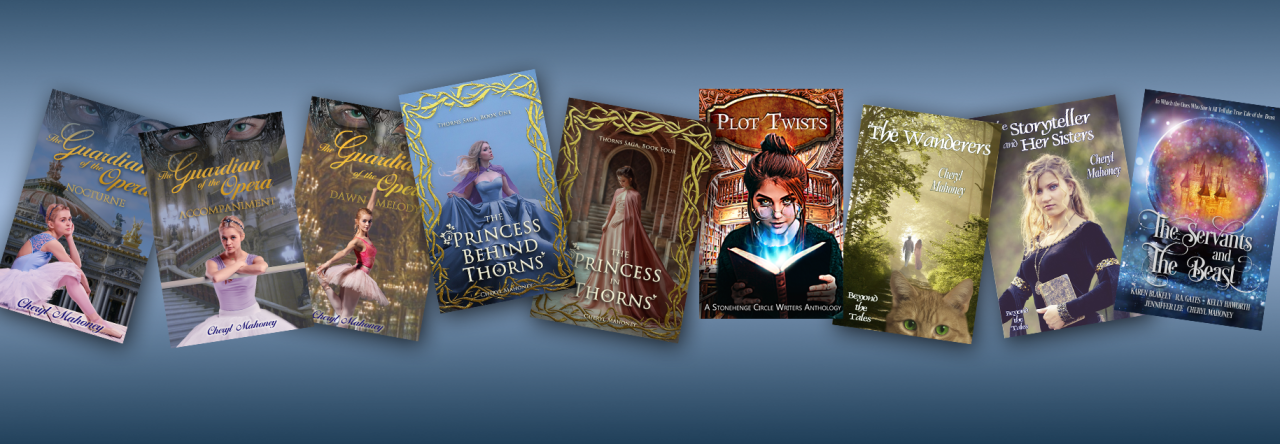
My L. M. Montgomery collection. I have...a few of her books.

I suppose I could take the obvious route.  Anne of Green Gables was her first novel, and the one I name when people look blank after I say L. M. Montgomery is my favorite author.  It’s a good place to start reading if you’re not familiar with her books.  Anne is a red-headed orphan who is adopted by Matthew and Marilla Cuthbert by mistake–their friend was supposed to bring them a boy from the orphanage, who could help Matthew on the farm.  The story follows how Anne found her place in Green Gables.  Anne is precocious, whimsical, imaginative, deeply in love with nature, and, though always well-meaning, apt to get into scrapes.  Once she dyes her hair green–another time she breaks her leg after walking on a roof on a dare.  Anne is a wonderful character and her adventures are funny and endearing.

That’s a good place to begin.  But I don’t want to stop there.  Because there’s also Emily, a dreamy writer, and Pat, who fiercely loves her home, and Valancy, who only starts to live her life when she thinks she’s dying.  And beautiful, tragic Kilmeny; Marigold with her imaginary and magical friend; capable and confident Jane.

I don’t know why Anne of Green Gables is Montgomery’s most famous book, because she wrote so many others that were at least as good.  The great gift of Montgomery is her ability to create appealing characters and place them in a beautiful world.  With very few exceptions, her books are all set in small towns in Prince Edward Island.  She herself grew up in Cavendish, a small town in PEI, and her books very much harken back nostalgically to the Cavendish she remembers in her childhood–a close-knit community where everyone knew everyone, and the chief social events were quilting circles, lectures and small dances–and weddings and funerals, of course.

Her books are also filled with nature.  Like Anne, Montgomery had a passionate love for the beauties of nature.  Pine trees, flowers, a range of hills against the sunset–from her journal you learn first-hand how deeply these affected her, and that carries into her books.  I once read a book that combined quotes from Montgomery about nature, with pictures that were meant to correspond.  I was amazed to find that none of the pictures were as beautiful as what she was describing.  She felt beauty so intensely–she was able to see it and then convey it in words, where someone else wouldn’t have seen the same thing at all.  A picture may be worth a thousand words, but not when the words were written by L. M. Montgomery.  She has a very unique writing style, which I obviously love–it may not appeal to everyone though, which is why I sometimes recommend starting with her short stories to see if it’s a style that works for you.  The Road to Yesterday or Chronicles of Avonlea are good collections.

Don’t get the impression, though, that her books are long treatises on nature.  The beautiful surroundings are the backdrop to human adventures.  They’re funny, exciting, romantic, sometimes tragic.  She had a gift for drawing out the emotions in events small and large–from the pettiness of carping relatives to the deep betrayal of a disloyal suitor to the fun of a picnic in the woods to the humor of an awkward dinner party.

There are some books I feel I’d love to live inside, and L. M. Montgomery’s certainly sit high on the list.  After reading her journals, I think she felt the same way.  Her life was not always happy, and the sunny world of her writing was sometimes an escape.  Fortunately, she’s made that world available to the rest of us too.

Spinning Stories from Straw

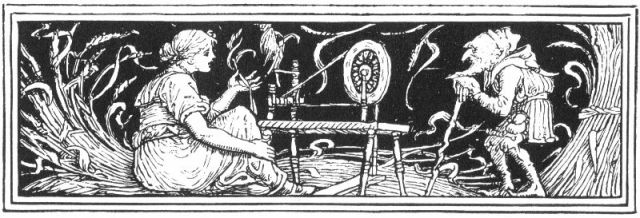
I think Vivian Vande Velde and I have similar feelings about fairy tales–wonderful stories, except for all those parts that don’t make sense.  She explores all those weird bits of “Rumpelstiltskin” in The Rumpelstiltskin Problem, and to very funny effect.

This book excellently shows the versatility of fairy tales.  This is a book of six short stories, all retellings of “Rumpelstiltskin,” and all very different.  Sometimes Rumpelstiltskin is well-meaning–sometimes the villian–once even a woman.  We meet a host of different miller’s daughters, clever and stupid and greedy.  Some kings are nice and some are cruel.  Some stories have magic, some don’t.  But all the stories follow the basic premise of “Rumpelstiltskin,” and all are funny.

I think my favorite part of the book is actually the introduction, when Velde discusses the inspiration behind the book–and analyzes all those parts of “Rumpelstiltskin” that don’t really add up.  Why does the miller tell the king his daughter can spin straw into gold when she can’t?  Why does Rumpelstiltskin want a baby?  Why does the miller’s daughter want to marry the king, after he kept threatening to cut her head off?  Why did Rumpelstiltskin agree to the name-guessing contest when, according to their original agreement, he’s already won, and has nothing more to gain?

I love fairy tales.  But they often don’t make sense, and I enjoyed Vivian Vande Velde’s discussion, and then retelling, of one I haven’t thought as much about.

I do believe that classic fairy tales, especially the best known ones, must have something in them that makes us keep telling them.  Some core truth, or spark of an idea that appeals.  What do you think it is for “Rumpelstiltskin”?  In a way it’s a “deal with the devil” story, so perhaps it’s that story of being pushed to desperation, making a questionable deal, and then the forces of good still triumphing in the end.  Well, assuming you consider the miller’s daughter and the king to be on the good side.

And that depends how you interpret the story–or which of Vivian Vande Velde’s retellings you’re reading.

Author’s Site: http://www.vivianvandevelde.com/

Breaking Out of the Story with the Three Pigs

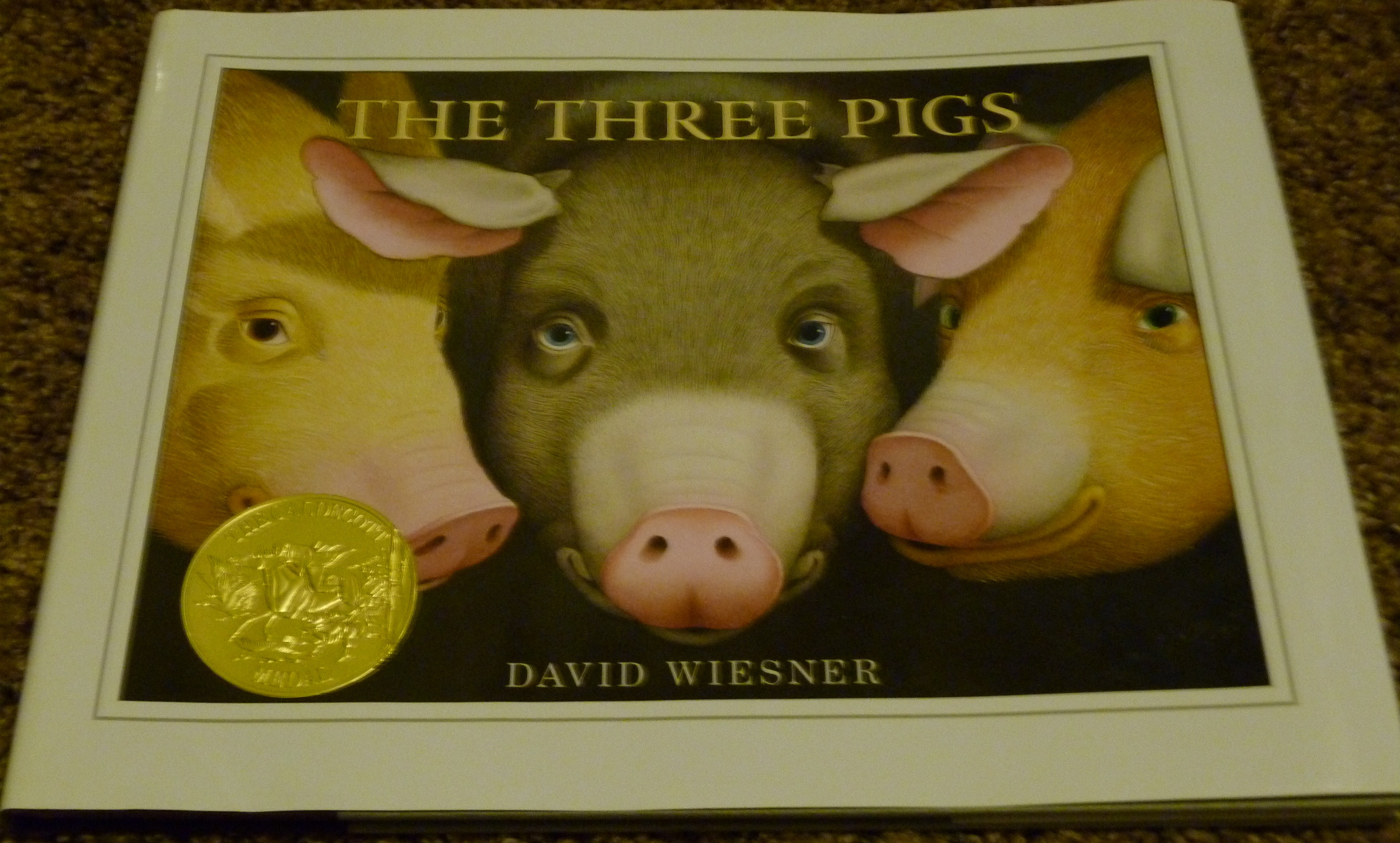
For my second post on picture books this week, I want to talk about The Three Pigs, written and illustrated by David Wiesner.  Unlike the Grandpa and Uncle Wainey books, this wasn’t a beloved childhood story for me–but that’s because it wasn’t written until I was already a teenager.  I somehow managed to stumble on it later in life, and I’m glad I did.  I’m pretty sure this would have been a beloved childhood story if I had been born twelve years later.

The story begins like the story always does, with the wolf coming to blow down the houses of the three pigs one by one.  But this time, the wolf blows the first pig right out of the story and into the margins.  He runs to get his brothers, and they escape from the wolf and go on an adventure out beyond their original storybook.  The pigs fold up one of the pages to make a paper airplane, and fly off into other stories.

I love the concept of characters coming out of the original story.  I love the absolute shattering of the fourth wall that entails.  I love the three-dimensional feeling of the book–the art makes you feel as though you can reach into it, or as though the pigs can lean out to look at you.

The art itself is beautiful.  I’ve read several books by Weisner, and he’s an incredible illustrator.  It really feels like there are works of art on every page.  He also does something very clever here where the art style changes as the pigs go in and out of different stories.  They go into a pen-and-ink drawn story at one point, and change to fit that art style.

I love retellings of traditional stories, and this is one of the most innovative and imaginative ones I’ve found.

Author’s site: http://www.hmhbooks.com/wiesner/index.html

Grandpa’s Tall Tales

I thought I’d do something a bit different this week.  I was recently talking to some friends about favorite picture books, which has got me thinking in that direction.  I usually review children’s and young adult books, but my goal is to highlight books that have cross-age appeal.  So when I recommend a book, even if its target age is officially twelve years old, my hope is that you can enjoy it even if you’re much older than twelve–after all, I enjoyed it!  So this week, I decided to review a couple of favorite picture books, which I think also have some of that cross-age appeal.  I hope you can enjoy them, even if you advanced to chapter books many years ago!

One of my all-time favorite series of picture books was written and illustrated by James Stevenson.  I don’t know if the series has a real name, but I always called them the Grandpa and Uncle Wainey books.

Whenever I get into a conversation about picture books (it comes up now and again!) I always ask if people have read them.  So far, I’ve only met one person who has.  This strikes me as a minor tragedy, because they are truly wonderful.

Each book follows roughly the same trajectory: Mary Ann and Louie come to see their Grandpa, and complain about something.  For example, it’s been raining too long.  And Grandpa always responds with a story about how, when he was a boy, it was SO MUCH worse…  Then the story continues in nearly comic book form, with Grandpa as a little boy with his baby brother, Uncle Wainey, having a tall tale adventure.  Because Mary Ann and Louie are imagining this, Grandpa and Uncle Wainey look like little boys with moustaches, which sounds strange but looks adorable (if you click the picture, you can see it larger, and hopefully see what I mean!)

We Hate Rain! is one of my favorites, when it rained for weeks and weeks, and Grandpa’s entire house filled up with water.  But at least there was plenty of company–neighbors kept floating in to visit, in through one window and out through another.  When the rain stopped and the water receded, they still had a problem because the house was full of water.  Fortunately, Grandpa hit on the idea of pulling the plug in the bathtub, and all the water drained away.

The books are full of funny, absurd details like that.  One of my favorite parts is the way Grandpa, Uncle Wainey, and especially their parents take all of these happenings so matter-of-factly.  One of the best bits of We Hate Rain! is when the water starts coming in under the door.  Grandpa’s parents very calmly stand in ankle deep water and watch it rise.  His mother says, “Oh my.  The water seems to be coming under the door,” to which his father responds, “So I see, my dear.”  And over the next few panels they continue about their life, reading and cooking and playing the piano, in steadily rising water.

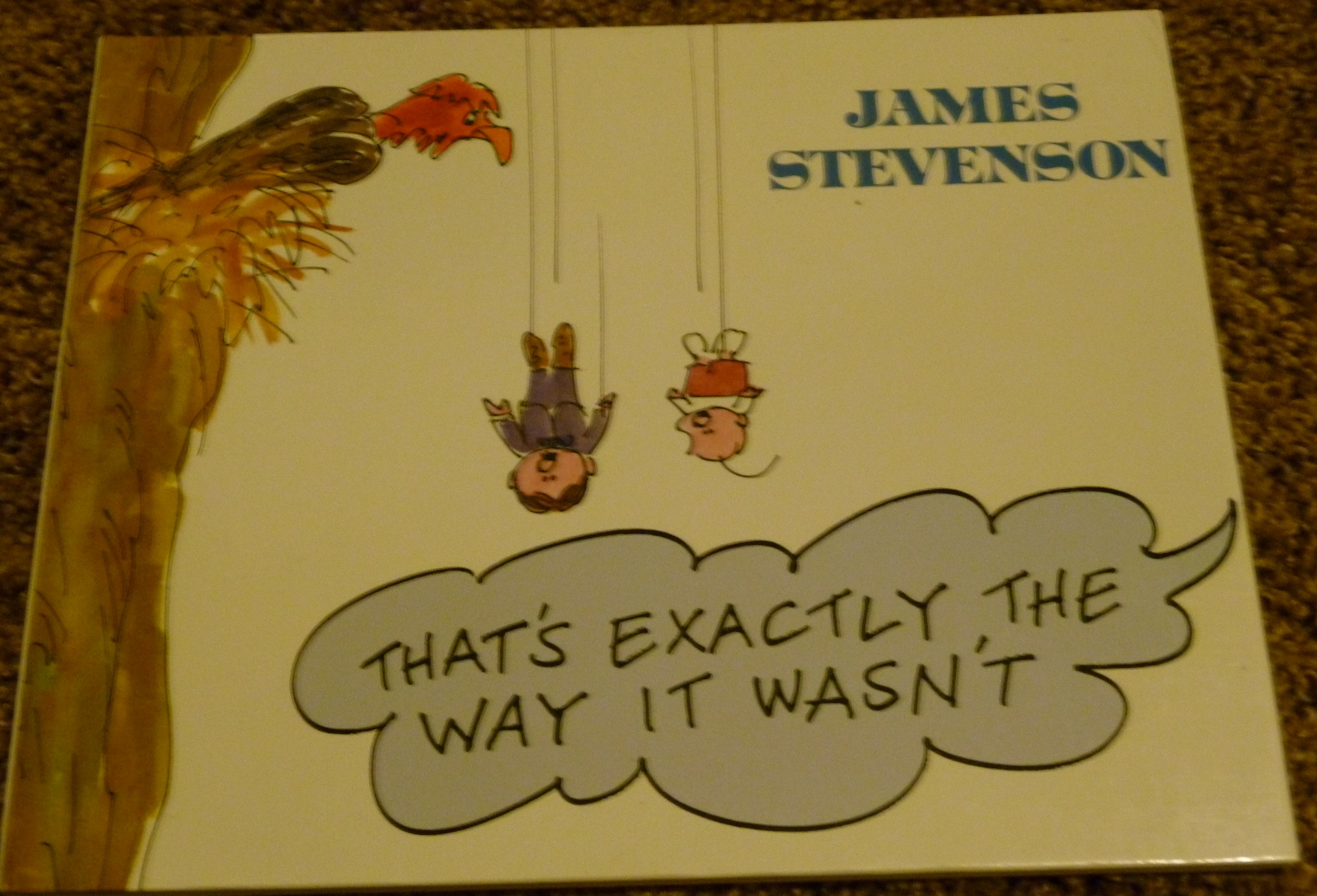
There’s at least ten books in the series.  Another of my favorites is That’s Exactly the Way It Wasn’t (cover above), in which Grandpa and Uncle Wainey keep disagreeing about everything–including whether or not they’re falling off a cliff, a point they debate as they fall headfirst through the air (including politely asking the opinion of a bird as they pass her nest).

The stories always end up happily, with Mary Ann and Louie’s problem being resolved (or dwindling into unimportance by comparison), and with the grown-up Uncle Wainey coming to visit bearing ice cream.

I loved these as a kid, and I still love them now.  I think I took Grandpa’s stories much more at face-value when I was younger–all kinds of fantastical things happen in picture books, after all–and I can see more clearly now that perhaps there was a message in there about not complaining about rain, or about not arguing with your brother.  This probably never consciously occurred to me when I was actually in the target age group. 

But just because I’ve migrated a little from Mary Ann and Louie’s point of view over to seeing things from Grandpa’s angle, that doesn’t change how much I enjoy the books.  And they’re still just as funny.

Guest Post Featured on the O.W.L.

I’m very happy to say that I have a guest book review up on the O.W.L. today!  Jill at the O.W.L. posted a few weeks ago about her plans for an I ❤ Lois Duncan month on her blog.  Lois Duncan is my favorite scary story writer, so I talked to Jill about participating.

You can read my review of The Twisted Window by Lois Duncan on Jill’s blog.

I’ve never been a fan of horror, but I do like suspense and sometimes a little supernatural creepiness.  I like to think of Duncan as the Hitchcock of writers–there’s something similar in her dark, sometimes mysterious, always suspenseful stories.  The Twisted Window is a particular favorite of mine; it lives up to its name with so many twists that you can never be sure you really know what’s going on…

But I won’t ramble on here.  I already talked all about it in my guest post.  🙂