Writing Advice from Gail Carson Levine

If I had read Writing Magic by Gail Carson Levine when I was twelve, I think it would have changed my life.  Unfortunately, it wasn’t published until I was several years past twelve, and I didn’t read it until I was in college.  But it was still an excellent read then.
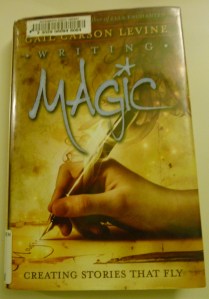
Writing Magic, as you may have guessed, is a book about writing, by one of my favorite authors.  I reviewed her best-known book, Ella Enchanted, early on in this blog.  Writing Magic is a wonderful book for kids who want to write.  It’s filled with good advice of all sorts: save what you write; jot down ideas; pay attention to details; make your characters suffer sometimes.  She covers coming up with ideas, writing the actual story, and working through revisions.  The book discusses practical things like the best way to write dialogue, and discusses why you might feel inspired to write to begin with.  And there are writing prompts at the end of every chapter.

This is a great book on writing, and I think it would also be a lot of fun for anyone who has read Levine’s novels–at least, it was for me!  She illustrates writing lessons with examples from her own books–not only by plucking scenes out of the published books, but also sharing pieces of earlier drafts, or talking about what a story started out looking like, and how her ideas changed along the way.  I love knowing the story behind the story.

If you get to the end of the book and want more, there’s good news: Levine has a blog.  It’s a lot like an extension of this book, with discussions on aspects of writing (and writing prompts at the end of each post).  One thing I particularly enjoy about it is the emphasis on young adult/children’s fantasy.  It makes sense–that’s what she writes, after all–and it’s fun to see a genre written about which is not so much a focus in more literary writing books I’ve read, and not at all a focus in most of my writing classes.  And don’t feel that you have to write children’s fantasy to get anything out of her blog (or her book).  The advice is good across genres; it just has a flavoring of children’s fantasy, and is more likely to use fairy tales than Virginia Woolf to draw an example.

The only reason Writing Magic didn’t change my life was that it reached me at a point when I had already read other books on writing, taken a lot of writing classes, and just had already heard a lot of the advice Levine gives.  It was still helpful!  Just less life-altering than it would have been at a younger age.  The gift of this book is that she’s put all this advice I picked up piecemeal together in an engaging way that I think kids will find appealing and relatable.  It might have got me farther along faster in my writing to have all of this advice dropped in my lap at a younger age.  So if you know a kid who likes to write–send them to get advice from Gail Carson Levine.

Author’s blog: http://gailcarsonlevine.blogspot.com/ (and it’s linked over in my list too!)

Obedience–But With Backbone

Cinderella, in her traditional form, is a character who drives me absolutely up the wall.  Come on, woman—I know you lived in a pre-feminist culture, but don’t you have any backbone at all?  Your life’s awful—so do something about it!  And the fairy godmother—where was she all these years while Ella was being mistreated?  The fairy only shows up when the girl wants to go to a party?  (Because obviously that’s something of paramount importance.)

But, like all great fairy tales, Cinderella does have that spark of eternal appeal.  Who can’t relate to the dream of being lifted out of your ordinary or even unpleasant life, because that one person (the prince, the book editor, the boss for the dream job, the head of the club…fill in your own relevant personality) sees you and says, yes, you’re special above all others.  That’s the core of Cinderella.  But Cinderella herself is irritating.

So when you can take that eternal spark and improve on the character and the plausibility—well, as I said when discussing Wildwood Dancing, then you’ve got something.  And Ella Enchanted by Gail Carson Levine is one of the best retellings of Cinderella I’ve ever read.

Ella is cursed at her christening—if anyone gives her a command (from “eat this cake” to “go jump off a roof”) she has to obey it.  And with that one brilliant stroke, Levine has a heroine who, like the traditional Cinderella, does everything her wicked stepfamily tells her to do—but who also has a mind of her own.  No one could accuse Levine’s Ella of lacking backbone.  She obeys, but I don’t think I’d describe her as obedient.  She can think for herself and, as much as she can around the limits of her curse, takes control of her own life.

There’s a good plot, with ogres and adventures and a kind of quest in Ella’s search for a way to overcome her curse, but I think what mostly stands out in my mind are the characters.  Ella, of course.  And her fairy godmothers—both of them—her more-than-usually complex wicked stepfamily, her absentee father, and, of course, Prince Charmont—because what’s a Cinderella story without a true love, right?

Ella Enchanted probably belongs in the juvenile category, rather than young adult.  But, kind of like the original Cinderella, it has a wide appeal, even if you’re not really the target age group.  So don’t be scared off just because it’s shelved in the kids section.

I unfortunately can’t quite just ignore the movie here.  There is one, but let’s all just pretend that there isn’t.  Don’t see it.  Really.  I did, and I think I spent most of it twitching and saying, “No, no, no, that’s wrong.”  Besides getting the details wrong, it got the spirit wrong, and while I can sometimes forgive a movie for changing the facts a little, it’s much harder to forgive a movie for maiming of the spirit of a story.

Because what Ella Enchanted really is is a very practical, plausible (once you accept the existence of magic) retelling of Cinderella.  The movie isn’t.  But the book is, and it’s well-worth the read.

Author’s site: http://www.gailcarsonlevine.com/