Good Omens from Terry Pratchett and Neil Gaiman

Good OmensTerry Pratchett is the funniest of authors and Neil Gaiman seems to be one of the coolest of people, so I’ve no idea why I didn’t read their co-authored Good Omens long ago…but I finally have, and it was wonderful!  And right on time for Once Upon a Time.

I realized after I opened the first page that I had almost no idea what this one was actually about.  Because, I mean, Pratchett and Gaiman–who cares what the plot is?  But in case you’re curious (and to add coherence to the rest of this review), I’ll give you an overview.

The book centers in large part around Crowley and Aziraphale, a demon and an angel, respectively, though the two have more in common than you might think.  Both have been on Earth for the past 6,000 years and have developed a solid working relationship in the process.  When the Antichrist is born, heralding the end of the world in eleven years, Crowley and Aziraphale both realize that they find Earth far more interesting than either Heaven or Hell, and set about to prevent the end of the world.

Meanwhile, the Four Horsemen of the Apocalypse are gathering, the last of the Army of Witchhunters is vigorously and ineptly pursuing his calling, and Anathema Device (witch) is following dictates set down by her ancestor in the Book, The Nice and Accurate Prophecies of Agnes Nutter, Witch.  And the Antichrist turns out to be a very nice young man.

The plot doesn’t even begin to do justice to the madness and hilarity of this book.  I don’t think there’s any way to discuss it very coherently, so perhaps a few representative examples…  Every cassette tape left in Crowley’s car for more than a week or so turns into something by Queen.  The Four Horsemen ride to the Apocalypse on motor bikes, accompanied by four more conventional Hell’s Angels, arguing about what horrible thing they want to be (including “People Covered in Fish,” for instance).  When the Antichrist (whose name, by the way, is Adam) starts latching onto some wild, part New Age, part urban legend concepts that he doesn’t quite understand, Atlantis rises and Tibetan monks start popping up out of holes everywhere.

The book is incredibly clever too.  Take the Four Horsemen–Famine goes around spreading his particular evil through fad diets and nutritionless fast food.  Pollution has replaced Pestilence, after penicillin was invented and Pestilence retired in a huff.  War makes a living first as an arms dealer and then as a war correspondent–who always gets to places just before war breaks out.  And Death, well…he’s not quite as funny as the Discworld Death, but he does speak in ALL CAPITAL LETTERS.

This book is all the more remarkable for being about a battle between angels and demons, drawing heavily from the Book of Revelations and occasionally Genesis, and pulls it off without being proselytizing or judgmental.  I wouldn’t recommend this as a source for theology, but it’s never offensive either–and I’m a practicing Catholic who found The Da Vinci Code deeply bothersome (for a number of reasons, scholarship as much as anything).

I could keep rambling on about this, but just take my word for it–it’s hilarious.  If you like either of these authors or think you might, then read it.  I mean, there’s a book-loving angel, a demon who “did not so much fall as saunter vaguely downwards,” a whole lot of footnotes, and Death.  And according to Wikipedia, once upon a time someone thought about casting Johnny Depp as Crowley, and now I so want to see that movie made!

Authors’ Sites: http://terrypratchettbooks.com/ and http://neilgaiman.com/

Other reviews:
Charley R’s Leaning Tower of Plot
Amidst the Meadow of Mind
Books, Writing, Tea
Death, Books and Tea (trend?)
Anyone else?

Buy it here: Good Omens: The Nice and Accurate Prophecies of Agnes Nutter, Witch

Death Comes for an Apprentice

MortIn my usual way of reading Discworld books, I had read most of the Death subseries without reading the first one.  But recently, I finally picked up Mort by Terry Pratchett to get the beginning of the story, confident of finding a book that would be about life and death and eternity–and it was–and be enormously funny–and it was!

Mort has never been much of a success at anything, so his father decides the answer is to apprentice him out to a trade.  As it happens, Death is looking for an apprentice.  The job is a little daunting but Mort begins to get into the swing of things (pun intended!)…but then matters become complicated when he saves the life of a princess who the universe is now convinced is dead, and when Death begins to explore happiness and contemplate escaping his duties.  Also there’s Death’s daughter (adopted) thrown into the mix, and more than one wizard of questionable power.  And…well, it’s Discworld.  There’s havoc and there’s hilarity.

There’s a whole collection of fun characters here, as I would expect from Terry Pratchett.  Mort undergoes an interesting transformation from ordinary screw-up to resembling Death just a little too much–including this problem he keeps having passing through objects.  Princess Keli is great fun, especially as she becomes immensely frustrated when the universe thinks she’s dead and everyone keeps forgetting about her.  She’s an odd blend of very strong and also quite inept in dealing with the world–as happens when you’ve been a princess all your life, and never needed to deal with the world.  Ysabell, Death’s daughter, is an odd blend of crazy and ultimately endearing.  And it was fun to learn the backstory on Albert, Death’s servant–he’s in later books, but his background isn’t revisited that I can recall.

My favorite character here was Death himself.  I tend to like him best in a supporting role–sometimes when he’s too much the focus it gets old (while often his two-paragraph cameos are the funniest bits of other books).  Here, there’s enough focus on Mort and the others that Death gets just the right balance–plenty of him, but not too much.  He tries to explore human happiness, which treats us to scenes of Death fly-fishing, line-dancing, and sitting in a bar (at a quarter to three, of course), and never quite understanding any of the things he’s doing.  My favorite may be when Death visits an employment agency and puts down “Anthropomorphic Personification” as his previous position.

The setting is also particularly fun here, something I don’t often say about books!  But Death created his own world, and though he tried very hard, he has some trouble–everything tends to be black and fake.  We also spend time in Keli’s mountain kingdom, and get to visit Ankh-Morpork.

There isn’t a huge lot of satire and depth here, but there are some discussions on justice and eternity and the meaning of life.  Death seems to struggle with these questions throughout his books.

The weak point of the book is the ending–only the very, very end.  At the risk of a slight spoiler, there’s a sudden switch in the romance, and even though I knew it had to be coming (based on the later books about Mort’s daughter), Pratchett still didn’t sell it to me.  It’s like he decided on the last chapter that there was more future potential in ending one way than with the other, and went for it without bothering about whether it made sense.  I won’t complain too much…since it did lead to the amazing Susan, heroine of later books.

This is the fourth book in the Discworld series, and it’s one I’d recommend as a place to start.  The books still get better, but this is the earliest one that’s already showing just how hilarious Terry Pratchett can be.  Highly recommended!

Author’s Site: http://terrypratchettbooks.com/

Other reviews:
Brian Jane’s Blog
Helen Scribbles
The Eagle’s Aerial Perspective
Anyone else?

Classic Review: A Semester in the Life of a Garbage Bag

One of my favorite funny authors growing up (and still, to some extent) was Gordon Korman.  Several of his books still make me laugh out loud, after repeated reading.  One of my favorites, for its humor and its philosophy, is A Semester in the Life of a Garbage Bag.  Gordon Korman understands stress.

He’s also an author who proved just how awesome he is–I emailed him after I posted this review, and got a very nice email back!

***********************************

Every high school student should read this book.  Actually, everyone should read it, if only for the metaphor of the title.  A Semester in the Life of a Garbage Bagby Gordon Korman sounds utterly ridiculous–and it is.  It is a hysterical, hilarious, wonderful book.
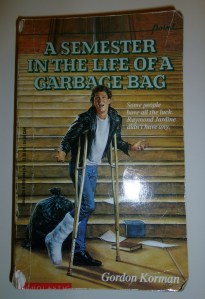
My slightly battered, much-loved copy

But the title is actually remarkably profound.  It’s based on a one-scene reference (like To Kill a Mockingbird‘s title) when the main character describes a commercial for garbage bags.  The garbage bag is hooked up to a machine that keeps pumping in more and more pounds of pressure, and the smiling spokesman talks about how much pressure the bag is taking.  He keeps on cranking it up, while the poor bag is struggling to hold together.  Sound like high school to anyone?  Or life, for that matter?

The main character in the book is Raymond Jardine.  He has no luck.  Zero, zip, zilch.  His overriding dream is to somehow make it Theamelpos, an island in Greece which he is convinced grants extraordinary luck to all visitors.  Six students will be selected (methodology unknown) for a school trip this summer, and Jardine is determined to lie, steal, cheat, scheme, and connive his way into one of those six slots.

And that’s just the beginning of the story.  We’re guided through the book by the comparatively normal Sean Delancey, who is paired with Jardine for an English assignment.  Korman often takes the wise tactic of giving us someone relatively sane as a lead character, who can navigate us through the wild and wacky world of the book, where anything is possible.

Where it’s perfectly normal, for instance, for students to surf on trays down tables in the cafeteria–the temperature in the cafeteria is typically around 90 degrees, because the school is powered by the experimental SACGEN, which all the students know doesn’t work but which the school board is determined to insist is a great triumph.  That’s just one example of the world we find ourselves in.

The English assignment Sean and Jardine have to do together is a 30 page report on a poet of their choice.  Jardine is determined to pick a poet no one else will do (reasoning that if they pick a famous poet, another group will too, the teacher can compare the two reports, and his is bound to be worse).  Literally minutes before the deadline to choose, Jardine selects Gavin Gunhold, the author of “Registration Day.”  They rave to their teacher about how much they love Gunhold’s work, and find out later that he never wrote anything else, having died in a freak accident shortly after writing his only poem.  Their solution is start writing their own poetry in Gunhold’s style, using for inspiration words they pick at random from the encyclopedia.

As to Gunhold’s one original poem:

On registration day at taxidermy school
I distinctly saw the eyes of the stuffed moose
Move.

I’m not usually a fan of poetry, and I have probably quoted Gavin Gunhold more often than almost any other poet.

A Semester in the Life of a Garbage Bag is packed with memorable characters, funny scenes, and even an explosion or two.  You will get your money’s worth in laughs out of this book.  And surely everyone can relate, at least a little, to how Jardine feels about that garbage bag?

Author’s website: www.gordonkorman.com

Guarding Ankh-Morpork

Not Pictured: Snuff, which isn’t in paperback yet

A couple of weeks ago, I wrote about one of Discworld’s most frequent recurring characters, Death.  This week, let’s look at my favorite group of regulars, the City Guard of Ankh-Morpork.  There are eight books focused on this group of rather hapless police officers, and they’re the one subseries I’ve read all the way through (but completely out of order).

The City Guard are led by Sam Vimes, the relatively sane focus point in the middle of some very odd characters.  I think Vimes is what makes these my favorite set of books.  Besides being an awesome character, he’s the straight man who makes the comedians even funnier.  Vimes is a world-weary police officer with a cynical streak a mile wide, who nevertheless believes in honor and justice and above all, the rule of law.  He’s uncorruptable while completely practical about the corrupt city he guards.  He undergoes more evolution than most Discworld characters, and even though I read him all out of order it’s interesting to see his character grow through the books.

Vime’s righthand man is Corporal Carrot, biologically a six-foot human and culturally a dwarf (it’s complicated).  He’s simple, but not stupid.  He also believes in honor and honesty, but unlike Vimes, he believes everyone else is honorable and honest too.  The funny thing is, around Carrot, they are.

Sargeant Fred Colon and Nobby Nobbs typically appear together.  Colon always knows the best place for a drink or a smoke, and the best ways to avoid any and all trouble.  Nobby has to carry around a card to verify that he’s human; descriptions are vague, but I picture him short, skinny, pimply and hairy.  He’s convinced of his own vast wisdom and sophistication, and is a guardsman who is nevertheless addicted to petty theft.

There are a few women on the force: Cheery Littlebottom is a dwarf who breaks dwarfish taboos by openly admitting to being female, and Angua is a brilliant fighter and tracker, largely because she’s a werewolf.

There are some other regulars among the guards, but those are my favorites.  They’re a motley and very funny crew, who generally manage to pull success out of chaos.  Guards! Guards! is the first in the subseries, and Jingo, Night Watch and Thud! are among my favorites.  But really, they’re all good, and you can probably just grab any you like.  It’s Discworld–you’ll figure things out.

A Humorous Reflection on Death

Today is Friday the 13th, and I’m currently hosting a Discworld reading challenge–so there’s really only one appropriate topic today.  Death.  Specifically, Pratchett’s character of Death.

There are several books with Death as a major character, and you can trust him to make at least a cameo in most of the books.  He looks rather as you might expect Death to look, a skeleton with a dark hood and a scythe.  Despite appearances, he isn’t really a frightening character.  Death never kills anyone; he appears as a guide when someone has died, which I think is an important distinction.

And did I mention also that Death is frequently extremely funny?  He talks IN ALL CAPITAL LETTERS, so you always know when he’s arrived.  He’s both insightful and a little baffled by humanity, he takes pride in his work, and he seems to be well-meaning as a rule.  One way or another, whether its telling knock-knock jokes or explaining that he really can’t take off his mask, even his briefest appearances tend to be wonderful.

The two Death-focused books that stand out the most for me are Reaper Man and Hogfather.  In the first, Death’s bosses decide he’s going soft and fire him.  He goes off to find a new job on a farm, while elsewhere no one’s dying anymore…  One of my favorites bits of the book is when he’s out cutting wheat (with a scythe, of course).  The woman who owns the farm notices that he’s very fast, but is cutting the wheat one stalk at a time.  She asks why he doesn’t cut a swathe at once, and Death is horrified.  That would be wrong–every stalk must die in its own time, with individual attention.

Hogfather is Pratchett’s Christmas book.  The Discworld’s Santa Clause equivalent goes missing (more or less) and the fabric of mythology and belief begins to unravel–despite Death’s best efforts to fill in.  This is largely focused on Death’s granddaughter, Susan.  You see, Pratchett’s Death has a family.  He has an adopted daughter, who got married and had a daughter.  Susan desperately wants to be normal, but that’s difficult when she’s inherited some of her grandfather’s talents.  There’s a movie version of Hogfather that’s very good; Susan is played by Michelle Dockery, who you might know as Lady Mary from Downton Abbey.

In other Discworld books, if a character dies you can pretty well expect Death to turn up to guide them to whatever awaits.  And odd though it may sound, it’s always fun when Death arrives.