Magicians, Neo-Druids, and an Orphan Waif

What if a magician in the sideshow had real magic?  It’s a great premise…and just the smallest part of Mairelon the Magician by Patricia C. Wrede.  It’s an excellent book, but it will do you no good to read the plot summary (at least on the copy I had), as it only addresses the first twenty pages.  Sometimes I wonder who writes these things…

So, as to the actual plot: Kim is an orphan on the streets of London, a girl who disguises herself as a boy to avoid the wrong kind of attention.  A stranger hires her to spy on Mairelon the Magician, who puts on the aforementioned sideshow.  Kim quickly realizes, however, that Mairelon is not merely an illusionist, but a real magician.  That’s as far as the book jacket will take you.  That’s barely the beginning, though.  Most importantly, Kim doesn’t find it at all shocking that he can actually do magic.  You see, Kim lives in a London where magic is real–it’s an academic, rich man’s profession, but it’s real.

The setting is actually very similar to Wrede’s Sorcery and Cecilia books, a magical version of Regency England, although her blog says they are not proven to be the same world.  I’d kind of like to think that they are.  🙂

Back to the plot, beyond what the book jacket says: Mairelon apparently sees something of value in Kim, and takes her on to be trained as his assistant for his magic show.  Kim quickly finds herself enmeshed in Mairelon’s quest to find the Saltash group, several silver objects that together can do powerful magic.  The quest takes them out of London and into the countryside where everyone you trip over is also chasing the same objects, though for various reasons.

It’s an often very funny story, a good mystery, and I enjoyed the characters.  Kim is a smart girl who knows how to watch out for herself, while watching for a chance to improve her lot.  She has a soft side too, and gets fond of Mairelon, even if she’s not likely to admit it.  Mairelon is one of those flamboyant characters who can be serious underneath it, who means well and is also enormously stubborn.  So is everyone, actually, including Kim and Hunch, Mairelon’s combination guard, wagon-driver, assistant and friend.

It’s the interplay between the three of them that I like best.  Mairelon’s tends to rush blithely ahead, carefully oblivious to Hunch and Kim’s attempts to restrain him for his own good.  The result is a lot of glowering, cursing and deliberate misdirections of the conversation.  I imagine you can surmise who’s doing what.  Hunch and Kim start out disliking each either, but develop a mutual respect–but one not likely to be admitted.

The other best part is the Sons of the New Dawn, a neo-druid group who have no idea what they’re doing, but whose leader is wildly adamant about finding his Sacred Dish, which is unfortunately the same as the Saltash Platter Mairelon wants.  They’re very funny all around.

The book winds up with a final scene featuring at least a dozen people and probably the best example of written hubbub I’ve ever seen.  I confess I have trouble balancing dialogue with three or more characters–Wrede somehow writes twelve people arguing with each other.

The end is somewhat marred in that she winds up the hubbub and then spends pages explaining everything that happened.  It’s the same device as a detective story, where the detective unmasks the killer and then neatly lays out all the steps of the crime and the investigation.  It goes on a bit, though, and feels somewhat forced.  On the other hand, she gets points for not leaving the reader wondering what on earth was going on–I’ve seen books that could desperately use a few pages of someone explaining it all.

There’s a sequel to the book, which I haven’t read yet–but if anything, the plot (if I can trust the summaries!) looks even better, so I’ll be tracking that down soon.  🙂

Author’s Site: http://pcwrede.com/index.html
Going Postal with Terry Pratchett

I’ve mentioned Terry Pratchett and Discworld a few times recently in “Favorites Friday” posts, but I haven’t done a review yet.  Time to change that!  Part of the trick with Discworld (rather like Dr. Who) is figuring out where to start.  Discworld is one of those big sprawling series with over forty books in it.  If that sounds intimidating, don’t worry–the books are interconnected, but very few directly follow each other plot-wise, so you can read as many or as few as you feel like.

And you can probably start almost anywhere.  I’ve bounced all over the series, and while with some it was clear that there was a previous, related installment it might have helped to read first, I don’t feel like it severely hampered my enjoyment of whatever I was reading.  However, there probably are some places that are better to start than others.

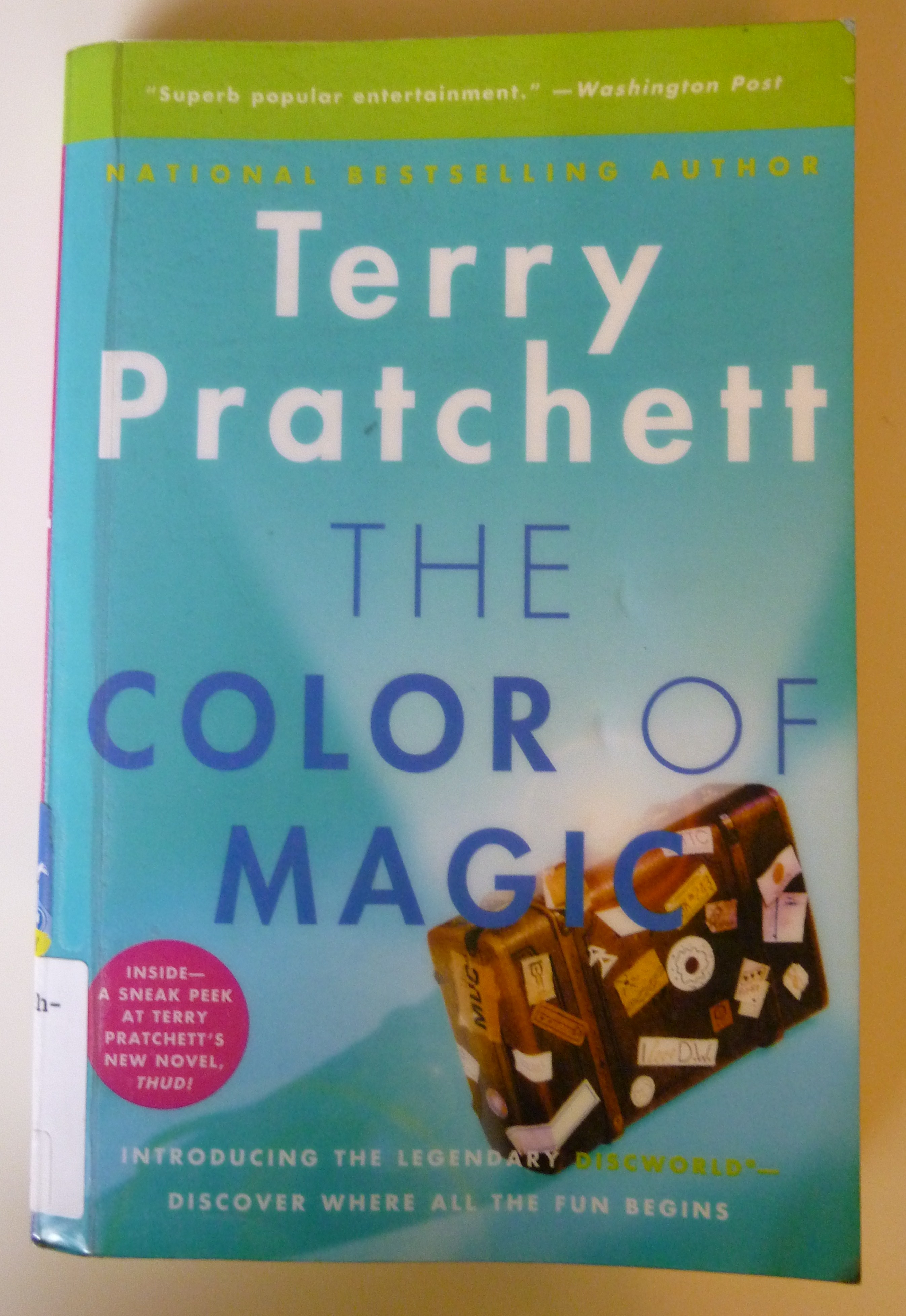
I actually wouldn’t recommend starting at the beginning.  That’s The Colour of Magic, and it’s good, but Pratchett was still sorting the world out, and it’s not as brilliant as many of the later books.  One really good place to start would be Going Postal.

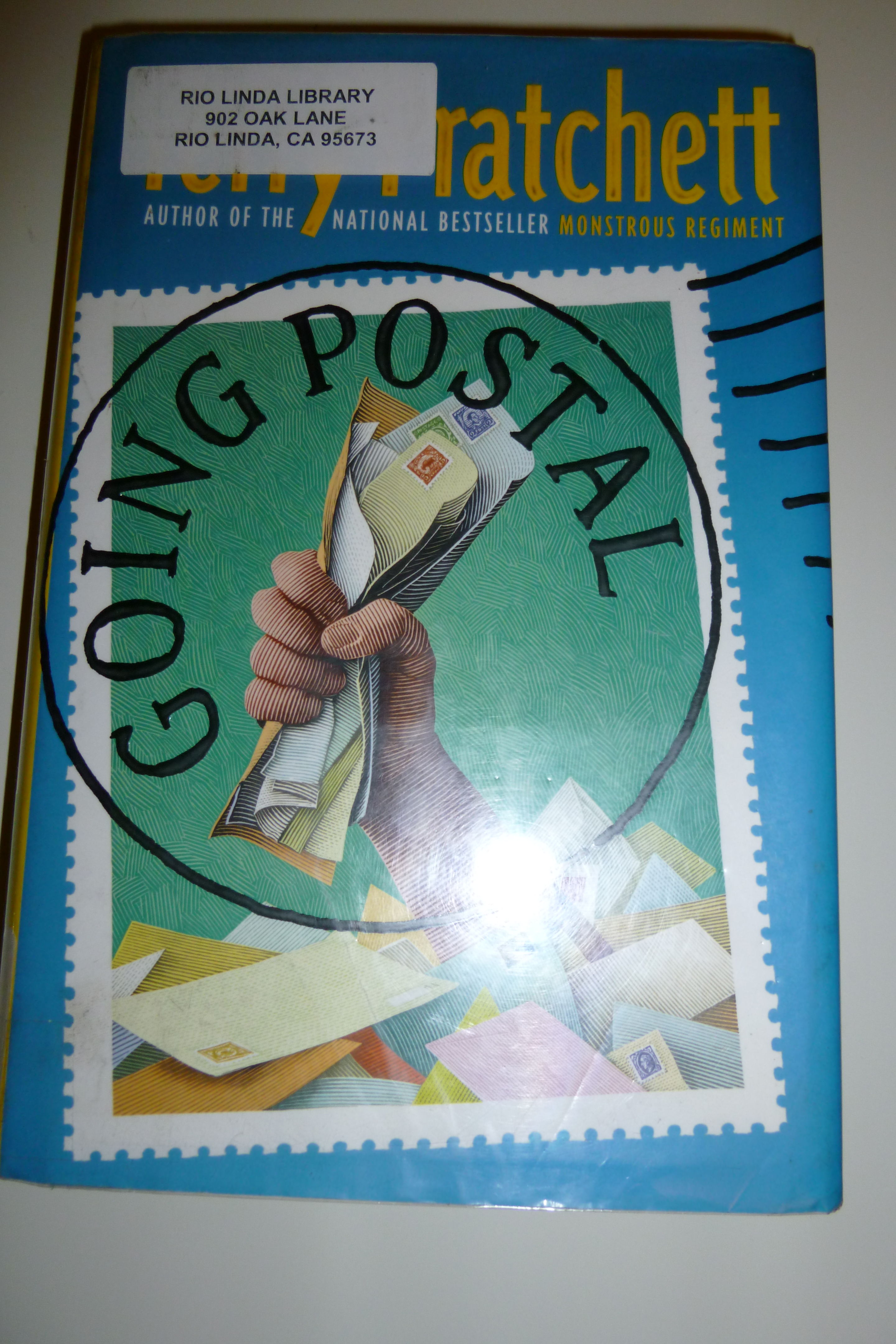
Going Postal stars Moist von Lipwig, a fast-talking conman who was supposed to be hanged, but finds himself revived after the gallows, and designated the new Postmaster of Ankh-Morpork.  The post office has been out of business for years, and the old building is falling to pieces–not to mention it’s literally filled with undelivered mail.  Moist finds himself trying to bring back the post, despite completely mad co-workers and violent competition from the clacks (telegraph) service.

It’s a wonderful, funny book, and it’s a good starting point because it’s stand-alone.  Moist and most of the other major characters make their first appearances here.  But you also get to meet a lot of characters who are significant in the series, but have only supporting roles here.

Vetinari, the Patrician, gets a good part; he’s a tyrant, and he’s terrifying, but he makes things work.  You get to meet a lot of the City Guard, who are my favorite group of characters (they have seven, soon to be eight, books written about them).  The Wizards of Unseen University, who are all at least little bit bonkers, make a guest appearance.  And I can’t remember for sure, but I think Death gets at least a cameo.  Death wears a big black hood and talks IN ALL CAPITAL LETTERS.  Usually someone dies at some point in every Discworld book, so Death gets to show up, and a few of the books focus on him.

So this is good for introducing characters who are important in other books, and it’s also good for giving you a feel for the city of Ankh-Morpork, and Discworld in general.  Pratchett is one of the funniest writers I’ve ever found.  He creates a crazy world (did I mention it’s a disc, which is on the back of four elephants, who are on a turtle?) filled with completely nutty and hilarious characters.  And he has a way of writing single lines which will make me laugh for days afterwards whenever I think of them.  Feeling down?  Read Pratchett.  I fully believe in self-medicating depression with Terry Pratchett books.

They’re not merely funny, though.  Pratchett is often very satirical.  Much of Ankh-Morpork is an extreme, but it’s an extreme you may recognize as based in something in our own society.  Going Postal is good satire too.

High, high recommendation for Discworld.  You won’t regret it!

Author’s Site: http://terrypratchettbooks.com/

Hilarity Happening at MacDonald Hall

A few months ago I reviewed A Semester in the Life of a Garbage Bag by Gordon Korman, and I’ve decided it’s time I reviewed some of his other many hilarious books.  A particular favorite is the Macdonald Hall Series.  Macdonald Hall is a boarding school for boys, around middle or high school age–it’s never very specific.  Miss Scrimmage’s Finishing School for Young Ladies is directly across the road.  With a host of improbable circumstances and wonderfully quirky characters, hilarity constantly ensues.

Korman follows the same pattern he uses in A Semester in the Life of a Garbage Bag, and gives us one fairly normal main character–Boots (real name Melvin, but don’t call him that).  His best friend and roommate is Bruno, who can always be relied upon to have a big, brilliant and probably ill-advised idea, whether it’s a way to earn money for a swimming pool or a new idea for a prank.  Bruno and Boots are incorrigible pranksters who are also fiercely loyal to their school, and Korman gets plots out of both qualities.

They’re surrounded by even wilder characters.  There’s big Wilbur Hackenschleimer, who thinks only about food, and genius Elmer Drimsdale who has a brilliant scientific mind and limited social skills.  I think my favorite is Sidney Rampulsky, who is endlessly klutzy.  Playing football, he manages to trip over the 30-yard line.  Another time he trips over the headmaster’s chair, while the headmaster is sitting in it.  The headmaster is Mr. Sturgeon, popularly known as The Fish–for his name, and for his cold, fishy stare.  The Fish is stern but fair, and secretly very fond of his students–but secretly.

Across the road, Miss Scrimmage is an enormous and rather terrifying woman, who will defend her precious, defenseless girls until the end–blissfully unaware that her girls are about as defenseless as a SWAT team.  Cathy and Diane are Bruno and Boots’ female counterparts.  Cathy is always up for an adventure, and her roommate Diane is generally dragged along.

There are six books in the series; the first is This Can’t Be Happening at Macdonald Hall, which Korman wrote and published when he was twelve.  He wrote most of the others during high school, which frankly boggles the mind a bit–especially because they’re brilliant.  The first one involves Bruno and Boots being split up as roommates because they commit one too many pranks; Bruno, of course, has endless ideas on how they can convince The Fish to put them back together–mostly ideas involving new pranks.

Other books in the series feature Hollywood descending to film a movie on campus; the adventures of a hapless football team (I don’t normally like sports stories, but this one is so funny I enjoy it); and a desperate plot to make Macdonald Hall famous so they won’t be shut down.  This one features a scene with Elmer Dynamicdale and the Original Round-Robin Happy-Go-Lucky Heel-Clicking Foot-Stomping Beat-Swinging Scrim-Band performing Science Rock, which essentially consists of Miss Scrimmage’s girls creating a cacophony of noise while Elmer screams scientific facts (you have to kick him to get him started).  It never fails to make me laugh out loud.  But that happens a lot with these books…

I could probably go on and on just giving funny anecdotes, but where would it end?  Just trust me.  Read them.  They’re hilarious.

Wizards and Luggage, Traversing a Disc

I’ve read upwards of ten books in Terry Pratchett’s Discworld series, but until recently I hadn’t actually read book one, The Colour of Magic.  It’s one of those series where you can really drop in at any point (though some books are better starting places than others).  I think there are over thirty books in the series, so if you, like me, feel a little baffled at where to begin, don’t bother–just grab something and go (though I recommend Guards! Guards! or The Truth as good starting points).  Or, of course, you could start with #1.

The Colour of Magic introduces us to Discworld, an alternate world which exists as a flat disc, riding on the back of four elephants, who are on the back of a giant turtle.  That right there may give you some idea of what we’re dealing with–a truly bizarre and wonderfully hilarious world.

The Colour of Magic begins in the ancient and cheerfully corrupt city of Ankh-Morpork, where Twoflower has come as the Disc’s first tourist, thrilled by the quaint bars and eager to meet heroes and see real Ankh-Morporkian brawls.  Rincewind the not-very-good wizard ends up roped in as his guide, and they embark on a perilous and hysterical adventure around the Disc.

It sounds almost reasonable, until I mention that Twoflower is followed everywhere by an animate trunk with hundreds of legs known as The Luggage, Death shows up every so often and is rather put out that Rincewind keeps stubbornly not dying, and at one point they encounter imaginary dragons who live inside a giant inverted mountain.  And that, of course, is only the half of it.

If you’re having a gloomy, depressing day, read a Discworld novel.  It will brighten everything.  Pratchett’s books are gritty but hilarious, have a grown-up feel but aren’t really inappropriate for young adults either.

There’s a vast cast of characters who wander in and out of the Discworld novels, and there are some subseries within the larger series (although good luck finding a comprehensive, helpful list of which books fall into which subseries), which focus on particular groups of characters.  There are the witches; the City Guard; the magicians; and let’s not forget Death.  I’m especially attached to the City Guard, led by noble but cynical Sam Vimes.

The Colour of Magic doesn’t focus particularly on any group of characters I recognize from later books, but it will definitely give you a solid introduction to the world of the Disc.

And, a random story: years ago I was on a bus, and overheard a couple of people talking about a book.  A wizard wound up in a tree, and was being visited by what seemed to be Death, but turned out to be a non-fatal disease.  The wizard objected that no one died of that disease, and he couldn’t be killed by him.  Sounds fun, right?  Of course I didn’t hear the book title, and I didn’t ask, and despite a little Googling I never could figure out what the reference was.  But now I’m reading along through The Colour of Magic and lo and behold: Rincewind lands himself in a tree, a cloaked figure appears with a scythe–but it’s not Death, it’s Scrofula.  Death was busy.  Rincewind objects, “I can’t die of scrofula!  I’ve got rights.”

Long-time mystery solved.  And almost as randomly as Discworld itself.

Adventures with Hats and Squirrels

I’ve been bouncing around a bit today.  You may remember I reviewed A Semester in the Life of a Garbage Bag by Gordon Korman a few months ago.  After that review, I wrote him a letter.  Well, I just got a personal email back.  Which has prompted a lot of “Gordon Korman wrote to ME!”  And a bit of bouncing.  Context for this excitement: I’ve been reading (and rereading) his novels since I was, I don’t know, ten.  Maybe younger.  And I own eighteen of them.  And there are some which rank easily among the funniest books I have ever read.

So.  Bouncing.

And having just had an email from one of my favorite writers of hilarious fiction, I think it’s a good time to share some humor for Fiction Friday.  My most absurdly humorous writing, barring some very early Star Trek parodies, is definitely my Pirates of the Caribbean novel-length extended joke (I hesitate to really call it a novel, because there isn’t a plot!)  So here you are: a scene from Cornfield Madness.  The only context you need is a basic familiarity with the characters of Jack Sparrow (Captain) and Will Turner, who are currently wandering around in a cornfield in the middle of the night, trying to avoid Navy sailors who are chasing after Jack.  Oh, and earlier in the story Jack acquired a bonsai tree and named it Hector.

*********************************

            Jack and Will walked through the cornfield, more or less aiming for the far end.  Will was in the lead, as that was how they had started and neither had yet taken the trouble to change that.  It was as they walked on that Jack’s hat suddenly fell off.  A small furry body had leapt out of the cornstalks and knocked into his hat.

            Jack’s hands went to his head.  “My hat!”

            Will hadn’t noticed the small furry body, and wasn’t comprehending Jack’s concern.  “So pick it up again.”

            “Oh.  Right.  Hold the tree.”  Jack handed Hector to Will and looked around.  His hat was lying quietly in the middle of the row a few feet away.  He took a step towards it.

            The hat skittered away.  Jack frowned.  He leaned forward.  The hat sidled back a few inches.  He took two quick steps towards it, the hat hastily backing up.

            Jack frowned at the hat.  “Now you stop that,” he said sternly.  The hat snuck back another inch.

Continue reading “Adventures with Hats and Squirrels”