
Across Five Aprils by Irene Hunt is one of those books. Not a bad kind of those books. One of those books that shows up on class reading lists and in books reports and that everyone seems to know the title of. I wish I’d liked it better.
Even as one of those books, I somehow never actually read it in school. I probably listened to an oral report or two, but I don’t remember them clearly (I remember endless reports on Harry Potter, but that’s another story). Somehow, Across Five Aprils never came my way, so I decided to pick it up recently–mostly because I knew it was one of those books and I thought maybe it would be worth forming an acquaintance.
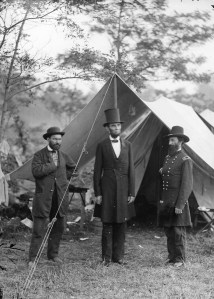 If you’re also unaquainted, Across Five Aprils covers the five Aprils of the Civil War, told from a farm in Illinois and mostly from the point of view of Jeth, too young to go to war and thrust into responsibility for the farm when his older brothers all go to fight.
I liked the book well enough, and there were were some good parts in here, especially in connection to Mr. Lincoln. That leaves me the task of sorting out why I didn’t like it better. Maybe it’s the hazard of covering five years in a fairly slim volume. By necessity you have to summarize past days and weeks and months, and only occasionally dip into more detail. I’m left with a feeling that I couldn’t get down into this book, that it was too much summary. Even though I know there were scenes that were more detailed, I feel as though the whole thing took place on a surface level.
Another matter probably comes down to personal preference. When I read historical fiction, I don’t like my history to get in the way of my fiction. I’d like to learn something, but I’d rather not notice too much that I’m doing it. Remember that this book is set on a farm–we’re not actually out engaged in the Civil War. And yet the story stops for paragraphs and pages at a time to discuss the progress of battles and which general has been promoted and demoted and who’s advancing where. It’s at that point that I start to feel the history is being foisted on me.
I think a fair comparison to make here would be with L. M. Montgomery’s book, Rilla of Ingleside. It’s set during World War I, but takes place on the Canadian homefront. Again, we’re not on the front lines, and yet we hear about every town that is taken, every time the line moves forward or back, every decisive battle–but it works. Because the story doesn’t stop for the narration to tell us that the Germans captured a town. Instead, the next event in the story is when one character comes flying into the kitchen to tell the other characters what the newspaper says today.
I feel arrogant saying this, when I’ve got a review from The New York Times reading “An intriguing and beautifully written book” staring up at me from the cover of Across Five Aprils, but I just don’t think the mix of fiction and history was handled all that masterfully here. If you know a kid with an interest in the Civil War, then I do think I could recommend this book. But you have to have that interest, because rather than fiction with a historical backdrop, this is definitely history told through fiction.
 Tales of the Marvelous