I’ve come down from the mad flurry of new books by favorite authors, and am mostly back to working through my usual goals and lists and challenges…
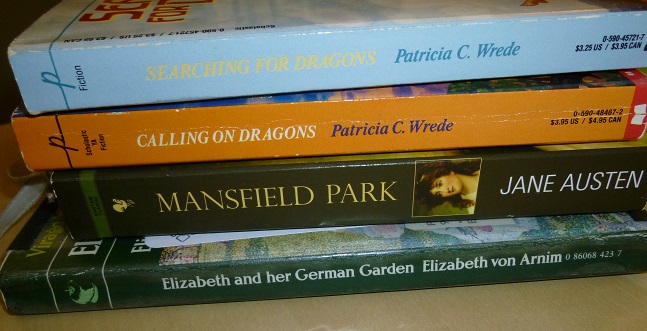
Right now I’m in the middle of Mansfield Park by Jane Austen. I’ve been making my way slowly through Austen for the last few years, and after this the only novel left will be Emma. So far I’m enjoying Mansfield Park, although I’m finding the collection of characters unusually difficult to keep straight, even for Austen. It doesn’t help having two Mr. Bertrams and two Miss Bertrams!
After Austen, I have a very random read I chose thoroughly on a whim. I recently read the second volume of L. M. Montgomery’s Complete Journals, and sometimes she discusses her reading. She mentioned Elizabeth and Her German Garden by Elizabeth von Armin often enough and warmly enough that I got curious…and since Montgomery and I both count J. M. Barrie as a favorite author, I’m hopeful!
After that, I’ve been meaning to reread the Enchanted Forest Chronicles by Patricia C. Wrede for ages and ages, so I plan to jump into one or two of those for something lighter.
Finishing out my reviews of the Emily of New Moon trilogy by L. M. Montgomery, today is Emily’s Quest!
Book Three sees Emily back home at New Moon, continuing to pursue her writing. Love-interest Teddy becomes a much more driving force in this volume, not so much in his presence as in his absence. Emily and Teddy are driven apart through a series of circumstances and misunderstandings, and even though it’s sometimes far-fetched or conveniently coincidental, Montgomery grounds everything in such genuine emotion and human nature that I’m willing to go along with her. Example: Teddy’s mother plays a convenient role in derailing their romance, but it’s so based in who she is as a character that I completely believe it.
Another strand of the plot is Dean Priest, Teddy’s only serious romantic rival. He’s an odd one, as he’s likable and sympathetic in some ways, but I keep running up against the problem that he’s far too old for Emily. This might be workable, except that it gets squickier because he harbors romantic feelings for Emily starting when she’s eleven, and is waiting for her to grow up. On the other hand–Dean seems to realize this is all a little weird, and that he’s too old for her–which possibly should make matters worse but actually seems to help. The realization comes with a strong overtone that he’s never, ever, ever going to do anything inappropriate, which makes it all a little less uncomfortable.
Although just as the Dean/Emily romance seems like a maybe, then he does some absolutely reprehensible things in the area of her writing, and I know some people have some very strong Dean-hatred as a consequence… Personally, I think he’s a little like Mad Mr. Morrison from the previous book, in that Montgomery gives us just enough of how Dean sees the situation, and himself, that I end up feeling more sorry for him than angry. Though it was reprehensible, and directly responsible for a lot of the sadder parts of the book.
Emily’s Quest was written directly after The Blue Castle, and it’s fascinating to look at Valancy’s blossoming from empty stagnation into a vibrant confidence and enthusiasm for life, compared with Emily’s vibrant youth and apparent path towards an emptier adulthood.
Emily is anguished at some points, and there are long stretches where she faces a very bleak future–and somehow that bleakness seemed even more affecting than the sharper pains. As far as I can remember, the last time I read this I saw it as a pretty standard true-love-never-runs-smooth story where the point was to get through the travails to the happy ending. This time I was really struck by all that’s being explored by those sections of darkness. Maybe it’s just the effect of being older–maybe it’s because I read Montgomery’s journals and know exactly what she was drawing from to write these sections. Either way, I found the book deeply moving on this read.
And for those who are worried…it’s worth noting that Emily believes in always giving her stories happy endings, and she’s a very autobiographical character. 😉
I feel like I’m making something of a litany of dark dark dark in these reviews! But it’s so different from how Montgomery is usually viewed that I think it’s worth emphasizing. And there is still soul-stirring beauty and occasional humor too. If you really just want sunshine, then by all means, read Anne of Green Gables. But if you want a few shadows to contrast with the light, then I highly recommend the Emily trilogy.
Following on my review of Emily of New Moon, I’m looking at the next book in the trilogy today, continuing the story of Emily Byrd Starr and her dreams of being an author.
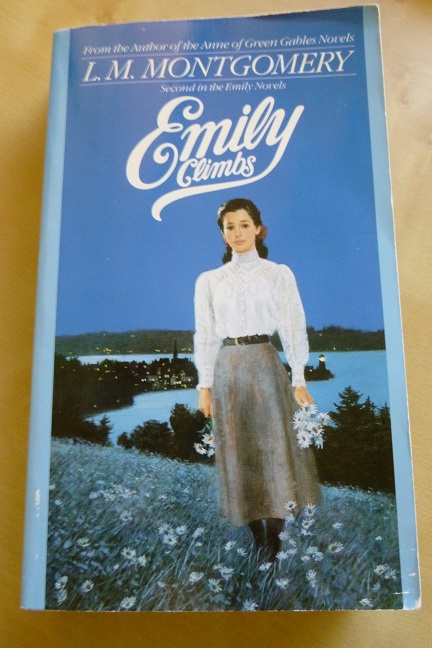
Emily Climbs by L. M. Montgomery gives us Emily’s high school years–even though she begins the book age 13, she felt about 16 to me throughout. This volume focuses mostly on her writing and her family, as she starts to sell a few stories and poems, and spars with various relatives who cannot understand the things that Emily girl gets up to. There are also a few ups and downs with best friend Ilse, who continues her wild flouting of propriety.
Male friends Teddy and Perry fade out for large sections of the book, which is a bit of a shame, as their scenes are some of the most compelling. First, there’s a scene when Emily becomes accidentally locked in the empty church with “Mad Mr. Morrison” and Teddy comes to the rescue. Later, all four friends take refuge in an abandoned house to escape a snowstorm, where Emily and Teddy share a suddenly soul-revealing glance; under the inspiration of new love, Emily spends the night dreaming out her great novel. And Perry contributes one of the funniest scenes, narrating a disastrous dinner party he attended.
As you can probably already tell, we’ve left childhood, for the most part, behind by this second book, and ventured with Emily into more adult territory. The scene with Mad Mr. Morrison is particularly striking for a number of reasons. As I mentioned in my review of the first book, there’s a darker strain in Emily, and never more so than here. Morrison is a generally harmless lunatic, endlessly seeking his lost love who died many years before. He mistakes Emily for his lost bride, and the scene when he searches through the darkened church for her is truly terrifying. Even though Montgomery mentions that when he finds girls he likes to stroke their hair (in other words–basically harmless), I don’t quite believe that, as the entire tone is that she’s in genuine danger.
Of course he doesn’t catch her, of course she escapes–it’s Montgomery, after all, and if she ever went to the really dark places I wouldn’t enjoy her so much. But the Emily books go just far enough to make me feel like they’re set in a real world, where there are real problems–and I like that. There’s also a beautiful conclusion to the scene, telling the reader how Morrison sees himself, the hero seeking his beloved, which brings him away from being a villain and turns him into a truly tragic figure shaped by lost love.
Emily also uses her second sight twice in this book, in more pronounced ways than she did in the first. I always found these incidents a little baffling because the book is clearly not a fantasy, yet it has these moments…which somehow don’t read as though they’re meant to be fantasy. Then I read Montgomery’s journal and found out she believed in prophetic dreams and, I would guess, other psychic phenomena (to a point!)
At the end of the book, we see Emily at a crossroads, making a decision about where her life will go next. I understand her ultimate choice…but in a way I wish she had chosen otherwise, as I would have loved to see where her life would go down that path. I also wonder if Emily’s decision is, to a certain extent, Montgomery’s efforts to satisfy herself about her path through life, when she never really had the opportunity to go the opposite direction. I love reading Montgomery’s books from the perspective of knowing the contents of her journals too!
I was originally planning a combined review for both of the remaining books in the trilogy…but then I had more to say than I expected! So come back next week for a review of Book Three, Emily’s Quest…
It’s been far too long since I read Emily of New Moon by L. M. Montgomery–ten years, I think, since I took the trilogy with me on a school trip to England. In fact, I found a customs form tucked into my book!
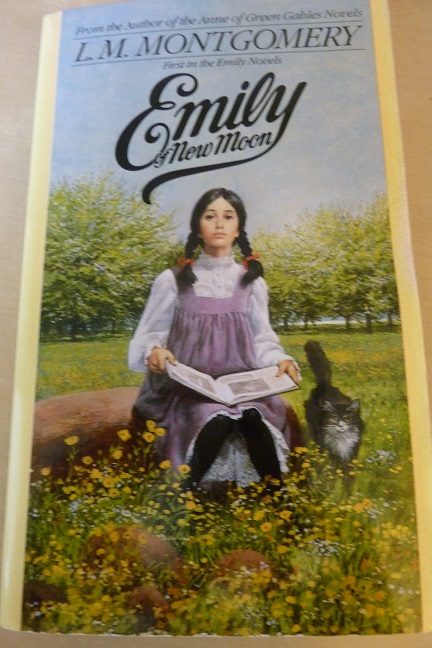
Emily is a lovely and beautiful tale of an imaginative girl who dreams of being a writer–of climbing the Alpine Path to success. She lives with relatives at New Moon farm, and runs about with her devoted friends, Ilse, Teddy and Perry.
The book sounds at a glance like it’s an opposite number to Anne of Green Gables, and there are certainly overlaps–kind yet not quite understanding guardians, the beautiful expanses of nature in Prince Edward Island, the bosom friends, flights of imagination and inevitable scrapes. But from the very beginning, when Emily learns in devastating fashion that her beloved father is dying, there’s a tragic strain here that gives a different color to the entire trilogy.
The difference is visually clear, looking at Emily’s midnight hair versus Anne’s fiery red locks, but it goes much deeper than that. Emily seems to feel things more deeply than Anne (despite all her drama)–both joys and sorrows.
The book also touches (with extreme discretion, of course!) on more mature subjects. There’s Mr. Carpenter, Emily’s irascible teacher, who drinks on weekends because he feels his life has been a failure. And there’s Ilse’s mother, who gossip has it left her husband and https://marveloustales.wordpress.com/wp-admin/post.php?post=4998&action=editbaby to run off with a sea captain. Anyone who thinks Montgomery only wrote gauzy fairy tales with no shadows is wrong.
However–don’t come to the conclusion that the book is dark or morbid or depressing! It’s still Montgomery–and it’s still Prince Edward Island–and there’s still more beauty than sadness. Emily has her trials and her sorrows but she is also surrounded by love and buoyed up by her dreams, her joy in the beauties of nature and her passion for writing. And while it’s been some time, I don’t remember being strongly conscious of the darker undertones when I read this at a younger age.
It’s fascinating to read this after all my reading of Montgomery’s journal. There are strong autobiographical strands, especially in Emily’s writing goals and experiences. I get a fun little moment of recognition every time I spot something from her real life–like when Emily’s aunt describes her blank verse poem as “very blank” (LMM’s father said the same once) or when Emily mentions a compact with a friend to never say good-bye (LMM had such an agreement with her beloved cousin, Frede).
You know I’m always going to recommend Montgomery books. 🙂 Emily of New Moon is a beautiful novel with an appealing heroine–and for adult readers, more depth and maturity than you might expect. Those elements become even stronger in the next two books…so stay tuned for next week’s review of Emily Climbs and Emily’s Quest.
It seems odd to me that I haven’t already written this post–but I haven’t! And since I have Montgomery on the brain right now (more than usual) due to my rereading of the Emily trilogy, it seems like an appropriate time…
The Blue Castle (novel): This is one of my top three favorite books of all time. It’s the story of Valancy Stirling, meek and mild and dominated by her family, who has never really lived–until the belief that she’s going to die gives her the courage to transform herself and her life. I love Valancy’s growth, and her subsequent adventures (and romance!) It’s full of Montgomery’s best qualities, of wit and beautiful nature and vivid characters, with a powerful message about overcoming fear and seizing life.
The Anne books (eight-book series): Anne of Green Gables, of course, is Montgomery’s most famous work, and the Anne books really are among her best. I like to read all eight in a row, as if they were one 2,400 page novel, but some do stand out. The first, of course, introduces us to charming, imaginative, impulsive Anne Shirley and her world. Book Six, Anne of Ingleside, was the last book Montgomery ever wrote, and I believe she was using it as a refuge from her own tumultuous life–and it feels like a charming, lovely, welcoming refuge. Book Eight, Rilla of Ingleside, is a powerful portrait of the Canadian World War I homefront, and brings it all to life better than any book I’ve read.
The Emily books (trilogy): Emily is dreamy and imaginative and quite different from harum-scarum Anne. She gets into her fair share of scrapes, but she’s driven always by her desire to be an author, and she delves into deeper and darker parts of the human consciousness than Anne ever touches. If Anne is sunlight, Emily is moonlight. Equally beautiful, but a different flavor.
The Road to Yesterday (short story collection): I have twelve collections of Montgomery short stories, I’ve read 200 stories total (I counted) and I have lots of favorites–but this volume seems to collect favorites better than any other. Although it wasn’t published during her lifetime, Montgomery did make the selections (that’s a long, complicated story) so perhaps that’s why. Some of the characters and stories here feel as vivid to me as the ones from the novels, despite our much briefer acquaintance with them.
The Selected Journals of L. M. Montgomery, Volume I (journal): I’ve read every volume of Montgomery’s selected journals, but the first one, covering age 14 to 35, is my favorite. Montgomery’s novels are, to large extent, set in the world of her girlhood, which is brought clearly to life in these early years of her journal. Her journal writing is as vivid and descriptive as her fiction, and the more you read the more you feel you know the people in her life–and, of course, Montgomery herself. Whether you really do, well, that’s a mystery, and one that grows more complex in later volumes. But this first one gives me the woman behind the fiction that I think I’d always been looking for. And then I got so attached to her that I went on a mad spree through the rest of the journals too!
Some Montgomery novels are better than others, and some short stories are mere pot-boilers (and she knew it), but I will still happily read anything she wrote. Her world is so alive and so beautiful and I feel like I know every one of her characters–not the least Montgomery herself, who died 65 years before I was born, but still feels like a very dear friend!
 I’ve come down from the mad flurry of new books by favorite authors, and am mostly back to working through my usual goals and lists and challenges…




 Tales of the Marvelous