The Hobbit by J.R.R. Tolkien

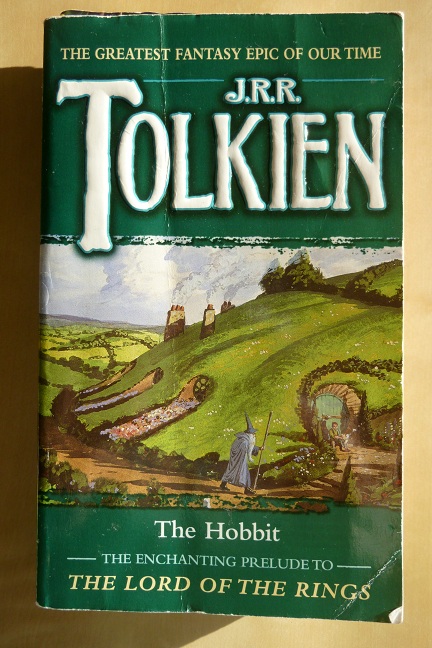
HobbitIn another read for the Once Upon a Time Challenge, I reread The Hobbit by J. R. R. Tolkien.  This is one I read so long ago (twelve years?  Fifteen?) that it mostly felt like a new read by now.  I kept meaning to read it before the movie (review here)…and then wanted to read it after…and mostly read it now because I plan to read the Lord of the Rings trilogy this spring, and it seemed like a good place to start!

The story, as most of you probably know, follows Bilbo Baggins, a Hobbit who only wants a tidy life and regular meals.  He is enticed into an adventure by Gandalf the Grey Wizard, who recruits him to join thirteen dwarves on their quest to reclaim their lost home and treasure from Smaug the dragon.  Adventures along the way involve elves, trolls, goblins, a truly creepy forest and, now and then, even a few humans.

I love Bilbo’s growth as a character throughout the book.  He begins by feeling that adventures are unpleasant things which make one late for dinner (one of my favorite lines!), and comes to find his own strength and ability–and a taste for adventure.  He learns how to use a sword, devise a daring plan, and make a hard decision about loyalties and sacrifice.  There’s a thread that runs through the novel about the state of Bilbo’s pocket handkerchiefs, and it’s just a delightful illustration of how he progresses.

I also love (spoiler?) that Bilbo ultimately does return home.  So often stories like this end up with the character in a new place, or deciding that they don’t really want to go home after all, or realizing that “you can never go home again” as the cliche goes.  (Or there’s Dorothy, who does go home, apparently only learning that home is really wonderful.)  The Hobbit takes a different and more complex path by sending Bilbo back home in the end, meaning that the real exploration is not ultimately how Bilbo’s life changes, but how he himself changes.

The world of Middle Earth is also great fun to explore–and I suspect that was a major part of Tolkien’s inspiration to write the story at all!  It’s a story about a character, but it’s just as much about the wild places he’s wandering through, with so many interesting creatures along the way.  Humans come across as a small minority, present in a few communities but no more dominant than any other species (at least in this installment).

My two favorite scenes are the very funny opening sequence of the dwarves descending unexpectedly on Bilbo, and the quite creepy Riddle contest with Gollum.  I very much look forward to more Gollum in the trilogy to come.

There are aspects to the book that didn’t work as well for me–and at times it’s abundantly obvious this was written in a different time, because a modern writer would make a different choice (or editors would insist on it).  The most obvious, perhaps, is when a character we’ve never seen before ends up killing Smaug.  It’s a rather disappointing way to finish off the dragon…though at least it leads into further excitement.  I’m very curious to see how Peter Jackson, as a modern filmmaker, is going to handle that part.

I also wish the dwarves had been better developed.  Rather like the discussion we’ve been having around the Twelve Dancing Princesses, it’s tough going when you have so many characters to juggle.  There were thirteen dwarves and most were completely undeveloped.  Even the five or so that had some personality were pretty slight.

Last critique–I don’t think there was a single female character with a name or a line of dialogue in the entire book.  For all I know, hobbits, goblins and elves are only men!  The dwarves reference a female relative or two in explaining family connections between men (Fili and Kili are the sons of Thorin’s sister, for instance), and some human women get into boats when Smaug attacks the town…but otherwise, Middle Earth seems to be entirely male.  Frustrating…though, if I can go by the movies, there are at least a few actual female characters in the LOTR trilogy!

Whatever its flaws, this is a still a very fun, very interesting adventure.  And, as I hoped, it’s great gateway-Tolkien, because it has me looking forward to exploring the world more and delving into new characters for the LOTR trilogy.  I’ll let you know how that goes. 😉

Other reviews:
Books Please
The Bookworm Chronicles
Pocketful of Books
There must be many, but I was struggling to find other good reviews…tell me about yours!

Buy it here: The Hobbit

A Journey Back to Middle Earth

Hobbit 1I saw The Hobbit this weekend, and it was so much fun to go back to Middle Earth.  The movie is excellent on so many levels, from the characters to the action to the vistas…and to the return to Middle Earth.  Also–Martin Freeman!

This is a prequel that is self-aware of its own sequel, but that works.  The movie begins, I believe, the same morning as The Fellowship of the Rings.  Bilbo is writing his memoirs and nephew Frodo is eagerly anticipating the arrival of Gandalf the wizard for Bilbo’s party.  And then we flash back sixty years…to watch an unchanged Gandalf select a much younger Bilbo for an adventure–along with thirteen dwarves who invade Bilbo’s home in a very funny fashion.  Bilbo reluctantly embarks on “an unexpected journey,” and soon finds himself engulfed in a quest to fight a dragon to reclaim the dwarf homeland, fighting orcs and trolls and even stranger creatures along the way.  Meanwhile, Gandalf and others are worried about the rise of darker powers in a pretty obvious foreshadowing–but no matter, it gives it a nice all-tied-together feeling.

Let’s start with Bilbo.  To reiterate–Martin Freeman!  This actually makes the long wait for Sherlock feel worth it.  Freeman is playing the character he plays best, the ordinary chap who just wants a peaceful life (and perhaps a hot cup of tea), only to find himself thrust into chaos far beyond his scope.  He has to rise to meet it, and discovers he has a zest for adventure in the process.  Such is Arthur Dent, Dr. Watson, and most definitely Bilbo Baggins.  Starting from a scene where he firmly tells Gandalf that no adventures are wanted here, they’re inconvenient and make one late for dinner, Bilbo grows into a hero almost in spite of himself.  At the risk of a slight spoiler, I will say that he eventually shows courage in battle–but I think I was more impressed by a scene afterwards when he shows that he understands what they’re fighting for, believes in the rightness of the cause, and is willing to persevere to make it happen.  That’s more indicative of character growth than hitting an orc with a sword.

The other biggest character in the movie is Gandalf the Grey Wizard, wise and yet at times very humanly unsure too.  Ian McKellan is excellent, conveying all sorts of depth of emotion with just a twinkle of the eye or a curl of the lip somewhere behind that enormous beard.

It’s a movie of beards, by the way, since we spend most of it in the company of dwarves with some fantastic beards.  Thorin, the dwarf king, is the most serious and complex of the group, the leader of the quest and the somewhat Aragorn-like figure of the movie: rough and sometimes terse, but good-hearted and a brave leader.  The rest of the dwarves shine largely as comic relief, but provide the occasional dramatic insight too.

One of the most striking characters of all is Gollum.  I doubt he was in the movie for more than fifteen minutes, but they are among the most memorable fifteen minutes.  He’s completely mad, big-eyed and sad one moment, snarling the next, and just so excellently done all the time.

There are also cameos by other old friends–Frodo was mentioned above, and we also see Elrond, Galadrial and Sarumon.  I confess I was rather hoping for Legolas (I don’t care what the purists say about his not being in the book), but IMDB tells me he won’t be along until the third movie.  I was also watching for Benedict Cumberbatch, never saw him except in the credits, and figured out after I got home that he was the Necromancer–who I think was only seen in silhouette for about five seconds.  Next movie, I hope for more.

But on the subject of old friends–it is so much fun to come back to this world, to see some of the same faces, to recognize the same creative style.  I am by no means a major Lord of the Rings fan, and it’s been years since I watched the movies.  Yet there’s something so nostalgic about The Hobbit.  This may be enhanced by the fact that we’ve come back to what is, in a way, a simpler time in Middle Earth.  Sauron is just starting to rise, Smaug is a comparatively small villain, and the movie is more light-hearted, at least in spots.

There are certainly epic sword fights and large-scale battles with hideous monsters, and moments that are just so deliciously Tolkienesque.  I don’t really know how else to describe it, because I think he set the definition.  He set the standards that so many others are emulating and going back to the original just brings it to some kind of pinnacle of fantasy.

But there are also funny parts, particularly the beginning as the dwarves run rough-shod over Bilbo’s home, and most especially a scene involving a trio of gourmet if stupid trolls who want Dwarf for dinner.

There are also incredible views.  If Lord of the Rings has led you to expect scenes of footsore travelers traipsing across mountain paths with breathtaking vistas behind them…you will not be disappointed.  The setting is really remarkable throughout, from the sweeping views to the beautiful Rivendell set amidst waterfalls, to the truly horrible troll kingdom, to the cozy homeyness of the Shire.  It’s all so vivid, so beautifully realized…and I saw it in simple old 2D.

I’d be remiss if I didn’t reflect on the fact that this is a long movie.  And it’s part one of three.  It reminds me of Harry Potter 7, Part 1, in that it feels like someone set about to include every detail they could.  The Hobbit is not a slow movie, but it is a movie that takes its time.  It will not be rushed, it will not leave anything out, and if there is an element of backstory or a moment of foreshadowing to be told, it will tell it.  No need to hurry, just relax and enjoy the scenery.  It’s almost a little cosy, if I can use that word to describe a movie involving orcs and swords and falling off of mountains.

I have to admit I’m not quite sure how there are going to be two more movies after this, but I’m content to sit back and see where the journey takes us.  I look forward to continuing to visit Middle Earth, because it’s an amazing place where so many fantastic things can happen.  I mean, there are dwarves, and elves, and a city built amongst waterfalls, and stone giants!  It’s just–wow!

Also–Martin Freeman! 🙂

Movie site: http://www.thehobbit.com

An Uninspired Apprentice

There are some parts of An Unexpected Apprentice by Jodi Lynn Nye which may sound a little familiar.  A magical world with a number of magical races.  One of them is a race of kind people smaller than humans.  One of the characters is a wise old wizard.  There’s a quest, involving a group made up of several races.  There’s an object of immense power on the loose, which could destroy the world.  Said-object tempts its bearer to use its power for his or her own gain.

Some of it, I suppose, is archetypal.  Some of it is Lord of the Rings.  I could forgive An Unexpected Apprentice for resembling Lord of the Rings, but it’s harder to forgive it for being, well, kind of bland.  I’m not sure why I was left with that feeling of blandness.  There are dangers, and the world is reasonably well-developed.  But maybe the world lacks enough details, and maybe I didn’t care enough about any (except one) of the characters to feel much concern about the dangers.

One good point: I do like that object of immense power.  Rather than a ring, it’s a book.  The Great Book that holds everything’s true sign, from individuals to entire countries.  Change the sign, and you change the thing.  Destroy the sign in the book, you destroy whatever it represents.  There’s something fascinating about that.

The essential plot of An Unexpected Apprentice is that someone has stolen the Great Book, and Tildi (a Halfling, one of those small people mentioned above) and her friends go on a quest to get it back and restore it to a place of safety.  Tildi and all the rest are nice enough, but no one on the quest made much of an impression on me.  I wanted to like Tildi, if only because I have a soft spot for girls who disguise themselves as boys to go pursue their dreams (ever since reading The Song of the Lioness Quartet by Tamora Pierce).  Tildi does that at the beginning, although she’s unmasked as soon as she takes up her apprenticeship with the wizard.  But despite that, I never developed much attachment to her.

No one in the book experienced that problem.  That is actually at the root of one of the book’s biggest problems, and certainly one of the most easily defined.  The other characters like Tildi too much.  That sounds odd, but what I mean by it is that they have all only recently met her, yet they worry about her, care about her, appreciate her–when I don’t feel Nye has built relationships that would justify it.  It almost feels as though the other characters know that she’s the main character. 

There is one great and glorious exception to this band of so-so characters, and that is Magpie.  He’s a prince who travels around in an alternate guise as a minstrel.  During a recent war, he became a close friend of the enemy king by becoming the minstrel at his court.  He’s engaged to a princess, has a volatile relationship with his family, and is charming and witty and a bit roguish.  All around, he’s the kind of character I could love.  Unfortunately, he’s only here in a supporting role, and we find out most of the above as backstory.

If I find out that Nye has written a book just about Magpie, I’d pick it up.  But so far, despite doing some searching, I haven’t found anything.  There is a sequel about Tildi.  But so far I haven’t picked that one up.  I said this blog would be about sharing favorites and warning you off of some not so good books…and this post is much more of a warning.