New Feature: Favorites Friday – Opening Lines

I’ve been thinking about Fridays.  As regular readers know, on Fridays I normally post my own writing.  Which is fun, but I think I want to mix it up with a new feature.  Book reviews are normally a drill-down focus on one book (or series or author).  But sometimes I want to do a round-up of several favorites of something…favorite characters, favorite opening lines, favorite paintings that plainly have a story in them (most of my favorite paintings are like that!)  Because I have a thing for alliteration, I’m going to start doing Favorites Friday.  I’ll still do Fiction Friday too, but I want to do a mix of both.  And by all means, let me know your preferences too!

To start us off, why not begin at the beginning?  Favorite opening lines.

“All children, except one, grow up.”
Peter Pan, by J. M. Barrie

Six words, yet it’s all there.  The tragic thread throughout, especially at the end, of children growing up and changing and leaving (“tragic” seems to be Barrie’s feeling on it).  The magic of one child who defies this most basic convention.  And the poetry and charm of Barrie’s writing.

“I have been in love with Titus Oates for quite a while now–which is ridiculous, since he’s been dead for ninety years.  But look at it this way.  In ninety years I’ll be dead, too, and the age difference won’t matter.”
The White Darkness by Geraldine McCaughrean

Brilliant, funny, and I love the way she talks about him simultaneously as both a distant historical figure, and as someone immediately present in her life–which is how Titus is throughout the book.

“If it had not rained on a certain May morning Valancy Stirling’s whole life would have been entirely different.”
-The Blue Castle by L. M. Montgomery

And now you have to keep reading to find out why, right?

“Last night I dreamt I went to Manderley again.”
Rebecca by Daphne du Maurier

I can’t analyze for you why I like this so much–but somehow it’s got into my head and when I read it I want to sigh and say, oh yes, Manderley…

And speaking of sighing:

“Sam Vimes sighed when he heard the scream, but he finished shaving before he did anything about it.”
Night Watch by Terry Pratchett

Which is Discworld in a nutshell.  And Sam too, for that matter.  Rather world-weary but still going about his business as head of the Night Watch.  In this case, tending to a would-be assassin who has fallen into his booby trap.  I don’t think anyone handles “oh bother, another assassin” quite like Pratchett–and makes it funny!

What are some other great opening lines?  I’d love to hear your favorites!

Floriat Etona!

Eton College

Sometimes we don’t want to find out that our favorite villain had a troubled childhood.  Sometimes we don’t want those shades of gray.  It’s better to just have black be black and white be white, and good is good and bad is bad.

But Captain Hook was always an elegant and melancholy sort of villain anyway.  And I’ve read that in the earliest version of the play he went to his death shouting “Floriat Etona!” so all the historical grounding is there besides.

Capt. Hook: The Adventures of a Notorious Youth by J. V. Hart rounds out my series on Peter Pan-related books with another prequel–a non-Barrie but successful one.  This gives us the boy who becomes Hook while he was at school at Eton, the prestigious school for boys.

Like Geraldine McCaughrean, J. V. Hart demonstrates a clear knowledge of the material he’s drawing from.  Hook’s first name is firmly established as James, which he signs Jas.  Hart tells us that his name is James Matthew B, and that he is the bastard son of a never-named Lord.  The name sounds to me like a none-too-subtle reference to James Matthew Barrie.  James’ best friend is Roger Peter Davies–again with the reference in the name, since Peter Pan was named after Peter Davies.  Roger swiftly acquires the nickname of Jolly Roger, and gives us the origin for the name of Hook’s pirate ship.

I find James a fascinating character.  He’s not exactly likable, yet I have to keep reminding myself that he’s the villain.  Hart has given us a character who can be dashing and gentlemanly, but also send a poisonous spider to inflict illness on an enemy.  James will go into the dark places the heroes won’t go, and perform the dastardly deeds a hero won’t do, and yet he also possesses the charm and the dashing airs that are usually reserved for the characters you want to cheer on unreservedly.  Hart has given us a villain who can fall in love, show deep loyalty to his best friend, and have dreams about a magical island–and yet who still has a dark side.  I don’t feel like he’s tried to make Hook out as a good guy…but he’s written about a very complex dark character.

He’s actually made me feel sad to know that, even though James will find his magical island one day, he’ll never get to rule it.

And then I have to stop and remind myself that I’m on Peter’s side.  That when it came down to it, I would root for Peter.  Because I would still root for Peter.  But I have to remind myself.  And I feel a little sad for Hook.

The first section (and majority) of the novel is set at Eton, where adventures center around conflicts with upperclassmen, the Wall Game (an extremely bizarre tradition), and James’ forbidden attraction for a foreign princess.  Later in the book James goes to sea, setting up his career as a pirate.  On the one hand, the adventures become in some ways more adventurous at that point, more in the style of Peter Pan, but I also think some of that conflict of James as the dashing villain is lost, as he becomes almost too much like a straightforward hero once he goes to sea.

This book makes me want to visit Eton one day.  I’m not exactly sure what I want to see there, aside from the memorial to Lawrence “Titus” Oates.  Apparently it’s good luck to rub his nose.  I swear I’m not making that up.  Anyway…even though I don’t know what I want to see, I would rather like to see the alma mater of Captain Hook.  Also the Davies boys, incidentally.

I’ve been hoping for a sequel to this novel.  The book itself sets you up to expect one.  Although there isn’t exactly a cliffhanger, much is left unresolved.  So far, nothing, and I haven’t been able to find any word on whether one might be expected.  Maybe one day…  This is J.V. Hart’s first and so far only novel, but he has written many screenplays, including Hook.  Less relevantly but most excitingly for me, he also wrote the screenplay for Muppet Treasure Island, which I have to say is the best version of the story I’ve ever found–even above the original.  Sorry, Robert Louis Stevenson.

If you’ve read Peter Pan and wondered about that scene where Hook’s wandering around the Jolly Roger and sighing because no little children like him, or noticed that Hook has this strange obsession with good and bad form, or wondered what Barrie was getting at when he made these veiled comments about Hook attending a very prestigious school…or even if you’ve never thought about any of that but just thought Hook was a pretty good character, Capt. Hook is a book worth looking into.

Finding the Way Back to Neverland

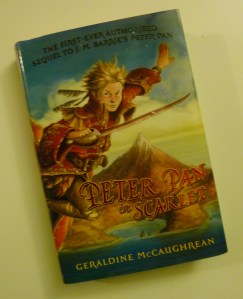
As a general rule, I’m against sequels to classic novels written by new authors, especially when the primary appeal of the original was the author’s voice.  How do you ever do that right?  I’ve only see it happen once.  Peter Pan in Scarlet by Geraldine McCaughrean is a beautiful sequel to Peter Pan.

I give a lot of the credit to her–and a lot of the credit to the way the sequel came to be.  That’s a fascinating story too.  In 1929, J. M. Barrie gave the rights to Peter Pan to the Great Ormond Street Hospital for Children, meaning that they receive all the royalty money, as well as controlling the rights.  Several years ago they held a contest inviting authors to submit a sample chapter and synopsis for a sequel.  All of this means that the people involved in the publishing had a primary interest, not in a later version, but in the original work–and you can tell.

I can’t say that Peter Pan in Scarlet feels like J. M. Barrie is telling the story, but I feel like the story is very much about the world and the characters that he created.  McCaughrean has done a very impressive job at staying true to the story J. M. Barrie gave us, and yet giving us another story that is, I think, what we all want.

Mr. Barrie was in some ways not kind to anyone who wanted to follow him with a sequel.  He left a lot of challenges behind him.  To name the chief ones–he killed off his villain, he grew up his supporting characters, and his heroine was rather annoyingly maternal all along.  So what is a sequel-writer, saddled with Wendy and knowing that readers really want to see Peter Pan and the (grown-up) Lost Boys fight (the deceased) Captain Hook, to do?

McCaughrean handles it all neatly and effectively, and with the kind of magical and whimsical solutions that are worthy of Mr. Barrie.  I don’t want to give it all away…but I can’t resist just a little.  Suppose a person wants to get back to Neverland but you can’t depend on Peter to show up at your window, how do you go about it?  Well, you’ve got to find a fairy for their dust, right?  And the best place to look…Kensington Gardens, of course.  And the way to find a fairy is to find a baby out with its nurse, and to catch the baby’s first laugh just as it turns into a fairy.  Brilliant, magical and whimsical.

Peter Pan in Scarlet opens with Wendy and the Lost Boys as grown-ups, but they’ve begun to dream about Neverland again.  They decide that something must be wrong, that perhaps Peter is in trouble.  They have to find a way to become children again so that they can return to Neverland and help him–and from there the adventures begin.  In Neverland they find that summer has turned into autumn, and something seems to be inexplicably wrong.
McCaughrean even handles Wendy well, successfully portraying her as simply a rather practical-minded child (after the grown-ups become children again), rather than a child who wasted all her time in Neverland darning socks.

After we return to Neverland and find everyone’s favorite Wonderful Boy, the adventures are “nicely crammed together,” and we have the chance to explore the greater geography of the magic lands.  Everyone’s favorite pirate captain appears too.  Again McCaughrean finds a way to stay true to the end of Mr. Barrie’s book, where the Crocodile eats Hook, and yet still bring the villain back.

Even if there was nothing else in this book to recommend it–which is obviously not the case!–there is a single line in here which would alone put it miles above Peter and the Starcatchers in my estimation.  At one point in the book, Wendy tells Peter and the Lost Boys a fairy story about a little white bird in the Kensington Gardens.  We don’t hear the story; we don’t even know what the story is supposed to be about.  But that doesn’t matter.  McCaughrean knew that a little white bird in Kensington Gardens is significant in Peter Pan lore.

Thank you, Geraldine McCaughrean, for knowing what you’re writing about, and for writing it so well.

Author’s site: http://www.geraldinemccaughrean.co.uk/

The Story That Didn’t Come Before Peter Pan

I might like Peter and the Starcatchers by Dave Barry and Ridley Pearson much better if it didn’t claim to reveal the story that came before J. M. Barrie’s Peter Pan.  As an independent adventure/fantasy story, it’s perfectly decent.  As a prequel to Peter Pan, it’s a lot of claptrap and nonsense that at no point convinces me anyone anywhere involved in the project ever so much as read J. M. Barrie’s Peter Pan.

There is a wonderful story that comes before Peter Pan.  It’s called The Little White Bird and J. M. Barrie wrote it himself in 1902.  To come along a century later and claim you’re writing a prequel without apparently doing any research is ridiculous, and insulting to Mr. Barrie.  Especially when the only research really required would be to read two books.  That’s hardly an exhaustive amount.

Mr. Barrie didn’t include a lot of details about Peter’s past life, but he did include some.  As far as I can tell, Peter and the Starcatchers ignores all of them.  The basic premise of the novel is that there is something called starstuff (strongly resembling fairy dust) loose in the world.  Peter is a member of a group of orphan boys.  The orphans, the starstuff, and a couple of factions fighting over the starstuff end up on an island somewhere.  When the starstuff gets loose, the island begins to transform into a magical place, not to mention changing Peter so he’ll never grow up.

If you’re not already spotting why most of this is an utter travesty on the original book, allow me to explain.  One–Peter was not an orphan.  It is clearly related that he ran away from home very shortly after he was born because he didn’t want to grow up to be a man–and he knew he would if he stayed because he heard his parents talking about it.  Two–Peter doesn’t grow up because he doesn’t want to.  You can take it two ways: either he forever rejected the idea of growing up the day he ran away, or he continues to reject it daily and his imagination is strong enough to make it actually happen.  Either way, it’s about Peter’s choices and his imagination.  Three–it’s pretty clear that the magical dust floating around is a byproduct of fairies, not the other way around.

These are central ideas to the Peter Pan mythology, and to ignore them from the onset creates overarching problems with the entire concept of the book.

It doesn’t get better in the details.  In Peter and the Starcatchers, Peter cuts off Hook’s left hand.  Whoops–in the original, Hook’s right hand was cut off.  Perhaps that’s nitpicking, but I’d say it demonstrates something about the amount of care taken.  If the rest of the book was true to the original I’d forgive the wrong hand, but when the rest of the book isn’t, all it does is exemplify the problems.

But you know what possibly annoys me the most?  There’s a scene in Peter and the Starcatchers where starstuff is put in a bag along with a bird, and out pops Tinker Bell.

The problem?  There is NO NEED to reveal how fairies came to be.  Because Mr. Barrie already told us that!  “When the first baby laughed for the first time, its laugh broke into a thousand pieces, and they all went skipping about, and that was the beginning of fairies.”  Now, when every baby laughs for the first time, its laugh becomes a new fairy.  Given the choice between the charming whimsy of laughter becoming fairies, and the painful practicality of smothering a bird with starstuff…well, that’s not much of a choice.  And you can’t claim to be in Mr. Barrie’s magical world and then just disregard every rule he wrote for it.

I know from looking at the bookshelf at the bookstore that there are two or three more books in the series.  I haven’t read them, so I can’t comment on them.  But after reading the first, I’d be shocked if the later ones did any better at drawing from J. M. Barrie’s books.

There is room in the world for a new prequel to Peter Pan.  There’s a gap between The Little White Bird and Peter Pan, and in that gap Peter learned to fly, went to Neverland, and met Tinker Bell and the Lost Boys.  I would love to see a well-done book that reveals that story.  But Peter and the Starcatchers is not that book.

A Tale Told By Mr. Barrie

All children, except one, grow up.

Peter Pan Statue in Kensington Gardens

I’m going to assume that most people are familiar with the premise of Peter Pan by J. M. Barrie.  In brief: Peter Pan flies with Wendy and her brothers to Neverland, where he lives with the Lost Boys and Tinkerbell the fairy, and has adventures fighting pirates and Indians.  And, of course, he never grows older.

Peter Pan (originally titled Peter and Wendy) is the ultimate celebration of childhood.  Neverland is the best parts of childhood, and the best parts of a child’s imagination, all rolled in together with none of the bad parts.  Even the bad things–say, villainous pirates–are only exciting adventures.

The peculiar thing about Peter Pan is that I don’t actually think much of the main characters.  Tink is a nasty brat, Peter is horribly arrogant (though oddly appealing in that, I must admit), John and Michael are fairly non-entities, and as for Wendy…well, I have no use at all for a girl who goes to Neverland and spends all her time cooking and cleaning and darning socks.  Hook, actually, is a more interesting character–dastardly but elegant, and rather melancholy (not sad–melancholy).  But it’s actually all right that the characters leave something to be desired as people, because the concept is so fantastic and the book is so charming.

More on the concept in a minute, but first on the charm.  That actually brings me to my favorite character: Mr. Barrie.  He doesn’t overtly appear in Peter Pan, not even in an fictionalized role like the kindly old gentleman in The Little White Bird, and yet he is very present as the narrator.  Every so often throughout the book “I” and “you” come into the narration–“I” who’s telling the story, and “you” the reader.  There’s a clear feeling that “I” is Mr. Barrie, and that you is you personally, you reading.

(On a side note, I always felt a bit smug in some of my writing classes in college, when the discussion turned to how wonderful experimental writing is, such as addressing the reader directly–experimental, maybe, but Mr. Barrie was doing it a century ago!)

My favorite part of the book is near the end of chapter seven–everyone is on the island by now, and Mr. Barrie is debating which of their many adventures to tell (because there isn’t possibly time for all of them).  Perhaps this battle with the Indians, or perhaps that prank of Tink’s…

Which of these adventures shall we choose?  The best way will be to toss for it.

I have tossed, and the lagoon has won.  This almost makes one wish that the gulch or the cake or Tink’s leaf had won.  Of course I could do it again, and make it best out of three; however, perhaps fairest is to stick to the lagoon.

I love it.  I know he’s not sitting in a study tossing a coin.  And yet, Mr. Barrie telling you the story is almost another level of the story.

Then of course the story of Peter Pan is exciting, dramatic and endlessly appealing…because who hasn’t occasionally wished they could escape to Neverland?  Even if most of us, most of the time, are reasonably happy about being grown-ups, Neverland is a place of youth and joy and innocence, free from cares or worries.  Sometimes a little fairy dust and a trip past a star looks very good.

Besides recommending the book itself, I also have to recommend a particular edition of Peter Pan.  I decided some while ago that I wanted to buy a really beautiful copy.  After looking at different versions in different bookstores, I fell completely in love with Scott Gustafson’s illustrations.  Every picture is an incredible work of art.  Lovely.

But so is the book.